
India PCB Encapsulation Market (2024-2029)

The India PCB Encapsulation Market was valued at $309.4 Million in 2024 and projected to reach to $482 Million by 2029, representing a compound annual growth rate of 9.3%. India's PCB encapsulation market is positioned for accelerated growth as the country strengthens its role in global electronics manufacturing.


| Market Size in | USD 26.32 MN |
| Market Forecast in | |
| CAGR | |
| Forecast Period | |
| Units Considered | Value (USD MN) |
India PCB Encapsulation Market Trends and Insights
- This represents a compound annual growth rate (CAGR) of 9.3%, outpacing global averages and reflecting India's strengthening position in electronics manufacturing and semiconductor packaging.
- India's market expansion is driven by rising demand from automotive, consumer electronics, and telecommunications sectors, alongside government initiatives promoting domestic semiconductor production and electronics manufacturing. The forecast period from 2024 to 2029 will witness accelerated adoption of advanced encapsulation materials in India, supported by increasing foreign direct investment in electronics assembly and testing facilities.
- India's competitive labor costs, improving infrastructure, and growing technical expertise position the country as a key hub for PCB encapsulation applications.
- Market players in India are investing in capacity expansion and technology upgrades to meet rising quality standards and production volumes across multiple end-use industries..
Key Market Statistics
- CAGR (2024-2029) 9.3% CAGR
- Market Size, 2024 ~USD 309.4 Million
- Forecast, 2029 ~USD 482 Million
- Country India
India PCB Encapsulation Market Overview
Market Valuation & Growth :
India's PCB encapsulation market reached USD 309.4 million in 2024, with a robust CAGR of 9.3% projected through 2029, significantly outpacing the global growth rate of 8.8%.
Electronics Manufacturing Hub :
India's emergence as a global electronics manufacturing destination, supported by government initiatives like Make in India and PLI schemes, is driving substantial demand for advanced PCB encapsulation solutions.
Semiconductor Packaging Expansion :
Growing semiconductor packaging and assembly operations across India, particularly in Bangalore, Hyderabad, and Tamil Nadu, are creating increased requirements for high-performance encapsulation materials.
Forecast Growth Trajectory :
The market is anticipated to reach USD 482.0 million by 2029, representing a 55.8% increase from 2024, driven by rising consumer electronics demand and automotive electronics integration.
India PCB Encapsulation Market Dynamics
- The expansion is fueled by increasing smartphone production, automotive electronics adoption, and government-backed semiconductor initiatives.
- Rising investments in electronics manufacturing clusters and growing domestic consumption of consumer electronics are creating sustained demand for advanced encapsulation materials. Looking ahead, India's market will benefit from supply chain diversification away from traditional Asian hubs, coupled with technological advancements in encapsulation materials.
- The convergence of 5G infrastructure development, IoT proliferation, and electric vehicle manufacturing will further amplify market opportunities, positioning India as a critical hub for PCB encapsulation solutions in the Asia-Pacific region..
Market Ecosystem
Related Ecosystem
Adhesives And Sealants
- Alkyd Resins
- Polyurethane Resin
- Epoxy Resin
- Polyester Resin
- Polyolefin
- 3M COMPANY
- Henkel ag and co. kgaa
- H.B. Fuller Company
- Sika ag
- DOW CHEMICAL COMPANY
Paints And Coatings
- Polyurethane Resin
- Alkyd Resins
- Epoxy Resin
- Polyester Resin
- Acrylics
- Basf se
- JOTUN
- PPG Industries, Inc.
- DOW CHEMICAL COMPANY
- Akzonobel n.v.
Speciality Chemicals
- Corrosion Inhibitors
- Polyetheretherketone (PEEK)
- Acrylonitrile Butadiene Styrene (ABS)
- Epoxy Resin
- Polycarbonate
- Basf se
- DOW CHEMICAL COMPANY
- Evonik industries ag
- Clariant ag.
- Solvay sa
Key Takeaways
- India's PCB encapsulation market is valued at USD 309.4 million in 2024 and will grow to USD 482.0 million by 2029, driven by a 9.3% CAGR.
- India's market growth outpaces the global average of 8.8% CAGR, reflecting strong domestic demand and manufacturing expansion.
- Government initiatives and FDI in electronics manufacturing are accelerating adoption of advanced encapsulation materials across India's automotive, consumer electronics, and telecom sectors.
- India's competitive advantages in labor costs and technical expertise position the country as a critical hub for PCB encapsulation production and innovation through 2029.
PCB Encapsulation Market Report Scope
| Report Metric | Details |
|---|---|
| Base Year | 2024 |
| Fastest Growing Segment | CONSUMER ELECTRONICS (Application) |
| Forecast Period | 2024-2029 |
| Growth Rate | CAGR of 8.8% from 2024 to 2029 |
| Largest Segment | EPOXY (Resin Type) |
| Market Size Base Year (Billions) | ~USD 3.67 (2024) |
| Revenue Forecast (Billions) | ~USD 5.59 (2029) |
| Segments Covered | Resin Type, Curing Type, Product Type, Application |
India PCB Encapsulation Market Report Segmentation
4 segment dimensions are covered across the global market.
By Resin Type
- Acrylic
- Epoxy
- Other Resin Types
- Polyurethane
- Polyurethanes
- Silicone
By Curing Type
- Heat Cure
- Other Curing Types
- Room Temperature Cure
- Uv Cure
By Product Type
- Conformal Coatings
- Connect Bonding
- Dam & Fill
- Glob Top
- Other Product Types
- Underfill
By Application
- Aerospace & Defense
- Automotive Electronics
- Consumer Electronics
- Medical Devices
- Other Applications
INDIA: PCB PROTECTION ADHESIVES MARKET, BY APPLICATION, 2024–2029
| Segment | 2024 | 2025 | 2026 | 2027 | 2028 | 2029 | CAGR (%) |
|---|---|---|---|---|---|---|---|
| AEROSPACE & DEFENSE | 50.6 | 55.2 | 60.2 | 65.7 | 71.8 | 78.6 | 9.2 |
| AUTOMOTIVE ELECTRONICS | 48.1 | 52.5 | 57.4 | 62.7 | 68.6 | 75.2 | 9.3 |
| CONSUMER ELECTRONICS | 99.9 | 109.4 | 119.8 | 131.5 | 144.3 | 158.6 | 9.7 |
| MEDICAL DEVICES | 62.7 | 68.6 | 75 | 82.2 | 90.1 | 98.8 | 9.5 |
| OTHER APPLICATIONS | 48.1 | 51.9 | 56 | 60.5 | 65.5 | 70.9 | 8.1 |
| TOTAL | 309.4 | 337.5 | 368.4 | 402.6 | 440.3 | 482 | 9.3 |
Target Audience
- Electronics Manufacturers : Indian and multinational electronics manufacturers need market data to understand encapsulation material demand, supplier capabilities, and cost structures specific to India's manufacturing ecosystem.
- PCB & Semiconductor Companies : PCB fabricators and semiconductor packaging firms require India-specific market insights to identify growth opportunities, assess local competition, and plan capacity investments.
- Material & Chemical Suppliers : Encapsulation material suppliers need detailed India market analysis to evaluate demand potential, pricing strategies, and distribution channel opportunities in this high-growth market.
- Investment & Private Equity Firms : Investors evaluating opportunities in India's electronics sector require comprehensive market data to assess growth potential, market size, and ROI prospects for PCB encapsulation ventures.
- Government & Policy Bodies : Indian government agencies and policy makers need market intelligence to align industrial policies, incentive schemes, and infrastructure development with actual market growth trajectories.
Reasons to Buy this Report
- Localized Market Intelligence : Gain India-specific insights into market dynamics, regional growth drivers, and country-level trends that differ significantly from global market patterns and forecasts.
- Investment & Expansion Strategy : Identify optimal entry points and expansion opportunities within India's high-growth PCB encapsulation sector, supported by detailed market sizing and CAGR projections through 2029.
- Competitive Positioning : Understand India's competitive landscape, manufacturing capabilities, and supply chain dynamics to benchmark against local and international competitors operating in the region.
- Government Policy Alignment : Leverage insights on India-specific regulatory frameworks, PLI schemes, and Make in India initiatives that directly impact market growth and business opportunities.
- Demand Forecasting & Planning : Access precise India market forecasts (USD 482.0M by 2029) to inform production planning, resource allocation, and strategic business decisions for the Indian market.
Frequently asked questions
What is the current size of India's PCB encapsulation market?
India's PCB encapsulation market was valued at USD 309.4 million in 2024 and is expected to reach USD 482.0 million by 2029.
What is the projected growth rate for India's PCB encapsulation market?
India's PCB encapsulation market is projected to grow at a CAGR of 9.3% from 2024 to 2029, outpacing the global average of 8.8%.
Which industries are driving demand for PCB encapsulation in India?
Key demand drivers in India include automotive, consumer electronics, telecommunications, and semiconductor packaging sectors, supported by government manufacturing initiatives.
Why is India's PCB encapsulation market growing faster than the global average?
India's faster growth is attributed to competitive labor costs, improving manufacturing infrastructure, government support for electronics production, and increasing foreign direct investment in assembly and testing facilities.
What market value growth is expected in India between 2024 and 2029?
India's PCB encapsulation market is expected to grow by USD 172.6 million, from USD 309.4 million in 2024 to USD 482.0 million in 2029.
RESEARCH METHODOLOGY
The study involved four major activities in estimating the market size of the PCB encapsulation market. Exhaustive secondary research was done to collect information on the market, the peer market, and the parent market. The next step was to validate these findings, assumptions, and sizing with industry experts across the value chain through primary research. Both top-down and bottom-up approaches were employed to estimate the complete market size. Thereafter, the market breakdown and data triangulation procedures were used to estimate the market size of the segments and subsegments.
Secondary Research
In the secondary research process, various secondary sources have been referred to for identifying and collecting information for this study. These secondary sources include annual reports, press releases, investor presentations of companies, white papers, certified publications, trade directories, articles from recognized authors, the gold standard and silver standard websites, and databases.
Secondary research has been used to obtain key information about the value chain of the industry, the monetary chain of the market, the total pool of key players, market classification, and segmentation according to industry trends to the bottom-most level and regional markets. It was also used to obtain information about the key developments from a market-oriented perspective.
Primary Research
The PCB encapsulation market comprises several stakeholders in the value chain, which include PCB adhesives, PCB manufacturers and end users. Various primary sources from the supply and demand sides of the PCB encapsulation market have been interviewed to obtain qualitative and quantitative information. The primary interviewees from the demand side include key opinion leaders in end-use sectors. The primary sources from the supply side include manufacturers, associations, and institutions involved in the Cranes rental industry.
Primary interviews were conducted to gather insights such as market statistics, data on revenue collected from the products and services, market breakdowns, market size estimations, market forecasting, and data triangulation. Primary research also helped in understanding the various trends related to resin type, application, product type, Curing type and region. Stakeholders from the demand side, such as CIOs, CTOs, and CSOs, were interviewed to understand the buyer’s perspective on the suppliers, products, fabricators, and their current usage of PCB adhesives and the outlook of their business, which will affect the overall market.
The breakdown of profiles of the primary interviewees is illustrated in the figure below:
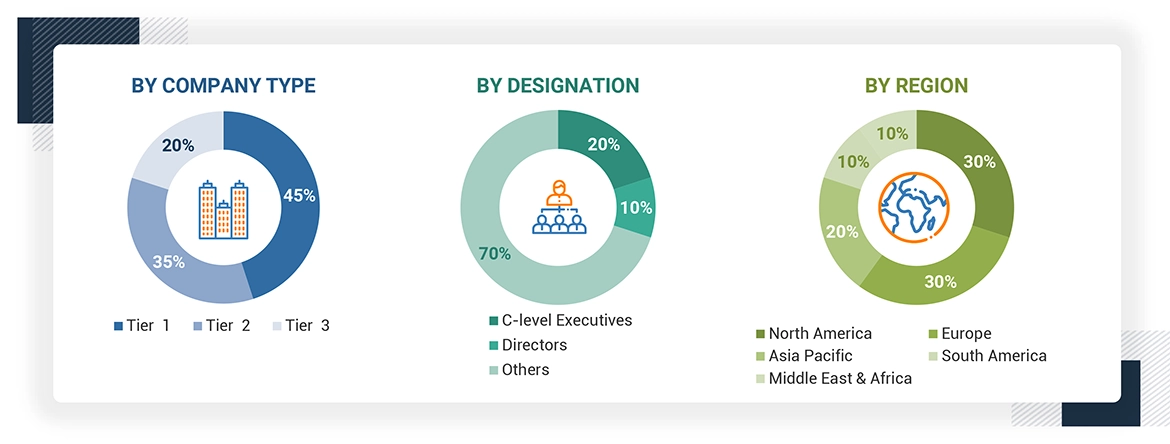
Note: Tier 1, Tier 2, and Tier 3 companies are classified based on their market revenue in 2023, available in the public domain, product portfolios, and geographical presence.
Other designations include consultants and sales, marketing, and procurement managers.
To know about the assumptions considered for the study, download the pdf brochure
| COMPANY NAME | DESIGNATION | |
|---|---|---|
| H.B. Fuller Company (US) | Sales manager | |
| Henkel AG & Co. KGaA (Germany) | Operations Manager | |
| Parker Hannifin Corp (US) | Vice President & District Manager | |
| Panacol-Elosol GmbH (Germany) | Head – adhesive Business | |
| Wacker Chemie AG (Germany) | PCB adhesive Specialist | |
Market Size Estimation
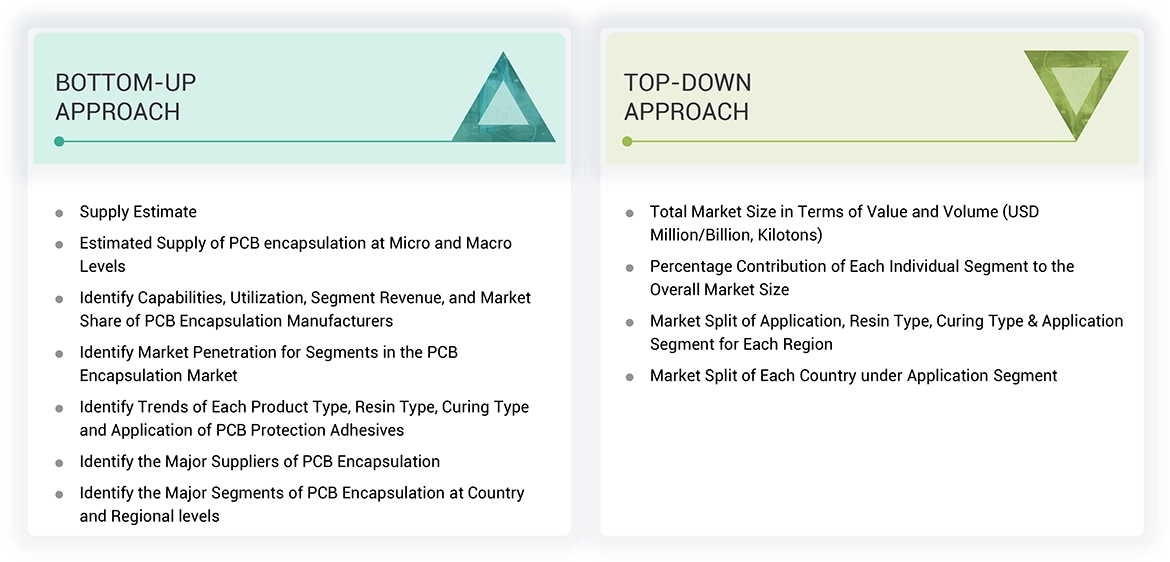
The top-down and bottom-up approaches have been used to estimate and validate the size of the PCB encapsulation market.
- The key players in the industry have been identified through extensive secondary research.
- The industry's supply chain has been determined through primary and secondary research.
- All percentage shares, splits, and breakdowns have been determined using secondary sources and verified through primary sources.
- All possible parameters that affect the markets covered in this research study have been accounted for, viewed in extensive detail, verified through primary research, and analyzed to obtain the final quantitative and qualitative data.
- The research includes the study of reports, reviews, and newsletters of the key market players, along with extensive interviews for opinions with leaders such as directors and marketing executives.
Data Triangulation
After arriving at the total market size from the estimation process explained above, the overall market has been split into several segments and sub-segments. To complete the overall market engineering process and arrive at the exact statistics for all the segments and sub-segments, the data triangulation and market breakdown procedures have been employed, wherever applicable. The data has been triangulated by studying various factors and trends from both the demand and supply sides. Along with this, the market size has been validated by using both the top-down and bottom-up approaches and primary interviews. Hence, for every data segment, there have been three sources—top-down approach, bottom-up approach, and expert interviews. The data was assumed correct when the values arrived from the three sources matched.
Market Definition
The PCB encapsulation market represents an array of adhesive solutions that are tailored to protect printed circuit boards from environmental and operational stresses, thereby ensuring the reliability and durability of the same. Segmentation can be done based on curing type, resin type, application, product type, and regional presence. Curing types include UV curing, heat curing, and room temperature curing. Each of these has a number of different advantages with respect to processing time and application methods. Basically, there are four main types of resin includes epoxy, silicone, polyurethane, and acrylic. Each resin gives unique properties of protection, which include chemical resistance, thermal stability, and mechanical strength. The application segments here are diversified, and the major sectors that drive demand for PCB encapsulation are consumer electronics, automotive, industrial, aerospace, and medical devices. Major product types in this market are conformal coatings and encapsulation compounds, and underfill materials—all of which have specific protective functions for different applications of PCBs. Geographically, the market has a strong presence across North America, Europe, Asia-Pacific, and other regions. Of these, Asia-Pacific has a lead in the market due to its large-scale electronics manufacturing base. This increasing technological advancement and rise in demand for durable and high-performance electronic devices further drive the growth of the PCB encapsulation market on a global basis.
Stakeholders
- Adhesives manufacturers
- Electronic industrial manufacturers
- Medical device manufacturers
- Research and development institutes
- Regulatory bodies
- Environmental groups
- End-users
Report Objectives
- To define, describe, and forecast the size of the PCB encapsulation market, in terms of value and volume.
- To provide detailed information regarding the major factors (drivers, opportunities, restraints, and challenges) influencing the growth of the market
- To estimate and forecast the market size based on product resin type, curing type, product type application, grade and region.
- To forecast the size of the market with respect to major regions, namely, Europe, North America, Asia Pacific and rest of the world, along with their key countries.
- To strategically analyze micromarkets1 with respect to individual growth trends, prospects, and their contribution to the overall market.
- To analyze opportunities in the market for stakeholders and provide a competitive landscape of market leaders.
- To track and analyze recent developments such as expansions, new product launches, partnerships & agreements, and acquisitions in the market.
- To strategically profile key market players and comprehensively analyze their core competencies.
Get the Full PCB Encapsulation Market Report
Full forecast, segment splits, and company analysis for all PCB Encapsulation Market.
- China PCB Encapsulation Market
- Japan PCB Encapsulation Market
- South Korea PCB Encapsulation Market
- Taiwan PCB Encapsulation Market
- Vietnam PCB Encapsulation Market
- Malaysia PCB Encapsulation Market
- Canada PCB Encapsulation Market
- Mexico PCB Encapsulation Market
- US PCB Encapsulation Market
- Germany PCB Encapsulation Market
- Italy PCB Encapsulation Market
- France PCB Encapsulation Market
- UK PCB Encapsulation Market
- Spain PCB Encapsulation Market
- Netherlands PCB Encapsulation Market
- Israel PCB Encapsulation Market
- South Africa PCB Encapsulation Market
- Rest Of Europe PCB Encapsulation Market
- Rest Of Asia Pacific PCB Encapsulation Market
- Other Countries PCB Encapsulation Market
Need a Tailored Report?
Customize this report to your needs
Get 10% FREE Customization
Customize This Report
