
South Korea Pharmaceutical Excipients Market (2025-2030)

The South Korea Pharmaceutical Excipients Market was valued at $233.4 Million in 2025 and projected to reach to $276.7 Million by 2030, representing a compound annual growth rate of 3.5%. South Korea's pharmaceutical excipients market is poised for steady growth driven by the country's established position as a regional pharmaceutical manufacturing hub.


| Market Size in | USD 26.32 MN |
| Market Forecast in | |
| CAGR | |
| Forecast Period | |
| Units Considered | Value (USD MN) |
South Korea Pharmaceutical Excipients Market Trends and Insights
- South Korea's robust pharmaceutical manufacturing sector and stringent regulatory standards drive steady demand for high-quality excipients across formulation development and production.
- The market in South Korea reflects the country's position as a leading pharmaceutical hub in Asia Pacific, supported by advanced R&D capabilities and increasing investment in generic and specialty drug manufacturing. Growth in South Korea's pharmaceutical excipients market is underpinned by rising domestic pharmaceutical output, growing biopharmaceutical development, and expanding export-oriented drug manufacturing.
- South Korea continues to strengthen its excipient supply chain through both domestic production and strategic imports, ensuring compliance with international quality standards.
- The forecast period through 2030 indicates moderate but consistent expansion as South Korea balances cost efficiency with innovation in excipient formulations..
Key Market Statistics
- CAGR (2025-2030) 3.5% CAGR
- Market Size, 2025 ~USD 233.4 Million
- Forecast, 2030 ~USD 276.7 Million
- Country South Korea
South Korea Pharmaceutical Excipients Market Overview
Market Valuation :
South Korea's pharmaceutical excipients market is valued at USD 233.4 million in 2025, with projections reaching USD 276.7 million by 2030, representing steady growth in the region's pharmaceutical manufacturing ecosystem.
Regulatory Excellence :
South Korea's stringent regulatory standards and MFDS oversight drive consistent demand for high-quality, compliant excipients, positioning the country as a quality-focused market within Asia-Pacific.
Manufacturing Hub Status :
The country's robust pharmaceutical manufacturing sector, supported by advanced facilities and skilled workforce, creates sustained demand for specialized excipients across formulation development and large-scale production.
Growth Trajectory :
With a CAGR of 3.5% through 2030, South Korea's market demonstrates moderate but consistent expansion, outpacing some mature markets while reflecting the region's stable pharmaceutical production environment.
South Korea Pharmaceutical Excipients Market Dynamics
- The nation's commitment to regulatory compliance and quality standards ensures sustained demand for premium excipients across diverse therapeutic applications.
- Increasing investments in biopharmaceutical development and contract manufacturing services are expected to bolster market expansion through 2030. The market will benefit from South Korea's strategic focus on advanced drug formulations, including biologics and specialty pharmaceuticals.
- Growing collaborations between domestic manufacturers and international pharmaceutical companies, coupled with rising R&D activities, will create additional opportunities for excipient suppliers.
- The country's aging population and expanding healthcare needs further support long-term market growth and product innovation..
Market Ecosystem
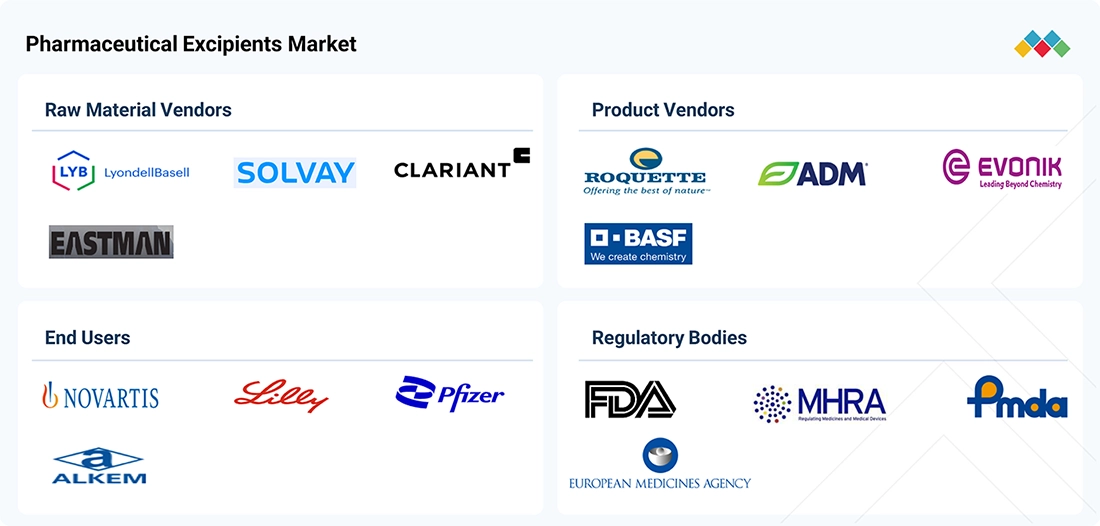
PHARMACEUTICAL EXCIPIENTS MARKET: COMMERCIAL USE CASES ACROSS INDUSTRIES
| COMPANY | USE CASE DESCRIPTION | BENEFITS |
|---|---|---|
 |
Supplies a broad portfolio of pharmaceutical excipients for immediate release, controlled release, solubility enhancement, tableting, granulation, coating, capsule formulation, and biologic applications | Its portfolio includes Avicel, METHOCEL, Ac-Di-Sol, AFFINISOL, Aquacoat, ETHOCEL, POLYOX, alginates, polyols, and capsule solutions | Helps pharmaceutical manufacturers improve flowability, binding, compression, disintegration, dissolution, controlled release, solubility, and formulation stability | The expanded portfolio following the IFF Pharma Solutions and Qualicaps acquisitions also enables broader end-to-end formulation support across oral, parenteral, and biologic dosage forms |
 |
Provides functional pharmaceutical excipients such as povidones, copovidones, crospovidones, solubilizers, surfactants, coating polymers, and specialty formulation polymers used in immediate-release, sustained-release, amorphous solid dispersion, and solubility-enhancement applications | Enables formulators to improve API solubility, bioavailability, binding, disintegration, coating performance, and processability, particularly for poorly soluble APIs and complex oral formulations | BASF’s digital formulation tools also support faster excipient selection and formulation development |
 |
Offers specialty excipients and drug-delivery technologies through products such as EUDRAGIT functional polymers, RESOMER biodegradable polymers, and high-purity excipients for oral solid dosage forms, modified-release products, enteric coatings, and long-acting parenteral formulations | Supports targeted and controlled drug release, enteric protection, taste masking, sustained-release profiles, and long-acting injectable delivery | These solutions help manufacturers develop differentiated dosage forms while improving patient convenience and formulation performance |
 |
Supplies cellulosic and synthetic excipients for binding, disintegration, controlled release, film coating, low-nitrite formulations, biologic stabilization, and long-acting injectables | Its portfolio includes Benecel, Plasdone, Polyplasdone, Aquarius, Vialose, and Viatel products | Helps address key formulation challenges including controlled release, nitrosamine-risk mitigation, protein stabilization, tablet coating, and extended drug delivery | Ashland’s portfolio supports both conventional oral dosage forms and more complex biologic and injectable formulations |
 |
Supplies pharmaceutical-grade oils, solvents, carbohydrate ingredients, and other functional excipients used in softgel, oral liquid, topical, injectable, and parenteral formulations | Provides manufacturers with high-purity, pharmacopeial-grade excipients suitable for lipid-based formulations, solubilization, vehicle systems, and parenteral applications, while benefiting from ADM’s large-scale manufacturing and global supply capabilities |
Logos and trademarks shown above are the property of their respective owners. Their use here is for informational and illustrative purposes only.
Related Ecosystem
Pharmaceuticals
- Bioreactors
- Analytical Testing
- Bioanalytical Testing Services
- Cell Counters
- Data Management Services
- Merck KGaA
- Thermo Fisher Scientific Inc.
- SANOFI
- NOVARTIS
- Pfizer Inc.
Key Takeaways
- South Korea's pharmaceutical excipients market is valued at USD 233.4 million in 2025 with a projected value of USD 276.7 million by 2030.
- South Korea maintains a 3.5% CAGR, reflecting steady growth driven by robust domestic pharmaceutical manufacturing and export demand.
- South Korea's advanced regulatory framework and R&D infrastructure support premium excipient quality and innovation.
- South Korea's market growth is supported by increasing biopharmaceutical development and generic drug production expansion.
Pharmaceutical Excipients Market Report Scope
| Report Metric | Details |
|---|---|
| Base Year | 2025 |
| Fastest Growing Segment | OTHER FUNCTIONALITIES (Functionality) |
| Forecast Period | 2025–2030 |
| Growth Rate | CAGR of 6.1% from 2025 to 2030 |
| Largest Segment | ORGANIC CHEMICALS (Product) |
| Market Size Base Year (Billions) | ~USD 11.05 (2025) |
| Revenue Forecast (Billions) | ~USD 14.86 (2030) |
| Segments Covered | Product, Type, Functionality Application, Functionality, Formulation |
South Korea Pharmaceutical Excipients Market Report Segmentation
5 segment dimensions are covered across the global market.
By Product
- Inorganic Chemicals
- Organic Chemicals
- Other Chemicals
By Type
- Acrylic Polymers
- Actual Sugars
- Artificial Sweeteners
- Calcium Carbonate
- Calcium Phosphate
- Calcium Sulphate
- Capsules
- Carbohydrates
- Cellulose
- Cellulose Esters
- Cellulose Ethers
- Cmc & Croscarmellose Sodium
- Converted Starch
- Dextrose
- Dextrose (D-Glucose)
- Dried Starch
- Fatty Alcohols
- Glycerin
- Glycols
- Halites
- Hard-Gelatin Capsules
- Lactose
- Liquid Formulations
- Mannitol
- Metal Oxides
- Metal Stearates
- Microcrystalline Cellulose
- Mineral Hydrocarbons
- Mineral Oils
- Mineral Stearates
- Mineral Waxes
- Modified Starch
- Oleochemicals
- Other Inorganic Chemicals
- Other Oleochemicals
- Other Oral Formulations
- Other Organic Chemicals
- Other Petrochemical Excipients
- Other Sugar Alcohols
- Petrochemicals
- Petrolatum
- Polyethylene Glycol
- Polyethylene Glycol (Peg)
- Povidones
- Propylene Glycol
- Propylene Glycol (Pg)
- Proteins
- Soft-Gelatin Capsules
- Sorbitol
- Starch
- Sucrose
- Sugar Alcohols
- Sugars
- Tablets
By Functionality Application
- Modified-Release
- Other Applications
- Solubility & Bioavailability Enhancement
- Stabilizer
- Stabilizers
- Taste Masking
By Functionality
- Binders
- Coating Agents
- Colorants
- Disintegrants
- Emulsifiers & Solubilizers
- Emulsifying Agents
- Fillers & Diluents
- Flavoring Agents & Sweeteners
- Flavouring Agents & Sweeteners
- Lubricants & Glidants
- Other Functionalities
- Preservatives
- Suspending & Viscosity Agents
By Formulation
- Oral Formulations
- Other Formulations
- Parenteral Formulations
- Topical Formulations
Target Audience
- Pharmaceutical Manufacturers : South Korean and international pharma companies need market data to optimize excipient sourcing strategies, negotiate supplier contracts, and plan formulation development investments aligned with local regulatory requirements.
- Excipient Suppliers & Distributors : Suppliers targeting South Korea require detailed market sizing, growth forecasts, and competitive intelligence to identify sales opportunities, assess market entry feasibility, and develop region-specific go-to-market strategies.
- Contract Manufacturing Organizations (CMOs) : CMOs operating in South Korea need excipient market insights to forecast raw material demand, optimize supply chain management, and ensure compliance with MFDS standards while maintaining cost competitiveness.
- Investment & Private Equity Firms : Investors evaluating pharmaceutical sector opportunities in South Korea require market data to assess growth potential, identify acquisition targets, and evaluate the viability of excipient manufacturing or distribution ventures.
- Regulatory & Compliance Consultants : Consultants advising pharmaceutical companies on South Korean market entry need comprehensive market analysis to guide regulatory strategy, competitive positioning, and product development aligned with local excipient demand trends.
Key Companies in the South Korea Pharmaceutical Excipients Market
| Company | HQ | Ownership | Strongest segments |
|---|---|---|---|
| PATHEON INC | Netherlands | Private Company | Drug product services (finished dosage manufacturing, packaging, lifecycle management),Pharmaceutical development services (formulation, analytical, clinical trial supply),Drug substance services (API and biologics substance production), |
| BIOMERIEUX S.A. | France | Public Company | Clinical microbiology (culture media, VITEK, ID/AST, ETEST, API),Syndromic and molecular diagnostics (BIOFIRE, SPOTFIRE, ARGENE, EMAG/NUCLISENS),Immunoassays and CLIA (VIDAS, Hybiome), |
| ALLERGAN PLC | Ireland | Private Company | Medical aesthetics & dermatology,Eye care,Neuroscience & CNS, |
| FMC CORPORATION | United States | Public Company | Insecticides,Herbicides,Fungicides, |
| TOKUYAMA CORPORATION | Japan | Public Company | Chemicals Products (chlor-alkali, PVC, solvents, basic chemicals),Cement and Building Materials,Electronics & Advanced Materials, |
| HELM AG | Germany | Private Company | Basic chemicals, acids and lyes,Plastics and polyurethanes,Crop protection and fertilizers, |
| INTERNATIONAL FLAVORS & FRAGRANCES INC. | United States | Public Company | Taste,Food Ingredients,Health & Biosciences, |
| ADM | United States | Public Company | Ag Services and Oilseeds,Carbohydrate Solutions,Nutrition (human and animal), |
| BASF SE | Germany | Public Company | Chemicals,Materials,Industrial Solutions, |
| EVONIK | Germany | Public Company | Advanced Technologies,Custom Solutions,Infrastructure, |
| ASHLAND | United States | Public Company | Life Sciences,Personal Care,Specialty Additives, |
| KERRY GROUP PLC | Ireland | Public Company | Taste solutions (dairy/dairy-free, savoury, smoke & grill, sweet, modulations),Nutrition solutions (enzymes, proteins, lipids, fibre, wellness, dairy ingredients),Functional ingredients, food & beverage solutions, |
| MERCK | United States | Public Company | Oncology (Keytruda, Keytruda Qlex, Welireg, Lynparza collaboration, deruxtecan ADCs),Vaccines (Gardasil, pediatric and adult vaccines including Vaxneuvance, Capvaxive, RotaTeq, Pneumovax 23),Hospital & Specialty (Bridion, Prevymis, Dificid, Zerbaxa, Winrevair, Adempas/Verquvo, Ohtuvayre), |
| ASSOCIATED BRITISH FOODS PLC | United Kingdom | Public Company | Retail (Primark/Penneys),Grocery,Ingredients, |
| WACKER CHEMIE AG | Germany | Public Company | Silicones,Polymers,Polysilicon, |
| AIR LIQUIDE | France | Public Company | Large Industries (oxygen, nitrogen, argon, hydrogen, CO, cogeneration),Industrial Merchant (bulk, cylinder, hardgoods, services),Healthcare (medical gases, home healthcare, equipment, specialty ingredients), |
| DOW | United States | Public Company | Packaging & Specialty Plastics,Industrial Intermediates & Infrastructure,Performance Materials & Coatings, |
PATHEON INC
Patheon Inc is a private pharmaceutical manufacturing company based in the Netherlands with 9,100 employees, providing contract development and manufacturing services.
BIOMERIEUX S.A.
bioMérieux S.A. is a French public company founded in 1963 with 14,894 employees, specializing in in vitro diagnostics and microbiology testing solutions.
ALLERGAN PLC
Allergan PLC is a private pharmaceutical company headquartered in Ireland, founded in 1983, with 17,400 employees focused on specialty therapeutics and medical aesthetics.
FMC CORPORATION
FMC Corporation is a U.S. public company founded in 1883 with 5,500 employees, operating in agricultural sciences, health and nutrition, and lithium production.
TOKUYAMA CORPORATION
Tokuyama Corporation is a Japanese public company founded in 1918 with 6,390 employees, producing specialty chemicals, semiconductors, and dental materials.
HELM AG
Helm AG is a German private chemical distribution and manufacturing company founded in 1900 with 1,430 employees, serving pharmaceutical and industrial sectors.
INTERNATIONAL FLAVORS & FRAGRANCES INC.
International Flavors & Fragrances Inc. is a U.S. public company founded in 1909 with 21,500 employees, creating flavors, fragrances, and specialty ingredients for consumer products.
ADM
ADM (Archer Daniels Midland) is a U.S. public company founded in 1902 with 41,147 employees, operating in agricultural processing, food ingredients, and nutrition.
BASF SE
BASF SE is a German public company founded in 1865 with 106,428 employees, operating as a global leader in chemicals, plastics, performance products, and agricultural solutions.
EVONIK
Evonik is a German public company founded in 1847 with 30,643 employees, specializing in specialty chemicals, advanced materials, and performance products.
ASHLAND
Ashland is a U.S. public company founded in 1924 with 2,900 employees, providing specialty chemicals and additives for coatings, adhesives, and other industrial applications.
KERRY GROUP PLC
Kerry Group PLC is an Irish public company founded in 1972 with 19,284 employees, specializing in food ingredients, flavors, and consumer nutrition solutions.
MERCK
Merck is a U.S. public pharmaceutical company founded in 1891 with 74,000 employees, developing and manufacturing prescription medicines, vaccines, and healthcare products.
ASSOCIATED BRITISH FOODS PLC
Associated British Foods PLC is a British public company founded in 1934 with 138,000 employees, operating in retail, food, ingredients, and logistics.
WACKER CHEMIE AG
Wacker Chemie AG is a German public company founded in 1914 with 16,196 employees, producing specialty chemicals, silicones, and polymers for diverse industries.
AIR LIQUIDE
Air Liquide is a French public company founded in 1902 with 63,126 employees, providing industrial gases, welding equipment, and healthcare solutions globally.
DOW
Dow is a U.S. public company founded in 1897 with 34,600 employees, manufacturing plastics, chemicals, and agricultural products for industrial and consumer markets.
Reasons to Buy this Report
- Market-Specific Sizing & Forecasts : Access precise valuation data for South Korea's excipients market (USD 233.4M in 2025) with detailed 5-year forecasts, enabling accurate budget allocation and investment planning specific to this regulated market.
- Regulatory Landscape Intelligence : Understand South Korea's MFDS compliance requirements and quality standards that shape excipient demand, helping suppliers and manufacturers align products with local regulatory expectations and competitive positioning.
- Manufacturing Sector Insights : Gain detailed analysis of South Korea's pharmaceutical manufacturing ecosystem, including contract manufacturing growth, biopharmaceutical expansion, and formulation trends driving excipient consumption patterns.
- Competitive Positioning Strategy : Identify market gaps, growth opportunities, and competitive dynamics specific to South Korea's excipient landscape, enabling strategic market entry or expansion decisions for suppliers and manufacturers.
- Regional Growth Context : Compare South Korea's 3.5% CAGR against global 6.1% growth to understand market maturity, identify underperformance drivers, and develop targeted strategies for accelerating market penetration in this key Asian market.
Frequently asked questions
What is the current size of South Korea's pharmaceutical excipients market?
South Korea's pharmaceutical excipients market is valued at USD 233.4 million in 2025.
What is the projected market size for South Korea by 2030?
South Korea's pharmaceutical excipients market is projected to reach USD 276.7 million by 2030.
What is the CAGR for South Korea's pharmaceutical excipients market?
South Korea's pharmaceutical excipients market is expected to grow at a CAGR of 3.5% from 2025 to 2030.
What factors drive growth in South Korea's pharmaceutical excipients market?
South Korea's market growth is driven by expanding pharmaceutical manufacturing, biopharmaceutical development, stringent regulatory standards, and export-oriented drug production.
How does South Korea's market compare to global pharmaceutical excipients trends?
South Korea's 3.5% CAGR reflects moderate, steady growth aligned with its position as a leading Asia Pacific pharmaceutical hub, supported by advanced R&D and manufacturing capabilities.
RESEARCH METHODOLOGY
This research study extensively used secondary sources, directories, and databases to identify and collect valuable information to analyze the global pharmaceutical excipients market. In-depth interviews were conducted with various primary respondents, including key industry participants, subject-matter experts (SMEs), C-level executives of key market players, and industry consultants, to obtain and verify critical qualitative and quantitative information and assess the growth prospects of the market. The global market size estimated through secondary research was then triangulated with inputs from primary research to arrive at the final maraket size.
Secondary Research
Secondary research was used mainly to identify and collect information for the extensive, technical, market-oriented, and commercial study of the pharmaceutical excipients market. The secondary sources used for this study were: European Federation of Pharmaceutical Industries and Associations (EFPIA), Pharmaceutical Research and Manufacturers of America (PhRMA), Parenteral Drug Association (PDA), International Pharmaceutical Excipients Council (IPEC), International Journal of Production Research (IJPR), Generics and Biosimilars Initiative (GaBI), International Trade Centre, World Journal of Pharmaceutical Sciences, Distributor Presentations, Annual Reports, SEC Filings, Investor Presentations, Press Releases, Conferences, Journals, Expert Interviews, and MarketsandMarkets Analysis. These sources were also used to obtain key information about major players, market classification, and segmentation according to industry trends, regional/country-level markets, market developments, and technology perspectives.
Primary Research
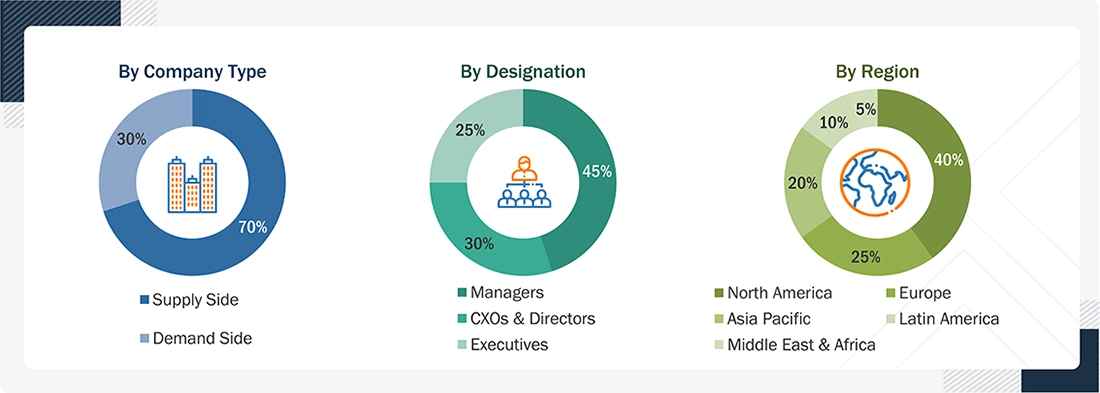
Following an initial assessment of the global Pharmaceutical Excipients market landscape through secondary research, comprehensive primary research was undertaken. This involved conducting in-depth interviews with market experts from the demand side, including stakeholders from pharmaceutical and biotechnology firms, CROs, CMOs, and academic and research institutions. Additionally, interviews were held with key supply-side participants, such as C-suite and senior executives, product managers, and marketing and sales leaders from prominent manufacturers, distributors, and channel partners. The research covered six major geographical regions: North America, Europe, Asia Pacific, Latin America, the Middle East, and Africa. Approximately 70% of the primary interviews were conducted with supply-side participants, while 30% involved demand-side experts. Data collection methods included structured questionnaires, email correspondence, online surveys, personal interviews, and telephonic discussions to understand the market dynamics comprehensively.
The following is a breakdown of the primary respondents:
To know about the assumptions considered for the study, download the pdf brochure
Market Size Estimation
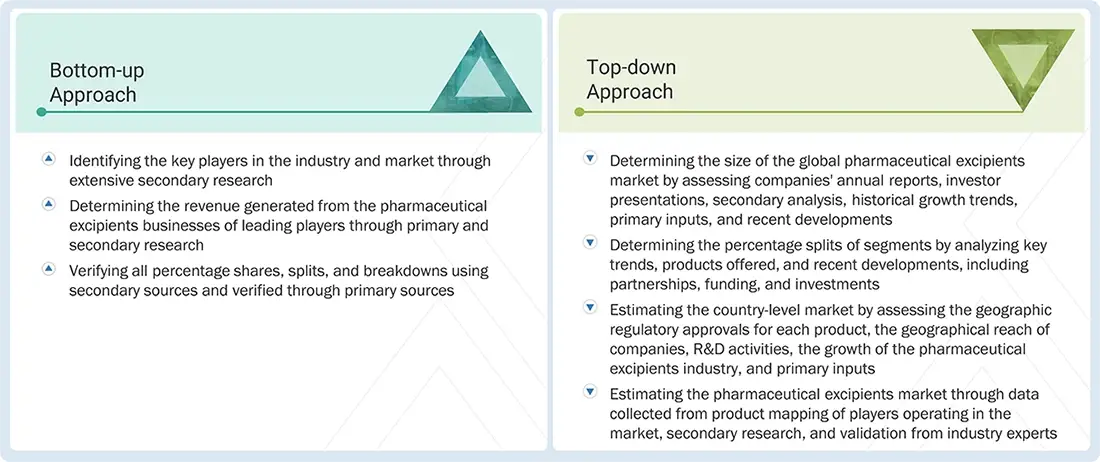
Both bottom-up and top-down approaches were used to estimate and validate the total size of the global pharmaceutical excipients market. These methods were also widely used to estimate the sizes of various subsegments in the market. The research methodology used to estimate the market size includes the following:
- A list of the major global players operating in the pharmaceutical excipients market was generated.
- The revenues generated from their pharmaceutical excipients product portfolios were determined through annual reports and secondary sources (including paid databases).
- The products were mapped according to the segments of the market. Percentage shares and splits were determined based on each segment's revenue contribution. This was verified through secondary sources and by industry experts.
- All assumptions, approaches, and individual shares/revenue estimates were validated through expert interviews.
Global Pharmaceutical excipients Market Size: Bottom-up and Top-down Approach
Data Triangulation
After arriving at the market size from the estimation process explained above, the total market was divided into several segments and subsegments. To complete the overall market engineering process and obtain exact statistics for all segments and subsegments, data triangulation and market breakdown procedures were employed, as applicable. The data was triangulated by studying various factors and trends from both the demand and supply sides.
Market Definition
Pharmaceutical excipients are inactive substances added to medications alongside the active pharmaceutical ingredient (API). They serve various purposes, such as improving the drug's stability, bioavailability, delivery, and overall effectiveness. These components, including preservatives, binders, fillers, disintegrants, lubricants, and flavoring agents, contribute to the final drug product's quality and efficacy.
Key Stakeholders
- Manufacturers, Importers & Exporters, Traders, Distributors, and Suppliers of Pharmaceutical Excipients
- Pharmaceutical and Biopharmaceutical Companies
- Contract Manufacturing Organizations (CMOs)
- Suppliers and Distributors of Pharmaceutical Products
- Research & Development (R&D) Companies
- Pharmaceutical/Medical Associations
- Regulatory Bodies & Government Agencies
- Research Institutes and Government Organizations
- Venture Capitalists and Investors
- Business Research and Consulting Service Providers
Report Objectives
- To define, describe, and forecast the global pharmaceutical excipients market based on product, functionality, formulation & functionality application.
- To provide detailed information regarding the major factors influencing market growth (such as drivers, restraints, opportunities, and challenges)
- To strategically analyze micromarkets concerning individual growth trends, prospects, and contributions to the pharmaceutical excipients market
- To analyze the opportunities in the market for stakeholders and provide details of the competitive landscape for market leaders
- To forecast the size of the market segments concerning six main regions: North America, Europe, Asia Pacific, Latin America, Middle East, and Africa
- To profile the key players in the global pharmaceutical excipients market and comprehensively analyze their product portfolios, market positions, and core competencies
- To analyze competitive developments such as product approvals and launches, expansions, agreements, and collaborations in the pharmaceutical excipients market
- To benchmark players within the pharmaceutical excipients market using the company evaluation matrix framework, which analyzes market players based on various parameters within the broad categories of business and offerings strategy
Available customizations:
With the market data given, MarketsandMarkets offers customizations to meet your company's needs. The following customization options are available for this report:
Portfolio Assessment
- Product Matrix, which gives a detailed comparison of the product portfolios of the top three companies.
Company Information
- Detailed analysis and profiling of additional market players (up to three).
Geographical Analysis
- A further breakdown of the Rest of Asia Pacific pharmaceutical excipients market into countries
- A further breakdown of the Rest of Europe pharmaceutical excipients market into countries
- A further breakdown of the Rest of Latin America pharmaceutical excipients market into countries
Get the Full Pharmaceutical Excipients Market Report
Full forecast, segment splits, and company analysis for all Pharmaceutical Excipients Market.
- Germany Pharmaceutical Excipients Market
- UK Pharmaceutical Excipients Market
- France Pharmaceutical Excipients Market
- Italy Pharmaceutical Excipients Market
- Spain Pharmaceutical Excipients Market
- Canada Pharmaceutical Excipients Market
- US Pharmaceutical Excipients Market
- China Pharmaceutical Excipients Market
- Japan Pharmaceutical Excipients Market
- India Pharmaceutical Excipients Market
- Brazil Pharmaceutical Excipients Market
- Mexico Pharmaceutical Excipients Market
Need a Tailored Report?
Customize this report to your needs
Get 10% FREE Customization
Customize This Report
