
Brazil Pharmaceutical Manufacturing Equipment Market (2026-2031)

The Brazil Pharmaceutical Manufacturing Equipment Market was valued at $374.8 Million in 2026 and projected to reach to $516.2 Million by 2031, representing a compound annual growth rate of 5.5%. Brazil's pharmaceutical manufacturing equipment market is positioned for sustained growth through 2031, driven by government initiatives to strengthen domestic production capacity and regulatory compliance requirements.


| Market Size in | USD 26.32 MN |
| Market Forecast in | |
| CAGR | |
| Forecast Period | |
| Units Considered | Value (USD MN) |
Brazil Pharmaceutical Manufacturing Equipment Market Trends and Insights
- Valued at USD 374.8 million in 2026, Brazil's market is expected to expand to USD 516.2 million by 2031, reflecting a compound annual growth rate of 5.5%.
- This expansion is underpinned by Brazil's strengthening regulatory framework, increased domestic pharmaceutical production capacity, and rising demand for advanced manufacturing technologies across the country's expanding biotech and generic drug sectors. The Brazilian market benefits from the nation's established pharmaceutical infrastructure and government initiatives to boost local manufacturing competitiveness.
- Brazil's investment in modernizing production facilities and adopting automation technologies is driving equipment demand across tablet presses, filling machines, and quality control systems.
- Between 2026 and 2031, Brazil is anticipated to see accelerated adoption of Industry 4.0 technologies, with manufacturers in Brazil increasingly integrating digital solutions to enhance operational efficiency and meet stringent international compliance standards..
Key Market Statistics
- CAGR (2026-2031) 5.5% CAGR
- Market Size, 2026 ~USD 374.8 Million
- Forecast, 2031 ~USD 516.2 Million
- Country Brazil
Brazil Pharmaceutical Manufacturing Equipment Market Overview
Market Valuation Growth :
Brazil's pharmaceutical manufacturing equipment market is valued at USD 374.8 million in 2026 and is projected to reach USD 516.2 million by 2031, demonstrating robust expansion in South America's life sciences sector.
Regulatory Framework Strengthening :
Brazil's evolving regulatory environment is creating favorable conditions for pharmaceutical equipment manufacturers, with ANVISA (National Health Surveillance Agency) implementing stricter quality standards that drive demand for advanced manufacturing solutions.
Domestic Pharmaceutical Production :
Increased investment in local pharmaceutical manufacturing capabilities is reducing Brazil's dependency on imports, spurring demand for state-of-the-art equipment and automation technologies across production facilities.
Regional Market Leadership :
As South America's largest pharmaceutical market, Brazil serves as a gateway for equipment suppliers targeting the broader Latin American region, with established distribution networks and manufacturing hubs.
Brazil Pharmaceutical Manufacturing Equipment Market Dynamics
- The 5.5% CAGR reflects increasing investments by both multinational and local pharmaceutical companies in modernizing production facilities.
- Key growth catalysts include Brazil's strategic focus on biopharmaceutical manufacturing, rising healthcare demand from a growing middle class, and incentives for technology adoption in manufacturing processes.
- The market is expected to benefit from expanding GMP-compliant facilities and increased automation to enhance operational efficiency and product quality standards..
Market Ecosystem
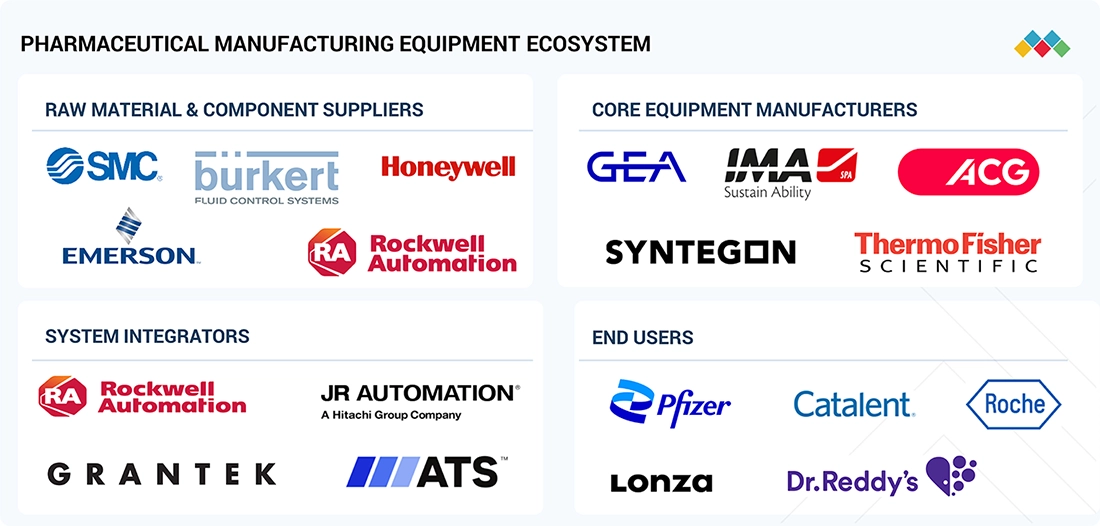
PHARMACEUTICAL MANUFACTURING EQUIPMENT MARKET: COMMERCIAL USE CASES ACROSS INDUSTRIES
| COMPANY | USE CASE DESCRIPTION | BENEFITS |
|---|---|---|
 |
Supplies end-to-end process equipment for pharmaceutical production including mixing, granulation, drying, tablet coating, sterile/aseptic processing, lyophilizers and single-use process skids for both batch and continuous manufacturing | Enables scalable, validated production with improved yield and reproducibility | Reduces contamination risk through closed/aseptic designs | Supports regulatory compliance and accelerates time-to-market |
 |
Provides automated processing and primary/secondary packaging lines: tablet handling, capsule filling, blistering, cartoning, serialization, labeling and integrated end-of-line systems for oral solids and parenterals | Delivers high throughput and packaging accuracy | Lowers manual intervention and labor cost | Simplifies serialization and traceability | Improves product protection and shelf presentation |
 |
Offers aseptic and non-aseptic filling systems, sterilization and inspection equipment, blister and bottle lines, track-and-trace solutions, and process automation for sterile drug manufacture | Raises product quality and batch consistency through validated aseptic technology | Strengthens GMP compliance with integrated inspection and serialization | Reduces total cost of ownership via reliable automation |
 |
Supplies capsule manufacturing and filling systems, tablet compression tooling, coating machines, blister packaging and visual inspection systems tailored for small to large scale pharmaceutical producers | Provides cost-effective, energy-efficient equipment suited to emerging and established markets | Enables modular scaling of capacity | Improves production uptime | Helps meet regulatory packaging standards |
 |
Delivers analytical and manufacturing support equipment including bioprocess single-use systems, environmental and process monitoring, sterilizers, analytical instruments and fill-finish support for biologics and small molecules | Strengthens quality control and process characterization | Supports scale-up from R&D to commercial production | Offers validated systems and service support that reduce technical risk and speed regulatory submissions |
Logos and trademarks shown above are the property of their respective owners. Their use here is for informational and illustrative purposes only.
Related Ecosystem
Industrial Automation
- Sensors
- Image Sensors
- Manufacturing Execution System (MES)
- Actuators
- Flow Sensors
- Siemens ag
- ABB India Limited
- Emerson Electric Co.
- HONEYWELL INTERNATIONAL INC.
- SCHNEIDER ELECTRIC SE
Key Takeaways
- Brazil's pharmaceutical manufacturing equipment market will grow from USD 374.8M (2026) to USD 516.2M (2031) at a 5.5% CAGR.
- Brazil is leveraging government support and regulatory modernization to strengthen domestic pharmaceutical production capacity and equipment adoption.
- Automation and Industry 4.0 integration are accelerating in Brazil, driving demand for advanced manufacturing and quality control equipment.
- Brazil's position as South America's largest pharmaceutical hub creates sustained demand for equipment modernization and technology upgrades through 2031.
Pharmaceutical Manufacturing Equipment Market Report Scope
| Report Metric | Details |
|---|---|
| Base Year | 2026 |
| Fastest Growing Segment | PACKAGING MACHINES (Equipment Type) |
| Forecast Period | 2026–2031 |
| Growth Rate | CAGR of 6.2% from 2026 to 2031 |
| Largest Segment | AUTOMATIC (Technology) |
| Market Size Base Year (Billions) | ~USD 21.18 (2026) |
| Revenue Forecast (Billions) | ~USD 28.62 (2031) |
| Segments Covered | Equipment Type, End-Product Type, Technology |
Brazil Pharmaceutical Manufacturing Equipment Market Report Segmentation
3 segment dimensions are covered across the global market.
By Equipment Type
- Extrusion Equipment
- Filling Machines
- Granulation Equipment
- Inspection Equipment
- Milling Equipment
- Mixing & Blending Machines
- Packaging Machines
- Spray Drying Equipment
- Sterilization Equipment
- Tablet Compression Presses
By End-Product Type
- Liquid
- Solid
By Technology
- Automatic
- Semi-Automatic
Target Audience
- Equipment Manufacturers : Pharmaceutical equipment suppliers need Brazil-specific market data to develop localized product strategies, identify customer segments, and understand competitive positioning in South America's largest pharmaceutical market.
- Pharmaceutical Companies : Local and multinational pharmaceutical manufacturers require insights into equipment market trends and supplier capabilities to optimize capital expenditure decisions and modernize production facilities in Brazil.
- Investment & Private Equity Firms : Investors evaluating opportunities in Brazil's life sciences sector need detailed market analysis, growth projections, and competitive landscape data to assess investment viability and portfolio company potential.
- Regulatory & Compliance Consultants : Consultants advising pharmaceutical companies on ANVISA compliance and facility upgrades require market intelligence on equipment standards, regulatory drivers, and technology adoption trends specific to Brazil.
- Market Research & Strategy Teams : Corporate strategy and business development teams need Brazil market cutout data to support expansion planning, competitive analysis, and long-term strategic positioning in Latin America's pharmaceutical sector.
Key Companies in the Brazil Pharmaceutical Manufacturing Equipment Market
| Company | HQ | Ownership | Strongest segments |
|---|---|---|---|
| GEA GROUP AKTIENGESELLSCHAFT | United States | Public Company | Separation & Flow Technologies,Liquid & Power Technologies,Food & Health Technologies, |
| KöRBER AG | Germany | Private Company | Supply chain software, automation, voice, robotics, and material handling,Pharma machinery, equipment, and related software,Technologies: measuring instruments, flavors, food and beverage, and e-mobility equipment, |
| IMA INDUSTRIA MACCHINE AUTOMATICHE SPA | Italy | Private Company | Pharmaceutical processing and packaging systems,Food, dairy, and beverage packaging lines,Tea, coffee, and related portioning systems, |
| ACG | Bermuda | Public Company | Insurance,Reinsurance,Mortgage, |
| THERMO FISHER SCIENTIFIC INC. | United States | Public Company | Life Sciences Solutions,Analytical Instruments,Specialty Diagnostics, |
| ELIZABETH COMPANIES | United States | Private Company | Prestige and heritage fragrances,Licensed designer and celebrity fragrances,Skincare (Elizabeth Arden, Ceramide, Prevage, Eight Hour, Pro), |
| FREUND | Japan | Private Company | Pharmaceutical granulation and coating equipment,Plant engineering and integrated systems,Pharmaceutical excipients, |
GEA GROUP AKTIENGESELLSCHAFT
GEA GROUP AKTIENGESELLSCHAFT is a publicly traded company founded in 1881 with 19,670 employees operating in the United States.
KöRBER AG
KÖRBER AG is a German private company founded in 1946 with 10,665 employees.
IMA INDUSTRIA MACCHINE AUTOMATICHE SPA
IMA INDUSTRIA MACCHINE AUTOMATICHE SPA is an Italian private company founded in 1961 with 6,121 employees.
ACG
ACG is a publicly traded company based in Bermuda founded in 1995 with 8,000 employees.
THERMO FISHER SCIENTIFIC INC.
THERMO FISHER SCIENTIFIC INC. is a publicly traded United States company founded in 1956 with 125,000 employees.
ELIZABETH COMPANIES
ELIZABETH COMPANIES is a United States-based private company founded in 1910 with 2,150 employees.
FREUND
FREUND is a Japan-based private company founded in 1964 with 427 employees.
Reasons to Buy this Report
- Market Entry Strategy : Gain comprehensive insights into Brazil's pharmaceutical equipment landscape to develop targeted market entry strategies, identify key distribution channels, and understand local regulatory requirements for successful business expansion.
- Competitive Intelligence : Access detailed analysis of competitive dynamics, major equipment suppliers operating in Brazil, market share distribution, and emerging players to benchmark your position and identify growth opportunities.
- Investment Decision Support : Make informed investment decisions with accurate market sizing, growth projections through 2031, and identification of high-potential segments within Brazil's pharmaceutical manufacturing equipment sector.
- Regulatory & Compliance Insights : Understand Brazil's evolving regulatory framework, ANVISA requirements, and compliance standards driving equipment demand, enabling you to align product offerings with market needs and regulatory expectations.
- Growth Opportunity Identification : Identify emerging trends, technology adoption patterns, and underserved market segments in Brazil's pharmaceutical manufacturing, including biopharmaceutical production and automation opportunities.
Frequently asked questions
What is the current size of Brazil's pharmaceutical manufacturing equipment market?
Brazil's pharmaceutical manufacturing equipment market is valued at USD 374.8 million in 2026 and is projected to reach USD 516.2 million by 2031.
What is the expected growth rate for Brazil's pharmaceutical manufacturing equipment market?
Brazil's market is expected to grow at a compound annual growth rate (CAGR) of 5.5% between 2026 and 2031.
What factors are driving growth in Brazil's pharmaceutical manufacturing equipment market?
Key drivers include Brazil's strengthening regulatory framework, increased domestic pharmaceutical production capacity, government initiatives to boost local manufacturing, and rising adoption of automation and Industry 4.0 technologies.
Which equipment types are most in demand in Brazil's pharmaceutical manufacturing sector?
Brazil's manufacturers are increasingly investing in tablet presses, filling machines, quality control systems, and digital solutions for operational efficiency and compliance.
How does Brazil's market compare to the global pharmaceutical manufacturing equipment market?
Brazil's 5.5% CAGR is slightly below the global average of 6.2%, reflecting the country's mature but steadily expanding pharmaceutical manufacturing base within South America.
RESEARCH METHODOLOGY
The research process for this study involved the systematic gathering, recording, and analysis of data on customers and companies operating in the pharmaceutical manufacturing equipment market. This process involved the extensive use of secondary sources, directories, and databases (Factiva and Oanda) to identify and collect valuable information for the comprehensive, technical, market-oriented, and commercial study of the pharmaceutical manufacturing equipment market. In-depth interviews were conducted with primary respondents, including experts from core and related industries, as well as preferred manufacturers, to obtain and verify critical qualitative and quantitative information and assess growth prospects. Key players in the pharmaceutical manufacturing equipment market were identified through secondary research, and their market rankings were determined through a combination of primary and secondary research. This research involved studying the annual reports of top players and conducting interviews with key industry experts, including CEOs, directors, and marketing executives.
Secondary Research
Various sources were utilized in the secondary research process to identify and collect information relevant to this study. These include company annual reports, press releases, investor presentations, white papers, technology journals, certified publications, articles by recognized authors, directories, and databases. Secondary research was primarily used to gather key information about the industry’s value chain, the total pool of market players, market classification according to industry trends at the most detailed level, regional markets, and key developments from both market and technology-oriented perspectives.
Primary Research
Primary research was conducted to identify the segmentation types, key players, competitive landscape, and key market dynamics, including drivers, restraints, opportunities, challenges, and industry trends, as well as key strategies adopted by players operating in the pharmaceutical manufacturing equipment market. Extensive qualitative and quantitative analyses were performed on the complete market engineering process to list key information and insights throughout the report.
Extensive primary research has been conducted after gaining insights into the pharmaceutical manufacturing equipment market scenarios through secondary research. Several primary interviews were conducted with experts from the demand (region) and supply side (equipment type, end-product type, and technology) across four major geographic regions: North America, Europe, Asia Pacific, and RoW. Approximately 60% and 40% of the primary interviews were conducted from the supply and demand sides, respectively. These primary data have been collected through questionnaires, emails, and telephonic interviews.
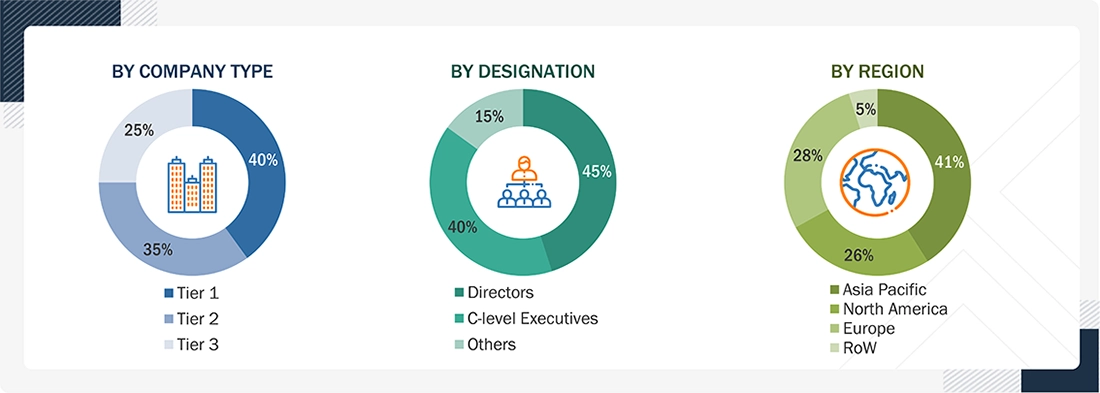
Notes: The three tiers of companies have been defined based on their total/segmental revenue as of 2025: Tier 1 = >USD 1 billion, Tier 2 = USD 500 million–USD 1 billion, and Tier 3 = <USD 500 million.
Other designations include sales, marketing, and product managers.
To know about the assumptions considered for the study, download the pdf brochure
Market Size Estimation
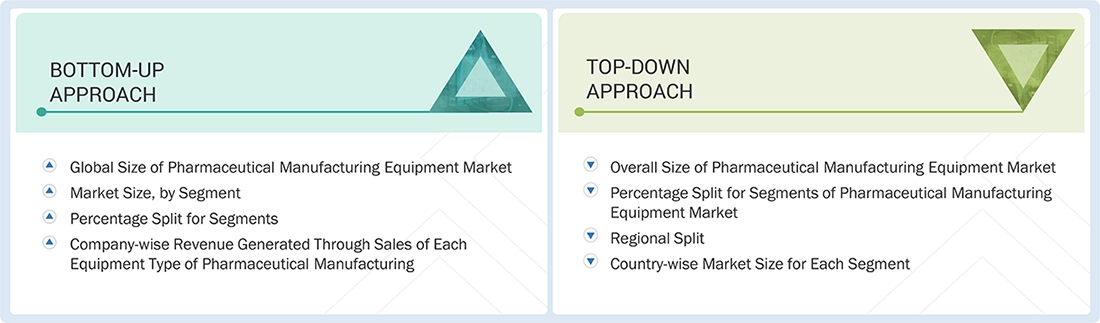
In the complete market engineering process, top-down and bottom-up approaches and several data triangulation methods were implemented to estimate and validate the size of the pharmaceutical manufacturing equipment market and various other dependent submarkets. Key players were identified through secondary research, and their market share in the respective regions was determined through a combination of primary and secondary research. This entire research methodology involved studying the annual and financial reports of the top players, as well as conducting interviews with experts (CEOs, VPs, directors, and marketing executives) to gather key insights (both quantitative and qualitative).
All percentage shares, splits, and breakdowns were determined using secondary sources and verified through primary sources. All the possible parameters that affect the markets covered in this research study were accounted for, viewed in detail, verified through primary research, and analyzed to obtain the final quantitative and qualitative data. This data was consolidated and supplemented with detailed inputs and analysis from MarketsandMarkets and presented in this report.
Pharmaceutical Manufacturing Equipment Market : Top-Down and Bottom-Up Approach
Data Triangulation
After determining the overall market size through the estimation process, as explained above, the total market was divided into several segments and subsegments. To complete the overall market engineering process and obtain precise statistics for all segments and subsegments, market breakdown and data triangulation procedures were employed, as applicable. The data was triangulated by studying various factors and trends from the demand and supply sides. Additionally, the market has been validated using both top-down and bottom-up approaches.
Market Definition
The pharmaceutical manufacturing equipment market covers the global ecosystem involved in the development, production, processing, and packaging of pharmaceutical products across solid and liquid formulations. It includes machinery and integrated systems designed to ensure precision and sterility. These systems maintain regulatory compliance and operational efficiency. Equipment supports activities from raw material handling to final packaging. Manufacturers use these systems to maintain product quality. Large-scale and contract facilities rely on advanced machinery to optimize throughput.
Key Stakeholders
- Pharmaceutical manufacturing equipment manufacturers
- End users
- Automation consultants
- Research organizations
- Technology investors
- Technology standards organizations, forums, alliances, and associations
- Process automation and instrumentation solution and product suppliers
- Instrumentation and automation products’ original equipment manufacturers (OEMs)
- Energy industry associations
Report Objectives
- To describe and forecast the pharmaceutical manufacturing equipment market, by equipment type, end-product type, and technology, in terms of value
- To forecast the market size for four key regions, namely North America, Europe, Asia Pacific, and the Rest of the World (RoW), along with their country-level analyses, in terms of value
- To estimate the market size, by equipment type, in terms of volume
- To provide detailed information regarding the major factors influencing the growth of the market, namely, drivers, restraints, opportunities, and challenges
- To strategically analyze micromarkets1 with respect to individual growth trends, prospects, and contributions to the total market
- To study the complete value chain of the pharmaceutical manufacturing equipment ecosystem, along with market trends and use cases
- To analyze opportunities for stakeholders in the market by identifying high-growth segments of the market
- To strategically profile key players and comprehensively analyze their core competencies2, along with detailing the competitive landscape for market leaders
- To analyze competitive developments, such as product launches, mergers, acquisitions, partnerships, collaborations, and expansions, in the pharmaceutical manufacturing equipment market.
- To benchmark market players using the company evaluation matrix, which analyzes players based on various parameters within broad business categories and product strategies
- To provide information on Porter’s five forces analysis, pricing analysis, trade analysis, investment and funding scenario, key conferences and events, regulatory landscape, ecosystem analysis, case study analysis, patent analysis, technology analysis, unmet needs of various equipment types, interconnected markets and cross-sector opportunities, macroeconomic outlook, and the impact of AI, and the impact of 2025 US tariff
- To benchmark market players using the company evaluation quadrant, which analyzes players based on various parameters within broad business categories and product strategies
- To provide a macroeconomic outlook for all regions covered in this report
- To provide information on ecosystem analysis, case study analysis, patent analysis, technology analysis, unmet needs from various applications, interconnected markets, and cross-sector opportunities, and the impact of AI and its use cases, and the 2025 US tariff impact
Available customizations:
With the given market data, MarketsandMarkets offers customizations according to the company’s specific needs. The following customization options are available for the report:
Get the Full Pharmaceutical Manufacturing Equipment Market Report
Full forecast, segment splits, and company analysis for all Pharmaceutical Manufacturing Equipment Market.
- Canada Pharmaceutical Manufacturing Equipment Market
- Mexico Pharmaceutical Manufacturing Equipment Market
- US Pharmaceutical Manufacturing Equipment Market
- UK Pharmaceutical Manufacturing Equipment Market
- Germany Pharmaceutical Manufacturing Equipment Market
- France Pharmaceutical Manufacturing Equipment Market
- Italy Pharmaceutical Manufacturing Equipment Market
- China Pharmaceutical Manufacturing Equipment Market
- Japan Pharmaceutical Manufacturing Equipment Market
- India Pharmaceutical Manufacturing Equipment Market
- South Korea Pharmaceutical Manufacturing Equipment Market
- Rest Of Europe Pharmaceutical Manufacturing Equipment Market
- Rest Of Asia Pacific Pharmaceutical Manufacturing Equipment Market
- GCC Pharmaceutical Manufacturing Equipment Market
- South Africa Pharmaceutical Manufacturing Equipment Market
- Argentina Pharmaceutical Manufacturing Equipment Market
- Rest Of South America Pharmaceutical Manufacturing Equipment Market
Need a Tailored Report?
Customize this report to your needs
Get 10% FREE Customization
Customize This Report
