
India Phototherapy Equipment Market (2026-2031)

The India Phototherapy Equipment Market was valued at $12.91 Million in 2026 and projected to reach to $18.99 Million by 2031, representing a compound annual growth rate of 8.0%. India's phototherapy equipment market is poised for accelerated growth driven by rising healthcare spending, increasing awareness of advanced therapeutic technologies, and expanding clinical applications.


| Market Size in | USD 26.32 MN |
| Market Forecast in | |
| CAGR | |
| Forecast Period | |
| Units Considered | Value (USD MN) |
India Phototherapy Equipment Market Trends and Insights
- This 8.0% compound annual growth rate reflects India's increasing adoption of advanced therapeutic technologies across dermatology, neonatology, and wound care applications.
- India's growing healthcare infrastructure, rising prevalence of skin disorders, and expanding middle-class population are driving demand for phototherapy solutions. The Indian market benefits from rising awareness of non-invasive treatment options and government initiatives supporting healthcare modernization.
- India's phototherapy equipment sector is characterized by a mix of domestic manufacturers and international players establishing regional presence.
- Between 2026 and 2031, India is expected to see accelerated penetration in tier-2 and tier-3 cities, supported by improving healthcare accessibility and increasing patient preference for light-based therapies over conventional treatments..
Key Market Statistics
- CAGR (2026-2031) 8.0% CAGR
- Market Size, 2026 ~USD 12.91 Million
- Forecast, 2031 ~USD 18.99 Million
- Country India
India Phototherapy Equipment Market Overview
Market Valuation Growth :
India's phototherapy equipment market is valued at USD 12.91 million in 2026 and is projected to reach USD 18.99 million by 2031, representing a robust 8.0% CAGR, outpacing the global growth rate of 5.5%.
Healthcare Infrastructure Expansion :
India's rapidly expanding healthcare infrastructure, coupled with increasing government initiatives in medical technology adoption, is driving demand for advanced phototherapy solutions across urban and emerging tier-2 cities.
Rising Disease Prevalence :
Growing incidence of skin disorders, neonatal jaundice, and chronic wound conditions in India's large population base is creating sustained demand for phototherapy equipment across dermatology, neonatology, and wound care segments.
Affordability & Accessibility Focus :
Increasing availability of cost-effective phototherapy solutions and government healthcare schemes are improving accessibility, particularly in rural and semi-urban regions, expanding the addressable market significantly.
India Phototherapy Equipment Market Dynamics
- The market benefits from India's large patient population, growing prevalence of dermatological and neonatal conditions, and improving healthcare infrastructure across metropolitan and tier-2 cities.
- Government initiatives promoting medical device adoption and rising private healthcare investments are creating favorable conditions for market expansion.
- The 8.0% CAGR reflects strong momentum as hospitals, clinics, and diagnostic centers increasingly integrate phototherapy solutions into their treatment protocols.
- By 2031, the market is expected to achieve significant penetration across major metropolitan areas and secondary cities, supported by declining equipment costs and enhanced clinical evidence..
Market Ecosystem
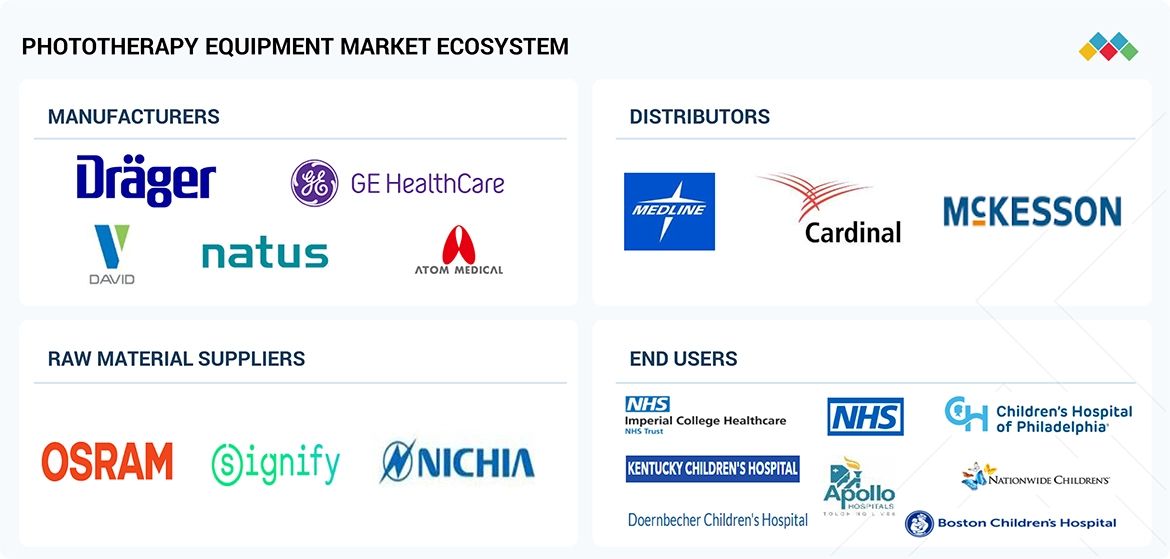
PHOTOTHERAPY EQUIPMENT MARKET: COMMERCIAL USE CASES ACROSS INDUSTRIES
| COMPANY | USE CASE DESCRIPTION | BENEFITS |
|---|---|---|
 |
Develops advanced neonatal phototherapy systems used in NICUs for treating neonatal jaundice through controlled light exposure. Focuses on integration with incubators and monitoring systems (Market Intel) | High treatment precision | Seamless NICU integration | Improved patient safety | Energy-efficient systems |
 |
Offers LED-based phototherapy devices such as bilirubin management systems for hospitals and neonatal care units, addressing hyperbilirubinemia in newborns (Market Data Forecast) | Advanced LED technology | Faster bilirubin reduction | Improved clinical outcomes | Global service network |
 |
Provides neonatal phototherapy solutions including LED-based systems for hospitals and homecare settings, focusing on ease of use and flexibility (Market Intel) | User-friendly devices | Portable solutions | Reduced treatment time | High efficiency |
 |
Manufactures neonatal care equipment, including phototherapy units designed for safe and continuous jaundice treatment in NICUs (MarkWide Research) | Reliable performance | Continuous therapy capability | High safety standards |
 |
Provides NICU-compatible phototherapy systems like LED-based units used alongside warmers and incubators for newborn care (Phoenix Medical Systems) | Cost-effective solutions | Compatibility with NICU setups | Efficient light distribution |
Logos and trademarks shown above are the property of their respective owners. Their use here is for informational and illustrative purposes only.
Related Ecosystem
Medical Devices
- Polymerase Chain Reaction (PCR)
- Magnetic Resonance Imaging (MRI)
- Disposable Autoinjectors
- Pulse Oximeters
- Blood Pressure Monitors
- Medtronic plc
- Abbott Laboratories
- Stryker Corporation
- Becton, Dickinson and Company
- CONMED Corporation
Key Takeaways
- India's phototherapy equipment market is projected to grow from USD 12.91 million in 2026 to USD 18.99 million by 2031, representing an 8.0% CAGR.
- India's market growth is driven by rising dermatological disorders, increasing healthcare infrastructure investment, and growing adoption of non-invasive therapeutic solutions.
- India's expanding middle-class population and improving healthcare accessibility in tier-2 and tier-3 cities are creating new market opportunities for phototherapy equipment.
- India's competitive landscape includes both domestic manufacturers and international players, with government healthcare initiatives supporting market expansion through 2031.
Phototherapy Equipment Market Report Scope
| Report Metric | Details |
|---|---|
| Base Year | 2026 |
| Fastest Growing Segment | FIBER-OPTIC PHOTOTHERAPY EQUIPMENT (Product) |
| Forecast Period | 2026–2031 |
| Growth Rate | CAGR of 5.5% from 2026 to 2031 |
| Largest Segment | CONVENTIONAL PHOTOTHERAPY EQUIPMENT (Product) |
| Market Size Base Year (Billions) | ~USD 0.47 (2026) |
| Revenue Forecast (Billions) | ~USD 0.62 (2031) |
| Segments Covered | Product, Application, Type, End User |
India Phototherapy Equipment Market Report Segmentation
4 segment dimensions are covered across the global market.
By Product
- Conventional Phototherapy Equipment
- Fiber-Optic Phototherapy Equipment
By Application
- Neonatal Jaundice
- Skin Diseases
By Type
- Eczema
- Psoriasis
- Vitiligo
By End User
- Home Care Settings
- Hospitals
INDIA: PHOTOTHERAPY EQUIPMENT MARKET, BY END USER, 2024–2031
| Segment | 2024 | 2025 | 2026 | 2027 | 2028 | 2029 | 2030 | 2031 | CAGR (%) |
|---|---|---|---|---|---|---|---|---|---|
| HOME CARE SETTINGS | 1.29 | 1.44 | 1.61 | 1.79 | 1.99 | 2.21 | 2.45 | 2.7 | 11 |
| HOSPITALS | 11.97 | 13.01 | 14.16 | 15.39 | 16.69 | 18.06 | 19.49 | 20.98 | 8.2 |
| TOTAL | 13.26 | 14.45 | 15.77 | 17.18 | 18.69 | 20.28 | 21.94 | 23.68 | 8.5 |
Target Audience
- Medical Device Manufacturers : Manufacturers need India-specific market data to assess market entry opportunities, identify growth segments (dermatology, neonatology, wound care), and develop localized product strategies for India's price-sensitive healthcare market.
- Healthcare Providers & Hospital Networks : Hospital administrators and procurement teams require market insights to evaluate phototherapy equipment investments, understand competitive offerings, and make informed purchasing decisions aligned with India's clinical and budgetary requirements.
- Investors & Private Equity Firms : Investment professionals need India market analysis to identify growth opportunities, assess portfolio company potential, evaluate market attractiveness, and support due diligence for healthcare technology investments in India.
- Distributors & Channel Partners : Distribution networks and healthcare equipment suppliers require India market data to identify partnership opportunities, assess demand across regions, and develop effective go-to-market strategies for phototherapy equipment distribution.
- Government & Healthcare Policy Bodies : Healthcare regulators and policy makers need market intelligence to inform medical device regulations, healthcare infrastructure planning, and technology adoption initiatives aligned with India's healthcare modernization goals.
Key Companies in the India Phototherapy Equipment Market
| Company | HQ | Ownership | Strongest segments |
|---|---|---|---|
| GALDERMA S.A. | Switzerland | Public Company | Injectable aesthetics (fillers, toxins, biostimulators, skinboosters),Dermatological skincare (Cetaphil, ALASTIN, other OTC/clinic brands),Therapeutic dermatology Rx (acne, rosacea, AK, onychomycosis, others), |
GALDERMA S.A.
Galderma S.A. is a Swiss pharmaceutical company founded in 1981 that specializes in dermatology and aesthetics. As a publicly traded company, it employs 7,676 people and develops treatments for skin health conditions.
Reasons to Buy this Report
- Market Size & Growth Validation : Obtain precise market valuation data for India (USD 12.91M in 2026, USD 18.99M in 2031) with verified 8.0% CAGR to support investment decisions, business planning, and competitive positioning in this high-growth market.
- Segment-Specific Insights : Access detailed analysis of India's phototherapy applications across dermatology, neonatology, and wound care segments, enabling targeted product development and market entry strategies tailored to India's clinical needs.
- Regional Opportunity Assessment : Understand India's unique market dynamics, healthcare infrastructure expansion, government initiatives, and tier-2 city growth opportunities to identify high-potential regions for market penetration and distribution partnerships.
- Competitive Landscape Analysis : Benchmark against India-specific market trends, pricing strategies, and competitive positioning to develop effective go-to-market strategies and differentiation approaches for the Indian healthcare sector.
- Strategic Decision Support : Leverage India market data to support M&A evaluations, partnership negotiations, product localization decisions, and resource allocation for maximizing ROI in this emerging high-growth phototherapy market.
Frequently asked questions
What is the current size of India's phototherapy equipment market?
India's phototherapy equipment market was valued at USD 12.91 million in 2026 and is expected to reach USD 18.99 million by 2031.
What is the projected growth rate for India's phototherapy equipment market?
India's phototherapy equipment market is projected to grow at a compound annual growth rate (CAGR) of 8.0% from 2026 to 2031.
What are the primary drivers of growth in India's phototherapy equipment market?
India's market growth is driven by rising prevalence of skin disorders, expanding healthcare infrastructure, increasing awareness of non-invasive treatments, and government healthcare modernization initiatives.
Which applications dominate India's phototherapy equipment market?
India's phototherapy equipment market is primarily driven by dermatology, neonatology, and wound care applications, with dermatological treatments representing the largest segment.
How is India's phototherapy equipment market expected to evolve by 2031?
India's market is expected to see increased penetration in tier-2 and tier-3 cities, greater adoption of advanced phototherapy technologies, and expanded presence of both domestic and international manufacturers.
RESEARCH METHODOLOGY
The study involved major activities in estimating the current market size for the phototherapy equipment market. Exhaustive secondary research was done to collect information on the phototherapy equipment market. The next step was to validate these findings, assumptions, and sizing with industry experts across the value chain using primary research. Different approaches, such as top-down and bottom-up, were employed to estimate the total market size. After that, the market breakup and data triangulation procedures were used to estimate the market size of the segments and subsegments of the phototherapy equipment market.
Secondary Research
This research study involved the wide use of secondary sources, directories, databases such as Dun & Bradstreet, Bloomberg Businessweek, Factiva, whitepapers, and companies’ house documents. Secondary research was undertaken to identify and collect information for this extensive, technical, market-oriented, and commercial study of the phototherapy equipment market. It was also used to obtain important information on the top players, market classification and segmentation aligned with industry trends, the lowest level of geographic markets, and key market developments. A database of the key industry leaders was also prepared using secondary research.
Primary Research
In the primary research process, various supply- and demand-side sources were interviewed to obtain qualitative and quantitative information for this report. Primary sources from the supply side included industry experts such as CEOs, VPs/Managing Directors, Marketing Heads/Directors, Sales Directors, Marketing/Sales Managers, Regional/Area Sales Managers, Export/Import Heads/Managers, and Other Phototherapy equipment Market Related Personnel from various companies and organizations operating in the phototherapy equipment market. Primary sources from the demand side included Law Enforcement Agencies, Vice Presidents, C-level Executives, Department Heads, Enterprises, Individuals, Supply Management Team of Hospitals, Clinic Personnel, and Laboratory Technicians.
Breakdown of Primary Interviews
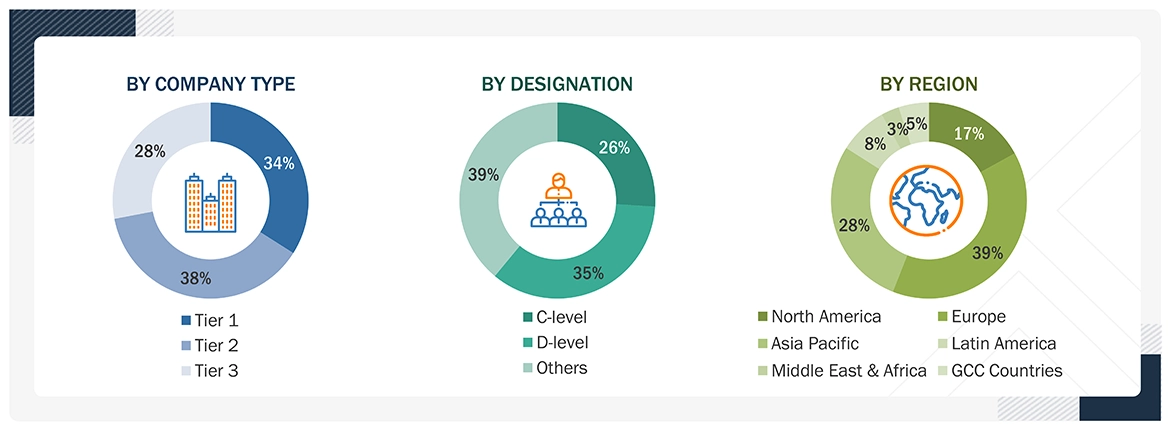
Note 1: C-level primaries include CEOs, COOs, CTOs, and VPs.
Note 2: Other primaries include sales, marketing, and product managers.
Note 3: Companies are classified into tiers based on their total revenue. As of 2025: Tier 1 = >USD 1 billion, Tier 2 = USD 500 million to USD 1 billion, and Tier 3 = <USD 500 million.
To know about the assumptions considered for the study, download the pdf brochure
Market Size Estimation
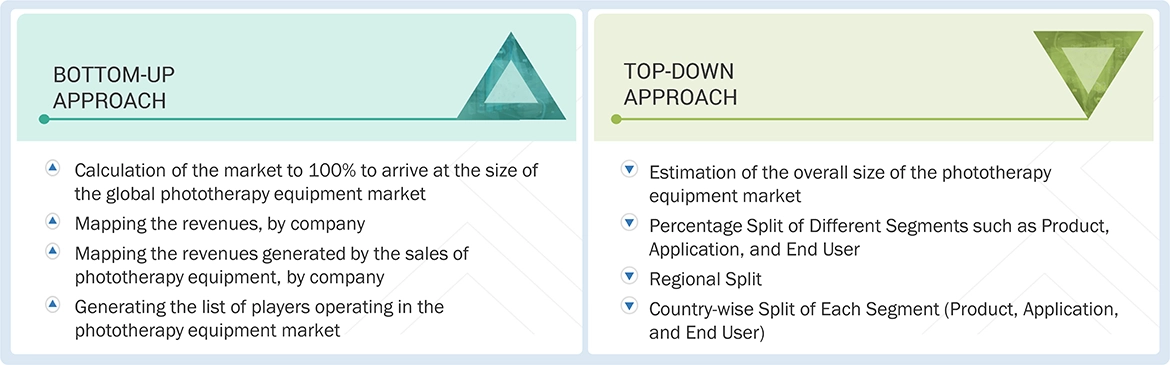
Both top-down and bottom-up approaches were used to estimate and validate the total size of the phototherapy equipment market. These methods were also used extensively to estimate the size of various subsegments in the market. The research methodology used to estimate the market size includes the following:
Phototherapy Equipment Market : Top-Down and Bottom-Up Approach
Data Triangulation
The entire market was split into three segments when the market size was determined. Data triangulation and market breakdown were used where necessary to complete the market engineering process and derive precise statistics for all segments.
Approach for deriving the market size and estimating market growth.
Using secondary data from paid and unpaid sources, the market rankings of the major players were determined through a thorough analysis of their phototherapy equipment sales. Due to data restrictions, in certain cases, the revenue share was determined after a thorough analysis of large corporations' product portfolios and individual sales performance. This information was verified at each stage by in-depth interviews with professionals in the field.
Market Definition
Phototherapy involves using a specific wavelength of light to treat various medical conditions (such as psoriasis, vitiligo, acne vulgaris, neonatal jaundice, cancer, and eczema) by exposing the affected area of the body to a light source.
Key Stakeholders
- Phototherapy equipment manufacturing companies
- Phototherapy equipment accessories manufacturing companies
- Phototherapy equipment suppliers and distributors
- Neonatologists
- Dermatologists
- Distributors, suppliers, and commercial service providers
- Hospitals and clinics
- Research laboratories and academic institutes
Report Objectives
- To describe, analyze, and forecast the phototherapy equipment market by product, application, end user, and region
- To describe and forecast the phototherapy equipment market for key regions, namely, North America, Europe, the Asia Pacific, Latin America, the Middle East and Africa, and GCC Countries
- To provide detailed information regarding drivers, restraints, opportunities, and challenges influencing the growth of the phototherapy equipment market
- To strategically analyze the ecosystem, regulations, patenting trend, value chain, Porter’s five forces, and prices pertaining to the market under study
- To strategically analyze micromarkets1 with respect to individual growth trends, prospects, and contributions to the overall market
- To analyze market opportunities for stakeholders and provide details of the competitive landscape for market players
- To profile key players and comprehensively analyze their market shares and core competencies2 in the phototherapy equipment market
- To analyze competitive developments such as collaborations, acquisitions, product launches, expansions, and R&D activities in the phototherapy equipment market
Available customizations:
With the given market data, MarketsandMarkets offers customizations as per your company’s specific needs. The following customization options are available for the report:
Product Analysis
- Product matrix, which gives a detailed comparison of the product portfolios of each company
Regional Analysis
- Further breakdown of the Rest of Asia Pacific phototherapy equipment market into Vietnam, New Zealand, and others.
- Further breakdown of the Rest of Latin America phototherapy equipment market into Colombia, Chile, Ecuador, and others.
- Further breakdown of the Rest of Europe phototherapy equipment market into Belgium, Russia, the Netherlands, Switzerland, and others.
Company Information
- Detailed analysis and profiling of additional market players (up to 5)
Get the Full Phototherapy Equipment Market Report
Full forecast, segment splits, and company analysis for all Phototherapy Equipment Market.
- Canada Phototherapy Equipment Market
- US Phototherapy Equipment Market
- Germany Phototherapy Equipment Market
- UK Phototherapy Equipment Market
- France Phototherapy Equipment Market
- Italy Phototherapy Equipment Market
- Spain Phototherapy Equipment Market
- China Phototherapy Equipment Market
- Japan Phototherapy Equipment Market
- Australia Phototherapy Equipment Market
- South Korea Phototherapy Equipment Market
- Brazil Phototherapy Equipment Market
- Mexico Phototherapy Equipment Market
- GCC Countries Phototherapy Equipment Market
- Rest Of Europe Phototherapy Equipment Market
- Rest Of Asia Pacific Phototherapy Equipment Market
Need a Tailored Report?
Customize this report to your needs
Get 10% FREE Customization
Customize This Report
