
UK Photovoltaics (PV) Films Market (2025-2030)

The UK Photovoltaics (PV) Films Market was valued at $122.7 Million in 2025 and projected to reach to $190.2 Million by 2030, representing a compound annual growth rate of 9.2%. The UK photovoltaics films market is positioned for sustained growth through 2030, driven by the government's commitment to renewable energy expansion and ambitious carbon neutrality targets.


| Market Size in | USD 26.32 MN |
| Market Forecast in | |
| CAGR | |
| Forecast Period | |
| Units Considered | Value (USD MN) |
UK Photovoltaics (PV) Films Market Trends and Insights
- The UK market benefits from strong renewable energy policies, increasing solar adoption targets, and growing demand for advanced PV film technologies across residential and commercial sectors.
- The UK's commitment to net-zero emissions by 2050 and substantial government incentives for solar installations are driving sustained investment in photovoltaic materials. The UK PV films market is characterized by rising competition among manufacturers and expanding applications in building-integrated photovoltaics (BIPV) and flexible solar solutions.
- The UK's established supply chain and technological expertise position it as a key hub for PV film innovation within Europe.
- Between 2025 and 2030, the UK market will likely see accelerated adoption of high-efficiency films and emerging technologies, supported by declining production costs and improved performance metrics.
- Regional manufacturers and international players are increasingly targeting the UK to capitalize on its favorable regulatory environment and growing consumer awareness of renewable energy solutions..
Key Market Statistics
- CAGR (2025-2030) 9.2% CAGR
- Market Size, 2025 ~USD 122.7 Million
- Forecast, 2030 ~USD 190.2 Million
- Country UK
UK Photovoltaics (PV) Films Market Overview
Market Size & Growth :
The UK photovoltaics films market is valued at USD 122.7 million in 2025, with projected growth to USD 190.2 million by 2030, representing a 9.2% CAGR, outpacing global average growth rates.
Government Support & Policy :
UK renewable energy policies and net-zero commitments drive strong solar adoption targets, creating favorable conditions for PV film technology deployment across residential and commercial installations.
Sector Expansion :
Growing demand for advanced PV film technologies spans both residential rooftop installations and large-scale commercial solar projects, supported by declining costs and improved efficiency standards.
Technology Innovation :
UK market benefits from increased investment in next-generation PV film materials, including perovskite and thin-film technologies, enhancing energy conversion efficiency and market competitiveness.
UK Photovoltaics (PV) Films Market Dynamics
- Increasing solar adoption across residential, commercial, and utility-scale sectors will accelerate demand for high-performance PV films.
- The market will benefit from technological advancements, cost reductions, and supportive regulatory frameworks including feed-in tariffs and renewable energy incentives.
- Competition among manufacturers will intensify, fostering innovation in film efficiency and durability.
- Supply chain development and local manufacturing capabilities are expected to strengthen, reducing import dependency and supporting market resilience..
Market Ecosystem
Related Ecosystem
Foam And Insulation
- Fiberglass
- Acoustic Insulation
- Elastomeric Foam
- HVAC System
- Flexible Foam
- Basf se
- Saint-gobain
- ARMACELL INTERNATIONAL
- THE WOODBRIDGE GROUP
- Sekisui Chemical Co., Ltd.
Key Takeaways
- The UK PV films market is valued at USD 122.7 million in 2025 and will reach USD 190.2 million by 2030, growing at a 9.2% CAGR.
- The UK's net-zero commitment and renewable energy incentives are primary drivers of sustained market growth through 2030.
- Building-integrated photovoltaics (BIPV) and flexible solar film applications are expanding rapidly across the UK residential and commercial sectors.
- The UK market attracts both regional and international manufacturers seeking to leverage its advanced supply chain and favorable regulatory environment.
Photovoltaics (PV) Films Market Report Scope
| Report Metric | Details |
|---|---|
| Base Year | 2025 |
| Fastest Growing Segment | POE (Raw Material) |
| Forecast Period | 2025-2030 |
| Growth Rate | CAGR of 12.8% from 2025 to 2030 |
| Largest Segment | GROUND-MOUNTED PV (Application) |
| Market Size Base Year (Billions) | ~USD 14.07 (2025) |
| Revenue Forecast (Billions) | ~USD 25.69 (2030) |
| Segments Covered | Raw Material, Application |
UK Photovoltaics (PV) Films Market Report Segmentation
2 segment dimensions are covered across the global market.
By Raw Material
- Eva
- Other Raw Materials
- Poe
- Pvb
By Application
- Building-Integrated Pv
- Ground-Mounted Pv
UK: PHOTOVOLTAIC (PV) FILMS MARKET, BY APPLICATION, 2025–2030
| Segment | 2025 | 2026 | 2027 | 2028 | 2029 | 2030 | CAGR (%) |
|---|---|---|---|---|---|---|---|
| BUILDING-INTEGRATED PV | 10.1 | 11.4 | 12.6 | 13.6 | 14.4 | 15 | 8.3 |
| GROUND-MOUNTED PV | 112.5 | 128.5 | 142.7 | 155.1 | 165.8 | 175.1 | 9.2 |
| TOTAL | 122.7 | 140 | 155.3 | 168.6 | 180.2 | 190.2 | 9.2 |
Target Audience
- Solar Equipment Manufacturers : Manufacturers need UK-specific market data to optimize production capacity, develop localized product offerings, and identify distribution channels aligned with British solar installation trends.
- Renewable Energy Investors : Investment firms require detailed UK market forecasts and growth drivers to evaluate portfolio opportunities, assess risk profiles, and make informed capital allocation decisions in the PV sector.
- Government & Policy Bodies : UK regulatory agencies and policymakers need market intelligence to design effective renewable energy incentives, set realistic solar adoption targets, and monitor industry development progress.
- Commercial Solar Installers : Installation companies require UK market insights to forecast demand, plan inventory, identify emerging technologies, and position services competitively within the growing commercial solar segment.
- Material & Chemical Suppliers : Suppliers of PV film materials need UK-specific demand forecasts to optimize supply chains, plan capacity investments, and develop specialized products for the British renewable energy market.
Reasons to Buy this Report
- UK-Specific Market Sizing : Obtain precise market valuation data for the UK PV films sector with detailed 2025-2030 forecasts, enabling accurate investment planning and resource allocation decisions tailored to the British market.
- Policy & Regulatory Insights : Understand UK-specific renewable energy policies, net-zero commitments, and solar adoption targets that directly influence market dynamics and create growth opportunities for stakeholders.
- Competitive Landscape Analysis : Identify key players, market share distribution, and competitive strategies within the UK PV films market to benchmark performance and identify partnership or acquisition opportunities.
- Sector-Specific Demand Drivers : Analyze residential, commercial, and utility-scale solar adoption patterns unique to the UK, including regional variations and emerging application areas for advanced PV film technologies.
- Strategic Growth Planning : Leverage comprehensive UK market intelligence to develop targeted expansion strategies, product development roadmaps, and go-to-market approaches aligned with local demand and regulatory requirements.
Frequently asked questions
What is the current size of the UK photovoltaics films market?
The UK photovoltaics films market is estimated at USD 122.7 million in 2025 and is expected to grow to USD 190.2 million by 2030.
What is the projected growth rate for the UK PV films market?
The UK PV films market is projected to grow at a compound annual growth rate (CAGR) of 9.2% from 2025 to 2030.
What are the main drivers of growth in the UK PV films market?
Key drivers include the UK's net-zero emissions target by 2050, government solar installation incentives, rising demand for building-integrated photovoltaics, and declining production costs for advanced PV film technologies.
Which applications are growing fastest in the UK PV films market?
Building-integrated photovoltaics (BIPV) and flexible solar film solutions are experiencing the fastest growth in the UK market, driven by demand in both residential and commercial sectors.
Who are the key players in the UK photovoltaics films market?
The UK market includes both regional manufacturers with established supply chains and international players entering the market to capitalize on favorable regulatory conditions and growing renewable energy adoption.
RESEARCH METHODOLOGY
The study involved four major activities in estimating the market size of the photovoltaics films market. Exhaustive secondary research was done to collect information on the market, the peer market, and the parent market. The next step was to validate these findings, assumptions, and sizing with industry experts across the value chain through primary research. Both top-down and bottom-up approaches were employed to estimate the complete market size. Thereafter, the market breakdown and data triangulation procedures were used to estimate the market size of the segments and subsegments.
Secondary Research
Various secondary sources have been used in the secondary research process to identify and collect information for this study. These sources include annual reports, press releases, investor presentations of companies, white papers, certified publications, trade directories, articles from recognized authors, gold-standard and silver-standard websites, and databases.
Secondary research has been used to obtain key information about the value chain of the industry, the monetary chain of the market, the total pool of key photovoltaic films market classification and segmentation according to industry trends to the bottom-most level, and regional markets. It was also used to obtain information about the key developments from a market-oriented perspective.
Primary Research
The photovoltaic films market comprises several stakeholders in the value chain, which include raw material suppliers, manufacturers, and end users. Various primary sources from the supply and demand sides of the photovoltaic films market have been interviewed to obtain qualitative and quantitative information. The primary interviewees from the demand side include key opinion leaders in end-use sectors. The primary sources from the supply side include manufacturers, associations, and institutions involved in the photovoltaic films market industry.
Primary interviews were conducted to gather insights such as market statistics, data on revenue collected from the products and services, market breakdowns, market size estimations, market forecasting, and data triangulation. Primary research also helped in understanding the various trends related to raw material, application, and region. Stakeholders from the demand side, such as CIOs, CTOs, and CSOs, were interviewed to understand the buyer’s perspective on the suppliers, products, component providers, and their current usage of photovoltaic films and future outlook of their business, which will affect the overall market.
The breakdown of profiles of the interviews with experts is illustrated in the figure below:
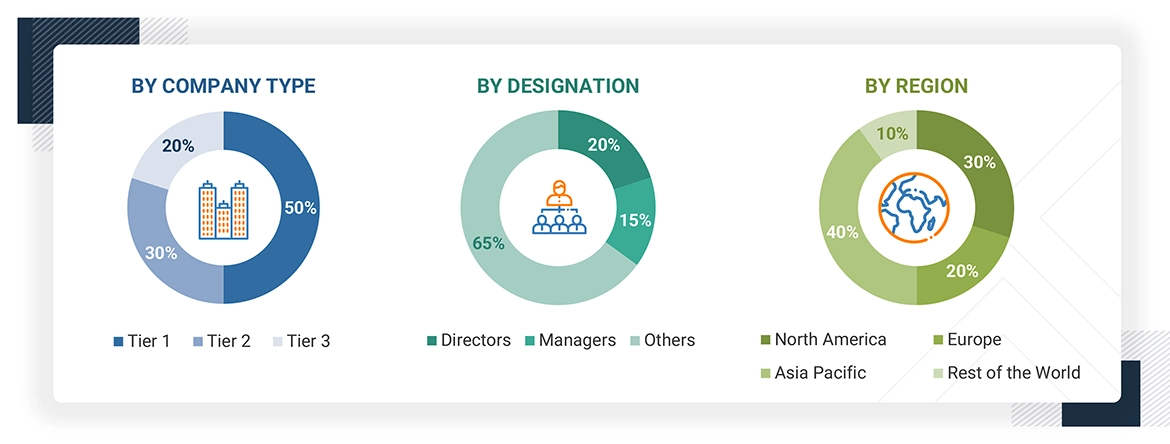
Note: Tier 1, Tier 2, and Tier 3 companies are classified based on their market revenue in 2024, available in the public domain, product portfolios, and geographical presence.
Other designations include sales representatives, production heads, and technicians.
To know about the assumptions considered for the study, download the pdf brochure
Market Size Estimation
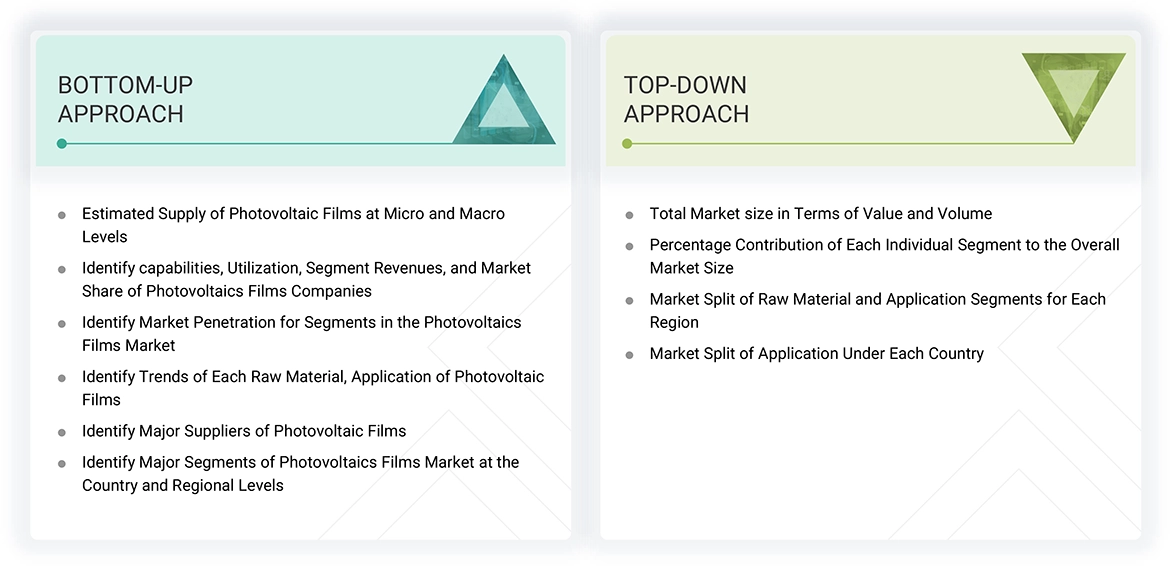
The top-down approach was used to estimate and validate the size of various submarkets for photovoltaics films. The research methodology used to estimate the market size included the following steps:
- The key players in the industry have been identified through extensive secondary research.
- The supply chain of the industry has been determined through primary and secondary research.
- All percentage shares, splits, and breakdowns based on raw material, application, and region were determined using secondary sources and verified through primary sources.
- All possible parameters that affect the markets covered in this research study were accounted for, viewed in extensive detail, verified through primary research, and analyzed to get the final quantitative and qualitative data. This data was consolidated and added with detailed inputs and analysis and presented in this report.
Data Triangulation
After arriving at the total market size from the estimation process above, the overall market has been split into several segments and subsegments. To complete the overall market engineering process and arrive at the exact statistics for all the segments and subsegments, the data triangulation and market breakdown procedures have been employed, wherever applicable. The data has been triangulated by studying various factors and trends from both the demand and supply sides. Along with this, the market size has been validated by using both the top-down and bottom-up approaches and interviews with experts. Hence, for every data segment, there have been three sources—top-down approach, bottom-up approach, and interviews with experts. The data was assumed correct when the values arrived from the three sources matched.
Market Definition
Photovoltaic films are specialized polymeric materials that encase and protect photovoltaic cells housed in solar panels; they help PV cells remain durable, functional, and viable over time. The films function as a protective layer, keep the delicate solar cells safe from environmental stressors (moisture, sunlight, dust/debris, physical damage), and are clear to allow passage of sunlight, and can electrically insulate the PV cells from the environment. The most common types of photovoltaic encapsulation films are ethylene vinyl acetate (EVA), polyolefin elastomers (POE), and polyvinyl butyral (PVB). EVA dominates the market partially because of its low-cost, high-transparency, and high-strength adhesion, encasing over 80% of PV modules in use across the globe. Photovoltaic films are produced through extrusion or co-extrusion processes - the polymers are melted, shaped into thin sheets, and submerged or bonded together by coating them with silica or adhesion promoters (like silanes) to be able to bond the film to attachment materials beyond just glass or back sheets. Process designs, like vacuum lamination, help precisely embed the solar cells among the films (such as between sublimation film, support, or back sheet film), sealing all exposed surfaces from external threats and preserving the PV module.
Photovoltaic films are instrumental in the process of manufacturing solar panels because they are integrated into crystalline silicon and thin-film PV modules. (They are used in residential, commercial, automotive, and construction applications.) In addition, encapsulation films enhance the efficiency of solar panel systems, as they limit the degradation from external forces that deteriorate the panel integrity. Further, encapsulation films are increasingly being used in new alternatives, such as flexible solar modules and building-integrated photovoltaics. The encapsulation film market is developing rapidly due to rising solar adoption, increasing government incentives, and improving technology in encapsulant durability.
Stakeholders
- Photovoltaic Films Market Manufacturers
- Photovoltaic Films Market Traders, Distributors, and Suppliers
- Raw Type Suppliers
- Government and Private Research Organizations
- Associations and Industrial Bodies
- R&D Institutions
- Environmental Support Agencies
Report Objectives
- To define, describe, and forecast the size of the photovoltaic films market, in terms of value and volume
- To provide detailed information regarding the major factors (drivers, opportunities, restraints, and challenges) influencing the growth of the market
- To estimate and forecast the market size based on raw material, application, and region
- To forecast the size of the market with respect to major regions, namely, North America, Europe, Asia Pacific, and Rest of the World along with their key countries
- To strategically analyze micromarkets with respect to individual growth trends, prospects, and their contribution to the overall market
- To analyze opportunities in the market for stakeholders and provide a competitive landscape of market leaders
- To track and analyze recent developments, such as product launches, partnerships, agreements, joint ventures, collaborations, announcements, awards, and expansions in the market
- To strategically profile key market players and comprehensively analyze their core competencies
Get the Full Photovoltaics (PV) Films Market Report
Full forecast, segment splits, and company analysis for all Photovoltaics (PV) Films Market.
- China Photovoltaics (PV) Films Market
- Japan Photovoltaics (PV) Films Market
- India Photovoltaics (PV) Films Market
- South Korea Photovoltaics (PV) Films Market
- Taiwan Photovoltaics (PV) Films Market
- Canada Photovoltaics (PV) Films Market
- Mexico Photovoltaics (PV) Films Market
- US Photovoltaics (PV) Films Market
- Germany Photovoltaics (PV) Films Market
- Italy Photovoltaics (PV) Films Market
- France Photovoltaics (PV) Films Market
- Spain Photovoltaics (PV) Films Market
- Russia Photovoltaics (PV) Films Market
- Saudi Arabia Photovoltaics (PV) Films Market
- UAE Photovoltaics (PV) Films Market
- Egypt Photovoltaics (PV) Films Market
- Oman Photovoltaics (PV) Films Market
- South Africa Photovoltaics (PV) Films Market
- Rest Of Europe Photovoltaics (PV) Films Market
- Rest Of Asia Pacific Photovoltaics (PV) Films Market
- Others In Row Photovoltaics (PV) Films Market
Need a Tailored Report?
Customize this report to your needs
Get 10% FREE Customization
Customize This Report
