
Canada Physical Security Information Management (PSIM) Market (2024-2029)

The Canada Physical Security Information Management (PSIM) Market was valued at $285.4 Million in 2024 and projected to reach to $387.9 Million by 2029, representing a compound annual growth rate of 6.3%. Canada's PSIM market is positioned for sustained expansion through 2029, with the projected growth from USD 285.4 million to USD 387.9 million reflecting strong demand for integrated security solutions.


| Market Size in | USD 26.32 MN |
| Market Forecast in | |
| CAGR | |
| Forecast Period | |
| Units Considered | Value (USD MN) |
Canada Physical Security Information Management (PSIM) Market Trends and Insights
- This represents a compound annual growth rate (CAGR) of 6.3%, outpacing global averages and reflecting Canada's increasing investment in integrated security solutions across critical infrastructure, enterprise, and government sectors.
- Canada's market expansion is driven by heightened security concerns, regulatory compliance requirements, and the adoption of advanced technologies that consolidate multiple security systems into unified platforms. The Canadian PSIM market benefits from strong demand in major metropolitan areas and critical infrastructure protection initiatives.
- Canada's emphasis on cybersecurity integration with physical security, coupled with government modernization programs, is accelerating PSIM adoption among federal, provincial, and municipal agencies.
- Organizations across Canada are recognizing the value of centralized security management in reducing operational costs and improving incident response capabilities.
- By 2029, Canada's PSIM market is expected to solidify its position as a key growth region within North America, driven by continued digital transformation and security infrastructure investments..
Key Market Statistics
- CAGR (2024-2029) 6.3% CAGR
- Market Size, 2024 ~USD 285.4 Million
- Forecast, 2029 ~USD 387.9 Million
- Country Canada
Canada Physical Security Information Management (PSIM) Market Overview
Market Growth Acceleration :
Canada's PSIM market is growing at 6.3% CAGR, significantly outpacing the global rate of 4.6%, driven by heightened security concerns and digital transformation initiatives across federal and provincial governments.
Critical Infrastructure Investment :
Canadian organizations are prioritizing integrated security management for airports, ports, utilities, and financial institutions, with PSIM solutions becoming essential for unified threat detection and response.
Regulatory Compliance Drivers :
Stricter Canadian privacy regulations (PIPEDA), cybersecurity frameworks, and critical infrastructure protection mandates are compelling enterprises to adopt comprehensive PSIM platforms for compliance and risk mitigation.
Enterprise Adoption Surge :
Mid-to-large Canadian enterprises across retail, healthcare, and manufacturing sectors are increasingly deploying PSIM to consolidate fragmented security systems and improve operational efficiency.
Canada Physical Security Information Management (PSIM) Market Dynamics
- Government investments in critical infrastructure protection, combined with private sector digitalization efforts, are key growth catalysts.
- The market benefits from Canada's advanced technology adoption rates and heightened awareness of security threats. Looking ahead, Canadian organizations will increasingly prioritize cloud-based PSIM deployments, AI-driven analytics, and mobile-first security platforms.
- Regional players and international vendors are expanding their Canadian presence to capture market share.
- Partnerships between technology providers and system integrators will accelerate solution deployment across public and private sectors, supporting the projected 6.3% CAGR through 2029..
Market Ecosystem
Related Ecosystem
Application Security
- Cloud Security
- Security Analytics
- Network Testing
- Security Testing
- Web Application Security
- REDINGTON
- International Business Machines Corporation
- MICROSOFT CORPORATION
- Cisco Systems, Inc.
- PALO ALTO NETWORKS, INC
Cyber Security
- Cloud Security
- Biometric Systems
- Data Loss Prevention (DLP)
- Multi-Factor Authentication
- Security Analytics
- REDINGTON
- International Business Machines Corporation
- Cisco Systems, Inc.
- MITSUI BUSSAN SECURE DIRECTIONS INC
- MICROSOFT CORPORATION
Endpoint Security
- Cloud Security
- Security Analytics
- Multi-Factor Authentication
- Biometric Security and Authentication System
- Critical Communication Network
- REDINGTON
- International Business Machines Corporation
- MICROSOFT CORPORATION
- Cisco Systems, Inc.
- PALO ALTO NETWORKS, INC
Key Takeaways
- Canada's PSIM market is valued at USD 285.4 million in 2024 and is forecast to reach USD 387.9 million by 2029, representing a 6.3% CAGR.
- Canada's growth rate exceeds the global CAGR of 4.6%, indicating strong regional demand for integrated security management solutions.
- Government modernization initiatives and critical infrastructure protection are primary drivers of PSIM adoption across Canada.
- Canada's market is characterized by increasing convergence of physical and cybersecurity, creating opportunities for comprehensive platform solutions.
Physical Security Information Management (PSIM) Market Report Scope
| Report Metric | Details |
|---|---|
| Base Year | 2024 |
| Fastest Growing Segment | SYSTEMS (Component) |
| Forecast Period | 2024-2029 |
| Growth Rate | CAGR of 4.6% from 2024 to 2029 |
| Largest Segment | SYSTEMS (Component) |
| Market Size Base Year (Billions) | ~USD 3.43 (2024) |
| Revenue Forecast (Billions) | ~USD 4.3 (2029) |
| Segments Covered | Offering, Software Type, Deployment Mode, Organization Size, Vertical, Component |
Canada Physical Security Information Management (PSIM) Market Report Segmentation
6 segment dimensions are covered across the global market.
By Offering
- Services
- Software
By Software Type
- Access Control
- Fire Safety & Alarms
- Gis Mapping Systems
- Hvac
- Intrusion Detection Management
- Video Management
By Deployment Mode
- Cloud
- On-Premises
By Organization Size
- Large Enterprises
- Smes
By Vertical
- Bfsi
- Government
- Healthcare
- It & Ites
- Other Verticals
- Residential
- Retail & E-Commerce
- Retail & Ecommerce
- Transport & Logistics
- Transportation & Logistics
By Component
- Services
- Systems
CANADA: PHYSICAL SECURITY INFORMATION MANAGEMENT MARKET, BY VERTICAL, 2024–2029
| Segment | 2024 | 2025 | 2026 | 2027 | 2028 | 2029 | CAGR (%) |
|---|---|---|---|---|---|---|---|
| BFSI | 42.1 | 45.1 | 48.4 | 51.9 | 55.7 | 60.2 | 7.4 |
| GOVERNMENT | 36.3 | 38.5 | 40.9 | 43.5 | 46.3 | 49.6 | 6.4 |
| HEALTHCARE | 31.4 | 33.4 | 35.7 | 38.2 | 40.8 | 43.9 | 6.9 |
| IT & ITES | 32.6 | 34.4 | 36.4 | 38.6 | 40.9 | 43.6 | 6 |
| OTHER VERTICALS | 24.4 | 25.8 | 27.3 | 28.8 | 30.4 | 32.3 | 5.7 |
| RESIDENTIAL | 41.8 | 43.7 | 45.8 | 48 | 50.3 | 53.1 | 4.9 |
| RETAIL & ECOMMERCE | 27.6 | 29.8 | 32.2 | 34.9 | 37.8 | 41.2 | 8.4 |
| TRANSPORT & LOGISTICS | 49.1 | 51.6 | 54.3 | 57.2 | 60.3 | 64 | 5.4 |
| TOTAL | 285.4 | 302.2 | 321 | 341.1 | 362.4 | 387.9 | 6.3 |
Target Audience
- Government & Public Sector Agencies : Canadian federal, provincial, and municipal agencies require PSIM market intelligence to evaluate integrated security solutions for critical infrastructure, border security, and public safety operations.
- Enterprise Security Directors : C-suite and security leadership at large Canadian enterprises need market data to justify PSIM investments, benchmark against peers, and align security strategies with regulatory compliance requirements.
- Technology Vendors & System Integrators : PSIM solution providers and Canadian system integrators require market sizing, growth forecasts, and competitive landscape data to refine product offerings and capture expanding market opportunities.
- Private Equity & Investment Firms : Investors evaluating Canadian security technology companies need market validation, growth trajectories, and sector trends to assess investment potential and portfolio company valuations.
- Consultants & Strategic Advisors : Management consultants and security advisors serving Canadian clients require authoritative market research to support recommendations, feasibility studies, and digital transformation initiatives.
Reasons to Buy this Report
- Market Size & Growth Validation : Obtain precise Canadian market valuation (USD 285.4M in 2024) and verified 6.3% CAGR projections through 2029 to support investment decisions and competitive positioning in this high-growth segment.
- Regional Competitive Intelligence : Understand Canada-specific market dynamics, key players, and adoption patterns to identify opportunities for market entry, partnerships, or expansion within the country's unique regulatory and enterprise landscape.
- Regulatory & Compliance Insights : Access detailed analysis of Canadian privacy laws (PIPEDA), critical infrastructure requirements, and compliance drivers shaping PSIM demand to align product development and go-to-market strategies.
- Sector-Specific Opportunity Mapping : Identify high-potential Canadian verticals (government, utilities, finance, healthcare, retail) with detailed spending patterns and security priorities to optimize sales and marketing resource allocation.
- Strategic Forecasting for 2029 : Leverage Canada-focused projections and trend analysis to develop long-term business strategies, budget planning, and product roadmaps aligned with anticipated market evolution and emerging customer needs.
Frequently asked questions
What is the current size of Canada's PSIM market?
Canada's Physical Security Information Management market was valued at USD 285.4 million in 2024 and is expected to grow to USD 387.9 million by 2029.
What is the projected growth rate for Canada's PSIM market?
Canada's PSIM market is projected to grow at a compound annual growth rate (CAGR) of 6.3% from 2024 to 2029, outpacing the global average of 4.6%.
What are the main drivers of PSIM adoption in Canada?
Key drivers include government modernization programs, critical infrastructure protection requirements, regulatory compliance mandates, and the integration of physical and cybersecurity solutions across Canadian organizations.
Which sectors are leading PSIM adoption in Canada?
Federal, provincial, and municipal government agencies, critical infrastructure operators, large enterprises, and financial institutions are among the primary adopters of PSIM solutions in Canada.
How does Canada's PSIM market compare to global trends?
Canada's PSIM market growth rate of 6.3% CAGR significantly exceeds the global CAGR of 4.6%, reflecting stronger regional demand and investment in integrated security management technologies.
RESEARCH METHODOLOGY
The study involved major activities in estimating the current market size for the physical security information management market. Exhaustive secondary research was done to collect information on the physical security information management industry. The next step was to validate these findings, assumptions, and sizing with industry experts across the value chain using primary research. Different approaches, such as top-down and bottom-up, were employed to estimate the total market size. After that, the market breakup and data triangulation procedures were used to estimate the market size of the segments and subsegments of the physical security information management market.
Secondary Research
The market for the companies offering physical security information management solutions and services is arrived at by secondary data available through paid and unpaid sources, analyzing the product portfolios of the major companies in the ecosystem, and rating the companies by their performance and quality. Various sources were referred to in the secondary research process to identify and collect information for this study. The secondary sources include annual reports, press releases, investor presentations of companies, white papers, journals, certified publications, and articles from recognized authors, directories, and databases.
In the secondary research process, various secondary sources were referred to for identifying and collecting information related to the study. Secondary sources included annual reports, press releases, and investor presentations of physical security information management vendors, forums, certified publications, and whitepapers. The secondary research was used to obtain critical information on the industry’s value chain, the total pool of key players, market classification, and segmentation from the market and technology-oriented perspectives.
Primary Research
In the primary research process, various primary sources from both the supply and demand sides were interviewed to obtain qualitative and quantitative information for this report. The primary sources from the supply side included industry experts, such as Chief Executive Officers (CEOs), Vice Presidents (VPs), marketing directors, technology and innovation directors, and related key executives from various key companies and organizations operating in the physical security information management market.
After the complete market engineering (calculations for market statistics, market breakdown, market size estimations, market forecasting, and data triangulation), extensive primary research was conducted to gather information and verify and validate the critical numbers arrived at. Primary research was also conducted to identify the segmentation types, industry trends, competitive landscape of physical security information management solutions offered by various market players, and key market dynamics, such as drivers, restraints, opportunities, challenges, industry trends, and key player strategies.
In the complete market engineering process, the top-down and bottom-up approaches were extensively used, along with several data triangulation methods, to perform the market estimation and market forecasting for the overall market segments and subsegments listed in this report. Extensive qualitative and quantitative analysis was performed on the complete market engineering process to list the key information/insights throughout the report.
Following is the breakup of the primary study:
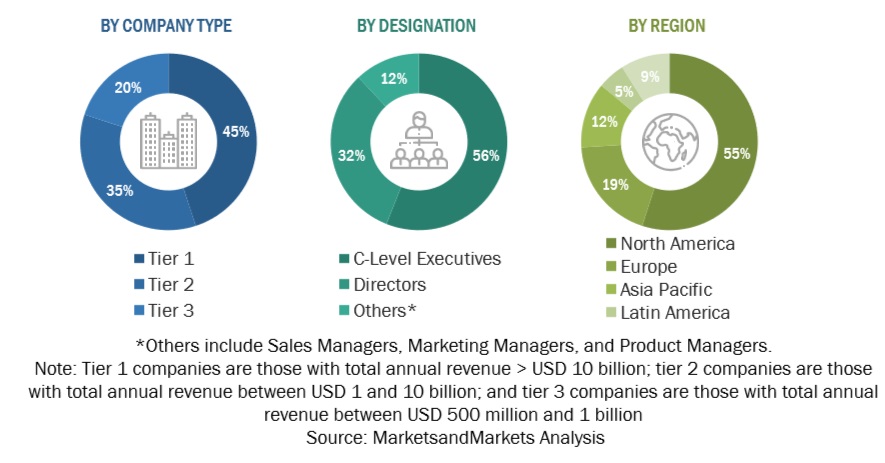
To know about the assumptions considered for the study, download the pdf brochure
Market Size Estimation
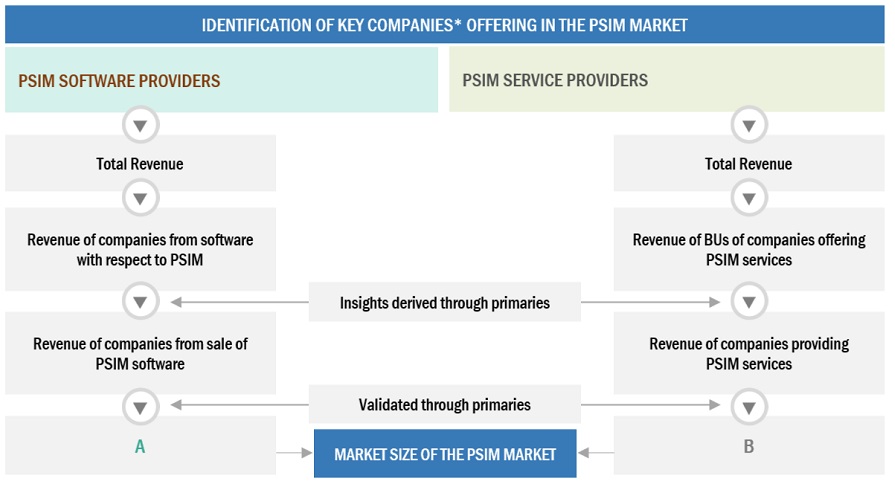
Top-down and bottom-up approaches were used to estimate and validate the size of the global physical security information management market and estimate the size of various other dependent sub-segments in the overall physical security information management market. The research methodology used to estimate the market size includes the following details: key players in the market were identified through secondary research, and their market shares in the respective regions were determined through primary and secondary research. This entire procedure included the study of the annual and financial reports of the top market players, and extensive interviews were conducted for key insights from the industry leaders, such as CEOs, VPs, directors, and marketing executives.
All percentage splits and breakdowns were determined using secondary sources and verified through primary sources. All possible parameters that affect the market covered in this research study have been accounted for, viewed in extensive detail, verified through primary research, and analyzed to get the final quantitative and qualitative data. This data is consolidated and added to detailed inputs and analysis from MarketsandMarkets.
Infographic Depicting Market Size Estimation Methodology - Approaches
Data Triangulation
After arriving at the overall market size using the market size estimation processes explained above, the market was split into several segments and subsegments. The data triangulation and market breakup procedures were employed, wherever applicable, to complete the overall market engineering process and arrive at the exact statistics of each market segment and subsegment. The data was triangulated by studying various factors and trends from both the demand and supply sides.
Market Definition
According to Noggin, A physical security information management system is a software platform that integrates security applications and devices, controlling them through a single interface. The importance of PSIM is that in integrating security devices and presenting all their relevant information into a single view, the physical security information management software improves detection efficiency and effectiveness. That contributes to greatly improved situational awareness and decision support.
Key Stakeholders
- Government agencies
- PSIM vendors
- Independent software vendors
- Consulting firms
- System integrators
- Value-Added Resellers (VARs)
- Information Technology (IT) security agencies
- Managed Security Service Providers (MSSPs)
- Raw material/component suppliers
- Research organizations and consulting companies
- Government bodies, such as regulating authorities and policymakers
- Venture capitalists and private equity firms
Report Objectives
- To define, describe, and forecast the physical security information management market based on - offering, software type, deployment organization size, vertical, and region.
- To define, describe, and forecast the market by – offering, software type, deployment organization size, vertical, and region.
- To forecast the market size of five main regions: North America, Europe, Asia Pacific (APAC), Middle East & Africa (MEA), and Latin America
- To analyze the subsegments of the market concerning individual growth trends, prospects, and contributions to the overall market.
- To provide detailed information related to the major factors (drivers, restraints, opportunities, and challenges) influencing the growth of the market.
- To analyze opportunities in the market for stakeholders by identifying high-growth segments of the market.
- To profile the key players of the market and comprehensively analyze their market size and core competencies in the market.
- To track and analyze competitive developments, such as new product launches, mergers and acquisitions, and partnerships, agreements, and collaborations in the global physical security information management market.
Customization Options
With the given market data, MarketsandMarkets offers customizations based on company-specific needs. The following customization options are available for the report:
Geographic Analysis
- Further breakup of the Asia Pacific market into countries contributing 75% to the regional market size
- Further breakup of the North American market into countries contributing 100% to the regional market size
- Further breakup of the Latin American market into countries contributing 75% to the regional market size
- Further breakup of the Middle Eastern and African market into countries contributing 75% to the regional market size
- Further breakup of the European market into countries contributing 75% to the regional market size
Company Information
- Detailed analysis and profiling of additional market players (up to 5)
Get the Full Physical Security Information Management (PSIM) Market Report
Full forecast, segment splits, and company analysis for all Physical Security Information Management (PSIM) Market.
- US Physical Security Information Management (PSIM) Market
- UK Physical Security Information Management (PSIM) Market
- Germany Physical Security Information Management (PSIM) Market
- France Physical Security Information Management (PSIM) Market
- Italy Physical Security Information Management (PSIM) Market
- China Physical Security Information Management (PSIM) Market
- Japan Physical Security Information Management (PSIM) Market
- India Physical Security Information Management (PSIM) Market
- UAE Physical Security Information Management (PSIM) Market
- Turkey Physical Security Information Management (PSIM) Market
- South Africa Physical Security Information Management (PSIM) Market
- Brazil Physical Security Information Management (PSIM) Market
- Mexico Physical Security Information Management (PSIM) Market
- Rest Of Europe Physical Security Information Management (PSIM) Market
- Rest Of Apac Physical Security Information Management (PSIM) Market
- Rest Of Latin America Physical Security Information Management (PSIM) Market
- GCC Countries Physical Security Information Management (PSIM) Market
- Ksa Physical Security Information Management (PSIM) Market
- Rest Of GCC Countries Physical Security Information Management (PSIM) Market
Need a Tailored Report?
Customize this report to your needs
Get 10% FREE Customization
Customize This Report
