
Brazil Physiotherapy Equipment Market (2024-2029)

The Brazil Physiotherapy Equipment Market was valued at $113.7 Million in 2024 and projected to reach to $163.3 Million by 2029, representing a compound annual growth rate of 7.5%. Brazil's physiotherapy equipment market is positioned for sustained expansion, growing at a CAGR of 7.5% from 2024 to 2029, outpacing the global growth rate of 7.1%.


| Market Size in | USD 26.32 MN |
| Market Forecast in | |
| CAGR | |
| Forecast Period | |
| Units Considered | Value (USD MN) |
Brazil Physiotherapy Equipment Market Trends and Insights
- This expansion in Brazil reflects increasing healthcare investment, rising awareness of rehabilitation services, and growing demand for advanced therapeutic devices across clinical and home-care settings.
- Brazil's aging population and rising prevalence of musculoskeletal disorders are driving adoption of physiotherapy solutions among both public and private healthcare providers. The Brazilian market benefits from improving healthcare infrastructure and expanding middle-class access to rehabilitation services.
- Brazil's physiotherapy equipment sector is characterized by a mix of imported premium devices and locally manufactured solutions, creating competitive pricing dynamics.
- Between 2024 and 2029, Brazil is expected to see accelerated penetration of electrotherapy, ultrasound, and mobility-assistance equipment, supported by regulatory improvements and increased reimbursement coverage in Brazil's healthcare system..
Key Market Statistics
- CAGR (2024-2029) 7.5% CAGR
- Market Size, 2024 ~USD 113.7 Million
- Forecast, 2029 ~USD 163.3 Million
- Country Brazil
Brazil Physiotherapy Equipment Market Overview
Market Valuation :
Brazil's physiotherapy equipment market reached USD 113.7 million in 2024, with strong momentum driven by healthcare modernization and increased rehabilitation service adoption across urban and emerging markets.
Aging Population Dynamics :
Brazil's demographic shift toward an older population is accelerating demand for physiotherapy equipment, as chronic conditions and mobility issues require sustained therapeutic interventions in both clinical and home-care environments.
Healthcare Investment Growth :
Increased public and private healthcare spending in Brazil is expanding access to advanced physiotherapy devices, rehabilitation centers, and integrated wellness programs across major metropolitan regions.
Home-Care Expansion :
Growing preference for home-based rehabilitation and remote patient monitoring is driving demand for portable and user-friendly physiotherapy equipment in Brazil's residential healthcare segment.
Brazil Physiotherapy Equipment Market Dynamics
- This acceleration reflects structural healthcare improvements, rising middle-class purchasing power, and increased awareness of preventive rehabilitation services.
- The market will benefit from both institutional procurement by hospitals and clinics and growing consumer investment in personal wellness devices. Key growth drivers include Brazil's aging demographic profile, expanding private healthcare sector, and government initiatives to improve rehabilitation accessibility.
- Urban centers like São Paulo and Rio de Janeiro will lead adoption, while secondary cities present emerging opportunities.
- Integration of digital health technologies and telemedicine platforms will further enhance market penetration, positioning Brazil as a significant growth engine within Latin America's physiotherapy equipment landscape..
Market Ecosystem
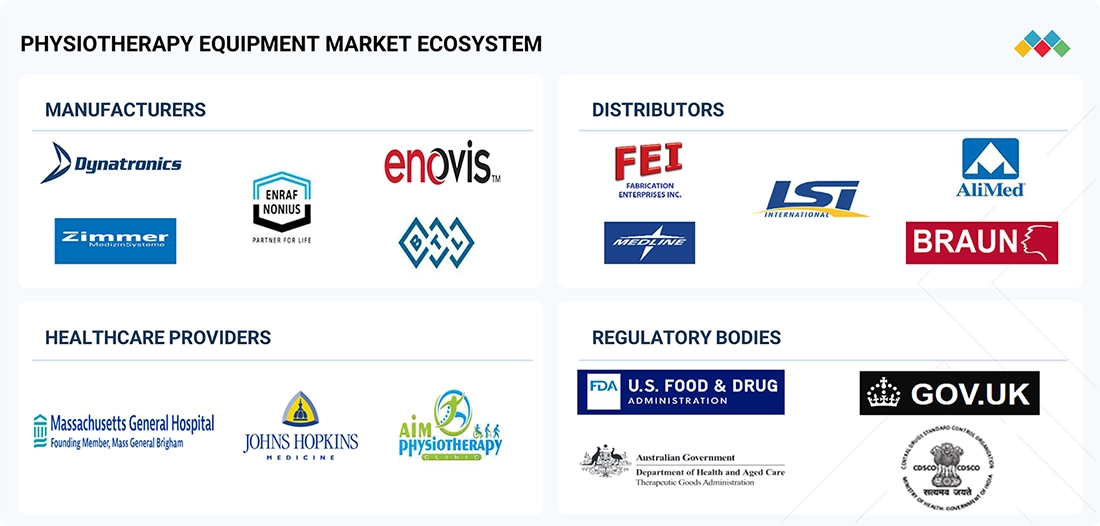
PHYSIOTHERAPY EQUIPMENT MARKET: COMMERCIAL USE CASES ACROSS INDUSTRIES
| COMPANY | USE CASE DESCRIPTION | BENEFITS |
|---|---|---|
 |
Chattanooga and Compex rehabilitation devices, including electrotherapy, ultrasound, shockwave therapy, NMES, CPM, traction systems, and treatment tables, are used for musculoskeletal rehabilitation, pain management, sports injuries, and post-operative recovery. | Enables multimodal rehabilitation; reduces pain; supports tissue healing, mobility improvement, and functional recovery. |
 |
Electrotherapy, ultrasound, shockwave therapy, induction therapy, cryotherapy, and laser systems are used for pain management, musculoskeletal rehabilitation, sports injuries, and soft tissue recovery | Provides non-invasive pain relief; promotes healing, mobility restoration, and faster rehabilitation. |
 |
Electrical stimulation, interferential therapy, NMES, FES, ultrasound, and combination therapy systems are used for orthopedic, musculoskeletal, and neurological rehabilitation | Reduces pain; improves muscle function, neuromuscular recovery, and rehabilitation outcomes. |
 |
TENS devices are used in home-based and outpatient physiotherapy for musculoskeletal pain management, including back, neck, shoulder, and arthritis-related pain. | Provides drug-free pain relief; enables convenient home therapy and long-term pain management. |
 |
Electrotherapy, ultrasound, photobiomodulation, traction systems, and rehabilitation tables are used for pain management, musculoskeletal rehabilitation, and post-operative recovery. | Supports rehabilitation; improves pain control, tissue healing, mobility, and treatment efficiency. |
Logos and trademarks shown above are the property of their respective owners. Their use here is for informational and illustrative purposes only.
Related Ecosystem
Medical Devices
- Polymerase Chain Reaction (PCR)
- Magnetic Resonance Imaging (MRI)
- Disposable Autoinjectors
- Pulse Oximeters
- Blood Pressure Monitors
- Medtronic plc
- Abbott Laboratories
- Stryker Corporation
- Becton, Dickinson and Company
- CONMED Corporation
Key Takeaways
- Brazil's physiotherapy equipment market is valued at USD 113.7 million in 2024 and will grow to USD 163.3 million by 2029, representing a 7.5% CAGR.
- Brazil's aging demographic and rising musculoskeletal disease burden are primary drivers of physiotherapy equipment demand across public and private sectors.
- Brazil's market is characterized by a dual supply structure combining imported premium devices with locally manufactured cost-effective solutions.
- Regulatory improvements and expanded reimbursement in Brazil's healthcare system are expected to accelerate market penetration through 2029.
Physiotherapy Equipment Market Report Scope
| Report Metric | Details |
|---|---|
| Base Year | 2024 |
| Fastest Growing Segment | ELECTROTHERAPY EQUIPMENT (Equipment Type) |
| Forecast Period | 2024-2029 |
| Growth Rate | CAGR of 7.1% from 2024 to 2029 |
| Largest Segment | EQUIPMENT (Product) |
| Market Size Base Year (Billions) | ~USD 6.71 (2024) |
| Revenue Forecast (Billions) | ~USD 9.45 (2029) |
| Segments Covered | Product, Equipment Type, Accessory Type, Application, End User, Equipment, Accessories |
Brazil Physiotherapy Equipment Market Report Segmentation
7 segment dimensions are covered across the global market.
By Product
- Accessories
- Equipment
By Equipment Type
- Combination Therapy Equipment
- Continuous Passive Motion Therapy Equipment
- Cryotherapy Equipment
- Electrotherapy Equipment
- Exercise Therapy Equipment
- Heat Therapy Equipment
- Laser Therapy Equipment
- Magnetic Pressure Therapy Equipment
- Other Physiotherapy Equipment
- Shockwave Therapy Equipment
- Traction Therapy Equipment
- Ultrasound Equipment
By Accessory Type
- Other Physiotherapy Accessories
- Physiotherapy Furniture
By Application
- Cardiovascular & Pulmonary
- Gynecological
- Musculoskeletal
- Neurological
- Other Applications
- Pediatric
By End User
- Home Care Settings
- Hospitals
- Other End Users
- Physicians' Offices
- Physiotherapy & Rehabilitation Centers
By Equipment
- Combination Therapy Equipment
- Continuous Passive Motion Therapy Equipment
- Cryotherapy Equipment
- Electrotherapy Equipment
- Exercise Therapy Equipment
- Heat Therapy Equipment
- Laser Therapy Equipment
- Magnetic Pressure Therapy Equipment
- Other Physiotherapy Equipment
- Shockwave Therapy Equipment
- Traction Therapy Equipment
- Ultrasound Equipment
By Accessories
- Physiotherapy Furniture
BRAZIL: PHYSIOTHERAPY EQUIPMENT MARKET, BY END USER, 2024–2031
| Segment | 2024 | 2025 | 2026 | 2027 | 2028 | 2029 | 2030 | 2031 | CAGR (%) |
|---|---|---|---|---|---|---|---|---|---|
| HOME CARE SETTINGS | 13.2 | 14.1 | 15 | 16.1 | 17.1 | 18.3 | 19.6 | 20.9 | 6.8 |
| HOSPITALS | 38.7 | 41.1 | 43.7 | 46.4 | 49.4 | 52.6 | 55.9 | 59.6 | 6.4 |
| OTHER END USERS | 10.5 | 10.9 | 11.4 | 11.9 | 12.5 | 13 | 13.7 | 14.3 | 4.6 |
| PHYSICIANS’ OFFICES | 23.3 | 25 | 26.9 | 28.9 | 31 | 33.4 | 35.9 | 38.6 | 7.5 |
| PHYSIOTHERAPY & REHABILITATION CENTERS | 49.2 | 52.7 | 56.4 | 60.3 | 64.6 | 69.1 | 74.1 | 79.4 | 7.1 |
| TOTAL | 134.9 | 143.8 | 153.4 | 163.6 | 174.6 | 186.4 | 199.1 | 212.8 | 6.8 |
Target Audience
- Medical Device Manufacturers : Manufacturers need Brazil-specific market data to develop localized product strategies, understand competitive positioning, and identify distribution partnerships for physiotherapy equipment in this high-growth Latin American market.
- Healthcare Facility Operators : Hospital and clinic administrators require market insights to optimize equipment procurement decisions, benchmark capital expenditure against market trends, and plan rehabilitation service expansion in Brazil.
- Private Equity & Investors : Investment firms evaluating healthcare opportunities in Brazil need detailed market sizing, growth trajectories, and segment analysis to assess portfolio companies and identify acquisition or funding targets in physiotherapy.
- Healthcare Consultants & Advisors : Consulting firms advising healthcare clients on market entry, business development, or strategic planning require Brazil-specific data to support client recommendations and competitive analysis.
- Distributors & Resellers : Equipment distributors and resellers need market forecasts, segment breakdowns, and regional demand patterns to optimize inventory management, sales strategies, and partnership development across Brazil's physiotherapy sector.
Reasons to Buy this Report
- Market-Specific Growth Projections : Access detailed forecasts showing Brazil's market expansion from USD 113.7M to USD 163.3M by 2029, enabling precise investment planning and resource allocation for market entry or expansion strategies.
- Competitive Landscape Intelligence : Understand Brazil-specific competitive dynamics, key players, market share distribution, and differentiation strategies tailored to local healthcare regulations and consumer preferences.
- Demographic & Healthcare Insights : Leverage data on Brazil's aging population trends, healthcare spending patterns, and regional variations to identify high-potential customer segments and geographic expansion opportunities.
- Regulatory & Reimbursement Analysis : Gain clarity on Brazil's healthcare policies, insurance coverage for physiotherapy equipment, regulatory requirements, and government initiatives affecting market accessibility and pricing strategies.
- Segment & Channel Opportunities : Identify high-growth segments including home-care equipment, clinical devices, and digital-integrated solutions, plus optimal distribution channels for reaching hospitals, clinics, and direct consumers in Brazil.
Frequently asked questions
What is the current size of Brazil's physiotherapy equipment market?
Brazil's physiotherapy equipment market was valued at USD 113.7 million in 2024 and is projected to reach USD 163.3 million by 2029.
What is the expected growth rate for physiotherapy equipment in Brazil?
Brazil's physiotherapy equipment market is expected to grow at a compound annual growth rate (CAGR) of 7.5% from 2024 to 2029.
What factors are driving growth in Brazil's physiotherapy equipment market?
Key drivers include Brazil's aging population, rising prevalence of musculoskeletal disorders, improving healthcare infrastructure, expanding middle-class access to rehabilitation services, and increased reimbursement coverage in Brazil's healthcare system.
What types of physiotherapy equipment are most in demand in Brazil?
Brazil shows strong demand for electrotherapy devices, ultrasound equipment, and mobility-assistance devices, driven by both clinical rehabilitation and home-care applications.
How is Brazil's physiotherapy equipment market structured?
Brazil's market comprises a mix of imported premium devices from international manufacturers and locally manufactured cost-effective solutions, creating competitive pricing dynamics and diverse product availability.
RESEARCH METHODOLOGY
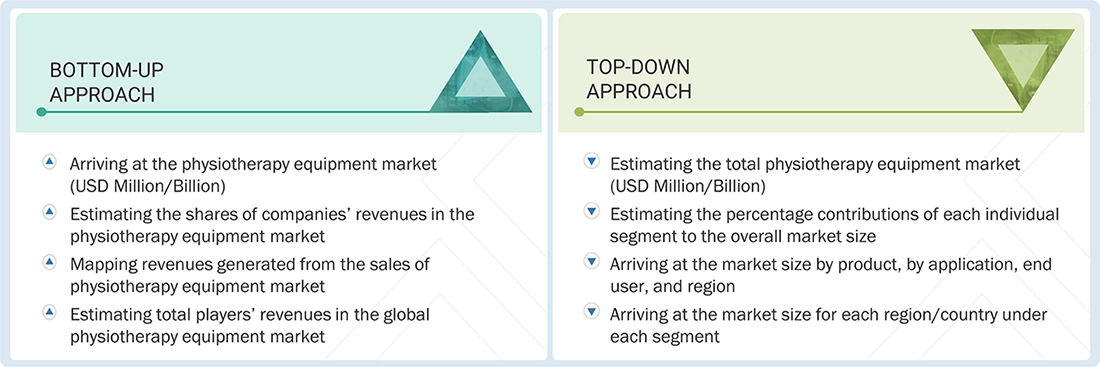
The study involved four major activities to estimate the current size of the physiotherapy equipment market. Exhaustive secondary research was conducted to gather information on the market and its subsegments. The next step was to validate these findings, assumptions, and sizing with industry experts across the value chain through primary research. Both top-down and bottom-up approaches were employed to estimate the complete market size. Thereafter, market breakdown and data triangulation procedures were used to estimate the market size of the segments and subsegments.
Secondary Research
Secondary sources used in this research study include financial statements of companies offering adhesion barriers and information from various trade, business, and professional associations. The secondary data were collected and analyzed to determine the overall size of the physiotherapy equipment market, a finding that primary respondents validated.
Primary Research
Extensive primary research was conducted after obtaining information regarding the physiotherapy equipment market scenario through secondary research. Several primary interviews were conducted with market experts from both the demand and supply sides across major countries of North America, Europe, Asia Pacific, Latin America, and the Middle East & Africa. Primary data were collected through questionnaires, emails, and telephone interviews. The primary sources from the supply side included industry experts, such as Chief X Officers (CXOs), Vice Presidents (VPs), and Directors from business development, marketing, and product development/innovation teams, as well as key executives from physiotherapy equipment manufacturers, distributors, and key opinion leaders.
Primary interviews were conducted to gather insights such as market statistics, revenue data from products and services, market breakdowns, market size estimates, market forecasts, and data triangulation. Primary research also helped in understanding the various trends related to technology, applications, verticals, and regions. Stakeholders from the demand side, customer/end users who are using physiotherapy equipment, were interviewed to understand the buyer’s perspective on the suppliers, products, and their current usage of physiotherapy equipment and future outlook of their business, which will affect the overall market.
Breakdown of Primary Interviews: Supply-Side Participants, By Company Type, Designation, and Region
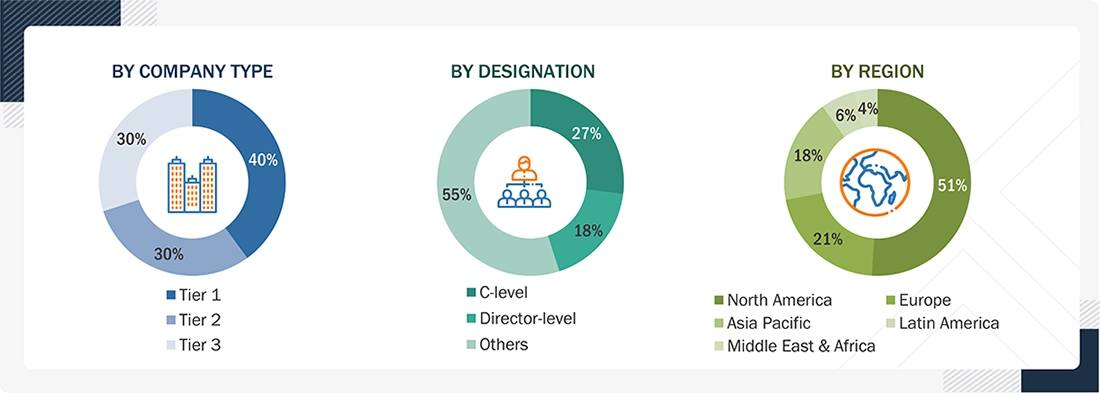
Note1: C-level primaries include CEOs, COOs, CTOs, and VPs.
Note 2: Other primary roles include sales managers, marketing managers, and product managers.
Note3: Companies are classified into tiers based on their total revenue. As of 2025: Tier 1=>USD 1billion, Tier 2=USD 500 million to USD 1 billion, Tier 3=<USD 500 million.
To know about the assumptions considered for the study, download the pdf brochure
Market Size Estimation
The research methodology used to estimate the size of the physiotherapy equipment market is as follows.
Market sizing was conducted from a global perspective.
Country-level Analysis: The size of the physiotherapy equipment market was obtained from the annual presentations of leading players and secondary data available in the public domain. The share of products in the overall physiotherapy equipment market was obtained from secondary data and validated with primary participants to derive the total market size. Primary participants further validated the numbers.
Geographic market assessment (by region & country): The geographic assessment was done using the following approaches:
Approach 1: Geographic revenue contributions/splits of leading players in the market (wherever available) and respective growth trends
Approach 2: Geographic adoption trends for individual product segments by end users and growth prospects for each of the segments (assumptions and indicative estimates validated from primary interviews)
At each point, the assumptions and approaches were validated through industry experts contacted during primary research. Considering the limitations of data available from secondary research, revenue estimates for individual companies (for the overall physiotherapy equipment market and geographic market assessment) were ascertained based on a detailed analysis of their respective product offerings, geographic reach/strength (direct or through distributors or suppliers), and the shares of the leading players in a particular region or country.
Physiotherapy Equipment Market : Top-Down and Bottom-Up Approach
Data Triangulation
The market was segmented into several subsegments after determining the overall market size using market size estimation processes. Data triangulation and market breakdown procedures were employed to complete the overall market engineering process and derive the exact statistics for each market segment and sub-segment. The data was triangulated by examining various factors and trends on both the demand and supply sides of the physiotherapy equipment market.
Market Definition
Physiotherapy refers to the assessment, diagnosis, and treatment of a disease/disability through physical means. Physiotherapy is a branch of rehabilitative health that uses specially designed exercises and equipment to help patients regain or improve their physical abilities. It is a distinct form of care that can be performed both in isolation and in conjunction with other types of medical management.
Key Stakeholders
- Physiotherapy Equipment Manufacturers, Vendors, and Distributors
- Group Purchase Organizations (GPOs)
- Original Equipment Manufacturers (OEMs)
- Hospitals
- Rehabilitation Clinics
- Physiotherapy Centers
- Healthcare Institutes
- Market Research and Consulting Firms
- Research Institutes and Government Organizations
Report Objectives
- To describe, analyze, and forecast the physiotherapy equipment market by product, application, end user, and region
- To provide detailed information regarding the drivers, restraints, opportunities, and challenges influencing the growth of the physiotherapy equipment market
- To strategically analyze micromarkets with respect to individual growth trends, prospects, and contributions to the overall physiotherapy equipment market
- To forecast the size of the physiotherapy equipment market with respect to five main regions (along with countries), namely, North America, Europe, Asia Pacific, Latin America and the Middle East and Africa
- To profile key players and comprehensively analyze their market shares and core competencies2 in the physiotherapy equipment market
- To analyze competitive developments such as partnerships, collaborations, agreements & acquisitions, product launches, expansions, and R&D activities in the physiotherapy equipment market
- To benchmark players within the market using the proprietary Company Evaluation Matrix framework, which analyzes market players on various parameters within the broad categories of business and product strategy
Available customizations:
With the given market data, MarketsandMarkets offers customizations as per the company’s specific needs. The following customization options are available for the report:
Geographic Analysis
- Further breakdown of the Rest of Europe physiotherapy equipment market into the Netherlands, Austria, Belgium, and others
- Further breakdown of the Rest of Asia Pacific physiotherapy equipment market into Singapore, Malaysia, and others
Company Information
-
Detailed analysis and profiling of additional market players.
Get the Full Physiotherapy Equipment Market Report
Full forecast, segment splits, and company analysis for all Physiotherapy Equipment Market.
- Canada Physiotherapy Equipment Market
- US Physiotherapy Equipment Market
- Germany Physiotherapy Equipment Market
- UK Physiotherapy Equipment Market
- France Physiotherapy Equipment Market
- Italy Physiotherapy Equipment Market
- Spain Physiotherapy Equipment Market
- Japan Physiotherapy Equipment Market
- China Physiotherapy Equipment Market
- India Physiotherapy Equipment Market
- Australia Physiotherapy Equipment Market
- South Korea Physiotherapy Equipment Market
- Mexico Physiotherapy Equipment Market
- Argentina Physiotherapy Equipment Market
- Rest Of Europe Physiotherapy Equipment Market
- Rest Of Asia Pacific Physiotherapy Equipment Market
- Rest Of Latin America Physiotherapy Equipment Market
- GCC Countries Physiotherapy Equipment Market
Need a Tailored Report?
Customize this report to your needs
Get 10% FREE Customization
Customize This Report
