
India Plant Extracts Market (2022-2027)

The India Plant Extracts Market was valued at $5374.5 Million in 2022 and projected to reach to $9190.2 Million by 2027, representing a compound annual growth rate of CAGR 11.3%. India's plant extracts market is positioned for sustained growth, with an 11.3% CAGR through 2027, outpacing many global markets.


| Market Size in | USD 26.32 MN |
| Market Forecast in | |
| CAGR | |
| Forecast Period | |
| Units Considered | Value (USD MN) |
India Plant Extracts Market Trends and Insights
- India's market is driven by rising consumer demand for natural and plant-based ingredients across food, beverage, and nutraceutical applications.
- The country's rich biodiversity and traditional knowledge systems position India as a significant producer and consumer of plant extracts in the Asia Pacific region. India's plant extracts sector benefits from increasing health consciousness, regulatory support for natural products, and growing export opportunities.
- India's domestic food and beverage industry is increasingly incorporating plant extracts to meet consumer preferences for clean-label and functional products.
- Between 2022 and 2027, India is expected to capture significant market share through innovation in extraction technologies and expansion of cultivation practices for medicinal and aromatic plants..
Key Market Statistics
- CAGR (2022-2027) CAGR 11.3%
- Market Size, 2022 ~USD 5374.5 Million
- Forecast, 2027 ~USD 9190.2 Million
- Country India
India Plant Extracts Market Overview
Market Valuation Growth :
India's plant extracts market reached USD 5,374.5 million in 2022 and is projected to grow to USD 9,190.2 million by 2027, demonstrating strong market expansion driven by increasing health consciousness among Indian consumers.
Biodiversity Advantage :
India's rich biodiversity and traditional knowledge systems provide a competitive advantage in sourcing diverse plant materials for extracts, supporting both domestic production and export opportunities in the global market.
Sector Diversification :
Plant extracts are increasingly utilized across food & beverage, nutraceuticals, pharmaceuticals, and cosmetics sectors in India, creating multiple revenue streams and application opportunities for market participants.
Consumer Preference Shift :
Rising demand for natural, plant-based, and clean-label ingredients among Indian consumers is accelerating adoption of plant extracts in functional foods, beverages, and wellness products across urban and semi-urban markets.
India Plant Extracts Market Dynamics
- The expansion is fueled by increasing consumer awareness of natural ingredients, growing middle-class purchasing power, and rising adoption of Ayurvedic and traditional formulations in mainstream food and beverage products.
- Government initiatives promoting natural product manufacturing and export further strengthen market dynamics. The Indian market benefits from abundant raw material availability, skilled labor, and established supply chains.
- Emerging opportunities in functional beverages, plant-based proteins, and herbal supplements are attracting both domestic and international investments.
- However, regulatory standardization and quality control remain critical factors for sustained growth and market credibility in India's competitive landscape..
Market Ecosystem
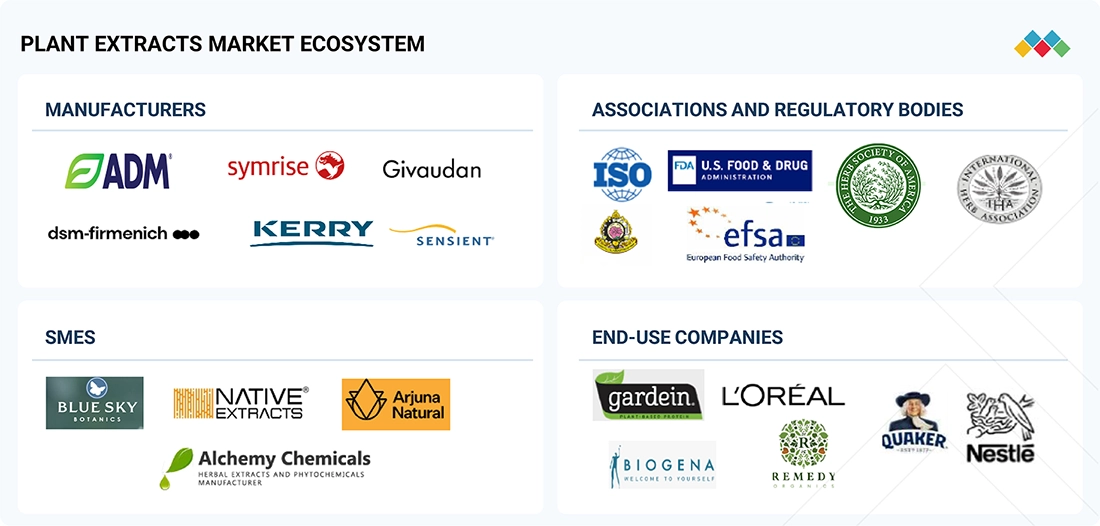
Plant Extracts Market: COMMERCIAL USE CASES ACROSS INDUSTRIES
| COMPANY | USE CASE DESCRIPTION | BENEFITS |
|---|---|---|
 |
Symrise entered into a strategic partnership with Evoxx Technologies. | The partners plan to create biotechnological procedures for ingredients used in cosmetics. Evoxx provides expertise in R&D, and Symrise extends its expertise and capabilities in developing novel and long-lasting cosmetic components. |
 |
Givaudan Active Beauty uses advanced vegetal extraction and biomimetic NaDES technology to develop authentically natural, sustainable botanical actives. Its expertise in phytochemistry and innovative platforms like Eutectys enables the creation of unique plant-derived skincare ingredients. | These technologies deliver high-performance actives that support hydration, anti-ageing, and skin balance while meeting consumer demand for clean, green formulations. The approach also promotes sustainability through efficient extraction and upcycling of botanical resources. |
 |
Kerry acquired US-based Natreon, Inc., a leading supplier of branded Ayurvedic botanical ingredients. | The acquisition is expected to deliver health benefits substantiated by clinical research to a greater number of consumers, ultimately supporting its ambition to reach over two billion people with sustainable nutrition solutions by 2030. |
Logos and trademarks shown above are the property of their respective owners. Their use here is for informational and illustrative purposes only.
Related Ecosystem
Fandb Ingredients
Key Takeaways
- India's plant extracts market is valued at USD 5,374.5 million in 2022 and is forecast to reach USD 9,190.2 million by 2027.
- India's market is growing at an 11.3% CAGR, driven by demand for natural ingredients in food and beverage applications.
- India's biodiversity and traditional knowledge provide competitive advantages in plant extract production and innovation.
- India's regulatory environment and export infrastructure support sustained market expansion through 2027.
Plant Extracts Market Report Scope
| Report Metric | Details |
|---|---|
| Base Year | 2022 |
| Fastest Growing Segment | COSMETICS (Application) |
| Forecast Period | 2022–2027 |
| Growth Rate | CAGR of 12.3% from 2022 to 2027 |
| Largest Segment | DRY (Form) |
| Market Size Base Year (Billions) | ~USD 34.43 (2022) |
| Revenue Forecast (Billions) | ~USD 61.5 (2027) |
| Segments Covered | Type, Application, Source, Form |
India Plant Extracts Market Report Segmentation
4 segment dimensions are covered across the global market.
By Type
- Alkaloids
- Carotenoids
- Essential Oils
- Flavonoids
- Oleoresins
- Other Types
By Application
- Cosmetics
- Dietary Supplements
- Food & Beverages
- Other Applications
- Pharmaceuticals
By Source
- Flowers
- Fruits & Vegetables
- Herbs & Spices
By Form
- Dry
- Liquid
Target Audience
- Food & Beverage Manufacturers : Indian F&B companies need market data to formulate growth strategies, develop plant-based product lines, and understand competitive positioning in the rapidly expanding natural ingredients segment.
- Nutraceutical & Supplement Companies : Domestic and international nutraceutical firms require India-specific market intelligence to identify growth opportunities, assess market demand for herbal supplements, and plan product launches in this high-growth sector.
- Investment & Private Equity Firms : Investors evaluating opportunities in India's plant extracts industry need validated market sizing, growth projections, and sector analysis to make informed investment decisions and identify acquisition targets.
- Raw Material Suppliers & Farmers : Agricultural producers and botanical suppliers in India need market insights to understand demand trends, pricing dynamics, and opportunities for scaling production of plant materials for extract manufacturing.
- Pharmaceutical & Cosmetics Companies : Pharma and cosmetics manufacturers require India market data to evaluate plant extract sourcing opportunities, assess market demand for natural formulations, and plan regional expansion strategies.
Key Companies in the India Plant Extracts Market
| Company | HQ | Ownership | Strongest segments |
|---|---|---|---|
| MITSUBISHI CHEMICAL HOLDINGS CORPORATION | Japan | Public Company | Specialty Materials (performance polymers, battery/display/semiconductor materials, carbon fiber composites),MMA & Derivatives (MMA monomer, PMMA, related intermediates),Basic Materials & Polymers (petrochemicals, commodity polymers, engineering plastics, elastomers), |
| SYMRISE | Germany | Public Company | Taste, Nutrition & Health – Food & Beverage,Taste, Nutrition & Health – Pet Food & Aquafeed,Taste, Nutrition & Health – Probiotics & Dietary Supplements, |
| SENSIENT TECHNOLOGIES CORPORATION | United States | Public Company | Flavors & Extracts,Color,Asia Pacific (cross-category), |
| INTERNATIONAL FLAVORS & FRAGRANCES INC. | United States | Public Company | Taste,Food Ingredients,Health & Biosciences, |
| GIVAUDAN | Switzerland | Public Company | Taste & Wellbeing – Beverages,Taste & Wellbeing – Dairy, Snacks, Savory, Bakery & Confectionery,Taste & Wellbeing – Supplements & Nutraceuticals / Wellbeing Ingredients, |
| ADM | United States | Public Company | Ag Services and Oilseeds,Carbohydrate Solutions,Nutrition, |
| CARGILL, INCORPORATED | United States | Private Company | Grains and oilseeds origination, trading, and processing,Animal nutrition and supplements (livestock and aquaculture),Meat and poultry products, |
| DSM | Switzerland | Public Company | Perfumery & Beauty,Taste, Texture & Health,Health, Nutrition & Care, |
| KERRY GROUP PLC | Ireland | Public Company | Taste solutions (flavours, extracts, modulations),Nutrition solutions (enzymes, proteins, lipids, fibre, wellness),Functional ingredients and food solutions (texturants, protection, reformulation, bakery freshness), |
MITSUBISHI CHEMICAL HOLDINGS CORPORATION
Mitsubishi Chemical Holdings Corporation is a major Japanese public company founded in 1933 with 56,678 employees. The company operates across chemicals, plastics, and related industries on a global scale.
SYMRISE
Symrise is a German public company founded in 1874 with 12,697 employees. The company specializes in flavors, fragrances, and cosmetic ingredients for global markets.
SENSIENT TECHNOLOGIES CORPORATION
Sensient Technologies Corporation is a United States-based public company founded in 1882 with 4,070 employees. The company manufactures colors, flavors, and fragrances for food, beverage, and other industries.
INTERNATIONAL FLAVORS & FRAGRANCES INC.
International Flavors & Fragrances Inc. is a United States-based public company founded in 1909 with 21,500 employees. The company is a leading global supplier of flavors, fragrances, and specialty ingredients.
GIVAUDAN
Givaudan is a Swiss public company founded in 1796 with 17,508 employees. The company is a leading manufacturer of flavors, fragrances, and specialty ingredients for the food, beverage, and personal care industries.
ADM
ADM (Archer Daniels Midland) is a United States-based public company founded in 1902 with 41,147 employees. The company is a global processor and supplier of agricultural commodities and ingredients.
CARGILL, INCORPORATED
Cargill, Incorporated is a United States-based private company founded in 1865 with 155,000 employees. The company is one of the world's largest privately held corporations, operating in agriculture, food, and ingredient sectors.
DSM
DSM is a Swiss public company founded in 1902 with 26,873 employees. The company specializes in nutrition, health, and sustainable living solutions across multiple industries.
KERRY GROUP PLC
Kerry Group PLC is an Irish public company founded in 1972 with 19,284 employees. The company is a global leader in taste and nutrition solutions for the food, beverage, and pharmaceutical industries.
Reasons to Buy this Report
- Market Size & Growth Validation : Obtain precise valuation data for India's plant extracts market (USD 5,374.5M in 2022) with verified 11.3% CAGR projections through 2027, enabling accurate business planning and investment decisions specific to the Indian market.
- Competitive Positioning Strategy : Understand India's market dynamics relative to global trends (12.3% global CAGR) to identify competitive advantages, market gaps, and opportunities for differentiation in the rapidly expanding Indian plant extracts sector.
- Sector-Specific Insights : Access detailed analysis of plant extract applications across India's food & beverage, nutraceutical, and pharmaceutical industries, enabling targeted product development and market entry strategies for specific segments.
- Investment & Expansion Planning : Leverage comprehensive India market data to support investment decisions, facility planning, supply chain optimization, and expansion strategies in one of Asia's fastest-growing plant extracts markets.
- Regulatory & Sourcing Intelligence : Gain insights into India's biodiversity advantages, traditional knowledge systems, and regulatory landscape to optimize sourcing strategies, ensure compliance, and capitalize on India's position as a global plant extract supplier.
Frequently asked questions
What is the current size of India's plant extracts market?
India's plant extracts market was valued at USD 5,374.5 million in 2022 and is projected to grow to USD 9,190.2 million by 2027.
What is the growth rate of India's plant extracts market?
India's plant extracts market is expected to grow at a compound annual growth rate (CAGR) of 11.3% from 2022 to 2027.
What drives demand for plant extracts in India?
India's demand for plant extracts is driven by increasing health consciousness, preference for natural ingredients, functional food trends, and growing export opportunities in the food and beverage sector.
Why is India significant in the global plant extracts market?
India's significance stems from its rich biodiversity, traditional knowledge systems, established cultivation practices for medicinal and aromatic plants, and strong export infrastructure for plant-based products.
What applications dominate India's plant extracts market?
India's plant extracts are primarily used in food and beverage applications, nutraceuticals, dietary supplements, and functional food products that cater to health-conscious consumers.
RESEARCH METHODOLOGY
This study employed two primary approaches to estimate the current size of the plant extracts market. Exhaustive secondary research was conducted to gather information on the market segments, including type, application, source, form, and extraction process. The next step involved validating these findings, assumptions, and sizing with industry experts across the value chain through primary research. The top-down and bottom-up approaches were employed to estimate the complete market size. Thereafter, data triangulation was used to estimate the market size of segments and subsegments.
Secondary Research
This research study used extensive secondary sources—directories and databases such as Bloomberg Businessweek and Factiva—to identify and collect information for a technical, market-oriented, and commercial market study. In the secondary research process, sources such as annual reports, press releases & investor presentations of companies, white papers, food journals, certified publications, articles from recognized authors, directories, and databases were referred to identify and collect information. Secondary research was mainly used to obtain key information about the industry’s supply chain, the pool of key players, and market classification and segmentation based on the industry trends to the bottom-most level, regional markets, and key developments from market- and technology-oriented perspectives.
Primary Research
Extensive primary research was conducted after obtaining information regarding the plant extracts market scenario through secondary research. Several primary interviews were conducted with market experts from the demand and supply sides across major countries of North America, Europe, Asia Pacific, South America, and the Rest of the World. Primary data was collected through questionnaires, emails, and telephonic interviews. The primary sources from the supply side included various industry experts, such as chief experience officers (CXOs), vice presidents (VPs), directors from business development, marketing, research, and development teams, as well as key executives from distributors and key opinion leaders.
Primary interviews were conducted to gather insights, including market statistics, revenue data from products and services, market breakdowns, market size estimations, market forecasting, and data triangulation. Primary research also helped to understand the various trends related to type, application, source, form, extraction process, and region. Stakeholders from the demand side, including distributors, importers, exporters, and end-use sectors such as food & beverages, dietary supplements, cosmetics & personal care, and pharmaceutical product manufacturers, were interviewed to understand the buyers’ perspective on suppliers, products, and the outlook for their business, which will impact the overall market.
Breakdown Of Primary Interviews
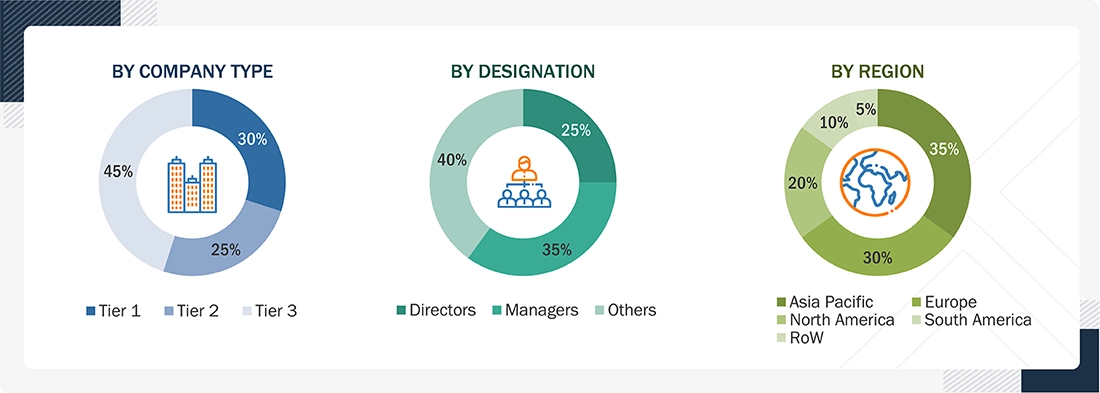
Note: The three tiers of companies are defined based on their total revenues in 2023 or 2024, as available financial data permits: Tier 1: Revenue > USD 1 billion; Tier 2: USD 100 million ≤ revenue ≤ USD 1 billion; Tier 3: Revenue < USD 100 million. RoW includes Africa and the Middle East.
To know about the assumptions considered for the study, download the pdf brochure
| COMPANY NAME | DESIGNATION | |
|---|---|---|
| Givaudan | Product Development Manager | |
| Flora & Fragrances International | Sales Manager | |
| RS Fragrances International Pvt. Ltd | Marketing Head | |
| Bell Flavors & Fragrances | Marketing Head | |
| Synthite Technologies | Senior Sales Manager | |
| Indesso Aroma | Business Development Manager | |
Market Size Estimation
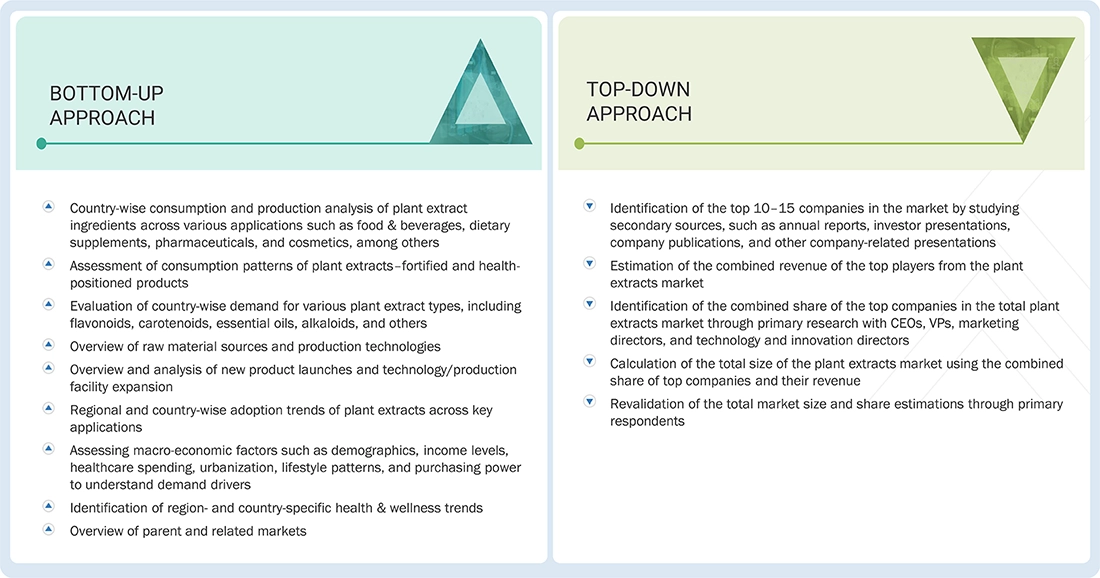
The top-down and bottom-up approaches were used to estimate and validate the total size of the plant extracts market. These approaches were also used extensively to determine the size of various subsegments in the market. The research methodology used to estimate the market size includes the following details:
- The key players in the industry and the overall markets were identified through extensive secondary research.
- All shares, splits, and breakdowns were determined using secondary sources and verified through primary sources.
- All possible parameters that affect the market covered in this research study were accounted for, viewed in extensive detail, verified through primary research, and analyzed to obtain final quantitative and qualitative data.
- The research included the study of reports, reviews, and newsletters of top market players, along with extensive interviews for opinions from leaders, such as CEOs, directors, and marketing executives.
Plant Extracts Market: Bottom-up and Top-down Approaches
Data Triangulation
After determining the overall market size from the estimation process explained above, the total market was split into several segments and subsegments. The data triangulation procedure was employed, wherever applicable, to estimate the overall plant extracts market and obtain precise statistics for all segments and subsegments. The data was triangulated by studying various factors and trends from the demand and supply sides. The market size was also validated using the top-down and bottom-up approaches.
Market Definition
A plant extract is a substance or an active ingredient with desirable properties; this extract is removed from the tissue of a plant, usually by treating it with a solvent, to be used for a particular purpose. Extracts may be used in various sectors of activity, including pharmaceuticals for their therapeutic properties, food & beverage products for their functional properties, and cosmetics with functional properties for beauty and well-being.
As defined by Alfa Chemistry, a plant extract is a substance or active substance of a desired property extracted from plant tissue by treatment for a specific purpose. Plant extracts can be used in a variety of areas, including health foods, therapeutic drugs, cosmetics, processing aids, additives, chemical alternatives, and so on.
Stakeholders
- Supply side: Plant extract producers, suppliers, distributors, importers, and exporters
- Demand side: Food & beverage manufacturers, cosmetics manufacturers, nutraceutical manufacturers, pharmaceutical industries, and dietary supplement manufacturers
- Regulatory bodies: Government agencies and Non-governmental Organizations (NGO)
- Commercial R&D institutions and financial institutions
-
Associations, regulatory bodies, and other industry-related bodies:
- Food and Drug Administration (FDA)
- United States Department of Agriculture (USDA)
- Herb Society of America
- American Herbal Products Association
- International Herb Association
- American Spice Trade Association
- European Spices Association
- Spices Board
- Essential Oil Association of India
- International Federation of Essential Oils and Aroma Trades
- European Flavors & Fragrances Association
Report Objectives
- To determine and project the size of the plant extracts market based on type, application, source, form, extraction process, and region, over five years, ranging from 2025 to 2030
- To identify the attractive opportunities in the market by determining the largest and fastest-growing segments across regions
- To provide detailed information about the key factors influencing market growth (drivers, restraints, opportunities, and challenges)
- To analyze the opportunities in the market for stakeholders and provide details of the competitive landscape for market leaders
- To analyze the micromarkets with respect to individual growth trends, prospects, and their contribution to the total market
- To identify and profile the key players in the market
- To understand the competitive landscape and identify the major growth strategies adopted by players across the key regions
Get the Full Plant Extracts Market Report
Full forecast, segment splits, and company analysis for all Plant Extracts Market.
- US Plant Extracts Market
- Canada Plant Extracts Market
- Mexico Plant Extracts Market
- Germany Plant Extracts Market
- UK Plant Extracts Market
- France Plant Extracts Market
- Italy Plant Extracts Market
- Spain Plant Extracts Market
- Russia Plant Extracts Market
- Poland Plant Extracts Market
- China Plant Extracts Market
- Japan Plant Extracts Market
- Singapore Plant Extracts Market
- Brazil Plant Extracts Market
- South Africa Plant Extracts Market
- Rest Of Europe Plant Extracts Market
Need a Tailored Report?
Customize this report to your needs
Get 10% FREE Customization
Customize This Report
