
Europe Plastic Compounds Market (2024-2029)

The Europe Plastic Compounds Market was valued at $15596.3 Million in 2024 and projected to reach to $21302.5 Million by 2029, representing a compound annual growth rate of 6.4%. Europe's plastic compounds market is poised for steady expansion through 2029, driven by increasing demand from automotive lightweighting initiatives and stringent environmental regulations promoting sustainable alternatives.


| Market Size in | USD 26.32 MN |
| Market Forecast in | |
| CAGR | |
| Forecast Period | |
| Units Considered | Value (USD MN) |
Europe Plastic Compounds Market Trends and Insights
- Europe maintains a significant position in the global plastic compounds landscape, driven by stringent regulatory frameworks, advanced manufacturing capabilities, and a strong emphasis on sustainable material innovation.
- The region's market growth is supported by increasing demand from automotive, packaging, and consumer goods sectors, where Europe continues to lead in adopting high-performance and eco-friendly plastic compound solutions. Throughout the forecast period from 2024 to 2029, Europe is expected to experience steady market expansion fueled by circular economy initiatives and investment in recycled plastic compounds.
- Europe's commitment to reducing carbon footprints and meeting EU sustainability directives is reshaping the competitive landscape, with manufacturers increasingly focusing on bio-based and recyclable formulations.
- The region's mature industrial base and technological expertise position Europe as a hub for innovation in specialty plastic compounds, supporting both domestic demand and export opportunities across adjacent markets..
Key Market Statistics
- CAGR (2024-2029) 6.4% CAGR
- Market Size, 2024 ~USD 15596.3 Million
- Forecast, 2029 ~USD 21302.5 Million
- Geography Europe
Europe Plastic Compounds Market Overview
Market Valuation & Growth :
Europe's plastic compounds market is valued at USD 15,596.3 million in 2024 and is projected to reach USD 21,302.5 million by 2029, demonstrating a robust CAGR of 6.4% over the forecast period.
Regulatory Leadership :
Europe leads globally in stringent regulatory frameworks governing plastic compounds, including EU directives on circular economy and single-use plastics, driving innovation in sustainable material development.
Sustainability Focus :
European manufacturers prioritize bio-based and recycled plastic compounds to meet environmental compliance standards, positioning the region as a hub for sustainable material innovation and green manufacturing practices.
Advanced Manufacturing Capabilities :
Europe maintains world-class manufacturing infrastructure and technological expertise in plastic compound production, supporting diverse end-use industries including automotive, packaging, and consumer goods.
Europe Plastic Compounds Market Dynamics
- The region's commitment to circular economy principles and investment in advanced manufacturing technologies will continue to support market growth.
- Key growth drivers include rising adoption of bio-based compounds, regulatory compliance requirements, and technological advancements in material science.
- However, market expansion will be tempered by raw material volatility and competitive pressures from emerging markets.
- European manufacturers are increasingly focusing on innovation in high-performance compounds to maintain competitive advantage while meeting evolving sustainability standards..
Market Ecosystem
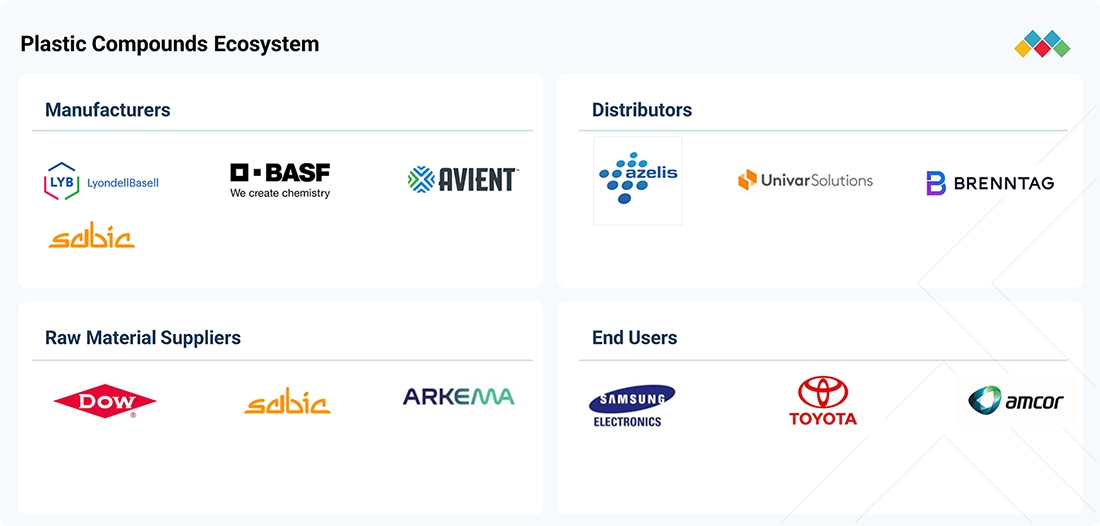
PLASTIC COMPOUNDS MARKET: COMMERCIAL USE CASES ACROSS INDUSTRIES
| COMPANY | USE CASE DESCRIPTION | BENEFITS |
|---|---|---|
 |
Provides engineering plastic compounds through portfolios such as Ultramid polyamide and Ultradur polybutylene terephthalate (PBT), used across automotive, electrical & electronics, consumer goods, construction, and industrial applications | High mechanical strength | Thermal stability | Dimensional stability | Electrical performance | Lightweighting |
 |
Provides polymer modification and compounding solutions, including specialty polymers, impact modifiers, and materials for polypropylene compounds, with applications across automotive, packaging, construction, electronics, and consumer products | Improved impact strength | Enhanced durability | Better processing | Lightweighting | Improved compatibility |
 |
Provides polyolefin resins and compounds based on polypropylene and polyethylene for injection molding, extrusion, films, packaging, automotive, electrical & electronics, consumer products, and building & construction applications | Improved stiffness | Impact resistance | Adhesion | Processability | Application-specific performance |
 |
Provides engineered thermoplastic compounds through its LNP portfolio, along with polypropylene compounds, PC/ABS, PBT, and other specialty materials for automotive, electrical & electronics, EV, and industrial applications | High thermal performance | Mechanical strength | Electrical performance | Lightweighting | Recycled and bio-based content options |
 |
Provides engineering plastics and polypropylene compounds, including LEONA polyamide, TENAC POM, XYRON modified PPE, and Thermylene polypropylene compounds for automotive, electrical & electronics, appliances, and industrial applications | Heat resistance | Strength and rigidity | Dimensional stability | Chemical resistance | Improved component durability |
Logos and trademarks shown above are the property of their respective owners. Their use here is for informational and illustrative purposes only.
Related Ecosystem
Resins And Polymers
- Polycarbonate
- Acrylonitrile Butadiene Styrene (ABS)
- Epoxy Resin
- Light Commercial Vehicles (LCVs)
- Polypropylene (PP)
- Basf se
- DOW CHEMICAL COMPANY
- Solvay sa
- Saudi arabia basic industries corporation (sabic)
- DuPont de Nemours, Inc.
Fibers And Composites
- Polyetheretherketone (PEEK)
- Polyphenylene Sulfide (PPS)
- Epoxy Resin
- Polycarbonate
- Polyester Resin
- Toray Industries, Inc.
- Teijin Limited
- Sgl carbon se
- Hexcel Corporation
- Solvay sa
Automotive Electronics And Electrical Equipment
- Battery Electric Vehicle (BEV)
- Light Commercial Vehicles (LCVs)
- Fuel Cell Electric Vehicle (FCEV)
- Sensors
- Hybrid Electric Vehicle (HEV)
- BOSCH LIMITED
- DENSO Corporation
- Continental ag
- Panasonic Holdings Corporation
- Texas Instruments Incorporated
Key Takeaways
- Europe's plastic compounds market will grow from USD 15.6 billion in 2024 to USD 21.3 billion by 2029 at a 6.4% CAGR.
- Europe leads in sustainable plastic compound innovation, driven by strict EU regulations and circular economy mandates.
- Automotive and packaging sectors are primary growth drivers for Europe's plastic compounds demand through 2029.
- Europe's advanced manufacturing infrastructure and R&D capabilities position it as a global innovation hub for specialty compounds.
Plastic Compounds Market Report Scope
| Report Metric | Details |
|---|---|
| Base Year | 2024 |
| Fastest Growing Segment | BIO-BASED (Source) |
| Forecast Period | 2024-2029 |
| Growth Rate | CAGR of 6.6% from 2024 to 2029 |
| Largest Segment | FOSSIL-BASED (Source) |
| Market Size Base Year (Billions) | ~USD 70.68 (2024) |
| Revenue Forecast (Billions) | ~USD 97.3 (2029) |
| Segments Covered | Product, Source, End-Use Industry |
Europe Plastic Compounds Market Report Segmentation
3 segment dimensions are covered across the global market.
By Product
- Acrylonitrile Butadiene Styrene
- Other Products
- Polyamide
- Polycarbonate
- Polyethylene
- Polyethylene Terephthalate
- Polypropylene
- Polystyrene
- Polyurethane
- Polyvinyl Chloride
By Source
- Bio-Based
- Fossil-Based
- Recycled
By End-Use Industry
- Automotive
- Building & Construction
- Consumer Goods
- Electrical & Electronics
- Medical
- Other Industries
- Packaging
- -Commercial
- -Commercial Vehicles
- -Industrial
- -Passenger Cars
- -Residential
EUROPE: PLASTIC COMPOUNDS MARKET, BY END-USE INDUSTRY, 2024–2029
| Segment | 2024 | 2025 | 2026 | 2027 | 2028 | 2029 | CAGR (%) |
|---|---|---|---|---|---|---|---|
| AUTOMOTIVE | 2333.6 | 2486.4 | 2652.2 | 2832.1 | 3027.6 | 3240.3 | 6.8 |
| BUILDING & CONSTRUCTION | 2927.8 | 3111.2 | 3309.8 | 3525 | 3758.6 | 4012.3 | 6.5 |
| CONSUMER GOODS | 1033.1 | 1093 | 1157.6 | 1227.4 | 1302.9 | 1384.7 | 6 |
| ELECTRICAL & ELECTRONICS | 1610.2 | 1705.9 | 1809.1 | 1920.8 | 2041.8 | 2172.9 | 6.2 |
| MEDICAL | 1159.9 | 1233.9 | 1314 | 1400.8 | 1495.2 | 1597.7 | 6.6 |
| OTHER INDUSTRIES | 2470 | 2625.1 | 2793 | 2975 | 3172.5 | 3387.1 | 6.5 |
| PACKAGING | 4061.6 | 4307 | 4572.2 | 4859.3 | 5170.3 | 5507.7 | 6.3 |
| –COMMERCIAL | 966.5 | 1028.2 | 1095.1 | 1167.7 | 1246.4 | 1332.1 | 6.6 |
| –COMMERCIAL VEHICLES | 372.2 | 397.8 | 425.6 | 455.9 | 488.9 | 524.9 | 7.1 |
| –INDUSTRIAL | 843.9 | 896 | 952.4 | 1013.4 | 1079.6 | 1151.5 | 6.4 |
| –PASSENGER CARS | 1961.4 | 2088.6 | 2226.5 | 2376.1 | 2538.6 | 2715.3 | 6.7 |
| –RESIDENTIAL | 1117.3 | 1186.9 | 1262.3 | 1343.9 | 1432.5 | 1528.7 | 6.5 |
| TOTAL | 15596.3 | 16562.4 | 17607.9 | 18740.5 | 19968.9 | 21302.5 | 6.4 |
Target Audience
- Plastic Compound Manufacturers : European and global manufacturers need detailed market intelligence to optimize production strategies, identify growth segments, and align product portfolios with regional regulatory requirements and sustainability trends.
- Automotive & Packaging Companies : End-use industry players require insights into material availability, pricing trends, and sustainable compound options to support lightweighting initiatives and meet environmental compliance standards.
- Investment & Private Equity Firms : Investors seeking European market opportunities need comprehensive data on market size, growth trajectories, and competitive dynamics to evaluate acquisition targets and investment viability.
- Chemical & Material Distributors : Distributors and supply chain partners require regional market forecasts and country-level data to optimize inventory management, identify emerging demand centers, and plan distribution network expansion.
- Policy Makers & Regulatory Bodies : Government agencies and regulatory organizations need market intelligence to inform policy development, assess industry compliance trends, and evaluate the effectiveness of sustainability initiatives.
Countries within Europe - compare and drill down
| Country | 2025 size (native) |
|---|---|
| Germany | USD 5943.4 Million |
| France | USD 2385.9 Million |
| UK | USD 1853.3 Million |
| Italy | USD 3727.9 Million |
| Spain | USD 1981.1 Million |
| Rest Of Europe | USD 5410.8 Million |
Country market size visualization
Reasons to Buy this Report
- Regional Market Insights : Gain detailed understanding of Europe's plastic compounds market dynamics, including country-level breakdowns for Germany, France, Italy, UK, Spain, and Rest of Europe to identify high-growth opportunities.
- Regulatory Compliance Intelligence : Access comprehensive analysis of European regulatory frameworks and compliance requirements shaping the plastic compounds market, enabling strategic alignment with evolving environmental standards.
- Competitive Landscape Analysis : Understand competitive positioning of European manufacturers and identify market consolidation trends, technological innovations, and strategic partnerships driving market evolution.
- Sustainability & Innovation Trends : Explore emerging trends in bio-based and recycled plastic compounds across Europe, including investment patterns and technological breakthroughs in sustainable material development.
- Strategic Growth Planning : Leverage accurate market forecasts and growth projections through 2029 to inform investment decisions, product development strategies, and market entry or expansion plans in Europe.
Frequently asked questions
What is the current size of Europe's plastic compounds market?
Europe's plastic compounds market is valued at USD 15,596.3 million in 2024 and is expected to reach USD 21,302.5 million by 2029.
What is the projected growth rate for Europe's plastic compounds market?
Europe's plastic compounds market is projected to grow at a compound annual growth rate (CAGR) of 6.4% from 2024 to 2029.
Which industries drive demand for plastic compounds in Europe?
Europe's plastic compounds demand is primarily driven by automotive, packaging, consumer goods, and electronics sectors seeking high-performance and sustainable material solutions.
How are EU regulations impacting Europe's plastic compounds market?
EU sustainability directives and circular economy initiatives are pushing Europe's manufacturers toward bio-based and recyclable plastic compounds, reshaping product portfolios and competitive strategies.
What competitive advantages does Europe hold in plastic compounds?
Europe's mature industrial base, advanced manufacturing infrastructure, strong R&D capabilities, and commitment to innovation in sustainable materials position it as a global leader in specialty plastic compounds.
RESEARCH METHODOLOGY
The study involved four major activities to estimate the current size of the global plastic compounds market. Exhaustive secondary research was conducted to collect information on the market, the peer product market, and the parent product group market. The next step was to validate these findings, assumptions, and sizes with industry experts across the plastic compounds value chain through primary research. The top-down and bottom-up approaches were employed to estimate the overall size of the plastic compounds market. After that, market breakdown and data triangulation procedures were used to determine the size of different segments and sub-segments of the market.
Secondary Research
The market for companies offering plastic compounds was estimated using secondary data from paid and unpaid sources, analyzing the product portfolios of the major companies in the ecosystem, and rating the companies by their performance and quality. Secondary sources such as Business Standard, Bloomberg, World Bank, and Factiva were consulted to identify and collect information for this study on the plastic compounds market. These sources included annual reports, press releases, and investor presentations from door vendors, forums, certified publications, and whitepapers. The secondary research was used to obtain critical information on the industry’s value chain, the total pool of key players, market classification, and segmentation from both market and technology-oriented perspectives.
Primary Research
In the primary research process, various primary sources from both the supply and demand sides were interviewed to obtain qualitative and quantitative information for this report. The primary sources from the supply side included industry experts, such as Chief Executive Officers (CEOs), Vice Presidents (VPs), marketing directors, technology and innovation directors, and related key executives from several key companies and organizations operating in the Plastic compounds market. After the complete market engineering (calculations for market statistics, market breakdown, market size estimates, market forecasting, and data triangulation), extensive primary research was conducted to gather information and verify and validate the critical numbers arrived at. Primary research was also conducted to identify the segmentation types, industry trends, the competitive landscape of Plastic compounds offered by various market players, and key market dynamics, such as drivers, restraints, opportunities, challenges, and key player strategies. In the complete market engineering process, the top-down and bottom-up approaches and several data triangulation methods were extensively used to perform market estimation and market forecasting for the overall market segments and subsegments listed in this report. Extensive qualitative and quantitative analysis was performed throughout the complete market engineering process to list the key information/insights throughout the report.
Following is the breakdown of primary respondents:
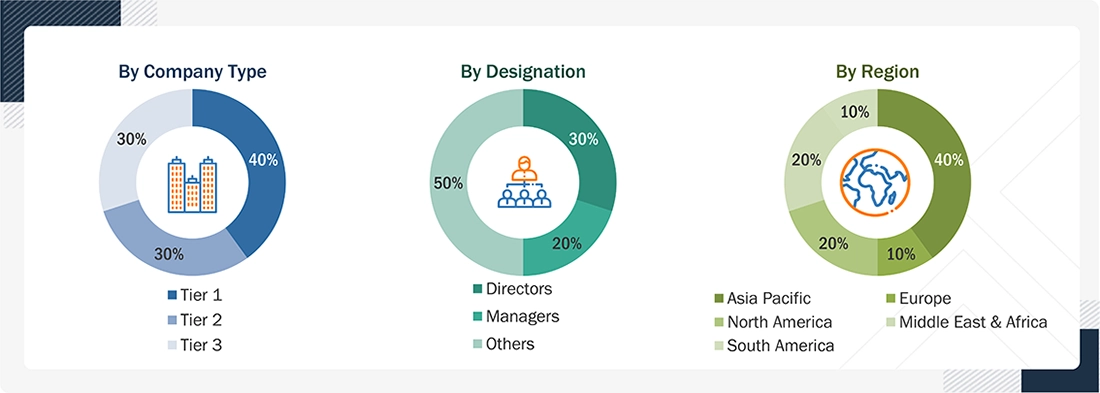
Notes: Other designations include sales, marketing, and product managers.
Tier 1: >USD 1 Billion; Tier 2: USD 500 million–1 Billion; and Tier 3: <USD 500 million.
To know about the assumptions considered for the study, download the pdf brochure
Market Size Estimation
The top-down and bottom-up approaches were used to estimate and validate the size of the global plastic compounds market. These approaches were also used extensively to estimate the size of various dependent market segments. The research methodology for estimating market size included the following:
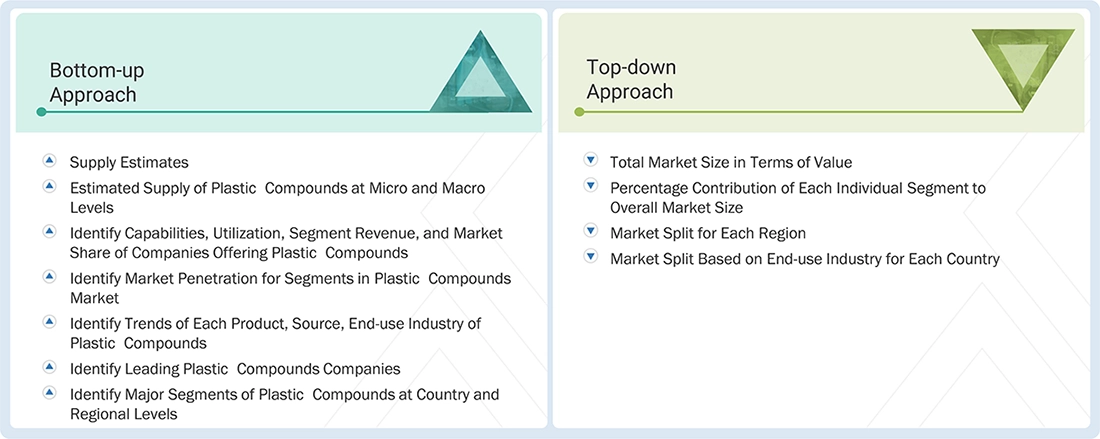
Data Triangulation
After determining the overall market size using market size estimation processes, the market was segmented into several segments and subsegments. Data triangulation and market breakup procedures were employed, wherever applicable, to complete the overall market engineering process and arrive at the exact statistics for each market segment and subsegment. The data was triangulated by analyzing various factors and trends from both the demand and supply sides.
Market Definition
Plastic compounds are formulated polymer materials created by combining base polymer resins with a variety of additives, fillers, reinforcement modifiers, pigments, and stabilizers to provide specific performance characteristics for various industrial and commercial uses. Functional properties of plastic compounds include improved mechanical, thermal, and chemical performance, impact resistance, dimensional stability, flame retardancy, durability, processability, and lightweight. Plastic compounds are classified by polymer composition into polyvinyl chloride (PVC), polypropylene (PP), polyethylene (PE), polystyrene (PS), polyamide (PA), polycarbonate (PC), polyethylene terephthalate (PET), polyurethane (PU), and acrylonitrile butadiene styrene (ABS). Based on raw material source, plastic compounds include fossil-based, bio-based, recycled, and so on. Different types of compounds have different formulations based on application requirements, available production facilities and manufacturing equipment, but they mainly depend on the optimized use of polymer composition, additive system, filler and reinforcement contents, and process conditions. The main application areas include automotive, packaging, electrical and electronics, building and construction, consumer goods, and medical, among others, driven by increasing demand for lightweight, durable, high-performance, and eco-friendly materials.
Key Stakeholders
- Plastic compound manufacturers
- Raw material and chemical suppliers
- Additive, filler, and reinforcement suppliers
- Distributors and plastic material suppliers
- End-use industries and industrial customers
- Regulatory bodies and industry associations
- Research and development (R&D) institutions
- Recyclers and recycled material suppliers
Report Objectives
- To define, describe, and forecast the size of the global plastic compounds market, based on product, source, end-use industry, and region in terms of value
- To provide detailed information on the significant drivers, restraints, opportunities, and challenges influencing the market
- To strategically analyze micro markets concerning individual growth trends, prospects, and their contribution to the market
- To assess the growth opportunities in the market for stakeholders and provide details on the competitive landscape for market leaders
- To forecast the market size of segments and subsegments for North America, Europe, Asia Pacific, South America, and the Middle East & Africa
- To strategically profile key players and comprehensively analyze their market shares and core competencies
- To analyze competitive developments such as product launches, acquisitions, expansions, partnerships, and agreements in the plastic compounds market
- To provide the impact of AI/Gen AI on the market
Available customizations:
With the given market data, MarketsandMarkets offers customizations according to client-specific needs.
The following customization options are available for the plastic compounds market report:
Product Analysis
- A product matrix that gives a detailed comparison of the product portfolio of each company
Regional Analysis
- A further breakdown of the plastic compounds market for additional countries
Company Information
- Detailed analysis and profiling of additional market players (up to five)
Get the Full Plastic Compounds Market Report
Full forecast, segment splits, and company analysis for all Plastic Compounds Market.
- Rest Of Asia Pacific Plastic Compounds Market
- GCC Countries Plastic Compounds Market
- -Rest Of GCC Plastic Compounds Market
- Rest Of South America Plastic Compounds Market
- US Plastic Compounds Market
- Canada Plastic Compounds Market
- Mexico Plastic Compounds Market
- Germany Plastic Compounds Market
- France Plastic Compounds Market
- UK Plastic Compounds Market
- Italy Plastic Compounds Market
- Spain Plastic Compounds Market
- China Plastic Compounds Market
- India Plastic Compounds Market
- Japan Plastic Compounds Market
- South Korea Plastic Compounds Market
- Malaysia Plastic Compounds Market
- Philippines Plastic Compounds Market
- Thailand Plastic Compounds Market
- Indonesia Plastic Compounds Market
- Australia Plastic Compounds Market
- South Africa Plastic Compounds Market
- Brazil Plastic Compounds Market
- Argentina Plastic Compounds Market
- Rest Of Europe Plastic Compounds Market
Need a Tailored Report?
Customize this report to your needs
Get 10% FREE Customization
Customize This Report
