
US Plywood Market (2025-2030)

The US Plywood Market was valued at $12.74 Million in 2025 and projected to reach to $13.66 Million by 2030, representing a compound annual growth rate of CAGR 1.4%. The US plywood market is positioned for steady, predictable growth through 2030, driven by consistent demand from the construction and furniture manufacturing sectors.


| Market Size in | USD 26.32 MN |
| Market Forecast in | |
| CAGR | |
| Forecast Period | |
| Units Considered | Value (USD MN) |
US Plywood Market Trends and Insights
- The US market reflects moderate expansion driven by steady demand from the construction and furniture manufacturing sectors.
- Despite global plywood markets experiencing a 4.21% CAGR, the US demonstrates more conservative growth patterns, influenced by mature market conditions and established supply chains. In 2025, the US plywood market maintains its position as a significant segment within North America's broader materials industry.
- The forecast period through 2030 indicates that the US will continue to experience incremental growth, with market expansion supported by residential construction activity and renovation projects.
- The US plywood sector benefits from established distribution networks and technological advancements in manufacturing, though growth remains tempered compared to emerging markets globally..
Key Market Statistics
- CAGR (2025-2030) CAGR 1.4%
- Market Size, 2025 ~USD 12.74 Million
- Forecast, 2030 ~USD 13.66 Million
- Country US
US Plywood Market Overview
Market Size & Growth :
The US plywood market is valued at $12.74 billion in 2025 and is expected to reach $13.66 billion by 2030, with a steady CAGR of 1.4%, indicating stable but moderate market expansion.
Construction Sector Demand :
US construction and residential building activities remain primary drivers of plywood consumption, with steady demand from housing renovation, commercial construction, and infrastructure projects supporting market growth.
Conservative Growth vs. Global Trends :
While the global plywood market grows at 4.21% CAGR, the US market demonstrates more conservative expansion at 1.4%, reflecting market maturity and saturation in developed construction segments.
Furniture & Manufacturing Applications :
Beyond construction, US furniture manufacturing and interior design sectors continue to drive plywood demand, with steady consumption from both residential and commercial furniture producers.
US Plywood Market Dynamics
- The 1.4% CAGR reflects a mature market with established supply chains and stable consumer preferences.
- Housing renovation projects, commercial construction initiatives, and ongoing infrastructure development will sustain demand across residential and industrial applications. Market maturity in the US suggests limited disruptive growth opportunities compared to emerging markets, but stability presents reliable investment potential.
- Sustainability trends and engineered wood alternatives may influence market dynamics, while domestic production capacity and import competition will shape competitive landscapes.
- Strategic focus on value-added products and niche applications may unlock incremental growth opportunities within this stable market environment..
Market Ecosystem
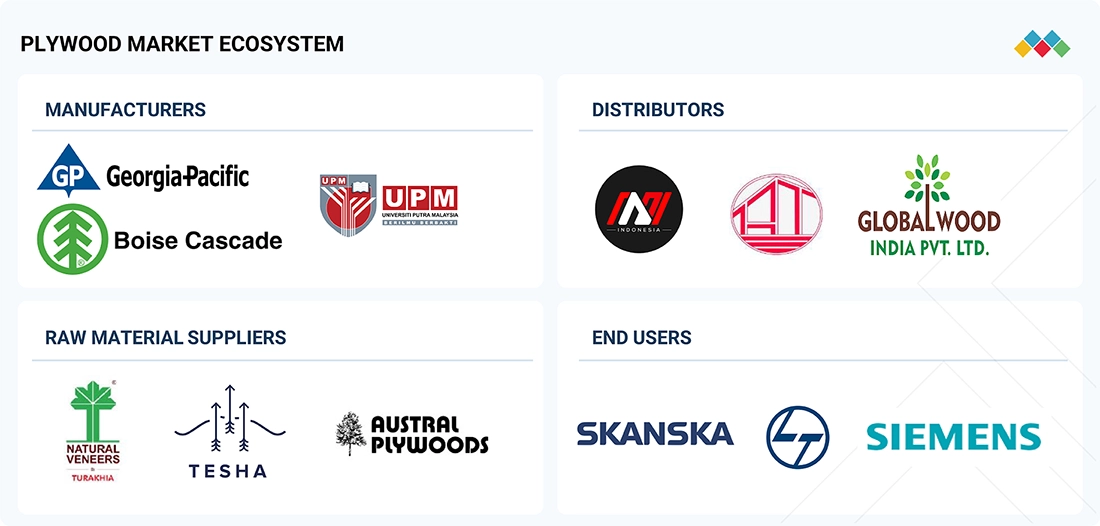
Plywood Market: COMMERCIAL USE CASES ACROSS INDUSTRIES
| COMPANY | USE CASE DESCRIPTION | BENEFITS |
|---|---|---|
 |
Uses plywood for manufacturing affordable, lightweight, and durable furniture, cabinets, and home décor products across global retail outlets. | Enables cost-effective mass production, supports sustainable sourcing, enhances product durability, reduces waste, and ensures design flexibility for modern, modular furniture. |
 |
Utilizes plywood in automotive interiors, flooring panels, and transport crates for components. | Reduces vehicle weight, improves noise insulation, enhances strength, supports eco-friendly materials usage, and lowers logistics costs through reusable transport solutions. |
 |
Uses plywood in construction, formwork, and interior infrastructure for residential and commercial projects. | Provides structural stability, reusability in formwork, smooth finishes, and cost efficiency, while reducing material waste in large-scale infrastructure projects. |
 |
Employs plywood in manufacturing durable packaging and base panels for appliances. | Ensures safe appliance transport, enhances product protection, reduces packaging costs, and aligns with eco-friendly packaging practices. |
 |
Uses plywood for interior furnishings, wall paneling, and modular furniture across hotels worldwide. | Offers premium aesthetics, longevity, acoustic comfort, and sustainability, while supporting consistent design standards across global hospitality properties. |
Logos and trademarks shown above are the property of their respective owners. Their use here is for informational and illustrative purposes only.
Related Ecosystem
Bulk Chemicals And Inorganics
- Corrosion Inhibitors
- Glycol Ethers
- Acetic Acid
- Acetone
- Ammonium Nitrate
- Basf se
- DOW CHEMICAL COMPANY
- Exxon Mobil Corporation
- AZELIS HOLDINGS SA
- Sinopec limited
Building And Construction
- HVAC System
- Acoustic Insulation
- Alkyd Resins
- Fiberglass
- Thermal Insulation
- Snc-lavalin group inc.
- Saint-gobain
- LHOIST S.A
- USG CORPORATION
- Basf se
Key Takeaways
- The US plywood market is valued at $12.74 billion in 2025 with projected growth to $13.66 billion by 2030.
- The US market exhibits a 1.4% CAGR, reflecting slower growth compared to the global 4.21% CAGR due to market maturity.
- US demand is primarily driven by residential construction, renovation projects, and furniture manufacturing sectors.
- The US plywood market benefits from established infrastructure and technological capabilities, supporting steady but moderate expansion.
Plywood Market Report Scope
| Report Metric | Details |
|---|---|
| Base Year | 2025 |
| Fastest Growing Segment | –TRANSPORT EQUIPMENT (Application) |
| Forecast Period | 2025–2030 |
| Growth Rate | CAGR of 4.21% from 2025 to 2030 |
| Largest Segment | CONSTRUCTION (Application) |
| Market Size Base Year (Billions) | ~USD 49.07 (2025) |
| Revenue Forecast (Billions) | ~USD 60.31 (2030) |
| Segments Covered | Type, Use Type, Application |
US Plywood Market Report Segmentation
3 segment dimensions are covered across the global market.
By Type
- Hardwood
- Softwood
By Use Type
- Industrial
- New Construction
- Rehabilitation
By Application
- Construction
- Industrial
- –Finish Flooring
- –Material Handling Products
- –Other Construction Applications
- –Other Industrial Applications
- –Roofing
- –Sliding
- –Subflooring
- –Transport Equipment
- –Wall Sheathing
Target Audience
- Construction & Building Companies : US construction firms need market data to forecast plywood demand, plan procurement strategies, and understand competitive dynamics within residential and commercial building projects.
- Furniture Manufacturers : Domestic furniture producers require insights into plywood supply trends, pricing forecasts, and market growth patterns to optimize production planning and material sourcing decisions.
- Investment & Private Equity Firms : Investors evaluating plywood industry opportunities in the US need accurate market sizing, growth projections, and sector analysis to assess investment viability and portfolio positioning.
- Plywood Distributors & Retailers : Distribution networks and retail chains need market forecasts to manage inventory levels, anticipate demand fluctuations, and develop effective sales strategies for US regional markets.
- Raw Material & Forest Product Companies : Timber and wood product suppliers require US-specific market intelligence to align production capacity, forecast raw material demand, and identify growth opportunities in domestic plywood markets.
Key Companies in the US Plywood Market
| Company | HQ | Ownership | Strongest segments |
|---|---|---|---|
| KODIAK | United States | Public Company | Softwood plywood logistics,Hardwood plywood logistics,Construction plywood (all types), |
| GEORGIA-PACIFIC | United States | Private Company | Softwood plywood,Hardwood plywood,Construction applications, |
| BOISE CASCADE COMPANY | United States | Public Company | Softwood Plywood – Construction,Softwood Plywood – Industrial,Hardwood Plywood – Construction/Interior, |
| WEYERHAEUSER COMPANY | United States | Public Investment Firm | Softwood Plywood – Construction,Softwood Plywood – Industrial,Hardwood Plywood – Construction/Interior, |
| UPM | Finland | Public Company | Hardwood/Birch Plywood – Construction Applications,Hardwood/Birch Plywood – Industrial & Vehicle Flooring,Softwood Plywood – Construction (New Build), |
| POTLATCHDELTIC CORPORATION | United States | Private Investment Firm | Softwood Plywood - Construction Applications,Softwood Plywood - Industrial Applications,Hardwood Plywood - Construction and Interior Uses, |
| GREENPLY INDUSTRIES LIMITED | India | Public Company | Hardwood plywood (construction and interiors),Softwood and specialty plywood (industrial and niche),MDF (Greenply MDF) and allied panels, |
| METSä GROUP | Finland | Private Company | Softwood plywood,Hardwood (birch) plywood,Construction applications (all types), |
| CENTURYPLY | India | Public Company | Hardwood plywood & blockboard,Softwood / structural plywood,MDF & pre-laminated boards, |
KODIAK
Kodiak is a United States-based public company founded in 2018 with 342 employees.
GEORGIA-PACIFIC
Georgia-Pacific is a private company established in 1927 in the United States and operates with 55,000 employees.
BOISE CASCADE COMPANY
Boise Cascade Company is a United States-based public company founded in 1957.
WEYERHAEUSER COMPANY
Weyerhaeuser Company is a public investment firm founded in 1900 in the United States with 9,517 employees.
UPM
UPM is a Finnish public company founded in 1871 and employs 13,665 people.
POTLATCHDELTIC CORPORATION
PotlatchDeltic Corporation is a private investment firm founded in 1903 in the United States with 1,383 employees.
GREENPLY INDUSTRIES LIMITED
Greenply Industries Limited is an Indian public company founded in 1984 with 2,649 employees.
METSä GROUP
Metsä Group is a private Finnish company established in 1947 and employs 8,767 people.
CENTURYPLY
CenturyPly is an Indian public company founded in 1982 with 7,396 employees.
Reasons to Buy this Report
- Accurate Market Sizing : Obtain precise valuation data for the US plywood market with verified figures for 2025 ($12.74B) and 2030 projections ($13.66B), enabling accurate financial planning and investment decisions.
- Sector-Specific Insights : Understand demand drivers specific to US construction and furniture manufacturing sectors, identifying growth opportunities and market gaps within domestic applications and end-user segments.
- Competitive Benchmarking : Compare US market performance against global trends (4.21% CAGR vs. 1.4% US CAGR) to assess competitive positioning, market maturity levels, and strategic differentiation opportunities.
- 5-Year Forecast Planning : Leverage detailed growth projections through 2030 to develop long-term business strategies, capacity planning, and resource allocation aligned with realistic US market expansion rates.
- Risk & Opportunity Assessment : Identify market stability factors and growth constraints specific to the US, enabling informed risk mitigation strategies and targeted investment in high-potential market segments.
Frequently asked questions
What is the current size of the US plywood market in 2025?
The US plywood market is estimated at $12.74 billion in 2025, representing a significant segment of the North American materials industry.
What is the projected size of the US plywood market by 2030?
The US plywood market is forecast to reach $13.66 billion by 2030, reflecting a 1.4% compound annual growth rate over the five-year period.
How does the US plywood market growth compare to global trends?
The US market grows at 1.4% CAGR, significantly slower than the global plywood market's 4.21% CAGR, indicating a more mature and stable market environment in the US.
What are the primary drivers of growth in the US plywood market?
The US plywood market is primarily driven by residential construction activity, home renovation projects, and demand from the furniture manufacturing sector.
Why is the US plywood market growing slower than global markets?
The US plywood market's slower growth reflects market maturity, established supply chains, and saturation in developed regions, contrasting with faster expansion in emerging markets globally.
RESEARCH METHODOLOGY
The study involved four major activities in estimating the market size of the plywood market. Exhaustive secondary research was done to collect information on the market, the peer market, and the parent market. The next step was to validate these findings, assumptions, and sizing with industry experts across the value chain through primary research. Both top-down and bottom-up approaches were employed to estimate the complete market size. After that, the market breakdown and data triangulation procedures were used to estimate the market size of the segments and subsegments.
Secondary Research
Secondary sources used in this study included annual reports, press releases, and investor presentations of companies; white papers; certified publications; articles from recognized authors; and gold standard & silver standard websites such as Factiva, ICIS, Bloomberg, and others. The findings of this study were verified through primary research by conducting extensive interviews with key officials such as CEOs, VPs, directors, and other executives. The breakdown of the profiles of the primary interviewees is illustrated in the figure below.
Primary Research
The plywood market comprises several stakeholders, such as raw material suppliers, end-product manufacturers, and regulatory organizations in the supply chain. The demand side of this market is characterized by key opinion leaders in various applications for the plywood market. The supply side is characterized by advancements in technology and diverse application industries. Various primary sources from both the supply and demand sides of the market were interviewed to obtain qualitative and quantitative information.
Breakdown of Primary Participants
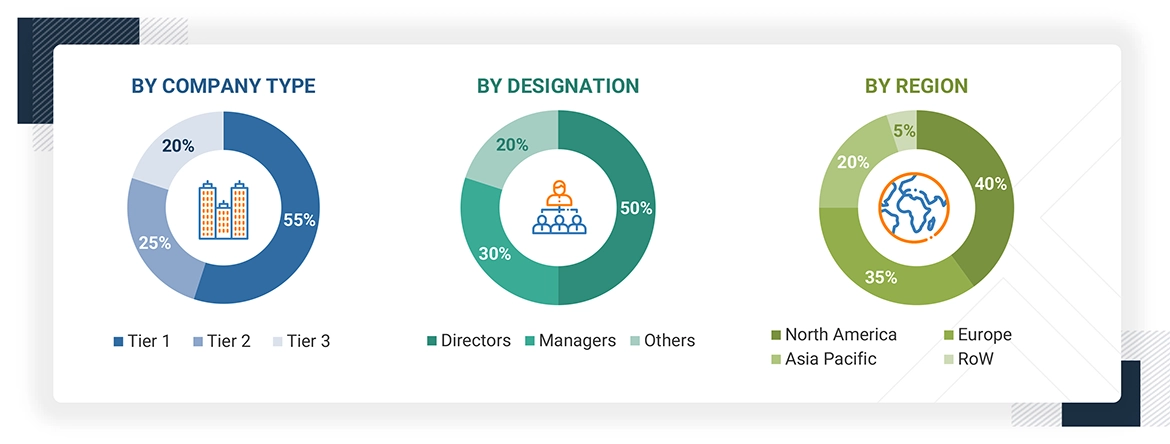
Note: Tier 1, Tier 2, and Tier 3 companies are classified based on their market revenue in 2023/2024, which is available in the public domain, product portfolios, and geographical presence.
Other designations include consultants and sales, marketing, and procurement managers.
To know about the assumptions considered for the study, download the pdf brochure
| COMPANY NAME | DESIGNATION | |
|---|---|---|
| Georgia-Pacific | Senior Manager | |
| Boise Cascade | Innovation Manager | |
| Weyerhaeuser Company | Vice President | |
| UPM | Production Supervisor | |
| SVEZA Group | Sales Manager | |
Market Size Estimation
Both top-down and bottom-up approaches were used to estimate and validate the total size of the plywood market. These methods were also used extensively to estimate the size of various subsegments in the market. The research methodology used to estimate the market size includes the following:
- The key players in the industry have been identified through extensive secondary research
- The supply chain of the industry has been determined through primary and secondary research
- All percentage shares, splits, and breakdowns have been determined using secondary sources and verified through primary sources
- All possible parameters that affect the markets covered in this research study have been accounted for, viewed in extensive detail, verified through primary research, and analyzed to obtain the final quantitative and qualitative data
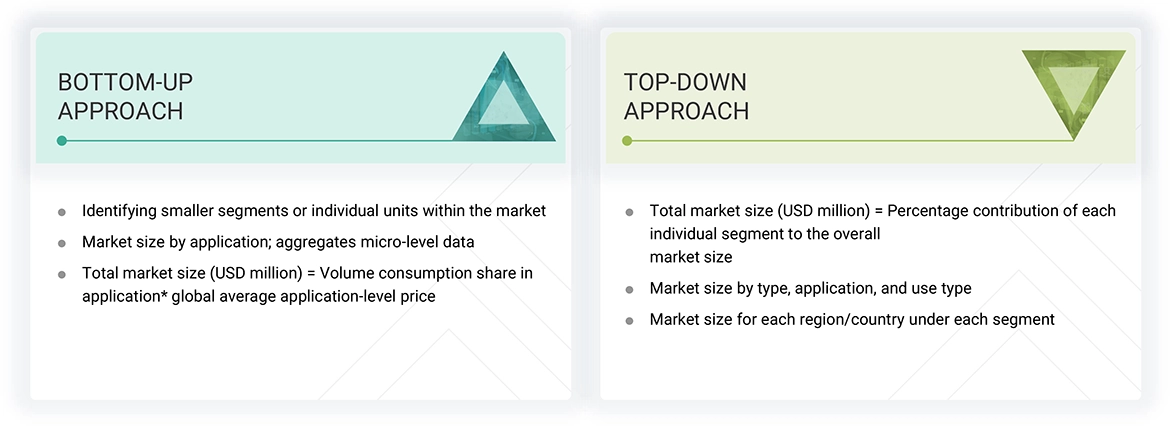
Data Triangulation
After arriving at the overall market size—using the market size estimation processes as explained above—the market was split into several segments and subsegments. To complete the overall market engineering process and arrive at the exact statistics of each market segment and subsegment, data triangulation and market breakdown procedures were employed, wherever applicable. The data was triangulated by studying various factors and trends from both the demand and supply sides in the plywood industry.
Market Definition
According to the Food and Agriculture Organization (FAO), “Plywood is a thin layer or sheets of wood of uniform thickness, usually 5 mm or less in thickness, usually peeled or sliced. The veneer sheets are glued together with adhesives in a way that each layer is perpendicular to the adjacent layer.
Stakeholders
- Plywood Manufacturers, Dealers, and Suppliers
- Plywood Developers and Service Providers
- Veneer and Other Material Dealers
- Large Infrastructure/Architecture Companies
- Consulting Companies in the Timber, Hardwood, Architecture, and Furniture Industries
- Plywood Associations
- United Nations Economic Commission for Europe
- Environmental Protection Agency
Report Objectives
- To analyze and forecast the plywood market in terms of value and volume
- To provide detailed information about the key factors (drivers, restraints, opportunities, and challenges) influencing market growth
- To define, segment, and project the size of the global plywood market based on type, application, and use type
- To project the market size for the five main regions: North America, Europe, Asia Pacific, the Middle East & Africa, and South America, with their key countries
- To analyze the micromarkets concerning individual growth trends, prospects, and their contribution to the overall market
- To analyze opportunities in the market for stakeholders and provide a competitive landscape of the market leaders
- To track and analyze R&D and competitive developments such as expansions, product launches, collaborations, investments, partnerships, agreements, and mergers & acquisitions in the plywood market
Get the Full Plywood Market Report
Full forecast, segment splits, and company analysis for all Plywood Market.
- Canada Plywood Market
- Mexico Plywood Market
- Germany Plywood Market
- UK Plywood Market
- France Plywood Market
- Spain Plywood Market
- Italy Plywood Market
- Russia Plywood Market
- Finland Plywood Market
- Netherlands Plywood Market
- Turkey Plywood Market
- Rest Of Europe Plywood Market
- China Plywood Market
- Japan Plywood Market
- India Plywood Market
- South Korea Plywood Market
- Indonesia Plywood Market
- Thailand Plywood Market
- Vietnam Plywood Market
- Malaysia Plywood Market
- Philippines Plywood Market
- Rest Of Asia Pacific Plywood Market
- Saudi Arabia Plywood Market
- UAE Plywood Market
- Iran Plywood Market
- Brazil Plywood Market
- Argentina Plywood Market
- Chile Plywood Market
- Rest Of South America Plywood Market
Need a Tailored Report?
Customize this report to your needs
Get 10% FREE Customization
Customize This Report
