
Japan Polybutylene Adipate Terephthalate Market (2025-2030)

The Japan Polybutylene Adipate Terephthalate Market was valued at $82.1 Million in 2025 and projected to reach to $133.64 Million by 2030, representing a compound annual growth rate of 10.2%. Japan's PBAT market is poised for steady expansion driven by stringent environmental regulations and corporate sustainability commitments.


| Market Size in | USD 26.32 MN |
| Market Forecast in | |
| CAGR | |
| Forecast Period | |
| Units Considered | Value (USD MN) |
Japan Polybutylene Adipate Terephthalate Market Trends and Insights
- Japan's advanced manufacturing capabilities and strong emphasis on sustainable materials are driving adoption of PBAT across packaging, textiles, and automotive applications.
- The market in Japan benefits from stringent environmental regulations and consumer demand for biodegradable polymers, positioning the country as a key player in Asia Pacific's circular economy transition. Japan's PBAT market growth is underpinned by increasing investments in green chemistry and biopolymer infrastructure.
- Japan's leading chemical manufacturers are expanding production capacity to meet rising demand from food packaging and single-use plastic alternatives.
- The forecast period through 2030 reflects Japan's commitment to reducing carbon footprint and achieving sustainability targets, with PBAT emerging as a critical material in Japan's shift toward eco-friendly industrial solutions..
Key Market Statistics
- CAGR (2025-2030) 10.2% CAGR
- Market Size, 2025 ~USD 82.1 Million
- Forecast, 2030 ~USD 133.64 Million
- Country Japan
Japan Polybutylene Adipate Terephthalate Market Overview
Market Size & Growth :
Japan's PBAT market is valued at USD 82.1 million in 2025, with a projected CAGR of 10.2% through 2030, reaching USD 133.64 million. This growth outpaces many developed markets due to Japan's commitment to circular economy principles.
Manufacturing Excellence :
Japan's advanced manufacturing infrastructure and precision engineering capabilities position it as a leader in PBAT production quality. Local manufacturers leverage cutting-edge technology to produce high-performance biodegradable polymers for demanding applications.
Sustainability Focus :
Strong regulatory support and consumer demand for eco-friendly materials drive PBAT adoption across Japan. Government initiatives promoting biodegradable plastics and carbon neutrality goals accelerate market penetration in packaging and consumer goods sectors.
Application Diversification :
PBAT adoption in Japan spans packaging, textiles, automotive components, and agricultural films. The automotive sector particularly benefits from PBAT's lightweight properties, supporting Japan's vehicle efficiency and emissions reduction targets.
Japan Polybutylene Adipate Terephthalate Market Dynamics
- The nation's advanced manufacturing ecosystem enables rapid commercialization of innovative PBAT applications, particularly in premium packaging and automotive sectors.
- Increasing collaboration between chemical manufacturers and end-users accelerates product development cycles. The market will benefit from Japan's leadership in biodegradable material research and development.
- Rising consumer awareness of plastic waste and government incentives for sustainable materials adoption will sustain demand through 2030.
- However, competition from alternative bio-based polymers and price volatility of raw materials may moderate growth rates in specific segments..
Market Ecosystem
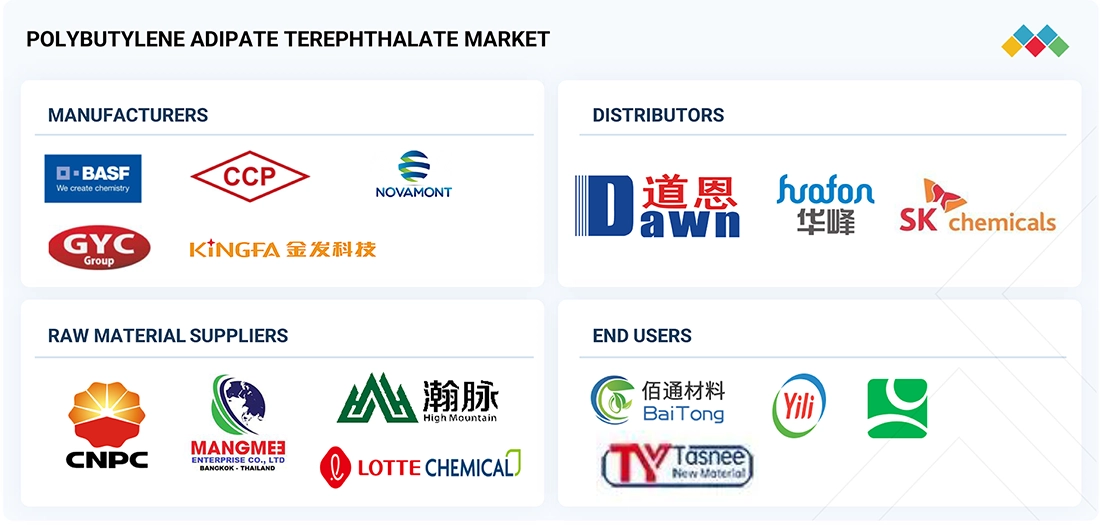
Polybutylene Adipate Terephthalate Market: COMMERCIAL USE CASES ACROSS INDUSTRIES
| COMPANY | USE CASE DESCRIPTION | BENEFITS |
|---|---|---|
 |
Novamont S.p.A. develops PBAT-based biopolymers under its Mater-Bi brand for use in compostable shopping bags, food packaging films, and agricultural mulch films. | Offers full biodegradability in industrial composting, reduces plastic waste, and supports circular economy and sustainability goals. |
 |
Anhui Jumei Biological Technology Co., Ltd. manufactures cost-effective PBAT resins for flexible packaging, single-use products, and agricultural applications. | Enables large-scale substitution of traditional plastics, ensures compostability, and reduces carbon footprint through bio-based raw material sourcing. |
 |
BASF SE produces PBAT under the ecoflex brand, used in blends for compostable films, coatings, and packaging materials. | Provides high mechanical performance, processability, and compatibility with PLA and starch-based polymers, supporting sustainable packaging solutions. |
 |
Kingfa Sci. & Tech. Co., Ltd. offers PBAT compounds optimized for film extrusion and 3D printing applications in biodegradable packaging and consumer goods. | Combines flexibility and strength with biodegradability, promotes eco-friendly product design, and reduces dependency on fossil-based plastics. |
Logos and trademarks shown above are the property of their respective owners. Their use here is for informational and illustrative purposes only.
Related Ecosystem
Agricultural Biologicals
- Bionematicides
- Auxins
- Cytokinins
- Ethylene
- Humic Substances
- NICHINO INDIA PVT LTD.
- Corteva, Inc.
- Basf se
- AZELIS HOLDINGS SA
- BAYER AG
Adhesives And Sealants
- Alkyd Resins
- Polyurethane Resin
- Epoxy Resin
- Polyester Resin
- Polyolefin
- 3M COMPANY
- Henkel ag and co. kgaa
- H.B. Fuller Company
- Sika ag
- DOW CHEMICAL COMPANY
Green Bio Chemicals
- Animal-Based Sealants
- Bacterial Fermentation
- Corrosion Inhibitors
- Hydrogen Peroxide
- Nitrile Butadiene Rubber (NBR)
- Basf se
- Evonik industries ag
- Solvay sa
- AZELIS HOLDINGS SA
- CARGILL, INCORPORATED
Key Takeaways
- Japan's PBAT market is valued at USD 82.1 million in 2025 and will grow to USD 133.64 million by 2030 at a 10.2% CAGR.
- Japan's stringent environmental regulations and consumer preference for biodegradable materials are primary growth catalysts for PBAT adoption.
- Japan's advanced manufacturing sector and chemical industry leadership position the country as a regional hub for sustainable polymer innovation.
- Japan's packaging and food service industries are the largest end-use segments driving PBAT demand through 2030.
Polybutylene Adipate Terephthalate Market Report Scope
| Report Metric | Details |
|---|---|
| Base Year | 2025 |
| Fastest Growing Segment | -MULCH FILMS (End-Use Industry) |
| Forecast Period | 2025-2030 |
| Growth Rate | CAGR of 12.8% from 2025 to 2030 |
| Largest Segment | EXTRUSION GRADE (Grade) |
| Market Size Base Year (Billions) | ~USD 1.51 (2025) |
| Revenue Forecast (Billions) | ~USD 2.76 (2030) |
| Segments Covered | Grade, Application, End-Use Industry |
Japan Polybutylene Adipate Terephthalate Market Report Segmentation
3 segment dimensions are covered across the global market.
By Grade
- Extrusion Grade
- Other Grades
- Thermoforming Grade
By Application
- Coatings & Adhesives
- Fibers
- Films, Sheets & Bin Liners
- Molded Plastics Products
- Molded Products
- Other Applications
By End-Use Industry
- Agriculture
- Bio-Medical
- Consumer Goods
- Other End-Use Industries
- Packaging
- -Bone Implants
- -Electronics
- -Food Packaging
- -Medical Consumables
- -Medical Devices
- -Mulch Films
- -Netting
- -Non-Food Packaging
- -Others
- -Textiles
JAPAN: POLYBUTYLENE ADIPATE TEREPHTHALATE MARKET, BY END-USE INDUSTRY, 2025–2030
| Segment | 2025 | 2026 | 2027 | 2028 | 2029 | 2030 | CAGR (%) |
|---|---|---|---|---|---|---|---|
| AGRICULTURE | 12.01 | 13.22 | 14.59 | 16.15 | 17.85 | 19.71 | 10.4 |
| BIO-MEDICAL | 7.42 | 8.15 | 8.97 | 9.9 | 10.91 | 12.02 | 10.1 |
| CONSUMER GOODS | 14.91 | 16.39 | 18.08 | 20 | 22.09 | 24.38 | 10.3 |
| OTHER END-USE INDUSTRIES | 9.62 | 10.55 | 11.61 | 12.81 | 14.12 | 15.55 | 10.1 |
| PACKAGING | 38.14 | 41.9 | 46.15 | 50.97 | 56.24 | 61.98 | 10.2 |
| –BONE IMPLANTS | 1.36 | 1.49 | 1.64 | 1.8 | 1.99 | 2.19 | 10 |
| –ELECTRONICS | 4.16 | 4.56 | 5.02 | 5.54 | 6.1 | 6.72 | 10.1 |
| –FOOD PACKAGING | 18.31 | 20.12 | 22.17 | 24.49 | 27.03 | 29.79 | 10.2 |
| –MEDICAL CONSUMABLES | 2.75 | 3.01 | 3.32 | 3.66 | 4.04 | 4.45 | 10.1 |
| –MEDICAL DEVICES | 3.17 | 3.49 | 3.84 | 4.25 | 4.69 | 5.17 | 10.3 |
| –MULCH FILMS | 6.79 | 7.48 | 8.26 | 9.15 | 10.12 | 11.19 | 10.5 |
| –NETTING | 3.53 | 3.88 | 4.28 | 4.73 | 5.23 | 5.77 | 10.4 |
| –NON-FOOD PACKAGING | 20.52 | 22.53 | 24.8 | 27.37 | 30.17 | 33.22 | 10.1 |
| –OTHERS | 1.68 | 1.84 | 2.03 | 2.24 | 2.48 | 2.73 | 10.2 |
| –TEXTILES | 5.41 | 5.94 | 6.54 | 7.21 | 7.95 | 8.76 | 10.1 |
| TOTAL | 82.1 | 90.21 | 99.39 | 109.83 | 121.22 | 133.64 | 10.2 |
Target Audience
- Chemical Manufacturers : Producers of PBAT and related polymers need Japan-specific market data to optimize production capacity, identify distribution partnerships, and develop products aligned with local regulatory standards and customer requirements.
- Packaging Companies : Packaging manufacturers seeking sustainable alternatives require detailed insights on PBAT availability, pricing, performance characteristics, and adoption rates across Japan's food, beverage, and consumer goods sectors.
- Automotive Suppliers : Component manufacturers targeting Japan's automotive industry need data on PBAT applications in lightweighting and sustainability initiatives, supporting vehicle efficiency goals and OEM specifications.
- Investment & Strategy Teams : Corporate development and investment professionals evaluating market opportunities in Japan's biodegradable materials sector require validated forecasts, competitive landscape analysis, and growth drivers through 2030.
- Sustainability Consultants : Environmental and corporate sustainability advisors need Japan market data to guide clients on eco-friendly material adoption, regulatory compliance, and alignment with circular economy initiatives.
Reasons to Buy this Report
- Localized Market Intelligence : Gain Japan-specific insights on PBAT market dynamics, including regional manufacturing capabilities, regulatory landscape, and consumer preferences that differ significantly from global trends.
- Competitive Positioning : Understand Japan's competitive advantages in PBAT production and identify opportunities to partner with or compete against local manufacturers leveraging advanced technology and quality standards.
- Application-Specific Demand : Access detailed analysis of PBAT adoption across Japan's key sectors—packaging, textiles, and automotive—with growth projections and market entry strategies tailored to each vertical.
- Regulatory & Policy Insights : Navigate Japan's stringent environmental regulations and government sustainability initiatives that create both opportunities and compliance requirements for PBAT market participants.
- Investment & Expansion Planning : Make informed decisions on market entry, capacity expansion, or product development in Japan with validated forecasts through 2030 and identification of high-growth application segments.
Frequently asked questions
What is the current market size of PBAT in Japan?
Japan's PBAT market is estimated at USD 82.1 million in 2025 and is expected to reach USD 133.64 million by 2030.
What is the projected growth rate for PBAT in Japan?
Japan's PBAT market is projected to grow at a compound annual growth rate (CAGR) of 10.2% from 2025 to 2030.
Which industries are driving PBAT demand in Japan?
Japan's packaging, food service, textiles, and automotive industries are the primary drivers of PBAT market growth.
Why is PBAT adoption accelerating in Japan?
Japan's strict environmental regulations, consumer demand for sustainable products, and government sustainability initiatives are accelerating PBAT adoption.
Who are the major PBAT manufacturers operating in Japan?
Japan's leading chemical and polymer manufacturers, including major domestic players, are expanding PBAT production capacity to meet regional demand.
RESEARCH METHODOLOGY
The study involves two major activities in estimating the current market size for the polybutylene adipate terephthalate (PBAT) market. Exhaustive secondary research was done to collect information on the market, peer market, and parent market. The next step was to validate these findings, assumptions, and sizing with industry experts across the value chain through primary research. Both top-down and bottom-up approaches were employed to estimate the complete market size. After that, market breakdown and data triangulation were used to estimate the market size of segments and subsegments.
Secondary Research
Secondary sources referred to for this research study include financial statements of companies offering PBAT and information from various trade, business, and professional associations. Secondary research has been used to obtain critical information about the industry’s value chain, the total pool of key players, market classification, and segmentation according to industry trends to the bottom-most level and regional markets. The secondary data was collected and analyzed to arrive at the overall size of the PBAT market, which was validated by primary respondents.
Primary Research
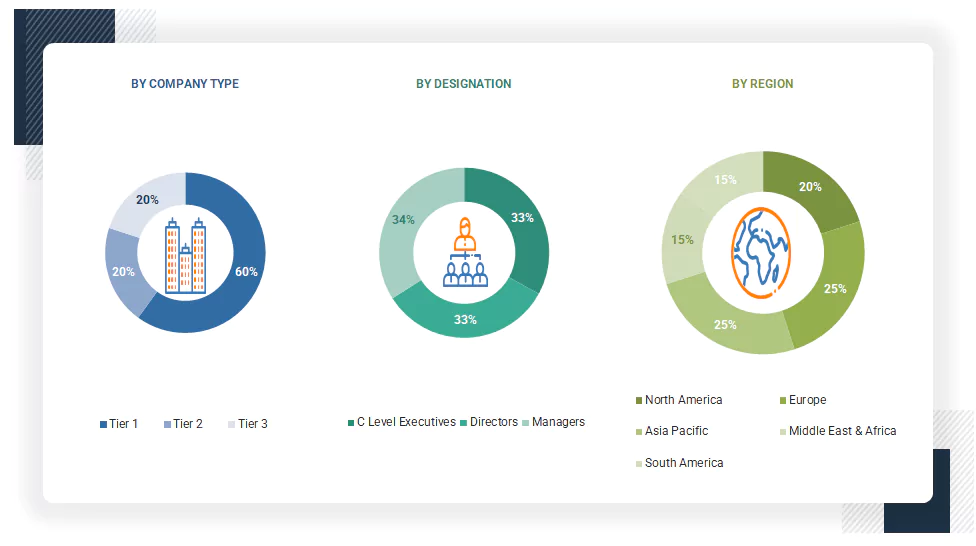
Extensive primary research was conducted after obtaining information regarding the PBAT market scenario through secondary research. Several primary interviews were conducted with market experts from both the demand and supply sides across major countries of North America, Europe, Asia Pacific, the Middle East & Africa, and South America. Primary data was collected through questionnaires, emails, and telephonic interviews. The primary sources from the supply side included various industry experts, such as chief executive officers (CXOs), vice presidents (VPs), directors from business development, marketing, product development/innovation teams, and related key executives from PBAT industry vendors, material providers, distributors, and key opinion leaders. Primary interviews were conducted to gather insights such as market statistics, data on revenue collected from the products and services, market breakdowns, market size estimations, market forecasting, and data triangulation. Primary research also helped in understanding the various trends related to grade, application, end-use industry, and region. Stakeholders from the demand side, such as CIOs, CTOs, CSOs, and installation teams of the customer/end users who are seeking PBAT services, were interviewed to understand the buyer’s perspective on the suppliers, products, component providers, and their current usage of PBAT and future outlook of their business which will affect the overall market.
The Breakup of Primary Research
To know about the assumptions considered for the study, download the pdf brochure
Market Size Estimation
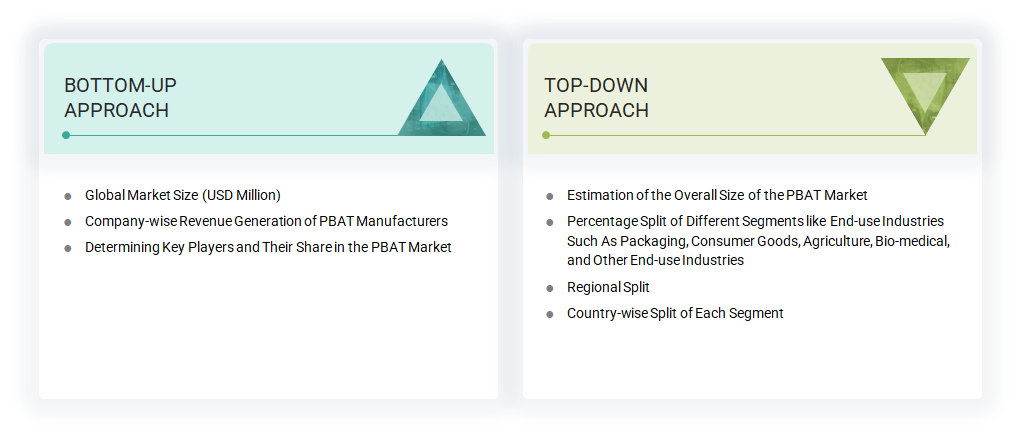
The research methodology used to estimate the size of the PBAT market includes the following details. The market sizing of the market was undertaken from the demand side. The market was upsized based on the demand for PBAT in different end-use industries at a regional level. Such procurements provide information on the demand aspects of the PBAT industry for each end-use industry. For each end-use industry, all possible segments of the PBAT market were integrated and mapped.
Data Triangulation
After arriving at the overall size from the market size estimation process explained above, the total market was split into several segments and subsegments. The data triangulation and market breakdown procedures explained below were implemented, wherever applicable, to complete the overall market engineering process and arrive at the exact statistics for various market segments and subsegments. The data was triangulated by studying various factors and trends from the demand and supply sides. Along with this, the market size was validated using both the top-down and bottom-up approaches.
Market Definition
PBAT is a biodegradable and compostable aliphatic aromatic copolyester. PBAT is synthesized from 1,4-butanediol, adipic acid, and terephthalic acid, and is engineered to offer properties similar to conventional low-density polyethylene (LDPE), including flexibility, toughness, and thermal stability, while being capable of complete biodegradation under industrial composting conditions. The market spans various segments based on grade, application, end-use industry (packaging, agriculture, consumer goods, bio-medical, and others), and region. Driven by increasing environmental regulations, consumer preference for sustainable products, and advancements in biopolymer technology, the PBAT market is gaining momentum as a critical component in the transition away from petroleum-based plastics. It plays a central role in enabling circular material flows across sectors that require short-life yet high-performance plastic alternatives.
Stakeholders
- PBAT Manufacturers
- PBAT Distributors and Suppliers
- End-use Industries
- Universities, Governments, and Research Organizations
- Associations and Industrial Bodies
- R&D Institutes
- Environmental Support Agencies
- Investment Banks and Private Equity Firms
- Research and Consulting Firms
Report Objectives
- To define, describe, and forecast the PBAT market size in terms of volume and value
- To provide detailed information regarding the key factors, such as drivers, restraints, opportunities, and challenges, influencing market growth
- To analyze and project the global PBAT market by grade, application, end-use industry, and region
- To forecast the market size concerning five main regions (along with country-level data), namely, North America, Europe, Asia Pacific, the Middle East & Africa, and South America, and analyze the significant region-specific trends
- To strategically analyze micromarkets with respect to individual growth trends, prospects, and contributions of the submarkets to the overall market
- To analyze the market opportunities and the competitive landscape for stakeholders and market leaders
- To assess recent market developments and competitive strategies, such as agreements, contracts, acquisitions, and new product developments/new product launches, to draw the competitive landscape
- To strategically profile the key market players and comprehensively analyze their core competencies
Get the Full Polybutylene Adipate Terephthalate Market Report
Full forecast, segment splits, and company analysis for all Polybutylene Adipate Terephthalate Market.
- Mexico Polybutylene Adipate Terephthalate Market
- US Polybutylene Adipate Terephthalate Market
- Brazil Polybutylene Adipate Terephthalate Market
- Argentina Polybutylene Adipate Terephthalate Market
- South Africa Polybutylene Adipate Terephthalate Market
- Rest Of Europe Polybutylene Adipate Terephthalate Market
- Rest Of Asia Pacific Polybutylene Adipate Terephthalate Market
- GCC Polybutylene Adipate Terephthalate Market
- -Rest Of The GCC Polybutylene Adipate Terephthalate Market
- Rest Of South America Polybutylene Adipate Terephthalate Market
- China Polybutylene Adipate Terephthalate Market
- India Polybutylene Adipate Terephthalate Market
- South Korea Polybutylene Adipate Terephthalate Market
- Germany Polybutylene Adipate Terephthalate Market
- UK Polybutylene Adipate Terephthalate Market
- France Polybutylene Adipate Terephthalate Market
- Italy Polybutylene Adipate Terephthalate Market
- Spain Polybutylene Adipate Terephthalate Market
- Canada Polybutylene Adipate Terephthalate Market
Need a Tailored Report?
Customize this report to your needs
Get 10% FREE Customization
Customize This Report
