
Australia Polyethylene Glycol Market (2024-2029)

The Australia Polyethylene Glycol Market was valued at $29.3 Million in 2024 and projected to reach to $37 Million by 2029, representing a compound annual growth rate of 4.7%. Australia's polyethylene glycol market demonstrates steady growth driven by robust pharmaceutical manufacturing and expanding personal care applications.


| Market Size in | USD 26.32 MN |
| Market Forecast in | |
| CAGR | |
| Forecast Period | |
| Units Considered | Value (USD MN) |
Australia Polyethylene Glycol Market Trends and Insights
- Australia's demand for polyethylene glycol is driven by its pharmaceutical, personal care, and industrial applications, with the country's manufacturing sector increasingly adopting PEG-based formulations.
- The Australian market reflects steady growth momentum, supported by rising consumer awareness of product quality and regulatory compliance in the region. Between 2024 and 2029, Australia is expected to experience moderate but consistent market expansion as end-use industries in Australia diversify their chemical sourcing and invest in advanced formulations.
- Australia's position within the Asia Pacific region positions it as a key market for specialty chemicals, with local manufacturers and importers responding to growing demand from cosmetics, pharmaceuticals, and food processing sectors.
- The forecast period indicates Australia will capture incremental market share through innovation and supply chain optimization..
Key Market Statistics
- CAGR (2024-2029) 4.7% CAGR
- Market Size, 2024 ~USD 29.3 Million
- Forecast, 2029 ~USD 37 Million
- Country Australia
Australia Polyethylene Glycol Market Overview
Market Valuation :
Australia's polyethylene glycol market reached USD 29.3 million in 2024, with steady growth trajectory positioning it as a significant regional market within the Asia-Pacific chemicals sector.
Pharmaceutical Dominance :
The pharmaceutical sector drives substantial PEG demand in Australia, leveraging polyethylene glycol in drug formulations, excipients, and delivery systems for both domestic and export markets.
Manufacturing Expansion :
Australia's manufacturing sector increasingly adopts PEG-based formulations across personal care, cosmetics, and industrial applications, reflecting growing localization of production capabilities.
Growth Trajectory :
Projected to reach USD 37.0 million by 2029 at a 4.7% CAGR, Australia's market growth lags the global 6.2% rate, indicating selective demand patterns and market maturity.
Australia Polyethylene Glycol Market Dynamics
- The country's regulatory environment and quality standards support premium PEG product adoption, particularly in therapeutic formulations and cosmetic innovations.
- Domestic manufacturers are increasingly investing in PEG-based product development to meet stringent Australian and regional compliance requirements. The forecast period through 2029 anticipates moderate expansion as industrial applications diversify beyond traditional sectors.
- Growth will be supported by rising demand from contract manufacturers serving export markets and increased adoption in specialty chemical applications.
- However, market growth remains constrained by limited domestic raw material sourcing and competition from imported formulations, suggesting opportunities for value-added PEG derivatives and customized solutions..
Market Ecosystem
Related Ecosystem
Bulk Chemicals And Inorganics
- Corrosion Inhibitors
- Glycol Ethers
- Acetic Acid
- Acetone
- Ammonium Nitrate
- Basf se
- DOW CHEMICAL COMPANY
- Exxon Mobil Corporation
- AZELIS HOLDINGS SA
- Sinopec limited
Fandb Processing And Technology
- Dairy Products
- Bakery Products
- Filtration Equipment
- Heat Exchanger
- Acetic Acid
- Gea group
- John Bean Technologies Corporation
- Alfa Laval Corporate AB
- AZELIS HOLDINGS SA
- SPX FLOW INC
Nutraceuticals And Dietary Supplements
- Dairy Products
- Animal-Based Sealants
- Carbohydrates
- Porcine
- Acrylic Polymers
- AZELIS HOLDINGS SA
- Amway
- Nestle s.a
- Kerry Group plc
- Basf se
Key Takeaways
- Australia's polyethylene glycol market is valued at USD 29.3 million in 2024 and will reach USD 37.0 million by 2029.
- Australia is experiencing a 4.7% CAGR, reflecting steady demand from pharmaceutical and personal care sectors.
- Australia's manufacturing base is increasingly adopting PEG formulations for specialty applications and regulatory compliance.
- Australia's strategic position in Asia Pacific supports long-term growth through supply chain integration and market diversification.
Polyethylene Glycol Market Report Scope
| Report Metric | Details |
|---|---|
| Base Year | 2024 |
| Fastest Growing Segment | PEG 400 (Grade) |
| Forecast Period | 2024-2029 |
| Growth Rate | CAGR of 6.2% from 2024 to 2029 |
| Largest Segment | FLAKE/POWDER (Form) |
| Market Size Base Year (Billions) | ~USD 3.93 (2024) |
| Revenue Forecast (Billions) | ~USD 5.31 (2029) |
| Segments Covered | Form, Grade, Package Size, End-Use Industry |
Australia Polyethylene Glycol Market Report Segmentation
4 segment dimensions are covered across the global market.
By Form
- Flake/Powder
- Liquid
- White Wax Solid
By Grade
- Other Grades
- Peg 1000
- Peg 200
- Peg 3350
- Peg 400
- Peg 4000
- Peg 6000
- Peg 8000
By Package Size
- Bulk Containers
- Drums
- Glass Bottles
- Other Package Sizes
By End-Use Industry
- Cosmetics & Personal Care
- Food & Beverage
- Industrial
- Other End-Use Industries
- Pharmaceutical
AUSTRALIA: POLYETHYLENE GLYCOL MARKET, BY END-USE INDUSTRY, 2024–2029
| Segment | 2024 | 2025 | 2026 | 2027 | 2028 | 2029 | CAGR (%) |
|---|---|---|---|---|---|---|---|
| COSMETICS & PERSONAL CARE | 7.9 | 8.4 | 8.9 | 9.5 | 10.1 | 10.7 | 6.1 |
| FOOD & BEVERAGE | 3.1 | 3.3 | 3.5 | 3.7 | 3.9 | 4.1 | 5.7 |
| INDUSTRIAL | 4.1 | 4.4 | 4.6 | 4.8 | 5.1 | 5.4 | 5.4 |
| OTHER END-USE INDUSTRIES | 1.4 | 1.5 | 1.6 | 1.6 | 1.7 | 1.8 | 5.1 |
| PHARMACEUTICAL | 15.4 | 16.4 | 17.4 | 18.5 | 19.6 | 20.8 | 6.2 |
| TOTAL | 32 | 33.9 | 35.9 | 38.1 | 40.35 | 42.8 | 6 |
Target Audience
- Pharmaceutical Manufacturers : Need Australia-specific formulation data and market demand forecasts to optimize excipient sourcing, develop compliant drug delivery systems, and plan production capacity.
- Personal Care & Cosmetics Companies : Require insights into Australian consumer preferences, regulatory compliance pathways, and PEG application trends to develop market-appropriate product formulations.
- Chemical Distributors & Suppliers : Seek localized market intelligence on customer segments, demand forecasts, and competitive landscape to optimize inventory management and sales strategies in Australia.
- Industrial Manufacturers : Need data on PEG adoption rates across industrial applications, manufacturing trends, and growth opportunities to identify new market segments and expansion possibilities.
- Strategic Investors & Consultants : Require validated market sizing, growth projections, and competitive analysis for Australia to support investment decisions, M&A strategies, and business development initiatives.
Reasons to Buy this Report
- Localized Market Intelligence : Gain Australia-specific insights into PEG demand patterns, regulatory requirements, and competitive dynamics that differ significantly from global market trends and regional averages.
- Pharmaceutical Sector Opportunity : Identify growth opportunities within Australia's pharmaceutical manufacturing ecosystem, including excipient specifications, formulation trends, and contract manufacturing partnerships.
- Investment Decision Support : Make informed decisions on market entry, capacity expansion, or product portfolio development in Australia with validated market sizing and growth projections through 2029.
- Competitive Positioning : Understand Australia's unique market structure, key application segments, and growth drivers to develop targeted strategies for personal care, industrial, and pharmaceutical channels.
- Supply Chain Strategy : Evaluate sourcing opportunities, manufacturing feasibility, and distribution strategies specific to Australia's regulatory environment and market maturity levels.
Frequently asked questions
What is the current size of Australia's polyethylene glycol market?
Australia's polyethylene glycol market was valued at USD 29.3 million in 2024 according to verified market data.
What is the projected market size for Australia by 2029?
Australia's polyethylene glycol market is forecast to reach USD 37.0 million by 2029, representing growth from the 2024 baseline.
What is the growth rate for Australia's polyethylene glycol market?
Australia's polyethylene glycol market is expected to grow at a compound annual growth rate of 4.7% between 2024 and 2029.
Which industries drive demand for polyethylene glycol in Australia?
Australia's polyethylene glycol demand is primarily driven by pharmaceutical, personal care, cosmetics, and food processing industries.
How does Australia's market compare to global polyethylene glycol trends?
Australia's 4.7% CAGR is slightly below the global average of 6.2%, reflecting a more conservative but stable regional growth pattern.
RESEARCH METHODOLOGY
The study involved four major activities in estimating the market size of the PEG market. Exhaustive secondary research was done to collect information on the market, the peer market, and the grandparent market. The next step was to validate these findings, assumptions, and sizing with industry experts across the value chain through primary research. Both top-down and bottom-up approaches were employed to estimate the complete market size. Thereafter, the market breakdown and data triangulation procedures were used to estimate the market size of the segments and subsegments.
Secondary Research
In the secondary research process, various secondary sources have been referred to for identifying and collecting information for this study. These secondary sources include annual reports, press releases, investor presentations of companies, white papers, certified publications, trade directories, articles from recognized authors, gold standard and silver standard websites, and databases. Secondary research has been used to obtain key information about the value chain of the industry, monetary chain of the market, the total pool of key players, market classification and segmentation according to industry trends to the bottom-most level, and regional markets. It was also used to obtain information about the key developments from a market-oriented perspective.
Primary Research
The PEG market comprises several stakeholders in the value chain, which include manufacturers, and end users. Various primary sources from the supply and demand sides of the PEG market have been interviewed to obtain qualitative and quantitative information. The primary interviewees from the demand side include key opinion leaders in industrial sectors. The primary sources from the supply side include manufacturers, associations, and institutions involved in the PEG industry. Primary interviews were conducted to gather insights such as market statistics, data of revenue collected from the products and services, market breakdowns, market size estimations, market forecasting, and data triangulation. Primary research also helped in understanding the various trends related to form, grade, package size, end-use industry, and region. Stakeholders from the demand side, such as CIOs, CTOs, and CSOs were interviewed to understand the buyer’s perspective on the suppliers, products, component providers, and their current usage of PEG and outlook of their business, which will affect the overall market.
The breakdown of profiles of the primary interviewees is illustrated in the figure below:
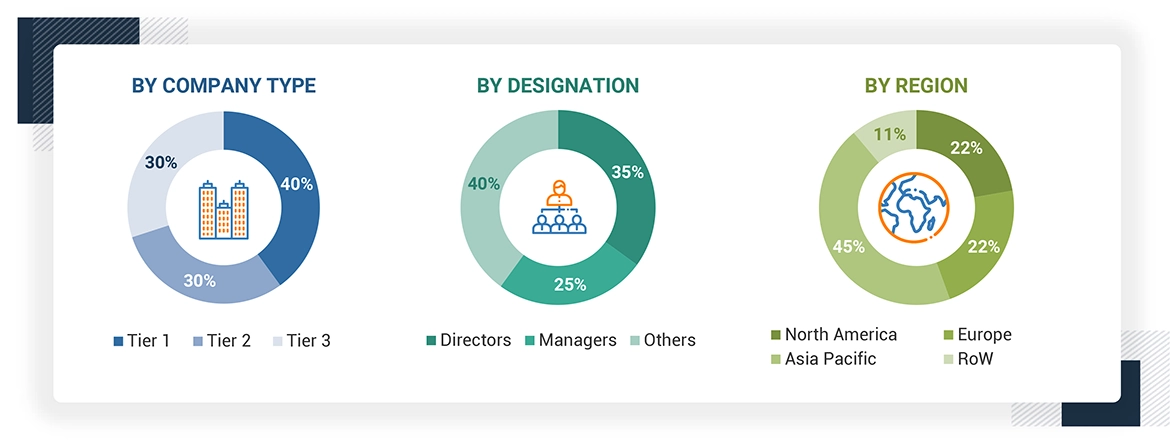
Note: Tier 1, Tier 2, and Tier 3 companies are classified based on their market revenue in 2022 available in the public domain, product portfolios, and geographical presence.
Other designations include consultants and sales, marketing, and procurement managers.
To know about the assumptions considered for the study, download the pdf brochure
Market Size Estimation
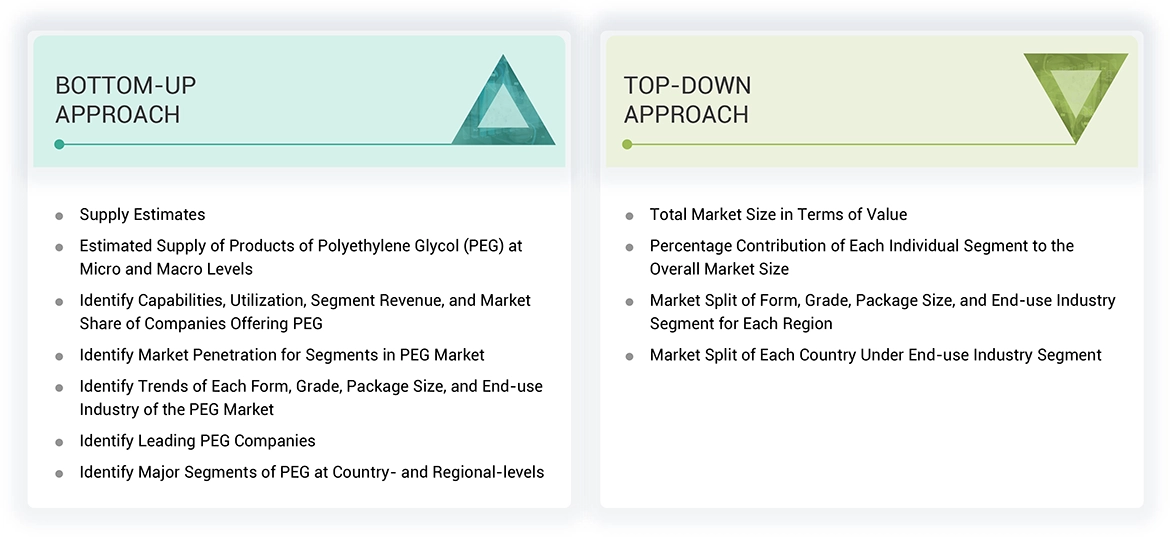
The top-down and bottom-up approaches have been used to estimate and validate the size of the PEG market.
- The key players in the industry have been identified through extensive secondary research.
- The supply chain of the industry has been determined through primary and secondary research.
- All percentage shares, splits, and breakdowns have been determined using secondary sources and verified through primary sources.
- All possible parameters that affect the markets covered in this research study have been accounted for, viewed in extensive detail, verified through primary research, and analyzed to obtain the final quantitative and qualitative data.
- The research includes the study of reports, reviews, and newsletters of the key market players, along with extensive interviews for opinions with leaders such as directors and marketing executives.
Data Triangulation
After arriving at the total market size from the estimation process, the overall market has been split into several segments and sub-segments. To complete the overall market engineering process and arrive at the exact statistics for all the segments and sub-segments, the data triangulation and market breakdown procedures have been employed, wherever applicable. The data has been triangulated by studying various factors and trends from both the demand and supply sides. Along with this, the market size has been validated by using both the top-down and bottom-up approaches and primary interviews. Hence, for every data segment, there have been three sources—top-down approach, bottom-up approach, and expert interviews. The data was assumed correct when the values arrived from the three sources matched.
Market Definition
Polyethylene Glycol (PEG) is a derived from ethylene oxide and having water soluble properties available in various grades and molecular weights. It is used across various industries due to its versatile properties such as non-toxicity, solubility and biodegradability. In pharmaceutical industry it serves as solvent and excipient in drug formulations and delivery systems. In cosmetics & personal care industries it is used in various products as moisturizer, emulsifier, and thickener. The PEG market comprises of range of products differentiated based on their molecular weight and applications in different industries. Specifically, due to high biocompatibility, PEG is used in drug delivery systems to enhance solubility as well as bioavailability of the drugs used. Due to its gelation capacity, it is important in the application of biomolecule delivery in medical uses. It has other uses too that being medical, it can be used in preservation of organic relics and enhances stability of other things like wood.
Stakeholders
- Senior Management
- End User
- Finance/Procurement Department
- R&D Department
- Manufacturers
- Raw Material Suppliers
Report Objectives
- To define, describe, and forecast the size of the PEG market, in terms of value and volume.
- To provide detailed information regarding the major factors (drivers, opportunities, restraints, and challenges) influencing the growth of the market
- To estimate and forecast the market size based on form, grade, package size, end-use industry, and region.
- To forecast the size of the market with respect to major regions, namely, Europe, North America, Asia Pacific, Middle East & Africa, and South America, along with their key countries
- To strategically analyze micro-markets with respect to individual growth trends, prospects, and their contribution to the overall market
- To analyze opportunities in the market for stakeholders and provide a competitive landscape of market leaders.
- To track and analyze recent developments such as expansions, new product launches, partnerships & agreements, and acquisitions in the market.
- To strategically profile key market players and comprehensively analyze their core competencies.
Get the Full Polyethylene Glycol Market Report
Full forecast, segment splits, and company analysis for all Polyethylene Glycol Market.
- US Polyethylene Glycol Market
- Canada Polyethylene Glycol Market
- Mexico Polyethylene Glycol Market
- Germany Polyethylene Glycol Market
- UK Polyethylene Glycol Market
- France Polyethylene Glycol Market
- Italy Polyethylene Glycol Market
- Spain Polyethylene Glycol Market
- China Polyethylene Glycol Market
- India Polyethylene Glycol Market
- Japan Polyethylene Glycol Market
- South Korea Polyethylene Glycol Market
- Indonesia Polyethylene Glycol Market
- South Africa Polyethylene Glycol Market
- Brazil Polyethylene Glycol Market
- Argentina Polyethylene Glycol Market
- Rest Of Europe Polyethylene Glycol Market
- Rest Of Asia Pacific Polyethylene Glycol Market
- GCC Polyethylene Glycol Market
- -Rest Of GCC Polyethylene Glycol Market
- Rest Of South America Polyethylene Glycol Market
Need a Tailored Report?
Customize this report to your needs
Get 10% FREE Customization
Customize This Report
