
GCC Countries Polyoxymethylene Market (2025-2030)

The GCC Countries Polyoxymethylene Market was valued at $28 Million in 2025 and projected to reach to $32.6 Million by 2030, representing a compound annual growth rate of 3.1%. The polyoxymethylene market in GCC Countries is positioned for steady growth through 2030, driven by increasing automotive production, industrial modernization, and rising demand for durable engineering materials.


| Market Size in | USD 26.32 MN |
| Market Forecast in | |
| CAGR | |
| Forecast Period | |
| Units Considered | Value (USD MN) |
GCC Countries Polyoxymethylene Market Trends and Insights
- GCC Countries' polyoxymethylene sector is driven by rising demand from automotive, consumer goods, and industrial applications across the region.
- The market in GCC Countries reflects steady expansion supported by regional manufacturing growth and increased adoption of high-performance engineering plastics in precision components.
- GCC Countries' polyoxymethylene demand is expected to benefit from infrastructure development and diversification initiatives across the Gulf economies through the forecast period..
Key Market Statistics
- CAGR (2025-2030) 3.1% CAGR
- Market Size, 2025 ~USD 28 Million
- Forecast, 2030 ~USD 32.6 Million
- Country GCC Countries
GCC Countries Polyoxymethylene Market Overview
Market Size & Growth :
GCC Countries' polyoxymethylene market is valued at USD 28.0 million in 2025, with projected growth to USD 32.6 million by 2030, reflecting a steady CAGR of 3.1% over the forecast period.
Automotive Sector Dominance :
The automotive industry in GCC Countries drives significant polyoxymethylene demand, utilizing the material for precision components, fuel systems, and interior applications due to its superior mechanical properties.
Industrial & Consumer Applications :
Beyond automotive, GCC polyoxymethylene consumption spans consumer goods manufacturing, industrial machinery, and appliances, supported by regional manufacturing expansion and rising consumer spending.
Regional Economic Drivers :
GCC Countries' diversification initiatives and infrastructure development projects create sustained demand for high-performance engineering plastics in construction, manufacturing, and industrial sectors.
GCC Countries Polyoxymethylene Market Dynamics
- Regional manufacturers are investing in advanced production capabilities to meet local demand while reducing import dependency.
- The market benefits from GCC Countries' strategic focus on manufacturing diversification and value-added industrial production. Key growth opportunities emerge from expanding consumer goods manufacturing, petrochemical sector applications, and infrastructure development projects across the region.
- As GCC economies continue diversifying beyond oil and gas, polyoxymethylene's applications in precision engineering and industrial components will gain prominence.
- Market players should focus on localized supply chains and partnerships with regional manufacturers to capitalize on this steady expansion..
Market Ecosystem
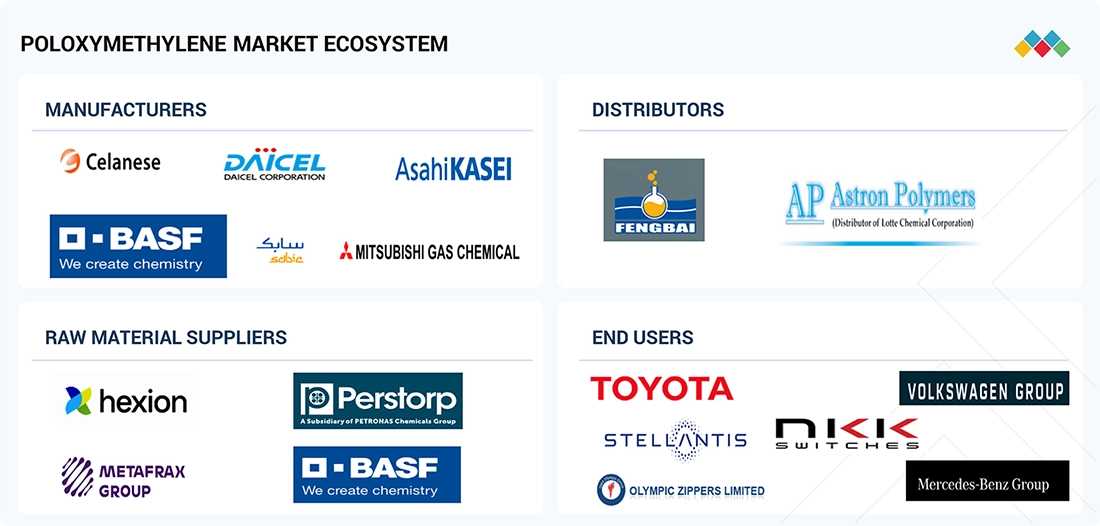
POLYOXYMETHYLENE MARKET: COMMERCIAL USE CASES ACROSS INDUSTRIES
| COMPANY | USE CASE DESCRIPTION | BENEFITS |
|---|---|---|
 |
Celanese developed Hostaform POM MetalX, an advanced acetal copolymer with an integrated metallic appearance that can be achieved directly during injection molding. The material was adopted by an automotive OEM for interior door handles in the Honda Accord, addressing the challenge of achieving a premium metallic look while reducing manufacturing complexity, cost, and environmental impact associated with secondary finishing processes such as painting, plating, or metallization. | Eliminated up to seven secondary manufacturing steps, including painting, plating, and metallization | Reduced production time, cost, and environmental footprint | Delivered a consistent, high-quality metallic appearance in a single molding step | Provided high stiffness, strength, and excellent scratch and impact resistance | Improved surface durability and resistance to environmental stress cracking | Enabled greater design flexibility, faster time-to-market, and scalable metal-replacement solutions for automotive interiors |
Logos and trademarks shown above are the property of their respective owners. Their use here is for informational and illustrative purposes only.
Related Ecosystem
On Highway Off Highway Vehicles
- Internal Combustion Engine (ICE)
- Agricultural Tractors
- Crawler Excavator
- Battery Electric Vehicle (BEV)
- Excavators
- Visteon Corporation
- Deere & Company
- AB VOLVO PENTA
- Honda Motor Co., Ltd.
- Komatsu Ltd.
Resins And Polymers
- Polycarbonate
- Acrylonitrile Butadiene Styrene (ABS)
- Epoxy Resin
- Light Commercial Vehicles (LCVs)
- Polypropylene (PP)
- Basf se
- DOW CHEMICAL COMPANY
- Solvay sa
- Saudi arabia basic industries corporation (sabic)
- DuPont de Nemours, Inc.
Speciality Chemicals
- Corrosion Inhibitors
- Polyetheretherketone (PEEK)
- Acrylonitrile Butadiene Styrene (ABS)
- Epoxy Resin
- Polycarbonate
- Basf se
- DOW CHEMICAL COMPANY
- Evonik industries ag
- Clariant ag.
- Solvay sa
Key Takeaways
- GCC Countries polyoxymethylene market valued at USD 28.0 million in 2025, growing at 3.1% CAGR through 2030.
- GCC Countries demand driven by automotive, consumer goods, and industrial precision component applications.
- GCC Countries market benefits from regional manufacturing expansion and engineering plastic adoption.
- GCC Countries polyoxymethylene forecast to reach USD 32.6 million by 2030 amid economic diversification.
Polyoxymethylene Market Report Scope
| Report Metric | Details |
|---|---|
| Base Year | 2025 |
| Fastest Growing Segment | LOW VOC (Grade) |
| Forecast Period | 2025-2030 |
| Growth Rate | CAGR of 4.51% from 2025 to 2030 |
| Largest Segment | COPOLYMER (Type) |
| Market Size Base Year (Billions) | ~USD 3.72 (2025) |
| Revenue Forecast (Billions) | ~USD 4.64 (2030) |
| Segments Covered | Type, Grade, Processing Technique, End-Use Industry |
GCC Countries Polyoxymethylene Market Report Segmentation
4 segment dimensions are covered across the global market.
By Type
- Copolymer
- Homopolymer
By Grade
- Antistatic
- Conductive
- Low Friction
- Low Voc
- Other Grades
By Processing Technique
- Compression Molding
- Extrusion
- Injection Molding
- Other Processing Techniques
By End-Use Industry
- Consumer
- Electrical & Electronics
- Industrial
- Other End-Use Industries
- Transportation
Target Audience
- Material Suppliers & Manufacturers : Polyoxymethylene producers and distributors need GCC-specific market data to identify growth opportunities, optimize regional supply chains, and develop targeted sales strategies for automotive and industrial customers.
- Automotive OEMs & Tier-1 Suppliers : Vehicle manufacturers and component suppliers operating in GCC Countries require market insights to forecast material demand, secure reliable polyoxymethylene sourcing, and plan production capacity investments.
- Industrial Equipment Manufacturers : Machinery and equipment producers in GCC Countries need polyoxymethylene market intelligence to select appropriate materials, evaluate supplier options, and understand regional demand trends for precision components.
- Investment & Business Development Teams : Corporate strategists and investors evaluating GCC market opportunities require detailed polyoxymethylene market analysis to assess growth potential, identify acquisition targets, and guide capital allocation decisions.
- Government & Economic Development Agencies : GCC policymakers and industrial development authorities need market data to support manufacturing diversification initiatives, attract polyoxymethylene producers, and develop regional industrial competitiveness strategies.
Reasons to Buy this Report
- Market-Specific Sizing & Forecasts : Access precise market valuation for GCC Countries (USD 28.0M in 2025) with detailed 5-year forecasts, enabling accurate budgeting and investment planning specific to this high-growth regional market.
- Automotive Sector Intelligence : Gain insights into polyoxymethylene applications within GCC automotive manufacturing, including component specifications, supplier relationships, and production trends critical for material suppliers and OEMs.
- Regional Growth Drivers Analysis : Understand GCC-specific economic factors, diversification initiatives, and industrial policies driving polyoxymethylene demand, enabling strategic market entry and expansion planning.
- Competitive Landscape Mapping : Identify key market players, local manufacturers, and distribution networks operating in GCC Countries, supporting partnership development and competitive positioning strategies.
- Investment & Expansion Strategy : Leverage GCC-focused market data to evaluate manufacturing facility locations, supply chain optimization, and market penetration strategies tailored to regional demand patterns and regulatory environments.
Frequently asked questions
What is the current market size of polyoxymethylene in GCC Countries?
The polyoxymethylene market in GCC Countries is estimated at USD 28.0 million in 2025.
What is the projected market size for polyoxymethylene in GCC Countries by 2030?
GCC Countries polyoxymethylene market is forecast to reach USD 32.6 million by 2030.
What is the CAGR for polyoxymethylene in GCC Countries?
The polyoxymethylene market in GCC Countries is expected to grow at a CAGR of 3.1% from 2025 to 2030.
Which industries drive polyoxymethylene demand in GCC Countries?
GCC Countries polyoxymethylene demand is primarily driven by automotive, consumer goods, and industrial precision component sectors.
What factors support polyoxymethylene market growth in GCC Countries?
GCC Countries polyoxymethylene growth is supported by regional manufacturing expansion, economic diversification initiatives, and increased adoption of high-performance engineering plastics.
RESEARCH METHODOLOGY
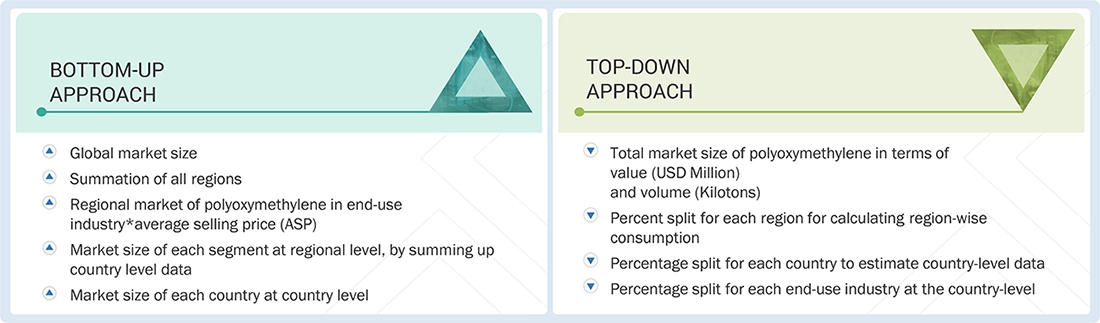
The study involved four major activities to estimate the current size of the global polyoxymethylene market. Exhaustive secondary research was carried out to collect information on the market, the peer product market, and the parent product group market. The next step was to validate these findings, assumptions, and sizes with the industry experts across the value chain of polyoxymethylene through primary research. The top-down and bottom-up approaches were employed to estimate the overall size of the polyoxymethylene market. After that, market breakdown and data triangulation procedures were used to determine the size of different segments of the market.
Secondary Research
The market for companies offering polyoxymethylene is arrived at by analyzing secondary data available through paid and unpaid sources, studying the product portfolios of the major companies in the ecosystem, and rating the companies by their performance and quality. For this study, various secondary sources, such as Business Standard, Bloomberg, the World Bank, and Factiva, were referred to identify and collect information on the polyoxymethylene market. Secondary sources included annual reports, press releases, and investor presentations of polyoxymethylene vendors, forums, certified publications, and whitepapers. The secondary research was used to obtain critical information on the industry’s value chain, the total pool of key players, market classification, and segmentation from the market and technology-oriented perspectives.
Primary Research
In the primary research process, various primary sources from the supply and demand sides were interviewed to obtain qualitative and quantitative information for this report. The primary sources from the supply side included industry experts, such as chief executive officers (CEOs), vice presidents (VPs), marketing directors, technology and innovation directors, and related key executives from several key companies and organizations operating in the polyoxymethylene market. After the complete market engineering (calculations for market statistics, market breakdown, market size estimations, market forecasting, and data triangulation), extensive primary research was conducted to gather information and verify and validate the critical numbers arrived at.
Primary research was also conducted to identify the segmentation types, industry trends, competitive landscape of polyoxymethylene offered by various market players, and key market dynamics, such as drivers, restraints, opportunities, challenges, trends, and key player strategies. In the complete market engineering process, the top-down and bottom-up approaches and several data triangulation methods were extensively used to perform the market estimation and market forecasting for the overall market segments and subsegments listed in this report. Extensive qualitative and quantitative analysis was performed on the complete market engineering process to list key information/insights throughout the report.
The following is the breakdown of primary respondents:
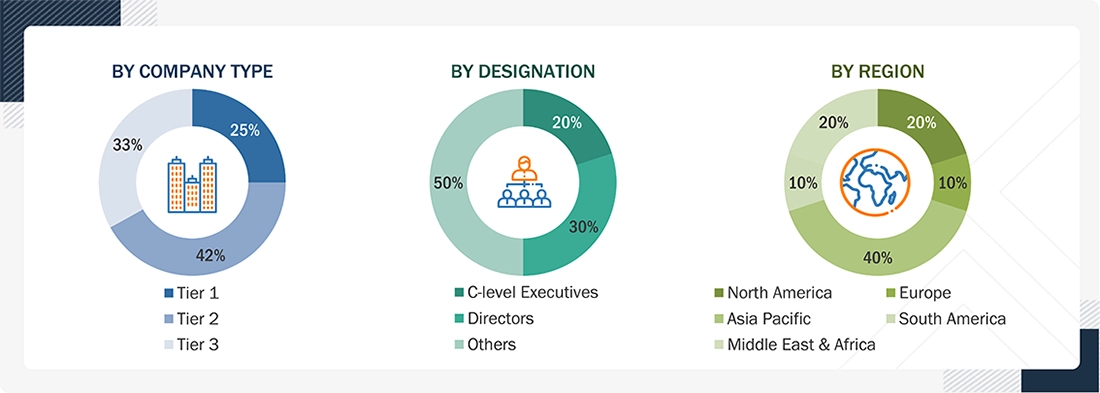
Notes: Other designations include sales, marketing, and product managers.
Tier 1: >USD 1 Billion; Tier 2: USD 500 million–1 Billion; and Tier 3: <USD 500 million
Market Size Estimation
The top-down and bottom-up approaches were used to estimate and validate the size of the global polyoxymethylene market. These approaches were also used extensively to estimate the size of various dependent market segments. The research methodology used to estimate the market size included the following:
Data Triangulation
After arriving at the overall market size using the market size estimation processes, the market was split into several segments and subsegments. The data triangulation and market breakup procedures were employed, wherever applicable, to complete the overall market engineering process and arrive at the exact statistics of each market segment and subsegment. The data was triangulated by studying various factors and trends from the demand and supply sides.
Market Definition
Polyoxymethylene (POM), also referred to as acetal, polyacetal, or polyformaldehyde, is a high-performance, semi-crystalline engineering thermoplastic widely recognized for its excellent mechanical strength and chemical resistance. It is produced through the polymerization of formaldehyde, resulting in a repeating molecular structure of (CH2O)n. Due to its high level of crystallinity, polyoxymethylene is naturally opaque white, though it can be readily compounded into a wide range of colors. The material is available in two types: homopolymer and copolymer.
Polyoxymethylene exhibits a broad range of performance characteristics, including high tensile strength, rigidity, hardness, and good impact resistance, particularly in acetal copolymer grades. It also demonstrates a low coefficient of friction, excellent wear resistance, high modulus, and strong resistance to many organic solvents and automotive fuels. These properties are maintained over a wide operating temperature range, typically from about −40°C to 140°C, along with low moisture absorption, minimal creep, and strong resistance to fatigue and environmental stress cracking. In addition, polyoxymethylene offers excellent dimensional stability, high surface gloss, low smoke emission, and superior sliding and lubricity characteristics.
Owing to this combination of mechanical, thermal, and chemical properties, polyoxymethylene is widely used to manufacture high-precision components and often serves as an effective alternative to metals. It finds extensive application across automotive, electrical & electronics, industrial machinery, consumer products, and medical & drug-delivery devices, where consistent performance, low friction, and long service life are critical. Polyoxymethylene is also recyclable, further supporting its adoption in modern engineering applications that prioritize both performance and sustainability.
Key Stakeholders
- Raw material suppliers and producers
- Polyoxymethylene manufacturers
- Polyoxymethylene distributors/suppliers
- Government and research organizations
- R&D institutions
- Industry associations and trade bodies
- Logistics and supply chain service providers
- Investors and financial institutions
- End Users
Report Objectives
- To define, describe, and forecast the size of the global polyoxymethylene market by type, grade, processing technique, and end-use industry, in terms of value and volume
- To forecast the market size of segments for North America, Europe, Asia Pacific, South America, and the Middle East & Africa, along with their respective countries, in terms of value and volume
- To provide detailed information on the significant drivers, restraints, opportunities, and challenges influencing the market
- To strategically analyze micromarkets concerning individual growth trends, prospects, and their contribution to the market
- To assess the growth opportunities in the market for stakeholders and provide details on the competitive landscape for market leaders
- To strategically profile key players and comprehensively analyze their market shares and core competencies
- To analyze competitive developments, such as product launches, expansion, acquisitions, and restructuring in the polyoxymethylene market
- To provide the impact of AI/Gen AI on the market
- To provide the macroeconomic outlook for each region covered under the study, and the impact of the 2025 US tariff on the market
Available customizations:
With the given market data, MarketsandMarkets offers customizations according to client-specific needs.
The following customization options are available for the polyoxymethylene report:
Product Analysis
A product matrix that gives a detailed comparison of the product portfolio of each company
Regional Analysis
A further breakdown of the polyoxymethylene market for additional countries
Company Information
Detailed analysis and profiling of additional market players (up to five)
Get the Full Polyoxymethylene Market Report
Full forecast, segment splits, and company analysis for all Polyoxymethylene Market.
- China Polyoxymethylene Market
- Japan Polyoxymethylene Market
- India Polyoxymethylene Market
- South Korea Polyoxymethylene Market
- Taiwan Polyoxymethylene Market
- Germany Polyoxymethylene Market
- UK Polyoxymethylene Market
- France Polyoxymethylene Market
- Italy Polyoxymethylene Market
- Spain Polyoxymethylene Market
- Russia Polyoxymethylene Market
- Canada Polyoxymethylene Market
- Mexico Polyoxymethylene Market
- US Polyoxymethylene Market
- Turkey Polyoxymethylene Market
- South Africa Polyoxymethylene Market
- Brazil Polyoxymethylene Market
- Argentina Polyoxymethylene Market
- Rest Of Europe Polyoxymethylene Market
- Rest Of Asia Pacific Polyoxymethylene Market
- -Rest Of GCC Countries Polyoxymethylene Market
- Rest Of South America Polyoxymethylene Market
Need a Tailored Report?
Customize this report to your needs
Get 10% FREE Customization
Customize This Report
