
Asia Pacific Polypropylene (PP) Compounds Market (2025-2030)

The Asia Pacific Polypropylene (PP) Compounds Market was valued at $9347.8 Million in 2025 and projected to reach to $12862.6 Million by 2030, representing a compound annual growth rate of 6.6%. Asia Pacific's polypropylene compounds market is poised for robust expansion through 2030, fueled by accelerating automotive production, lightweight material adoption, and infrastructure development across emerging economies.


| Market Size in | USD 26.32 MN |
| Market Forecast in | |
| CAGR | |
| Forecast Period | |
| Units Considered | Value (USD MN) |
Asia Pacific Polypropylene (PP) Compounds Market Trends and Insights
- In 2025, Asia Pacific's market size stands at USD 9,347.8 million, driven by robust industrial growth, automotive expansion, and rising consumer goods manufacturing across the region.
- Asia Pacific is projected to reach USD 12,862.6 million by 2030, reflecting a compound annual growth rate (CAGR) of 6.6%, outpacing the global average. The Asia Pacific polypropylene compounds market benefits from increasing adoption in packaging, automotive, and electrical applications.
- Asia Pacific's manufacturing infrastructure, coupled with growing middle-class consumption and infrastructure investments, fuels demand for lightweight, durable materials.
- Key markets within Asia Pacific, including China, India, and Southeast Asia, are accelerating production capacity and innovation in PP compound formulations. Asia Pacific's competitive advantage stems from cost-effective production, abundant raw material access, and proximity to end-use industries.
- By 2030, Asia Pacific is expected to maintain its leadership position, supported by regulatory shifts toward sustainable materials and circular economy initiatives across the region..
Key Market Statistics
- CAGR (2025-2030) 6.6% CAGR
- Market Size, 2025 ~USD 9347.8 Million
- Forecast, 2030 ~USD 12862.6 Million
- Geography Asia Pacific
Asia Pacific Polypropylene (PP) Compounds Market Overview
Market Dominance :
Asia Pacific commands the largest share of the global polypropylene compounds market, with USD 9,347.8 million in 2025, driven by rapid industrialization and manufacturing expansion across the region.
China's Leadership :
China leads Asia Pacific with USD 6,404 million market size, accounting for over 68% of the regional market due to its massive automotive and consumer goods production capacity.
Strong Growth Trajectory :
Asia Pacific is projected to grow at 6.6% CAGR, outpacing the global rate of 6.2%, reaching USD 12,862.6 million by 2030, reflecting sustained demand from emerging economies.
Diverse Growth Drivers :
India (USD 2,070.7M) and Japan (USD 1,773.2M) contribute significantly to regional growth, supported by automotive expansion, packaging innovation, and rising consumer spending.
Asia Pacific Polypropylene (PP) Compounds Market Dynamics
- China's manufacturing dominance, combined with India's rapid industrialization and Japan's advanced processing capabilities, creates a dynamic competitive landscape.
- The region's 6.6% CAGR reflects strong demand from automotive, packaging, and consumer goods sectors seeking high-performance, cost-effective polymer solutions. Key growth catalysts include electric vehicle production scaling, sustainable packaging mandates, and rising middle-class consumption in Southeast Asia.
- Investment in advanced compounding technologies and capacity expansions by major players will further strengthen Asia Pacific's market position.
- Strategic partnerships and localized production facilities are expected to enhance supply chain resilience and market penetration across the region..
Market Ecosystem
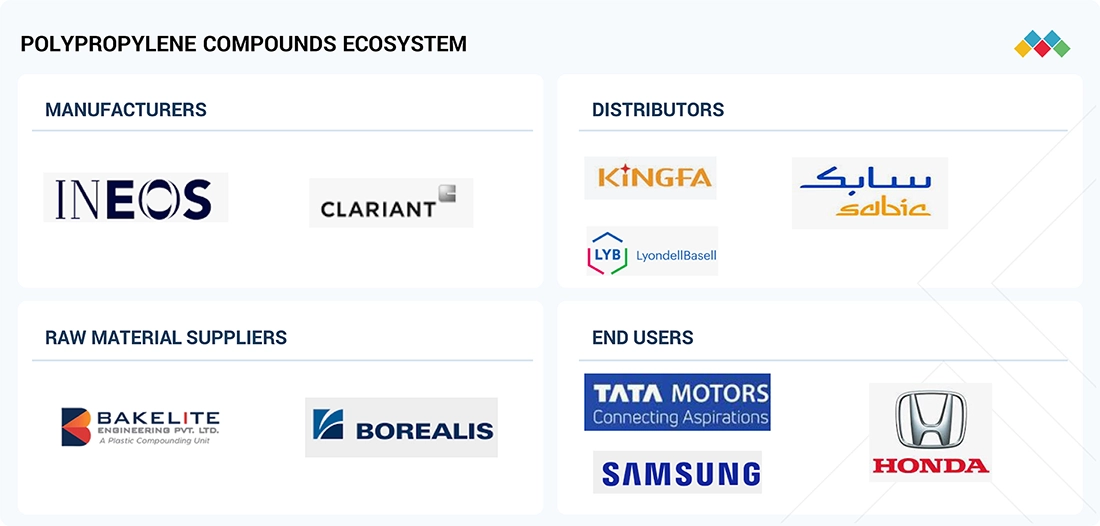
Polypropylene Compounds Market: COMMERCIAL USE CASES ACROSS INDUSTRIES
| COMPANY | USE CASE DESCRIPTION | BENEFITS |
|---|---|---|
 |
PP compounds used in dashboards, trims, and bumpers | Lightweighting improves energy efficiency and EV range |
 |
PP compounds used in interior panels and under-the-hood parts | Enhances durability while reducing manufacturing costs |
 |
PP compounds used in device casings and electronic housings | Provides insulation, heat resistance, and design flexibility |
 |
PP compounds integrated in rigid containers and flexible packaging | Offers extended product shelf life |
 |
Used in e-scooter body panels and battery housings | PP compounds improve durability, reduce weight, and support cost efficiency |
Logos and trademarks shown above are the property of their respective owners. Their use here is for informational and illustrative purposes only.
Related Ecosystem
Resins And Polymers
- Polycarbonate
- Acrylonitrile Butadiene Styrene (ABS)
- Epoxy Resin
- Light Commercial Vehicles (LCVs)
- Polypropylene (PP)
- Basf se
- DOW CHEMICAL COMPANY
- Solvay sa
- Saudi arabia basic industries corporation (sabic)
- DuPont de Nemours, Inc.
Key Takeaways
- Asia Pacific's PP compounds market is valued at USD 9,347.8 million in 2025 and is forecast to grow to USD 12,862.6 million by 2030 at a 6.6% CAGR.
- Asia Pacific's growth rate of 6.6% exceeds the global CAGR of 6.2%, positioning the region as a high-growth market for polypropylene compounds.
- Asia Pacific's automotive, packaging, and electrical sectors are primary drivers of PP compound demand, supported by manufacturing expansion and consumer spending.
- Asia Pacific's cost-competitive production base and proximity to end-use industries provide structural advantages for market leadership through 2030.
Polypropylene (PP) Compounds Market Report Scope
| Report Metric | Details |
|---|---|
| Base Year | 2025 |
| Fastest Growing Segment | AUTOMOTIVE & TRANSPORTATION (End-Use Industry) |
| Forecast Period | 2025–2030 |
| Growth Rate | CAGR of 6.2% from 2025 to 2030 |
| Largest Segment | INJECTION MOLDING (Processing Method) |
| Market Size Base Year (Billions) | ~USD 18.36 (2025) |
| Revenue Forecast (Billions) | ~USD 24.8 (2030) |
| Segments Covered | Product Type, Polymer Type, Processing Method, End-Use Industry, End Use Industry |
Asia Pacific Polypropylene (PP) Compounds Market Report Segmentation
5 segment dimensions are covered across the global market.
By Product Type
- Additive Concentrates
- Glass Fiber Reinforced
- Mineral-Filled Polypropylene Compounds
- Polypropylene-Based Tpo
- Polypropylene-Based Tpv
By Polymer Type
- Homopolymer
- Impact Copolymer
- Random Copolymer
By Processing Method
- Blow Molding
- Injection Molding
By End-Use Industry
- Automotive & Transportation
- Construction
- Electrical & Electronics
- Medical
- Other End-Use Industries
- Packaging
- Textile
By End Use Industry
- Automotive & Transportation
- Construction
- Electrical & Electronics
- Medical
- Other End-Use Industries
- Packaging
- Textile
Target Audience
- Automotive Manufacturers : Require detailed Asia Pacific market data to optimize PP compound sourcing, support lightweighting initiatives, and capitalize on EV production growth across China, India, and Japan.
- Polymer Producers & Compounders : Need regional market intelligence to guide capacity expansion, technology investments, and strategic partnerships in Asia Pacific's high-growth, competitive manufacturing ecosystem.
- Packaging & Consumer Goods Companies : Seek Asia Pacific-specific insights on PP compound demand trends, sustainability requirements, and supply chain opportunities to meet rising regional consumption and regulatory standards.
- Investment & Private Equity Firms : Require comprehensive Asia Pacific market analysis to evaluate M&A opportunities, assess growth potential, and make informed investment decisions in the region's chemical sector.
- Supply Chain & Procurement Managers : Need country-level market data and forecasts to optimize sourcing strategies, identify reliable suppliers, and manage costs across Asia Pacific's diverse manufacturing landscape.
Key Companies in the Asia Pacific Polypropylene (PP) Compounds Market
| Company | HQ | Ownership | Strongest segments |
|---|---|---|---|
| SABIC | Saudi Arabia | Public Company | Mineral-filled Polypropylene Compounds,Glass Fiber Reinforced,Polypropylene-based TPO, |
| REPSOL | Spain | Public Company | Mineral-filled Polypropylene Compounds,Glass Fiber Reinforced,Polypropylene-based TPO, |
| SUMITOMO CHEMICAL CO., LTD. | Japan | Public Company | Mineral-filled Polypropylene Compounds,Glass Fiber Reinforced,Polypropylene-based TPO, |
| BOREALIS GMBH | United States | Private Company | Mineral-filled Polypropylene Compounds,Glass Fiber Reinforced,Polypropylene-based TPO, |
| GS CALTEX CORPORATION | South Korea | Private Company | Mineral-filled Polypropylene Compounds,Glass Fiber Reinforced,Polypropylene-based TPO, |
| LOTTE CHEMICAL CORPORATION | South Korea | Public Company | Mineral-filled Polypropylene Compounds,Glass Fiber Reinforced,Polypropylene-based TPO, |
| TOTALENERGIES | France | Public Company | Mineral-filled Polypropylene Compounds,Glass Fiber Reinforced,Polypropylene-based TPO, |
| KINGFA SCI.&TECH. CO., LTD. | China | Public Company | Mineral-filled Polypropylene Compounds,Glass Fiber Reinforced,Polypropylene-based TPO, |
| LG CHEM | South Korea | Public Company | Mineral-filled Polypropylene Compounds,Glass Fiber Reinforced,Polypropylene-based TPO, |
| TASNEE | Saudi Arabia | Public Company | Mineral-filled Polypropylene Compounds,Glass Fiber Reinforced,Polypropylene-based TPO, |
| MITSUI CHEMICALS, INC. | Japan | Public Company | Mineral-filled Polypropylene Compounds,Glass Fiber Reinforced,Polypropylene-based TPO, |
| MITSUBISHI CHEMICAL GROUP CORPORATION | Japan | Public Company | Mineral-filled Polypropylene Compounds,Glass Fiber Reinforced,Polypropylene-based TPO, |
SABIC
SABIC is a Saudi Arabian public company founded in 1976 with 35,000 employees, operating as a major petrochemical manufacturer.
REPSOL
Repsol is a Spanish public company founded in 1927 with 24,881 employees, engaged in energy and petrochemical operations.
SUMITOMO CHEMICAL CO., LTD.
Sumitomo Chemical Co., Ltd. is a Japanese public company founded in 1913 with 27,491 employees, specializing in chemicals and related products.
BOREALIS GMBH
Borealis GmbH is a private company based in the United States, founded in 1994 with 5,887 employees.
GS CALTEX CORPORATION
GS Caltex Corporation is a South Korean private company founded in 1966 with 3,002 employees.
LOTTE CHEMICAL CORPORATION
Lotte Chemical Corporation is a South Korean public company founded in 1976 with 4,223 employees.
TOTALENERGIES
TotalEnergies is a French public company founded in 1924 with 94,847 employees, operating as a major integrated energy company.
KINGFA SCI.&TECH. CO., LTD.
Kingfa Sci. & Tech. Co., Ltd. is a Chinese public company founded in 1993 with 14,111 employees.
LG CHEM
LG Chem is a South Korean public company founded in 1947 with 14,019 employees, operating in chemicals and advanced materials.
TASNEE
TASNEE is a Saudi Arabian public company founded in 1984 with 7,000 employees.
MITSUI CHEMICALS, INC.
Mitsui Chemicals, Inc. is a Japanese public company founded in 1892 with 16,967 employees.
MITSUBISHI CHEMICAL GROUP CORPORATION
Mitsubishi Chemical Group Corporation is a Japanese public company founded in 1933 with 56,678 employees.
Countries within Asia Pacific - compare and drill down
| Country | 2025 size (native) |
|---|---|
| China | USD 6404 Million |
| Japan | USD 1773.2 Million |
| India | USD 2070.7 Million |
| South Korea | USD 1443.2 Million |
Country market size visualization
Reasons to Buy this Report
- Regional Market Dominance Insights : Gain comprehensive understanding of Asia Pacific's 68% global market share, with detailed analysis of China's leadership and emerging opportunities in India and Southeast Asia.
- Country-Level Intelligence : Access granular market data for China (USD 6.4B), India (USD 2.1B), Japan (USD 1.8B), and South Korea, enabling precise market entry and expansion strategies.
- Growth Forecasting Through 2030 : Leverage 5-year projections showing 6.6% CAGR growth to USD 12.9B, identifying high-potential segments and timing for capacity investments and product launches.
- Competitive Landscape Analysis : Understand regional competitive dynamics, manufacturing capabilities, and supply chain structures specific to Asia Pacific's diverse market conditions and regulatory environments.
- Sector-Specific Opportunities : Identify growth drivers in automotive, packaging, and consumer goods sectors unique to Asia Pacific, with actionable insights for product development and market positioning.
Frequently asked questions
What is the current market size of polypropylene compounds in Asia Pacific?
Asia Pacific's polypropylene compounds market is valued at USD 9,347.8 million in 2025, making it a dominant region in global PP compound consumption.
What is the projected market size for Asia Pacific PP compounds by 2030?
Asia Pacific's PP compounds market is forecast to reach USD 12,862.6 million by 2030, representing growth of approximately 37.5% over the five-year period.
What is the CAGR for Asia Pacific's polypropylene compounds market?
Asia Pacific's polypropylene compounds market is expected to grow at a CAGR of 6.6% from 2025 to 2030, outpacing the global average of 6.2%.
Which industries drive demand for PP compounds in Asia Pacific?
Asia Pacific's primary demand drivers include automotive manufacturing, packaging production, electrical and electronics applications, and consumer goods manufacturing.
Why is Asia Pacific a key market for polypropylene compounds?
Asia Pacific benefits from a large manufacturing base, cost-competitive production, abundant raw material access, growing consumer demand, and proximity to major end-use industries.
RESEARCH METHODOLOGY
The study involved four major activities in estimating the market size of the polypropylene compounds market. Exhaustive secondary research was done to collect information on the market, the peer market, and the parent market. The next step was to validate these findings, assumptions, and sizing with industry experts across the value chain through primary research. Both top-down and bottom-up approaches were employed to estimate the complete market size. Thereafter, the market breakdown and data triangulation procedures were used to estimate the market size of the segments and subsegments.
Secondary Research
In the secondary research process, various secondary sources have been referred to for identifying and collecting information for this study. These secondary sources include annual reports, press releases, investor presentations of companies, white papers, certified publications, trade directories, certified publications, articles from recognized authors, gold standard and silver standard websites, and databases.
Secondary research has been used to obtain key information about the value chain of the industry, monetary chain of the market, the total pool of key polypropylene compounds, market classification and segmentation according to industry trends to the bottom-most level, and regional markets. It was also used to obtain information about the key developments from a market-oriented perspective.
Primary Research
The polypropylene compounds market comprises several stakeholders in the value chain, which include raw material suppliers, manufacturers, distributors, suppliers, and end users. Various primary sources from the supply and demand sides of the polypropylene compounds market have been interviewed to obtain qualitative and quantitative information. The primary interviewees from the demand side include key opinion leaders in end-use sectors. The primary sources from the supply side include manufacturers, associations, manufacturers, and institutions involved in the Polypropylene compounds industry.
Interviews were conducted with industry experts to gather insights, such as market statistics, data of revenue collected from the products and services, market breakdowns, market size estimations, market forecasting, and data triangulation. Primary research also helped in understanding the various trends related to chemistry, form, end-use industry, product, and region. Stakeholders from the demand side, such as CIOs, CTOs, and CSOs were interviewed to understand the buyer’s perspective on the suppliers, products, component providers, and their current usage of polypropylene compounds and future outlook of their business which will affect the overall market.
The breakdown of profiles of the interviews with experts is illustrated in the figure below:
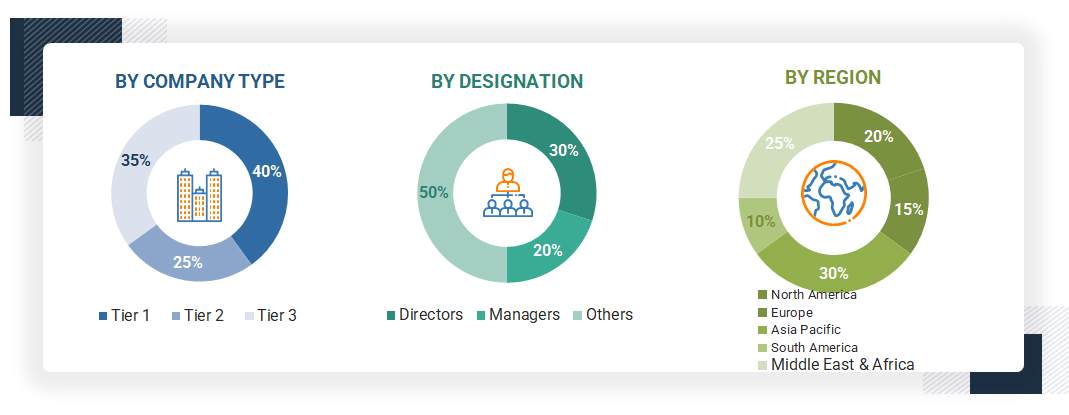
Note: Tier 1, Tier 2, and Tier 3 companies are classified based on their market revenue in 2024 available in the public domain, product portfolios, and geographical presence.
Other designations include sales representatives, production heads, and technicians.
To know about the assumptions considered for the study, download the pdf brochure
Market Size Estimation
The top-down approach was used to estimate and validate the size of various submarkets for polypropylene compounds for each region. The research methodology used to estimate the market size included the following steps:
- The key players in the industry have been identified through extensive secondary research.
- The supply chain of the industry has been determined through primary and secondary research.
- The global market was then segmented into five major regions and validated by industry experts.
- All percentage shares, splits, and breakdowns based on product type, polymer type, processing method, end-use industry, and regions were determined using secondary sources and verified through primary sources.
- All possible parameters that affect the markets covered in this research study were accounted for, viewed in extensive detail, verified through primary research, and analyzed to get the final quantitative and qualitative data. This data was consolidated and added with detailed inputs and analysis and presented in this report.
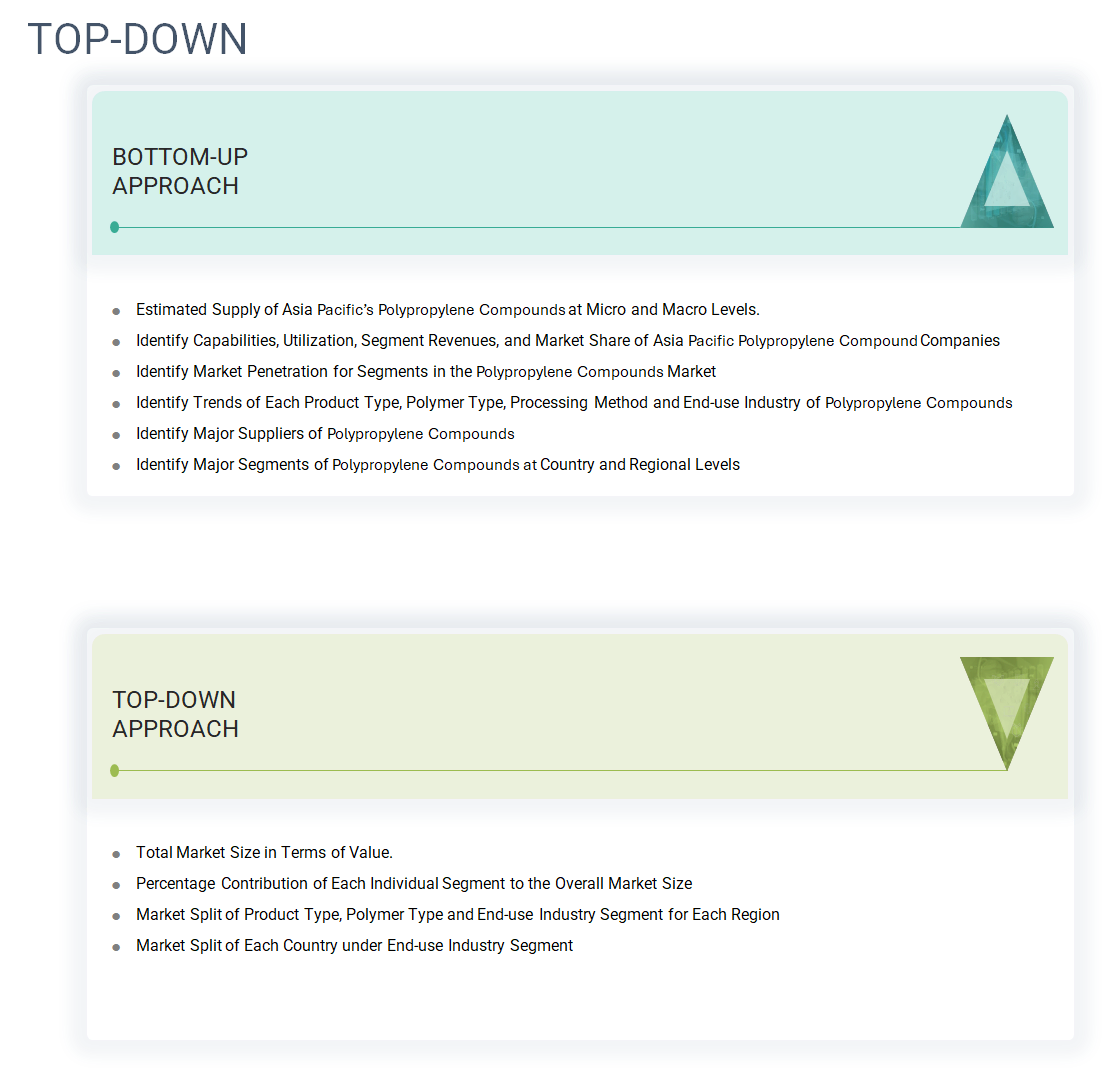
Data Triangulation
After arriving at the total market size from the estimation process polypropylene compounds above, the overall market has been split into several segments and subsegments. To complete the overall market engineering process and arrive at the exact statistics for all the segments and subsegments, the data triangulation and market breakdown procedures have been employed, wherever applicable. The data has been triangulated by studying various factors and trends from both the demand and supply sides. Along with this, the market size has been validated by using both the top-down and bottom-up approaches and interviews with experts. Hence, for every data segment, there have been three sources—top-down approach, bottom-up approach, and interviews with experts. The data was assumed correct when the values arrived from the three sources matched.
Market Definition
Polypropylene (PP) compounds are thermoplastic materials made by mixing base polypropylene resins with different fillers, reinforcements, impact modifiers, colorants, and additives. This blending aims to achieve specific mechanical, thermal, or chemical properties. These compounds improve performance attributes like strength, stiffness, heat resistance, impact resistance, and flame retardancy, based on the intended use. Polypropylene compounds are commonly used in various industries, such as automotive & transportation, electrical & electronics, construction, packaging, textiles, and consumer goods. The polypropylene compounds market includes a variety of types, polypropylene filled with minerals, glass fiber-reinforced polypropylene, polypropylene-based thermoplastic olefins, polypropylene -based thermoplastic vulcanizates, and additive concentrates. The demand for lightweight automotive components, environmental objectives, expanding infrastructure, and growing consumer and industrial applications are the main factors propelling the market. Polypropylene compounds are becoming increasingly relevant worldwide as companies search for high-performance plastic solutions.
Stakeholders
- Polypropylene Compound Manufacturers
- Raw Material Suppliers
- End-use Industries
- Polypropylene Compound Traders, Distributors, and Suppliers
- Research Organizations
- Industry Associations
- Government Research Organizations
Report Objectives
- To define, describe, and forecast the size of the polypropylene compounds market, in terms of value and volume
- To provide detailed information regarding the major factors (drivers, opportunities, restraints, and challenges) influencing the growth of the market
- To estimate and forecast the market size based on product type, polymer type, processing method, end-use industry, and region
- To forecast the size of the market with respect to major regions, namely, Europe, North America, Asia Pacific, Middle East & Africa, and South America, along with their key countries
- To strategically analyze micromarkets with respect to individual growth trends, prospects, and their contribution to the overall market
- To analyze opportunities in the market for stakeholders and provide a competitive landscape of market leaders
- To track and analyze recent developments, such as product launches, partnerships, acquisitions, and expansions in the market
- To strategically profile key market players and comprehensively analyze their core competencies
Get the Full Polypropylene (PP) Compounds Market Report
Full forecast, segment splits, and company analysis for all Polypropylene (PP) Compounds Market.
- China Polypropylene (PP) Compounds Market
- Japan Polypropylene (PP) Compounds Market
- India Polypropylene (PP) Compounds Market
- South Korea Polypropylene (PP) Compounds Market
- Canada Polypropylene (PP) Compounds Market
- Mexico Polypropylene (PP) Compounds Market
- US Polypropylene (PP) Compounds Market
- Brazil Polypropylene (PP) Compounds Market
- Argentina Polypropylene (PP) Compounds Market
- Germany Polypropylene (PP) Compounds Market
- France Polypropylene (PP) Compounds Market
- Italy Polypropylene (PP) Compounds Market
- UK Polypropylene (PP) Compounds Market
- Spain Polypropylene (PP) Compounds Market
- Egypt Polypropylene (PP) Compounds Market
- South Africa Polypropylene (PP) Compounds Market
- Rest Of Europe Polypropylene (PP) Compounds Market
- GCC Countries Polypropylene (PP) Compounds Market
- Turkey Polypropylene (PP) Compounds Market
- –Rest Of GCC Countries Polypropylene (PP) Compounds Market
- Rest Of South America Polypropylene (PP) Compounds Market
Need a Tailored Report?
Customize this report to your needs
Get 10% FREE Customization
Customize This Report
