
South Korea Post-Consumer Recycled Plastics Market (2024-2029)

The South Korea Post-Consumer Recycled Plastics Market was valued at $2181.7 Million in 2024 and projected to reach to $3763.8 Million by 2029, representing a compound annual growth rate of 11.5%. South Korea's post-consumer recycled plastics market is poised for accelerated expansion, with a projected CAGR of 11.5% from 2024 to 2029, significantly outpacing the global average of 8.4%.


| Market Size in | USD 26.32 MN |
| Market Forecast in | |
| CAGR | |
| Forecast Period | |
| Units Considered | Value (USD MN) |
South Korea Post-Consumer Recycled Plastics Market Trends and Insights
- South Korea's strong regulatory framework and circular economy initiatives are driving demand across packaging, construction, and industrial applications.
- The country's advanced waste management infrastructure and manufacturing capabilities position South Korea as a key player in the Asia Pacific region's recycled plastics sector. South Korea's commitment to sustainability and extended producer responsibility (EPR) policies are accelerating the adoption of post-consumer recycled plastics among manufacturers.
- South Korea's packaging and construction industries are increasingly integrating recycled plastic materials to meet environmental compliance and consumer demand.
- The 11.5% compound annual growth rate reflects South Korea's transition toward a circular economy model, supported by government incentives and corporate sustainability commitments through 2029..
Key Market Statistics
- CAGR (2024-2029) 11.5% CAGR
- Market Size, 2024 ~USD 2181.7 Million
- Forecast, 2029 ~USD 3763.8 Million
- Country South Korea
South Korea Post-Consumer Recycled Plastics Market Overview
Regulatory Leadership :
South Korea's stringent Extended Producer Responsibility (EPR) policies and circular economy mandates are accelerating post-consumer recycled plastics adoption across all sectors, creating sustained market demand.
Advanced Infrastructure :
The country's state-of-the-art waste management and sorting facilities enable high-quality recycled plastic production, positioning South Korea as a regional hub for PCR plastic manufacturing and innovation.
Packaging Sector Dominance :
South Korea's packaging industry is the largest consumer of post-consumer recycled plastics, driven by consumer preference for sustainable products and mandatory recycled content requirements in food and beverage applications.
Construction & Industrial Growth :
Expanding applications in construction materials, automotive components, and industrial goods are diversifying revenue streams beyond packaging, with construction accounting for significant market share growth through 2029.
South Korea Post-Consumer Recycled Plastics Market Dynamics
- This growth is underpinned by the government's ambitious circular economy targets, mandatory recycled content quotas, and increasing corporate sustainability commitments from major manufacturers.
- The packaging sector will remain the primary growth driver, while construction and industrial applications present emerging opportunities. Key growth catalysts include technological advancements in plastic sorting and processing, rising consumer demand for eco-friendly products, and stricter regulations on virgin plastic usage.
- South Korea's position as a manufacturing powerhouse and export hub amplifies market potential, as companies seek certified PCR materials for global supply chains.
- Investment in recycling infrastructure and R&D will further enhance market competitiveness and support the projected market value of USD 3,763.8 million by 2029..
Market Ecosystem
Related Ecosystem
Packaging
- Ampoules
- Gravure Process
- Rigid Packaging
- Aerosols
- Aseptic Filling and Sealing Equipment
- Amcor plc
- Essentra plc
- Berry Global Group, Inc.
- Mondi plc
- SEALED AIR CORPORATION
Resins And Polymers
- Polycarbonate
- Acrylonitrile Butadiene Styrene (ABS)
- Epoxy Resin
- Light Commercial Vehicles (LCVs)
- Polypropylene (PP)
- Basf se
- DOW CHEMICAL COMPANY
- Solvay sa
- Saudi arabia basic industries corporation (sabic)
- DuPont de Nemours, Inc.
Automotive Materials
- Light Commercial Vehicles (LCVs)
- Battery Electric Vehicle (BEV)
- Hybrid Electric Vehicle (HEV)
- Fuel Cell Electric Vehicle (FCEV)
- Agricultural Tractors
- AISIN CORPORATION
- GORKOVSKY AVTOMOBILNY ZAVOD
- Continental ag
- Basf se
- BOSCH LIMITED
Key Takeaways
- South Korea's post-consumer recycled plastics market is valued at USD 2,181.7 million in 2024 and will reach USD 3,763.8 million by 2029, growing at 11.5% CAGR.
- South Korea's stringent EPR regulations and circular economy policies are primary drivers of market expansion across packaging and construction sectors.
- South Korea's advanced waste collection and sorting infrastructure supports high-quality recycled plastic production and supply chain efficiency.
- South Korea's manufacturing sector is increasingly adopting recycled plastics to meet sustainability targets and reduce virgin plastic dependency by 2029.
Post-Consumer Recycled Plastics Market Report Scope
| Report Metric | Details |
|---|---|
| Base Year | 2024 |
| Fastest Growing Segment | POLYETHYLENE TEREPHTHALATE (PET) (Polymer Type) |
| Forecast Period | 2024-2029 |
| Growth Rate | CAGR of 8.4% from 2024 to 2029 |
| Largest Segment | MECHANICAL (Processing Type) |
| Market Size Base Year (Billions) | ~USD 71.47 (2024) |
| Revenue Forecast (Billions) | ~USD 106.97 (2029) |
| Segments Covered | Polymer Type, Source, End-Use Application, Processing Type |
South Korea Post-Consumer Recycled Plastics Market Report Segmentation
4 segment dimensions are covered across the global market.
By Polymer Type
- High-Density Polyethylene (Hdpe)
- Low-Density Polyethylene (Ldpe)
- Other Polymer Types
- Other Polymers
- Polyethylene Terephthalate (Pet)
- Polypropylene (Pp)
- Polystyrene (Ps)
- Polyurethane (Pur)
- Polyvinyl Chloride (Pvc)
By Source
- Bottles
- Non-Bottle Rigid
- Other Sources
By End-Use Application
- Automotive
- Building & Construction
- Electronics
- Other End-Use Applications
- Packaging
By Processing Type
- Biological
- Chemical
- Mechanical
Target Audience
- Packaging Manufacturers : South Korea's packaging companies need market data to navigate mandatory recycled content requirements, identify PCR suppliers, and align production strategies with regulatory mandates and consumer demand.
- Construction & Building Material Companies : Construction firms expanding into sustainable materials require insights on South Korea's PCR plastic applications, market growth rates, and competitive landscape to develop new product lines and capture market share.
- Waste Management & Recycling Operators : Recycling facilities and waste management companies need market forecasts and sector analysis to optimize collection strategies, invest in processing infrastructure, and identify high-value PCR plastic applications.
- Corporate Sustainability Officers : Sustainability leaders at multinational corporations require South Korea market data to meet ESG commitments, source certified PCR materials for supply chains, and report on circular economy progress.
- Investment & Strategy Consultants : Consultants advising clients on South Korea market entry, expansion, or M&A activity need comprehensive market sizing, growth projections, and regulatory analysis to support strategic recommendations.
Reasons to Buy this Report
- Market Size & Growth Validation : Obtain precise market valuation data for South Korea (USD 2,181.7M in 2024) with 5-year forecasts to support investment decisions, business planning, and competitive benchmarking in this high-growth market.
- Regulatory & Policy Intelligence : Understand South Korea's EPR frameworks, recycled content mandates, and circular economy policies that directly impact market dynamics, enabling compliant product development and market entry strategies.
- Sector-Specific Insights : Access detailed analysis of packaging, construction, and industrial applications within South Korea's market, identifying high-potential segments and customer segments for targeted business development.
- Competitive Positioning : Benchmark your operations against South Korea's advanced waste management infrastructure and manufacturing capabilities to identify competitive advantages and partnership opportunities in the region.
- Supply Chain Optimization : Leverage market intelligence on South Korea's PCR plastic availability, quality standards, and export potential to optimize sourcing strategies and secure reliable material supplies for regional operations.
Frequently asked questions
What is the current market size of post-consumer recycled plastics in South Korea?
South Korea's post-consumer recycled plastics market was valued at USD 2,181.7 million in 2024 and is expected to grow to USD 3,763.8 million by 2029.
What is the projected growth rate for South Korea's recycled plastics market?
South Korea's post-consumer recycled plastics market is projected to grow at a compound annual growth rate (CAGR) of 11.5% from 2024 to 2029.
Which industries drive demand for recycled plastics in South Korea?
South Korea's packaging, construction, mining, and industrial gas sectors are the primary drivers of post-consumer recycled plastics demand.
What regulatory factors support South Korea's recycled plastics market?
South Korea's extended producer responsibility (EPR) policies, circular economy initiatives, and waste management regulations mandate increased use of recycled plastics across industries.
How does South Korea's waste infrastructure support recycled plastics production?
South Korea's advanced waste collection, sorting, and processing infrastructure enables efficient recovery and high-quality recycled plastic material production for manufacturers.
RESEARCH METHODOLOGY
The study involved four major activities for estimating the current size of the global post-consumer recycled plastics market. Exhaustive secondary research was carried out to collect information on the market, the peer product market, and the parent product group market. The next step was to validate these findings, assumptions, and sizes with the industry experts across the value chain of post-consumer recycled plastics through primary research. Both the top-down and bottom-up approaches were employed to estimate the overall size of the post-consumer recycled plastics market. After that, market breakdown and data triangulation procedures were used to determine the size of different segments and sub-segments of the market.
Secondary Research
The market for the companies offering post-consumer recycled plastics is arrived at by secondary data available through paid and unpaid sources, analyzing the product portfolios of the major companies in the ecosystem, and rating the companies by their performance and quality. Various secondary sources such as Business Standard, Bloomberg, World Bank, and Factiva were referred to, to identify and collect information for this study on the post-consumer recycled plastics market. The secondary sources include annual reports, press releases, investor presentations of companies, white papers, journals, certified publications, and articles from recognized authors, directories, and databases. In the secondary research process, various secondary sources were referred to for identifying and collecting information related to the study. Secondary sources included annual reports, press releases, and investor presentations of post-consumer recycled plastics vendors, forums, certified publications, and whitepapers. The secondary research was used to obtain critical information on the industry’s value chain, the total pool of key players, market classification, and segmentation from the market and technology-oriented perspectives.
Primary Research
In the primary research process, various primary sources from both the supply and demand sides were interviewed to obtain qualitative and quantitative information for this report. The primary sources from the supply side included industry experts, such as Chief Executive Officers (CEOs), Vice Presidents (VPs), marketing directors, technology and innovation directors, and related key executives from various key companies and organizations operating in the post-consumer recycled plastics market. After the complete market engineering (calculations for market statistics, market breakdown, market size estimations, market forecasting, and data triangulation), extensive primary research was conducted to gather information and verify and validate the critical numbers arrived at. Primary research was also conducted to identify the segmentation types, industry trends, competitive landscape of post-consumer recycled plastics offered by various market players, and key market dynamics, such as drivers, restraints, opportunities, challenges, industry trends, and key player strategies. In the complete market engineering process, the top-down and bottom-up approaches were extensively used, along with several data triangulation methods, to perform the market estimation and market forecasting for the overall market segments and subsegments listed in this report. Extensive qualitative and quantitative analysis was performed on the complete market engineering process to list the key information/insights throughout the report.
Following is the breakdown of primary respondents—
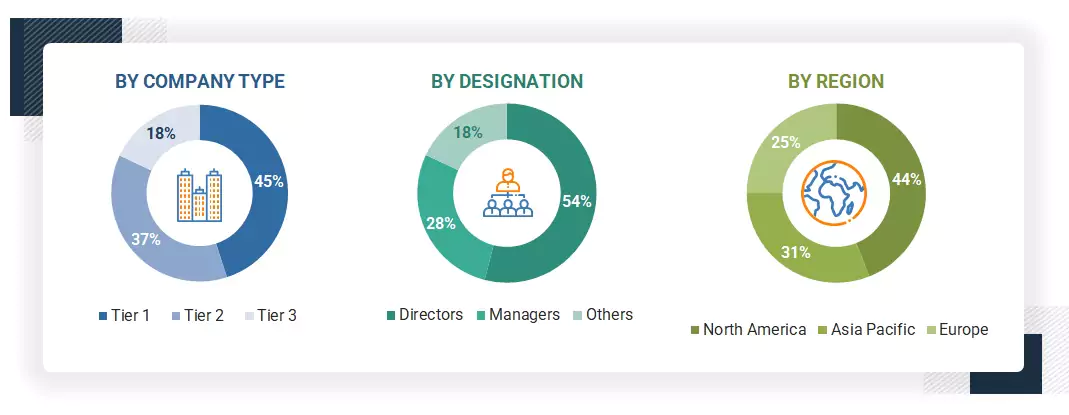
Notes: Others include sales, marketing, and product managers.
Tier 1: >USD 1 Billion; Tier 2: USD 500 million–1 Billion; and Tier 3: < USD 500 million.
To know about the assumptions considered for the study, download the pdf brochure
Market Size Estimation
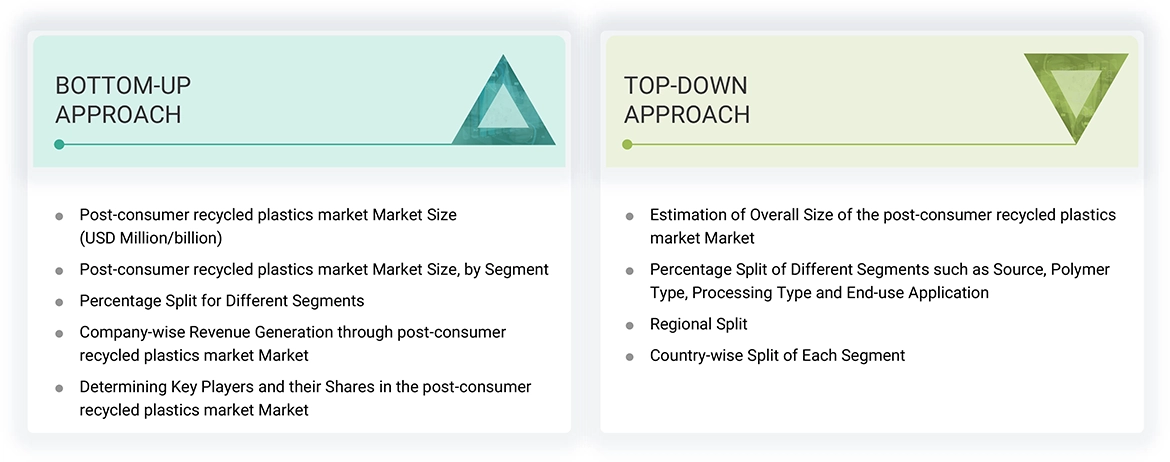
Both the top-down and bottom-up approaches were used to estimate and validate the global size of the post-consumer recycled plastics market. These approaches were also used extensively to estimate the size of various dependent segments of the market. The research methodology used to estimate the market size included the following:
Data Triangulation
After arriving at the overall market size using the market size estimation processes explained above, the market was split into several segments and subsegments. The data triangulation and market breakup procedures were employed, wherever applicable, to complete the overall market engineering process and arrive at the exact statistics of each market segment and subsegment. The data was triangulated by studying various factors and trends from both the demand and supply sides.
Market Definition
Post-consumer recycled resins or plastics are obtained by recycling the plastic waste collected from consumers, including bottles, containers, films and foams. Post-consumer plastic waste management covers recycling, recovery, and disposal of plastic waste collected from the consumers. Waste management systems across globle ensure the safe collection, segregation, storage, transportation, processing, and disposal of generated plastic waste. These systems also ensure that no harm is caused to the environment and the process is undertaken as per government rules, regulations and standards.
According to O. Berk Company (US), "Post-consumer resin (PCR) is an environmentally friendly packaging option that many manufacturers are using in support of recycling programs, consumer demand, and to reduce their impact on landfills." It further states that PCR plastics are recycled from existing PET bottles and other plastics.
According to Emmerson Packaging (Canada), "PCR is the technical term for plastic that has already been recycled and is ready to use again. It begins with the collection and sorting of recycled products-plastic bottles, for example. These bottles are then separated from other plastics, washed, and cleaned of all other materials (for example, the labels, bottle tops, etc.). The recycled plastic is then extruded and. reprocessed into PCR.
Stakeholders
- Post-consumer recycled plastics manufacturers
- Post-consumer recycled plastics traders, distributors, and suppliers
- End-use market participants of different segments of the post-consumer recycled plastics market
- Government and research organizations
- Associations and industrial bodies
- Research and consulting firms
- R&D institutions
- Environmental support agencies
- Investment banks and private equity firms
Report Objectives
- To estimate and forecast the post-consumer recycled plastics market, in terms of value and volume
- To provide detailed information about the major factors (drivers, restraints, opportunities, and challenges) influencing the market growth
- To define, describe, and forecast the market size, based on grade, process, application, and region
- To forecast the market size along with segments and submarkets, in key regions: North America, Europe, Asia Pacific (APAC), Middle East & Africa (MEA), and South America along with their key countries
- To strategically analyze micro markets, for individual growth trends, prospects, and their contribution to the total market
- To analyze growth opportunities in the market for stakeholders and provide details on the competitive landscape for market leaders
- To strategically profile key players and comprehensively analyze their market shares and core competencies
- To analyze competitive developments, such as merger & acquisition, expansion & investment, and agreements in the post-consumer recycled plastics market
Get the Full Post-Consumer Recycled Plastics Market Report
Full forecast, segment splits, and company analysis for all Post-Consumer Recycled Plastics Market.
- US Post-Consumer Recycled Plastics Market
- Canada Post-Consumer Recycled Plastics Market
- Mexico Post-Consumer Recycled Plastics Market
- Germany Post-Consumer Recycled Plastics Market
- UK Post-Consumer Recycled Plastics Market
- France Post-Consumer Recycled Plastics Market
- Italy Post-Consumer Recycled Plastics Market
- Russia Post-Consumer Recycled Plastics Market
- China Post-Consumer Recycled Plastics Market
- Japan Post-Consumer Recycled Plastics Market
- India Post-Consumer Recycled Plastics Market
- Vietnam Post-Consumer Recycled Plastics Market
- South Africa Post-Consumer Recycled Plastics Market
- Egypt Post-Consumer Recycled Plastics Market
- Brazil Post-Consumer Recycled Plastics Market
- Argentina Post-Consumer Recycled Plastics Market
- Rest Of Europe Post-Consumer Recycled Plastics Market
- Rest Of Asia Pacific Post-Consumer Recycled Plastics Market
- GCC Countries Post-Consumer Recycled Plastics Market
- -Rest Of The GCC Countries Post-Consumer Recycled Plastics Market
- Rest Of South America Post-Consumer Recycled Plastics Market
Need a Tailored Report?
Customize this report to your needs
Get 10% FREE Customization
Customize This Report
