
Europe Pumps Market (2024-2029)

The Europe Pumps Market was valued at $16234.5 Million in 2024 and projected to reach to $20231.3 Million by 2029, representing a compound annual growth rate of 4.5%. Europe's pumps market is positioned for steady growth through 2029, driven by industrial modernization, renewable energy infrastructure expansion, and regulatory compliance requirements.


| Market Size in | USD 26.32 MN |
| Market Forecast in | |
| CAGR | |
| Forecast Period | |
| Units Considered | Value (USD MN) |
Europe Pumps Market Trends and Insights
- This steady expansion reflects Europe's continued investment in industrial infrastructure, renewable energy transitions, and water management systems.
- Europe maintains a mature yet dynamic market characterized by stringent regulatory standards and a strong emphasis on energy efficiency and sustainability. The European pumps market benefits from robust demand across multiple sectors including power generation, oil and gas, water treatment, and HVAC applications.
- Europe's commitment to decarbonization and circular economy principles is driving adoption of advanced pump technologies that minimize energy consumption and environmental impact.
- Between 2024 and 2029, Europe is expected to see accelerated growth driven by infrastructure modernization, industrial automation, and the expansion of renewable energy projects across the region..
Key Market Statistics
- CAGR (2024-2029) 4.5% CAGR
- Market Size, 2024 ~USD 16234.5 Million
- Forecast, 2029 ~USD 20231.3 Million
- Geography Europe
Europe Pumps Market Overview
Market Valuation & Growth :
Europe's pumps market is valued at USD 16,234.5 million in 2024 and is projected to reach USD 20,231.3 million by 2029, with a steady CAGR of 4.5%, reflecting robust industrial demand and infrastructure investments.
Industrial Infrastructure Investment :
Europe's mature industrial base continues to drive pump demand across manufacturing, chemical processing, and HVAC systems, supported by ongoing modernization and replacement cycles in established economies.
Renewable Energy Transition :
The region's commitment to decarbonization and renewable energy adoption is accelerating demand for specialized pumps in hydroelectric, geothermal, and district heating systems across member states.
Water Management & Sustainability :
Stringent EU environmental regulations and water scarcity concerns are driving investments in advanced pumping solutions for wastewater treatment, desalination, and efficient water distribution networks.
Europe Pumps Market Dynamics
- The region's mature economy status ensures consistent replacement demand, while green energy transitions create new opportunities in specialized pump applications.
- Germany, France, and the UK lead market activity, supported by strong manufacturing sectors and environmental commitments.
- Investment in smart water systems and energy-efficient technologies will further propel market expansion, though growth rates remain moderate compared to emerging markets due to market saturation in developed economies..
Market Ecosystem
Related Ecosystem
Energy Circularity
- Epoxy Resin
- Progressive Cavity Pumps
- Amphoteric
- Bisphenol-A
- Cartridge Filters
- TotalEnergies SE
- ENEOS Holdings, Inc.
- Hess Corporation
- Baker Hughes Company
- Weatherford International plc
Industrial Equipment
- HVAC System
- Fiberglass
- Actuators
- Cartridge Filters
- Electrostatic Precipitators
- Siemens ag
- GRUNDFOS GROUP
- ABB India Limited
- SCHNEIDER ELECTRIC SE
- Eaton Corporation plc
Power Infrastructure
- Geographical Information System (GIS)
- Cogeneration
- Battery Electric Vehicle (BEV)
- Cellular Network
- Fuel Cell
- ABB India Limited
- Siemens ag
- SCHNEIDER ELECTRIC SE
- General Electric Company
- Eaton Corporation plc
Key Takeaways
- Europe's pumps market is valued at USD 16,234.5 million in 2024 and will reach USD 20,231.3 million by 2029 at a 4.5% CAGR.
- Europe's regulatory focus on energy efficiency and sustainability is accelerating demand for advanced, low-consumption pump technologies.
- Industrial modernization and renewable energy expansion across Europe are key growth drivers for the pumps market through 2029.
- Europe's mature market landscape is characterized by strong competition, technological innovation, and emphasis on environmental compliance.
Pumps Market Report Scope
| Report Metric | Details |
|---|---|
| Base Year | 2024 |
| Fastest Growing Segment | CENTRIFUGAL (Type) |
| Forecast Period | 2024-2029 |
| Growth Rate | CAGR of 5.2% from 2024 to 2029 |
| Largest Segment | INDUSTRIAL (End User) |
| Market Size Base Year (Billions) | ~USD 61.32 (2024) |
| Revenue Forecast (Billions) | ~USD 79.01 (2029) |
| Segments Covered | Type, Operation, End User, Industry |
Europe Pumps Market Report Segmentation
4 segment dimensions are covered across the global market.
By Type
- Between-Bearing Impeller
- Centrifugal
- Diaphragm
- Gear
- Lobe
- Overhung Impeller
- Peristaltic
- Piston
- Progressive Cavity
- Reciprocating
- Rotary
- Vane
- Vertically Suspended
By Operation
- Electric
- Mechanical
By End User
- Commercial & Residential
- Industrial
By Industry
- Agriculture
- Chemicals
- Food & Beverages
- Metals & Mining
- Oil & Gas
- Other Industries
- Pharmaceuticals
- Power Generation
- Water & Wastewater Management
REST OF EUROPE: PUMPS MARKET, BY END USER, 2024–2029
| Segment | 2024 | 2025 | 2026 | 2027 | 2028 | 2029 | CAGR (%) |
|---|---|---|---|---|---|---|---|
| COMMERCIAL & RESIDENTIAL | 1394 | 1441.4 | 1494.8 | 1555.7 | 1624.8 | 1701.8 | 4.1 |
| INDUSTRIAL | 4957.1 | 5097.6 | 5255.1 | 5433.9 | 5635.8 | 5859.1 | 3.4 |
| TOTAL | 6351.1 | 6539 | 6749.8 | 6989.6 | 7260.6 | 7560.9 | 3.5 |
EUROPE: PUMPS MARKET, BY END USER, 2024–2029
| Segment | 2024 | 2025 | 2026 | 2027 | 2028 | 2029 | CAGR (%) |
|---|---|---|---|---|---|---|---|
| COMMERCIAL & RESIDENTIAL | 3406 | 3521.1 | 3650.7 | 3798.9 | 3967.3 | 4154.8 | 4.1 |
| INDUSTRIAL | 12828.5 | 13317.5 | 13872.7 | 14513.1 | 15248 | 16076.5 | 4.6 |
| TOTAL | 16234.5 | 16838.6 | 17523.5 | 18312 | 19215.3 | 20231.3 | 4.5 |
Target Audience
- Industrial Equipment Manufacturers : Pump manufacturers and OEMs require detailed European market data to optimize product portfolios, identify regional demand patterns, and allocate R&D resources toward high-growth applications.
- Infrastructure & Utilities Companies : Water utilities, energy providers, and infrastructure operators need market insights to plan capital expenditures, evaluate pump technology upgrades, and align procurement strategies with regulatory requirements.
- Private Equity & Investment Firms : Investors evaluating acquisition targets or portfolio companies in the European pump sector require comprehensive market sizing, growth forecasts, and competitive dynamics to assess investment returns.
- Consulting & Engineering Firms : Engineering consultants and system integrators use European market data to advise clients on technology selection, cost optimization, and project feasibility across industrial and municipal applications.
- Government & Policy Organizations : EU regulatory bodies and national governments leverage market intelligence to inform energy efficiency policies, environmental standards, and infrastructure investment priorities aligned with sustainability goals.
Countries within Europe - compare and drill down
| Country | 2025 size (native) |
|---|---|
| Germany | USD 5933 Million |
| UK | USD 2172 Million |
| France | USD 2766.8 Million |
| Italy | USD 1798.8 Million |
| Rest Of Europe | USD 7560.9 Million |
Country market size visualization
Reasons to Buy this Report
- Country-Level Market Breakdown : Access detailed market sizing for Germany, UK, France, Italy, and Rest of Europe, enabling precise regional strategy development and competitive positioning across key European markets.
- Renewable Energy Opportunity Analysis : Identify high-growth segments within Europe's green energy transition, including hydroelectric, geothermal, and district heating pump applications driving incremental market value.
- Regulatory & Compliance Insights : Understand EU environmental standards, energy efficiency directives, and water management regulations shaping pump specifications and creating compliance-driven demand across the region.
- Competitive Landscape Intelligence : Benchmark against regional and global pump manufacturers operating in Europe, with insights into market consolidation, technology leadership, and customer preferences by country.
- Investment & Growth Forecasting : Leverage 5-year projections and CAGR analysis to identify expansion opportunities, capital allocation priorities, and market entry strategies tailored to European industrial dynamics.
Frequently asked questions
What is the current size of Europe's pumps market?
Europe's pumps market is valued at USD 16,234.5 million in 2024 and is expected to grow to USD 20,231.3 million by 2029.
What is the projected growth rate for Europe's pumps market?
Europe's pumps market is projected to grow at a compound annual growth rate (CAGR) of 4.5% from 2024 to 2029.
Which sectors drive demand in Europe's pumps market?
Key sectors driving Europe's pumps market include power generation, oil and gas, water treatment, HVAC systems, and renewable energy applications.
How is sustainability influencing Europe's pumps market?
Europe's commitment to decarbonization and energy efficiency standards is driving adoption of advanced, low-energy pump technologies that reduce environmental impact.
What factors will support Europe's pumps market growth through 2029?
Infrastructure modernization, industrial automation, renewable energy expansion, and stringent environmental regulations are key factors supporting Europe's pumps market growth.
RESEARCH METHODOLOGY
The study involved major activities in estimating the current size of the pumps market. Exhaustive secondary research was done to collect information on the peer and parent markets. The next step was to validate these findings, assumptions, and sizing with industry experts across the value chain through primary research. Both top-down and bottom-up approaches were employed to estimate the total market size. Thereafter, market breakdown and data triangulation were used to estimate the market size of the segments and subsegments.
Secondary Research
Secondary sources referred to for this research study include annual reports, press releases, and investor presentations of companies; white papers; certified publications; articles by recognized authors; and databases of various companies and associations. Secondary research was mainly used to obtain key information about the industry’s supply chain, the total pool of key players, market classification, and segmentation according to industry trends to the bottom-most level, regional markets, and key developments from both, market- and technology-oriented perspectives.
Primary Research
In the primary research process, various primary sources from the supply and demand sides were interviewed to obtain qualitative and quantitative information for this report. Primary sources from the supply side include industry experts such as chief executive officers (CEOs), vice presidents (VPs), marketing directors, and related key executives from various companies and organizations operating in the pumps market.
In the complete market engineering process, the top-down and bottom-up approaches, along with several data triangulation methods, were extensively used to perform the market size estimations and forecasts for all segments and subsegments listed in this report. Extensive qualitative and quantitative analyses were conducted to complete the market engineering process and list key information/insights throughout the report. Following is the breakdown of primary respondents:
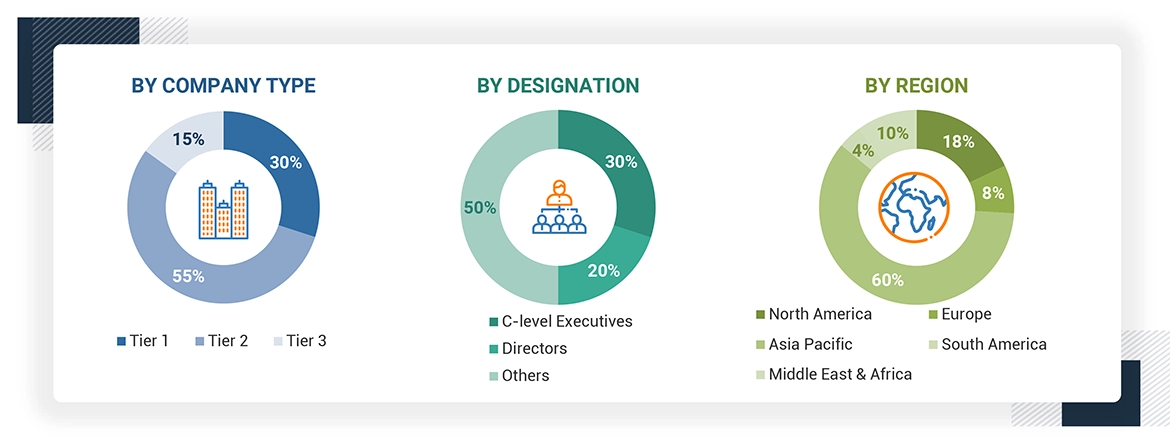
Note: Other designations include sales managers, engineers, and regional managers.
The tier of the companies is defined based on their total revenue; as of 2023: Tier 1 = > USD 1 billion,
Tier 2 = From USD 500 million to USD 1 billion, and Tier 3 = < USD 500 million.
To know about the assumptions considered for the study, download the pdf brochure
Market Size Estimation
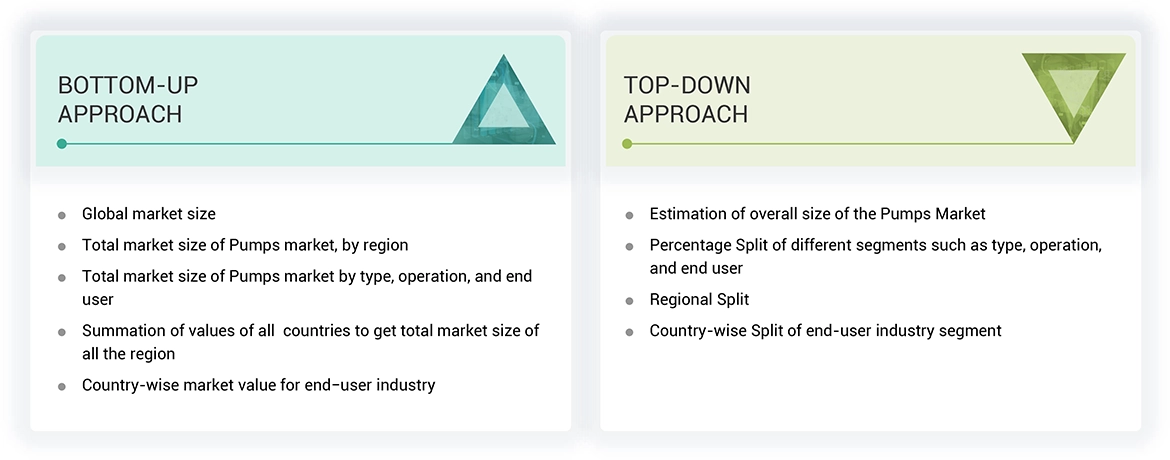
Both top-down and bottom-up approaches were used to estimate and validate the size of the pumps market. These methods were also used extensively to estimate the size of various subsegments in the market. The research methodology used to estimate the market size includes the following:
Pumps Market : Top-Down and Bottom-Up Approach
Data Triangulation
After arriving at the overall market size from the estimation process explained below, the total market was split into several segments and subsegments. The data triangulation and market breakdown procedures were employed, wherever applicable, to complete the overall market engineering process and arrive at the exact statistics for all segments and subsegments. The data was triangulated by studying various factors and trends from both the demand and supply sides. The market size was validated using the top-down and bottom-up approaches.
Market Definition
The global pumps market encompasses the production, distribution, and application of devices used to move fluids, such as water, oil, chemicals, and slurries, across various industries. These devices are essential for maintaining fluid flow in sectors including water and wastewater treatment, oil and gas, chemicals, power generation, pharmaceuticals, and construction. The market is segmented by pump types—such as centrifugal, positive displacement, and specialty pumps—each serving distinct operational needs based on fluid properties, pressure, and volume requirements. Driven by trends in infrastructure development, urbanization, and environmental regulations, the pumps market is increasingly influenced by the demand for energy-efficient, smart, and sustainable technologies, which are integral in reducing energy consumption and meeting environmental standards across industries..
Stakeholders
- Pump manufacturer associations.
- Oilfield service players
- Public and private water supply and pumping station operators
- Government and research organizations
- Pump raw material providers.
- Consulting companies
- Industrial users
Report Objectives
- To define, describe, segment, and forecast the pumps market, by type, technology, and end-user.
- To forecast the market size, by value, for five key regions: North America, Europe, Asia Pacific, Middle East & Africa, and South America, along with their key countries
- To provide detailed information about the key factors, such as drivers, restraints, opportunities, and challenges, value chain analysis, porters five forces analysis, trade analysis, case study analysis, technology analysis, influencing the growth of the market
- To strategically analyze the subsegments concerning individual growth trends, prospects, and contributions of each segment to the overall market size
- To analyze market opportunities for stakeholders and details of the competitive landscape for market leaders
- To strategically profile the key players and comprehensively analyze their market shares and core competencies.
- To track and analyze competitive developments, such as product launches, mergers, acquisitions, expansions, and supply contracts in the pumps market.
- To study impact of artificial intelligence on pumps market
Available Customizations
With the given market data, MarketsandMarkets offers customizations according to the specific requirements of companies. The following customization options are available for the report:
Product Analysis
- Product Matrix, which provides a detailed comparison of the product portfolio of each company
Company Information
- Detailed analyses and profiling of additional market players
Get the Full Pumps Market Report
Full forecast, segment splits, and company analysis for all Pumps Market.
- Saudi Arabia Pumps Market
- UAE Pumps Market
- South Africa Pumps Market
- Brazil Pumps Market
- Argentina Pumps Market
- Rest Of Europe Pumps Market
- Rest Of Asia Pacific Pumps Market
- GCC Pumps Market
- Rest Of GCC Pumps Market
- Rest Of South America Pumps Market
- China Pumps Market
- India Pumps Market
- Japan Pumps Market
- South Korea Pumps Market
- Germany Pumps Market
- UK Pumps Market
- France Pumps Market
- Italy Pumps Market
- Canada Pumps Market
- Mexico Pumps Market
- US Pumps Market
Need a Tailored Report?
Customize this report to your needs
Get 10% FREE Customization
Customize This Report
