
Germany Push-Pull Control Cables Market (2025-2030)

The Germany Push-Pull Control Cables Market was valued at $42680 Million in 2025 and projected to reach to $36704 Million by 2030, representing a compound annual growth rate of -2.1%. Germany's push-pull control cables market faces headwinds as the automotive industry accelerates its electrification agenda.


| Market Size in | USD 26.32 MN |
| Market Forecast in | |
| CAGR | |
| Forecast Period | |
| Units Considered | Value (USD MN) |
Germany Push-Pull Control Cables Market Trends and Insights
- This contraction in Germany signals structural headwinds in the automotive and transportation sector, where traditional mechanical cable systems face pressure from electrification and digital control technologies.
- Germany, as Europe's largest automotive manufacturer, is experiencing a shift away from conventional push-pull cable architectures toward integrated electronic control systems in vehicles. The decline in Germany's market through 2030 underscores the industry's transition toward alternative actuation methods and the maturation of legacy cable-based solutions.
- Germany's automotive OEMs and suppliers are increasingly investing in electric and hybrid powertrains, which require fewer mechanical control cables.
- Despite the negative trajectory, Germany remains a critical hub for automotive component innovation, and manufacturers in Germany continue to serve niche applications and aftermarket segments where push-pull control cables retain relevance..
Key Market Statistics
- CAGR (2025-2030) -2.1% CAGR
- Market Size, 2025 ~USD 42680 Million
- Forecast, 2030 ~USD 36704 Million
- Country Germany
Germany Push-Pull Control Cables Market Overview
Market Contraction in Germany :
Germany's push-pull control cables market is experiencing a -2.1% CAGR, declining from USD 42,680 million in 2025 to USD 36,704 million by 2030, reflecting significant structural challenges in the automotive sector.
Electrification Impact :
The shift toward electric vehicles and digital control systems in Germany's automotive industry is reducing demand for traditional mechanical cable systems, accelerating market decline.
Divergence from Global Trends :
While the global push-pull control cables market grows at 1.5% CAGR, Germany's negative trajectory highlights the country's advanced transition to next-generation vehicle technologies.
Strategic Market Repositioning :
German manufacturers must adapt to declining mechanical cable demand by investing in hybrid solutions and transitioning to electronic control systems to remain competitive.
Germany Push-Pull Control Cables Market Dynamics
- Traditional mechanical cable systems are being phased out in favor of electronic and digital control mechanisms, particularly in premium vehicle segments where German manufacturers dominate.
- The -2.1% CAGR reflects this structural shift, with OEMs and suppliers investing heavily in alternative technologies. By 2030, the market will stabilize at a lower baseline as legacy applications diminish.
- However, niche opportunities remain in commercial vehicles, aftermarket services, and specialized industrial applications.
- German suppliers must leverage their engineering expertise to develop hybrid solutions and position themselves in the emerging electronic control ecosystem to offset mechanical cable market losses..
Market Ecosystem
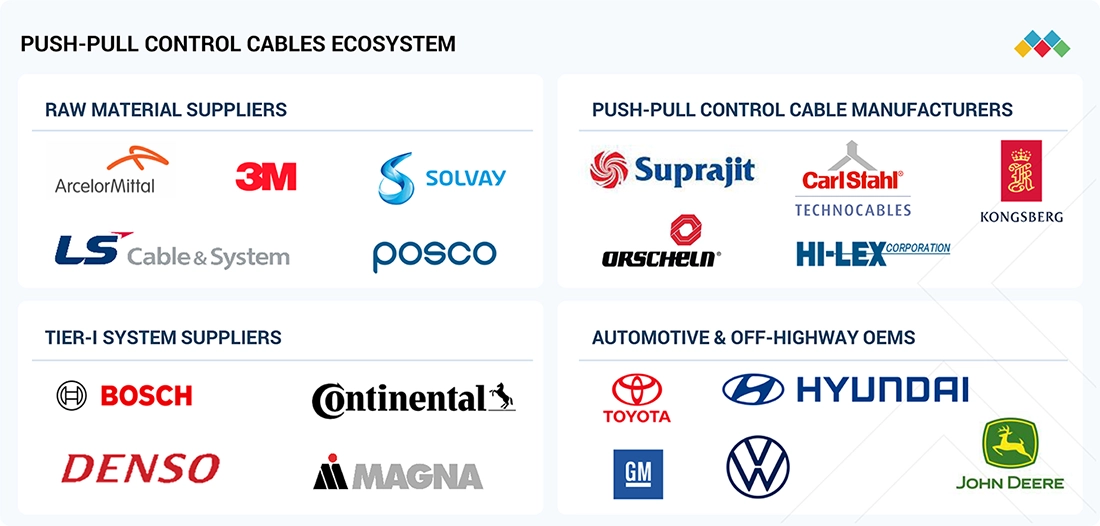
PUSH-PULL CONTROL CABLES MARKET: COMMERCIAL USE CASES ACROSS INDUSTRIES
| COMPANY | USE CASE DESCRIPTION | BENEFITS |
|---|---|---|
 |
Designs and supplies complete mechanical actuation solutions for throttle, clutch, and braking systems | Ensures smooth and reliable control in passenger and commercial vehicles under varying load and environmental conditions | Ensures high reliability, precision actuation, reduced maintenance, and ability to meet stringent global OEM standards |
 |
Provides integrated cable systems for door operation, window regulators, and seat adjustments | Enables consistent mechanical actuation and ergonomic functionality across mass-production vehicle platforms | Ensures smooth operation, long service life, and compliance with quality standards critical for OEM production lines |
 |
Delivers robust mechanical control solutions for throttle, brake, gear shift, pull-release, and remote valve systems in on-highway trucks and off-highway industrial/agricultural machinery, capable of operating in harsh conditions | Offers reliable actuation under vibration, dust, and thermal stress | Enhances operational safety and system longevity |
 |
Supplies heavy-duty key interlock and parking-brake cable assemblies for commercial trucks and off-road vehicles | Engineered to withstand high stress, extended duty cycles, and adverse environmental conditions | Offers high durability, operational safety, and optimized for demanding commercial and utility fleet applications |
Logos and trademarks shown above are the property of their respective owners. Their use here is for informational and illustrative purposes only.
Related Ecosystem
Key Takeaways
- Germany's push-pull control cables market contracts at -2.1% CAGR from 2025 to 2030, declining from USD 42.68B to USD 36.70B.
- Electrification of vehicles in Germany is reducing demand for traditional mechanical cable control systems in favor of electronic alternatives.
- Germany's position as Europe's automotive leader means the market decline reflects broader industry-wide transition toward digital and electric actuation technologies.
- Aftermarket and specialty applications in Germany provide residual demand, though OEM production volumes for push-pull cables continue to erode.
Push-Pull Control Cables Market Report Scope
| Report Metric | Details |
|---|---|
| Base Year | 2025 |
| Fastest Growing Segment | SPARE WHEEL CARRIER CABLE (Product Type) |
| Forecast Period | 2025–2030 |
| Growth Rate | CAGR of 1.5% from 2025 to 2030 |
| Largest Segment | AUTOMOTIVE (Industry) |
| Market Size Base Year (Billions) | ~USD 8.33 (2025) |
| Revenue Forecast (Billions) | ~USD 8.97 (2030) |
| Segments Covered | Product Type, Application, Industry, Equipment Type, Engine Power Output, Cable Type, Vehicle Type, Propulsion |
Germany Push-Pull Control Cables Market Report Segmentation
8 segment dimensions are covered across the global market.
By Product Type
- Clutch Cable
- Door Latch Cable
- Fuel Lid Cable
- Gear Shift Cable
- Hood Release Cable
- Parking Brake Cable
- Seat Recliner Release Cable
- Spare Wheel Carrier Cable
- Throttle Cable
- Trunk Release Cable
By Application
- Auxiliary
- Brake
- Engine
- Transmission
By Industry
- Agriculture
- Automotive
- Construction
- Marine
- Railway
By Equipment Type
- Backhoe Loaders
- Balers
- Compactors
- Dozers
- Dump Trucks
- Excavators
- Harvesters
- Mini Excavators
- Motor Graders
- Road Rollers
- Sprayers
- Tractors
By Engine Power Output
- 131–250 Hp
- 31–70 Hp
- 71–130 Hp
- < 30 Hp
- > 250 Hp
By Cable Type
- Pull-Only Cable
- Push-Pull Cable
By Vehicle Type
- Heavy Commercial Vehicle
- Heavy Commercial Vehicles
- Light Commercial Vehicle
- Light Commercial Vehicles
- Passenger Car
- Passenger Cars
By Propulsion
- EV
- ICE
Target Audience
- German Automotive OEMs : Major manufacturers need Germany-specific market data to plan cable system phase-outs, manage supplier relationships, and allocate R&D budgets toward electronic alternatives.
- Cable & Component Suppliers : German and international suppliers require detailed market forecasts to assess viability, plan capacity adjustments, and identify diversification opportunities in the declining mechanical cable segment.
- Private Equity & Investment Firms : Investors evaluating German automotive supply chain assets need market contraction data to assess portfolio risk, identify consolidation targets, and plan exit strategies.
- Automotive Consultants & Analysts : Strategy consultants advising German manufacturers and suppliers require granular market intelligence to develop transformation roadmaps and competitive positioning recommendations.
- Aftermarket & Service Providers : Companies serving the German automotive aftermarket need forecasts to understand long-term demand for replacement cables and plan service offerings for aging vehicle fleets.
Key Companies in the Germany Push-Pull Control Cables Market
| Company | HQ | Ownership | Strongest segments |
|---|---|---|---|
| HI-LEX CORPORATION | Japan | Public Company | Automotive door and closure systems (door modules, window regulators, power lift gates, electronic parking systems),Cables and actuators (push-pull, pull cables, SPIRAX, accelerator actuators, actuators for industrial equipment),Housing, marine, and nursing care equipment components, |
| SUPRAJIT | India | Public Company | Control cables and actuation systems,Lighting (halogen and LED bulbs, lighting systems),Instrument clusters, TFT clusters, and telematics, |
| KONGSBERG AUTOMOTIVE | Norway | Public Company | Drive Control Systems (DCS),Flow Control Systems (FCS), |
| DIPLOMA PLC | United Kingdom | Public Company | Seals,Controls,Life Sciences, |
| REMSONS INDUSTRIES LIMITED | India | Public Company | Automotive cables (parking brake, clutch, throttle, door, seat, window, push–pull, sunroof, winch),Brake systems and related components (parking brake mechanisms, brake slack adjusters, air brake components, defense brakes),Steering systems, gear shift and combi brake systems, pedal box assemblies, winches, jack kits, handle assemblies, |
| LEGGETT & PLATT, INCORPORATED | United States | Public Company | Bedding components and finished mattresses,Furniture and office components,Automotive and aerospace systems, |
HI-LEX CORPORATION
HI-LEX CORPORATION is a Japanese public company founded in 1946 with 12,071 employees. The company operates as a major industrial manufacturer with a significant global workforce.
SUPRAJIT
SUPRAJIT is an Indian public company established in 1985 with 2,188 employees. The company operates in the industrial manufacturing sector.
KONGSBERG AUTOMOTIVE
KONGSBERG AUTOMOTIVE is a Norwegian public company founded in 1957 with 4,214 employees. The company is an established industrial manufacturer with significant international operations.
DIPLOMA PLC
DIPLOMA PLC is a United Kingdom public company founded in 1999 with 3,400 employees. The company operates as an established industrial distributor and service provider.
REMSONS INDUSTRIES LIMITED
REMSONS INDUSTRIES LIMITED is an Indian public company founded in 1959 with 244 employees. The company operates as a specialized industrial manufacturer.
LEGGETT & PLATT, INCORPORATED
LEGGETT & PLATT, INCORPORATED is a United States public company founded in 1883 with 15,900 employees. The company is a long-established manufacturer with a substantial global workforce.
Reasons to Buy this Report
- Understand Market Decline Drivers : Gain detailed insights into why Germany's market is contracting at -2.1% CAGR, including electrification trends, regulatory pressures, and OEM strategy shifts specific to the German automotive sector.
- Competitive Positioning Strategy : Identify how German manufacturers are adapting to market contraction, benchmark against competitors, and discover repositioning opportunities in hybrid and electronic control systems.
- Investment & M&A Intelligence : Access data on market consolidation, supplier viability, and acquisition targets within Germany's declining mechanical cable segment to inform strategic investment decisions.
- Supply Chain Optimization : Understand Germany-specific supply chain dynamics, identify cost reduction opportunities, and plan transitions away from legacy mechanical systems toward next-generation technologies.
- Forecast-Driven Planning : Leverage 2025-2030 projections to align production capacity, R&D investments, and market exit strategies with Germany's evolving automotive landscape and electrification timeline.
Frequently asked questions
Why is Germany's push-pull control cables market declining?
Germany's market is declining due to the automotive industry's shift toward electrification and electronic control systems, which replace traditional mechanical push-pull cable architectures in modern vehicles manufactured in Germany.
What is the market size of push-pull control cables in Germany in 2025?
Germany's push-pull control cables market is valued at USD 42,680 million in 2025 according to verified market data.
What will Germany's push-pull control cables market be worth in 2030?
Germany's push-pull control cables market is forecast to reach USD 36,704 million by 2030, representing a decline of approximately 14% over the five-year period.
Which industries in Germany use push-pull control cables?
Push-pull control cables in Germany are primarily used in automotive and transportation applications, including commercial vehicles, specialty equipment, and aftermarket automotive components.
Are there growth opportunities in Germany's push-pull control cables market?
While the overall market declines, Germany offers niche opportunities in aftermarket replacement parts, specialty vehicles, and industrial equipment where mechanical cable systems remain essential.
RESEARCH METHODOLOGY
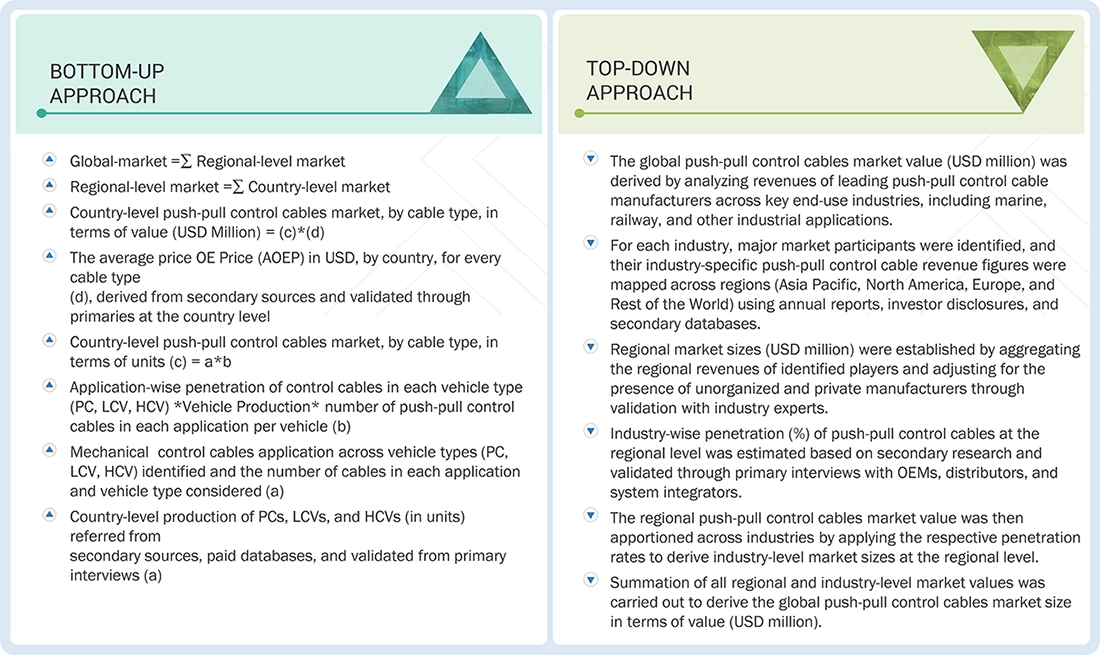
The study involves the use of four main activities to estimate the current size of the push-pull control cables market. Exhaustive secondary research was conducted to gather information on the market based on product, application, cable type, vehicle type, industry, and region. The next step was to validate these findings, assumptions, and market analysis with industry experts across value chains through primary research. Bottom-up and top-down approaches were employed to estimate the complete market size for different segments considered in this study. Thereafter, market breakdown and data triangulation processes were used to estimate the market size of segments and subsegments.
Secondary Research
Secondary sources referred to for estimating the push-pull control cables market included automotive industry organizations, such as Organisation Internationale des Constructeurs d’Automobiles (OICA) and publications from government sources [country-level automotive associations and organizations, Organisation for Economic Co-operation and Development (OECD), World Bank, CDC, and Eurostat]; corporate filings (such as annual reports, investor presentations, and financial statements); and trade repository. Additionally, historical production data was collected and analyzed, and this data was further validated by primary research.
Primary Research
During the primary research process, various primary sources from the supply and demand sides were interviewed to gather qualitative and quantitative information on the market. The primary sources from the supply side included various industry experts, such as CXOs; vice presidents; directors from business development, marketing, product development/innovation teams; and related key executives from various key companies. Various system integrators, industry associations, independent consultants/industry veterans, as well as key opinion leaders, were also interviewed.
Primary interviews were conducted to gather insights, including vehicle production forecasts, push-pull control cables market forecasts, future technology trends, and upcoming technologies in the push-pull control cables market. Data triangulation was conducted across all these points, utilizing information gathered from secondary research and model mapping. Stakeholders from the demand and supply sides were interviewed to understand their views on the aforementioned points.
Primary interviews were also conducted with market experts from the demand (OEMs) and supply-side (Mechanical control cable manufacturers) players across four major regions, namely North America, Europe, Asia Pacific, and the Rest of the World. Approximately 46% and 54% of primary interviews were conducted from the demand and supply sides, respectively. Primary data was collected through questionnaires, emails, and telephonic interviews. In the canvassing of primaries, various departments within organizations, such as sales and operations, were covered to provide a holistic viewpoint in our report.
After interacting with industry experts, brief sessions with highly experienced independent consultants were conducted to reinforce the findings from our primaries. This, along with the opinions of our in-house subject matter experts, led us to the conclusions described in the remainder of this report.
BREAKDOWN OF PRIMARY INTERVIEWS
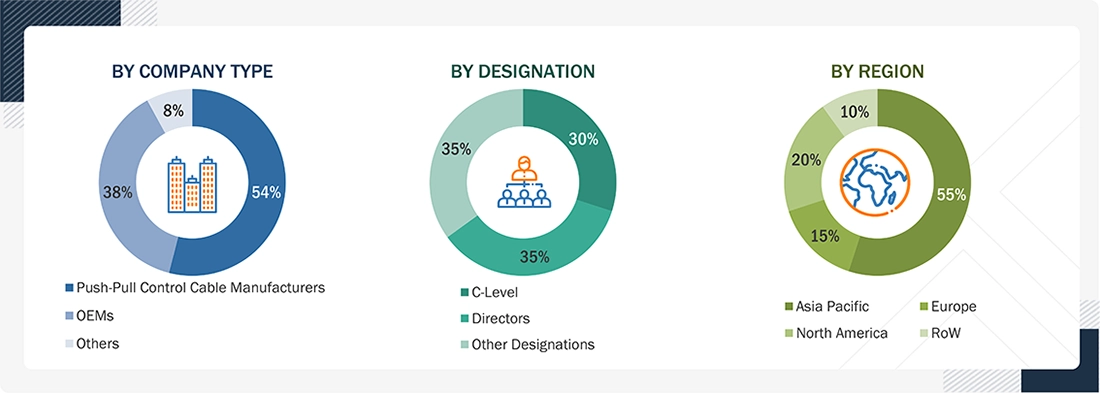
Notes:
- Others included Sales, Marketing, and Product Managers.
- Other Designations included Infotainment Component and Technology Providers.
- Company tiers are based on the value chain, and not the revenue figures of companies listed.
To know about the assumptions considered for the study, download the pdf brochure
Market Size Estimation
A detailed market estimation approach was employed to estimate and validate the value of the push-pull control cables market, as well as its dependent submarkets.
Top-Down and Bottom-Up Approach
Data Triangulation
After arriving at the overall market size using the market size estimation processes as explained above, the market was split into several segments and subsegments. To complete the overall market engineering process and arrive at the exact statistics of each market segment and subsegment, data triangulation and market breakdown procedures were employed, wherever applicable. The data was triangulated by studying various factors and trends from both the demand and supply sides.
Market Definition
The push-pull control cables market covers control cables, which are flexible mechanical assemblies used to transmit motion and force from a control input to a remote mechanism through an inner moving core guided by an outer conduit. They enable accurate mechanical actuation where rigid linkages are unsuitable due to routing, space, or movement constraints. Push-pull control cables are a category of push-pull control cables. They are designed to transmit force in compression and tension, allowing bidirectional movement and position control. Their inner core is constructed to resist buckling under compressive loads while maintaining smooth linear motion. Pull-only control cables are designed to transmit force only in tension and cannot carry compressive loads. Return motion in pull-only systems is achieved using external springs, gravity, or counteracting mechanisms.
Key Stakeholders
- Automotive OEMs
- Conduit, Liner, and Polymer Sheath Suppliers
- End Fitting, Terminal, and Linkage Hardware Manufacturers
- Fleet Operators and Industrial Equipment Owners
- Mechanical Control Cable Manufacturers
- Off-Highway, Agricultural, and Construction Equipment OEMs
- Rail, Marine, and Aerospace Equipment Manufacturers
- Steel Wire, Stranded Cable, and Rod Suppliers
- Testing, Certification, and Standards Organizations
- Tier-1 Mechanical System and Actuation Module Suppliers
- Tooling, Automation, and Cable Assembly Equipment Providers
Report Objectives
-
To define, describe, and forecast the size of the push-pull control cables market in terms of value (USD million) based on
- Industry (Automotive, Marine, Construction, Agriculture, Railway, Others)
- Application (Engine Cable, Transmission Cable, Brake Cable, Auxiliary Cable)
- Product (Throttle Cable, Gear Shift Cable, Clutch Cable, Parking Brake Cable, Hood Release Cable, Fuel Door Release Cable, Trunk Release Cable, Door Latch Cable, Spare Wheel Carrier Cable, Seat Recline Release Cable)
- Cable Type (Push-Pull Cable, Pull-Only Cable)
- Vehicle Type (Passenger Car, Light Commercial Vehicle, Heavy Commercial Vehicle)
- Region (Asia Pacific, Europe, North America, Rest of the World)
- To identify and analyze key drivers, restraints, opportunities, and challenges influencing market growth
- To study the following concerning the market:
- Supply Chain Analysis
- Ecosystem Analysis
- Technology Analysis
- Trade Analysis
- Case Study Analysis
- Patent Analysis
- Regulatory Landscape
- Average Selling Price Analysis
- Impact of AI/Gen AI
- Trend and Disruption Impact
- Key Stakeholders and Buying Criteria
- Key Conferences and Events
- To understand competition in the push-pull control cables market and position players as stars, emerging leaders, pervasive players, and participants based on their product portfolios and business strategies
- To strategically analyze key player strategies/right to win, as well as evaluate the competitive leadership mapping
- To analyze the opportunities in the market for stakeholders and provide details of the competitive landscape for market leaders
- To provide an analysis of recent developments, such as joint ventures, mergers & acquisitions, product launches/developments, and other activities carried out by key market players
Customizations Options:
Along with the given market data, MarketsandMarkets offers customizations in accordance with a company’s specific needs. The following customizations are available:
- Push-pull control cables Market, By Industry, at Country Level (For Countries Covered In Report)
- Company Information, Profiling of Additional Market Players (Up to 5)
Get the Full Push-Pull Control Cables Market Report
Full forecast, segment splits, and company analysis for all Push-Pull Control Cables Market.
- China Push-Pull Control Cables Market
- Japan Push-Pull Control Cables Market
- India Push-Pull Control Cables Market
- South Korea Push-Pull Control Cables Market
- Thailand Push-Pull Control Cables Market
- Indonesia Push-Pull Control Cables Market
- France Push-Pull Control Cables Market
- UK Push-Pull Control Cables Market
- Italy Push-Pull Control Cables Market
- Spain Push-Pull Control Cables Market
- Russia Push-Pull Control Cables Market
- US Push-Pull Control Cables Market
- Canada Push-Pull Control Cables Market
- Mexico Push-Pull Control Cables Market
- South Africa Push-Pull Control Cables Market
- Saudi Arabia Push-Pull Control Cables Market
- Egypt Push-Pull Control Cables Market
- Rest Of Asia Pacific Push-Pull Control Cables Market
Need a Tailored Report?
Customize this report to your needs
Get 10% FREE Customization
Customize This Report
