
South Korea Quantum Networking Market (2024-2029)

The South Korea Quantum Networking Market was valued at $14.9 Million in 2024 and projected to reach to $96.5 Million by 2029, representing a compound annual growth rate of 45.3%. South Korea's quantum networking market is positioned for exceptional growth through 2029, driven by strategic government initiatives, substantial corporate R&D investments, and the nation's technological expertise.


| Market Size in | USD 26.32 MN |
| Market Forecast in | |
| CAGR | |
| Forecast Period | |
| Units Considered | Value (USD MN) |
South Korea Quantum Networking Market Trends and Insights
- This exceptional growth trajectory reflects South Korea's strategic investments in quantum technologies and its position as a global semiconductor leader.
- South Korea is leveraging its advanced infrastructure and R&D capabilities to establish itself as a key player in quantum networking innovation. The quantum networking sector in South Korea is driven by government initiatives, private sector investment, and collaboration between technology companies and research institutions.
- South Korea's commitment to quantum computing and secure communications is accelerating the adoption of quantum networking solutions across telecommunications, finance, and defense sectors.
- By 2029, South Korea is expected to capture significant market share within the Asia Pacific region, solidifying its role in the global quantum networking ecosystem..
Key Market Statistics
- CAGR (2024-2029) 45.3% CAGR
- Market Size, 2024 ~USD 14.9 Million
- Forecast, 2029 ~USD 96.5 Million
- Country South Korea
South Korea Quantum Networking Market Overview
Rapid Market Expansion :
South Korea's quantum networking market is projected to grow from $14.9 million in 2024 to $96.5 million by 2029, representing a robust 45.3% CAGR, outpacing the global average of 44.2%.
Semiconductor Leadership Advantage :
South Korea's established position as a global semiconductor powerhouse provides a competitive foundation for quantum networking development, with companies like Samsung and SK Hynix investing in quantum infrastructure.
Government-Backed R&D Initiatives :
South Korean government support through strategic quantum technology programs and substantial R&D funding is accelerating innovation in quantum networking applications and commercialization timelines.
Advanced Infrastructure Ecosystem :
South Korea's world-class telecommunications infrastructure, 5G leadership, and tech-savvy workforce create an ideal environment for quantum networking deployment and integration with existing networks.
South Korea Quantum Networking Market Dynamics
- The country's semiconductor industry leaders are actively developing quantum-ready infrastructure and exploring practical applications in secure communications and financial services.
- South Korea's commitment to becoming a quantum technology hub, combined with its advanced manufacturing capabilities and skilled workforce, will likely attract international partnerships and accelerate commercialization.
- The market is expected to benefit from increased enterprise adoption, government procurement programs, and the integration of quantum networking with South Korea's existing 5G and telecommunications networks, solidifying its position as a key regional quantum innovation center..
Market Ecosystem
Related Ecosystem
Communication And Connectivity Technology
- Sensors
- Smart Card & Readers
- Cellular Network
- Femtocell
- Image Sensors
- Cisco Systems, Inc.
- HUAWEI TECHNOLOGIES CO LTD
- Lenovo
- CommScope Holding Company, Inc.
- Texas Instruments Incorporated
Cloud Computing
- Software as A Service (SaaS)
- Natural Language Processing (NLP)
- Platform as A Service (PaaS)
- Machine Learning
- Supply Chain Management
- International Business Machines Corporation
- MICROSOFT CORPORATION
- Oracle Corporation
- Amazon.com, Inc.
Key Takeaways
- South Korea's quantum networking market is projected to grow from $14.9M (2024) to $96.5M (2029), representing a 45.3% CAGR.
- South Korea is positioning itself as a regional quantum technology hub through government-backed R&D initiatives and private sector partnerships.
- South Korea's advanced semiconductor infrastructure and telecommunications expertise are accelerating quantum networking adoption across multiple sectors.
- South Korea is expected to emerge as a significant contributor to Asia Pacific quantum networking growth by 2029.
Quantum Networking Market Report Scope
| Report Metric | Details |
|---|---|
| Base Year | 2024 |
| Fastest Growing Segment | IT & TELECOM (End-Use Industry) |
| Forecast Period | 2024-2029 |
| Growth Rate | CAGR of 44.2% from 2024 to 2029 |
| Largest Segment | HARDWARE (Offering) |
| Market Size Base Year (Billions) | ~USD 0.86 (2024) |
| Revenue Forecast (Billions) | ~USD 5.38 (2029) |
| Segments Covered | Offering, Type, End-Use Industry |
South Korea Quantum Networking Market Report Segmentation
3 segment dimensions are covered across the global market.
By Offering
- Banking & Finance
- Energy & Utilities
- Government & Defense
- Hardware
- Healthcare & Life Sciences
- It & Telecom
- Manufacturing
- Other End-Use Industries
- Software
By Type
- Other Hardware Types
- Quantum Key Distribution Systems
- Quantum Memory
- Quantum Random Number Generators
- Quantum Repeater
By End-Use Industry
- Banking & Finance
- Energy & Utilities
- Government & Defense
- Healthcare & Life Sciences
- It & Telecom
- Manufacturing
- Other End-Use Industries
Target Audience
- Technology Investors & VCs : Identify high-growth quantum networking investment opportunities in South Korea with detailed market sizing, growth trajectories, and emerging company profiles to guide capital allocation decisions.
- Semiconductor & Electronics Companies : Evaluate South Korea's quantum networking market potential for product development, partnership strategies, and market entry planning within the region's competitive semiconductor ecosystem.
- Government & Policy Makers : Leverage market intelligence to inform quantum technology policy, R&D funding priorities, and strategic initiatives that position South Korea as a leading quantum innovation hub.
- Telecommunications Providers : Understand quantum networking integration opportunities within South Korea's advanced telecom infrastructure and identify use cases for secure communications and next-generation network services.
- Strategic Consultants & Analysts : Access comprehensive South Korea market data to support client advisory services, competitive benchmarking, and strategic recommendations for quantum technology stakeholders in the region.
Reasons to Buy this Report
- Market-Specific Growth Projections : Access detailed South Korea-specific forecasts showing 45.3% CAGR through 2029, enabling precise investment planning and resource allocation for the region's quantum networking opportunities.
- Competitive Landscape Intelligence : Understand South Korea's unique competitive positioning relative to global markets, including analysis of local players, government support mechanisms, and strategic advantages in quantum technology development.
- Regional Investment Opportunities : Identify high-potential investment targets and partnership opportunities within South Korea's quantum networking ecosystem, including emerging startups and established semiconductor companies expanding into quantum.
- Government Policy & Incentive Analysis : Gain insights into South Korean government quantum initiatives, funding programs, and regulatory frameworks that directly impact market growth and create entry points for international stakeholders.
- Localized Technology Roadmap : Understand South Korea-specific technology adoption timelines, infrastructure requirements, and integration pathways with existing 5G and telecommunications networks for strategic planning.
Frequently asked questions
What is the current size of South Korea's quantum networking market?
South Korea's quantum networking market was valued at $14.9 million in 2024 and is expected to grow significantly through 2029.
What is the projected market size for South Korea's quantum networking sector by 2029?
South Korea's quantum networking market is forecasted to reach $96.5 million by 2029, driven by technological advancement and increased adoption.
What is the CAGR for South Korea's quantum networking market?
South Korea's quantum networking market is expected to grow at a compound annual growth rate of 45.3% between 2024 and 2029.
Which sectors are driving quantum networking adoption in South Korea?
South Korea's telecommunications, finance, and defense sectors are primary drivers of quantum networking adoption, supported by government initiatives.
How does South Korea's quantum networking market compare to the global market?
South Korea's 45.3% CAGR slightly exceeds the global average of 44.2%, reflecting the country's strong commitment to quantum technology development.
RESEARCH METHODOLOGY
The research process for this technical, market-oriented, and commercial study of the quantum networking market included the systematic gathering, recording, and analysis of data about companies operating in the market. It involved the extensive use of secondary sources, directories, and databases (Factiva, Oanda, and OneSource) to identify and collect relevant information. In-depth interviews were conducted with various primary respondents, including experts from core and related industries and preferred manufacturers, to obtain and verify critical qualitative and quantitative information as well as to assess the growth prospects of the market. Key players in the quantum networking market were identified through secondary research, and their market rankings were determined through primary and secondary research. This included studying annual reports of top players and interviewing key industry experts, such as CEOs, directors, and marketing executives.
Secondary Research
In the secondary research process, various secondary sources were used to identify and collect information for this study. These include annual reports, press releases, and investor presentations of companies, whitepapers, certified publications, and articles from recognized associations and government publishing sources. Research reports from a few consortiums and councils were also consulted to structure qualitative content. Secondary sources included corporate filings (such as annual reports, investor presentations, and financial statements); trade, business, and professional associations; white papers; Journals and certified publications; articles by recognized authors; gold-standard and silver-standard websites; directories; and databases. Data was also collected from secondary sources, such as the International Trade Centre (ITC) (Switzerland), and the International Monetary Fund (IMF).
Primary Research
Extensive primary research was accomplished after understanding and analyzing the quantum networking market scenario through secondary research. Several primary interviews were conducted with key opinion leaders from both demand- and supply-side vendors across four major regions—North America, Europe, Asia Pacific, and RoW. Approximately 30% of the primary interviews were conducted with the demand side, and 70% with the supply side. Primary data was collected through questionnaires, emails, and telephonic interviews. Various departments within organizations, such as sales, operations, and administration, were contacted to provide a holistic viewpoint in the report.
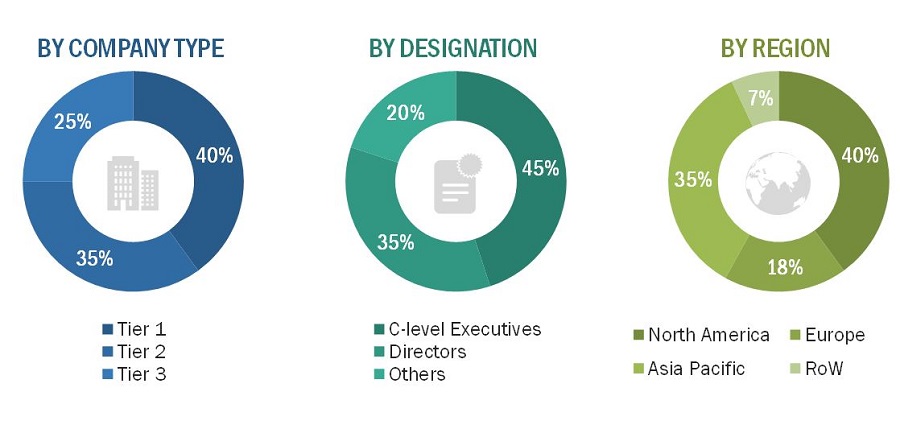
To know about the assumptions considered for the study, download the pdf brochure
Market Size Estimation
In the complete market engineering process, both top-down and bottom-up approaches were used, along with several data triangulation methods, to estimate and forecast the size of the market and its segments and subsegments listed in the report. Extensive qualitative and quantitative analyses were carried out on the complete market engineering process to list the key information/insights pertaining to quantum networking market.
The key players in the market were identified through secondary research, and their rankings in the respective regions determined through primary and secondary research. This entire procedure involved the study of the annual and financial reports of top players, and interviews with industry experts such as chief executive officers, vice presidents, directors, and marketing executives for quantitative and qualitative key insights. All percentage shares, splits, and breakdowns were determined using secondary sources and verified through primary sources. All parameters that affect the markets covered in this research study were accounted for, viewed in extensive detail, verified through primary research, and analyzed to obtain the final quantitative and qualitative data. This data was consolidated, supplemented with detailed inputs and analysis from MarketsandMarkets, and presented in this report.
Quantum Networking Market: Bottom-Up Approach
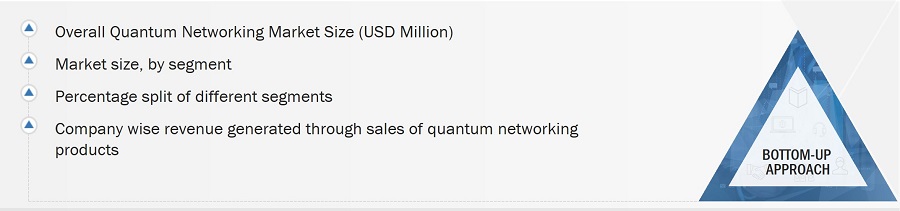
The bottom-up procedure was employed to arrive at the overall size of the quantum networking market from revenues of the key players and their share in the market. The overall market size was calculated on the basis of the revenues of the key companies identified in the market.
Quantum Networking Market: Top-Down Approach
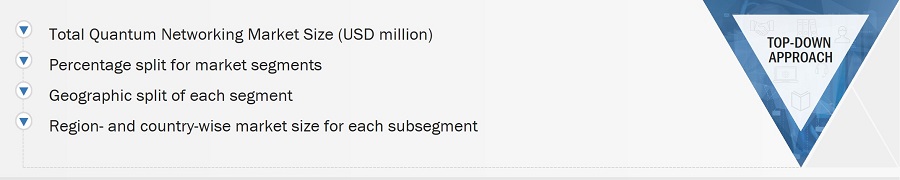
In the top-down approach, the overall size of the quantum networking market was used to estimate the size of the individual markets (mentioned in the market segmentation) through percentage splits obtained from secondary and primary research. To calculate the size of the specific market segments, the size of the most appropriate parent market was used to implement the top-down approach. The bottom-up approach was also implemented for the data extracted from the secondary research to validate the size of various segments of the quantum networking market. The share of each company in the market was estimated to verify the revenue shares used earlier in the bottom-up approach. With the data triangulation procedure and the validation of data through primaries, sizes of the parent market and each individual market were determined and confirmed. The data triangulation procedure used for this study has been explained in the next section.
Data Triangulation
After arriving at the overall market size from the market size estimation process explained above, the total market was split into several segments and subsegments. Data triangulation and market breakdown procedures were employed, wherever applicable, to complete the overall market engineering process and arrive at the exact statistics for all segments and subsegments. The data was triangulated by studying various factors and trends from both demand and supply sides. Along with this, the market size was validated using both top-down and bottom-up approaches.
Market Definition
Quantum networking is an emerging technology that uses quantum mechanics to enable secure, high-speed communication over existing networks. Quantum networks make use of certain quantum phenomena that classical networks are unable to employ, such as superposition, and quantum entanglement. The photon exists in a superposition of all possible quantum states, each with a corresponding probability, prior to measurement. These are used across various industries like banking & finance, government & defense, healthcare & life sciences, IT & telecom, energy & utilities, manufacturing, and others.
Key Stakeholders
- Quantum networking device manufacturers
- Research organizations and universities
- Original equipment manufacturers (OEMs)
- Technology standard organizations, forums, alliances, and associations
- Analysts and strategic business planners
- Government bodies, venture capitalists, and private equity firms
- Existing and prospective end users
- Venture capitalists, private equity firms, and startup companies
- Distributors and traders
Report Objectives
- To define, describe, segment, and forecast the quantum networking market size, in terms of value, based on offering, vertical, and region
- To forecast the market size, in terms of value, across North America, Europe, Asia Pacific, and the Rest of the World (RoW)
- To present detailed information regarding the major factors influencing the growth of the market (drivers, restraints, opportunities, and challenges)
- To provide an ecosystem analysis, case study analysis, patent analysis, technology analysis, ASP analysis, Porter’s Five Forces analysis, investment and funding scenario, and regulations pertaining to the market.
- To offer a comprehensive overview of the value chain of the quantum networking market ecosystem
- To critically analyze micromarkets1 with respect to individual growth trends, prospects, and contributions to the total market
- To strategically profile the key players and comprehensively analyze their market shares and core competencies
- To assess the opportunities in the market for stakeholders and describe the competitive landscape of the market
- To analyze competitive developments in the market, such as collaborations, agreements, partnerships, product developments, and research and development (R&D)
Available Customizations
With the given market data, MarketsandMarkets offers customizations according to the company’s specific needs. The following customization options are available for the report:
Company Information
- Detailed analysis and profiling of additional market players (up to 7)
Get the Full Quantum Networking Market Report
Full forecast, segment splits, and company analysis for all Quantum Networking Market.
- Canada Quantum Networking Market
- Mexico Quantum Networking Market
- US Quantum Networking Market
- France Quantum Networking Market
- Germany Quantum Networking Market
- UK Quantum Networking Market
- China Quantum Networking Market
- Japan Quantum Networking Market
- Rest Of Europe Quantum Networking Market
- Rest Of Asia Pacific Quantum Networking Market
- GCC Countries Quantum Networking Market
- Rest Of Middle East Quantum Networking Market
Need a Tailored Report?
Customize this report to your needs
Get 10% FREE Customization
Customize This Report
