
Asia Pacific Racing Simulator Market (2024-2029)

The Asia Pacific Racing Simulator Market was valued at $54.8 Million in 2024 and projected to reach to $159 Million by 2029, representing a compound annual growth rate of 19.4%. The Asia Pacific racing simulator market is positioned for exceptional growth through 2029, with the region's market size expanding from $54.8 million to $159.0 million.


| Market Size in | USD 26.32 MN |
| Market Forecast in | |
| CAGR | |
| Forecast Period | |
| Units Considered | Value (USD MN) |
Asia Pacific Racing Simulator Market Trends and Insights
- Asia Pacific's accelerating growth trajectory reflects rising consumer interest in esports, increasing adoption of advanced simulation technology, and expanding gaming infrastructure across the region.
- The 19.4% compound annual growth rate significantly outpaces global trends, positioning Asia Pacific as a critical growth engine for the racing simulator industry. Asia Pacific's market momentum is driven by a confluence of factors including growing disposable incomes, proliferation of gaming cafes and esports venues, and strong automotive enthusiasm in key markets such as China, Japan, and South Korea.
- Asia Pacific consumers increasingly view racing simulators as both entertainment and competitive platforms, with professional esports racing gaining mainstream recognition.
- Between 2024 and 2029, Asia Pacific is expected to capture substantial market share as manufacturers and esports organizations invest heavily in regional infrastructure and localized content. The competitive landscape in Asia Pacific reflects both established global players and emerging regional innovators capitalizing on local preferences and distribution networks.
- Asia Pacific's young, tech-savvy demographic and rising investment in gaming ecosystems position the region for sustained double-digit growth through 2029..
Key Market Statistics
- CAGR (2024-2029) 19.4% CAGR
- Market Size, 2024 ~USD 54.8 Million
- Forecast, 2029 ~USD 159 Million
- Geography Asia Pacific
Asia Pacific Racing Simulator Market Overview
Rapid Market Expansion :
Asia Pacific racing simulator market is growing at 19.4% CAGR, significantly outpacing the global rate of 15.6%, driven by surging esports adoption and gaming infrastructure investments across the region.
China's Market Dominance :
China leads Asia Pacific with $69.7 million in market size, representing over 127% of the regional 2024 valuation, reflecting massive consumer base and advanced gaming technology ecosystem.
Emerging Gaming Culture :
Rising consumer interest in esports and competitive gaming in Asia Pacific is fueling demand for high-fidelity racing simulators, with younger demographics driving adoption of immersive simulation experiences.
Technology Infrastructure Growth :
Expanding gaming infrastructure, improved internet connectivity, and increasing investment in esports facilities across Asia Pacific are creating favorable conditions for racing simulator market penetration.
Asia Pacific Racing Simulator Market Dynamics
- This trajectory reflects the region's unique advantages including a massive gaming population, rapidly growing esports ecosystem, and increasing consumer spending on premium gaming experiences.
- China's dominance combined with emerging markets in India and Southeast Asia creates substantial growth opportunities. Key drivers include technological advancement in VR and haptic feedback systems, rising disposable incomes among younger demographics, and growing professional esports infrastructure.
- The region's competitive advantage in gaming hardware manufacturing and software development positions Asia Pacific as a critical growth engine for the global racing simulator market, with sustained momentum expected through the forecast period..
Market Ecosystem
Related Ecosystem
Automotive Advance Technologies
- Battery Electric Vehicle (BEV)
- Light Commercial Vehicles (LCVs)
- Fuel Cell Electric Vehicle (FCEV)
- Hybrid Electric Vehicle (HEV)
- Internal Combustion Engine (ICE)
- BOSCH LIMITED
- Continental ag
- Visteon Corporation
- DENSO Corporation
- ZF FRIEDRICHSHAFEN AG
Key Takeaways
- Asia Pacific racing simulator market grows from $54.8M (2024) to $159.0M (2029) at 19.4% CAGR, outpacing global growth rates.
- Asia Pacific's young demographic and esports infrastructure drive adoption of racing simulators as competitive and entertainment platforms.
- Key Asia Pacific markets including China, Japan, and South Korea show strong automotive enthusiasm and gaming investment.
- Asia Pacific regional players and global manufacturers are expanding distribution and localized content strategies through 2029.
Racing Simulator Market Report Scope
| Report Metric | Details |
|---|---|
| Base Year | 2024 |
| Fastest Growing Segment | COMMERCIAL VEHICLE (Vehicle Type) |
| Forecast Period | 2024-2029 |
| Growth Rate | CAGR of 15.6% from 2024 to 2029 |
| Largest Segment | PASSENGER CAR (Vehicle Type) |
| Market Size Base Year (Billions) | ~USD 0.46 (2024) |
| Revenue Forecast (Billions) | ~USD 0.95 (2029) |
| Segments Covered | Type, Offering, Vehicle Type, Application, Sales Channel, Component, Simulator Type |
Asia Pacific Racing Simulator Market Report Segmentation
7 segment dimensions are covered across the global market.
By Type
- Compact/Entry-Level Simulator
- Full-Scale Simulator
- Mid-Level Simulator
By Offering
- Brake Pad
- Hardware
- Master Cylinder
- Software
By Vehicle Type
- Commercial Vehicle
- Passenger Car
By Application
- Commercial
- Home/Personal Use
By Sales Channel
- Offline
- Online
By Component
- Cockpit
- Gearbox Shifter
- Monitor Stand
- Pedal Sets
- Seat
- Steering Wheel
By Simulator Type
- Compact/Entry-Level Simulator
- Full-Scale Simulator
- Mid-Level Simulator
Target Audience
- Gaming Hardware Manufacturers : Need regional market data to optimize product development, pricing strategies, and distribution networks across Asia Pacific's diverse gaming markets and consumer preferences.
- Esports Platform Operators : Require insights into Asia Pacific's esports infrastructure growth and racing simulator adoption to develop competitive offerings and expand tournament ecosystems in high-growth markets.
- Investment & Private Equity Firms : Seek detailed market analysis and growth forecasts to identify acquisition targets, investment opportunities, and portfolio companies in Asia Pacific's rapidly expanding gaming sector.
- Software & Game Developers : Need regional market intelligence to guide game development priorities, localization strategies, and go-to-market approaches tailored to Asia Pacific consumer preferences and gaming trends.
- Automotive & OEM Companies : Require market data to evaluate racing simulator opportunities for brand engagement, driver training programs, and virtual showroom experiences in Asia Pacific's growing automotive gaming segment.
Countries within Asia Pacific - compare and drill down
| Country | 2025 size (native) |
|---|---|
| China | USD 69.7 Million |
| India | USD 6.8 Million |
| Japan | USD 49.8 Million |
| South Korea | USD 12.5 Million |
| Australia | USD 20.2 Million |
Country market size visualization
Reasons to Buy this Report
- Regional Growth Intelligence : Gain comprehensive insights into Asia Pacific's 19.4% CAGR trajectory, understanding market dynamics specific to the region's unique gaming culture and consumer behavior patterns.
- Country-Level Market Data : Access detailed market sizing for key Asia Pacific markets including China ($69.7M), Japan ($49.8M), and Australia ($20.2M) to identify high-potential investment and expansion opportunities.
- Competitive Positioning Strategy : Benchmark your business against regional competitors and understand market concentration, enabling data-driven decisions for market entry, partnerships, and product localization strategies.
- Forecast-Driven Planning : Leverage 2029 projections ($159.0M) to develop long-term strategic plans, resource allocation, and investment decisions aligned with Asia Pacific's accelerating market expansion.
- Emerging Market Opportunities : Identify high-growth segments and underserved markets within Asia Pacific, including India and Southeast Asia, where esports adoption and gaming infrastructure investments are rapidly accelerating.
Frequently asked questions
What is the projected size of the Asia Pacific racing simulator market by 2029?
The Asia Pacific racing simulator market is projected to reach $159.0 million by 2029, growing from $54.8 million in 2024.
What is the CAGR for the Asia Pacific racing simulator market?
Asia Pacific's racing simulator market is expected to grow at a compound annual growth rate of 19.4% between 2024 and 2029.
Which countries in Asia Pacific are driving racing simulator market growth?
Key Asia Pacific markets including China, Japan, and South Korea are driving growth through strong automotive enthusiasm, esports investment, and gaming infrastructure expansion.
What factors are accelerating racing simulator adoption in Asia Pacific?
Asia Pacific adoption is accelerated by rising disposable incomes, proliferation of gaming cafes and esports venues, professional esports racing recognition, and tech-savvy younger demographics.
How does Asia Pacific's growth compare to the global racing simulator market?
Asia Pacific's 19.4% CAGR significantly outpaces the global market CAGR of 15.6%, positioning the region as a critical growth engine for the racing simulator industry.
RESEARCH METHODOLOGY
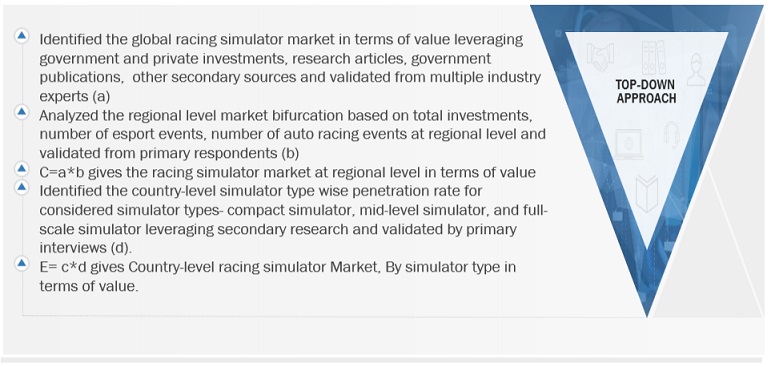
The study involved four major activities in estimating the current size of the racing simulator market. Exhaustive secondary research was done to collect information on the market and its sub-segments. The next step was to validate these findings and assumptions and size them with industry experts across value chains through primary research. The top-down approach was employed to estimate the complete market size. After that, market breakdown and data triangulation processes were used to estimate the market size of segments and subsegments.
Secondary Research
In the secondary research process, various secondary sources have been used to identify and collect information useful for an extensive commercial study of the racing simulator market. The secondary sources referred to in this research study include investor presentations and annual reports of Key market players, Racing Simulator Component Manufacturer Associations, Corporate Filings (such as annual reports, investor presentations, and financial statements), Trade, Business, and related Associations, Racing Simulator Manufacturers’ white papers/research papers, Racing Simulator Blogs/Articles/Magazines, Sim Racing Expo, Virtual Motorsports Racing League (VMRL), The National Training & Simulation Association (NTSA), International Sim Racing Association (ISRA), International Sim Racing Association (ISRA), Sim Racing Association Singapore, Driving Simulation Association (DSA). Secondary data has been collected and analyzed to determine the overall market size, further validated by primary research.
Primary Research
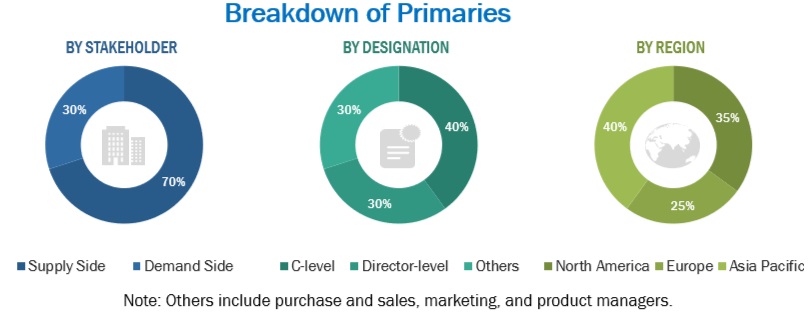
In the primary research process, various primary sources from both the supply and demand sides were interviewed to obtain qualitative and quantitative information on the market. The primary sources from the supply side included industry experts such as CXOs, vice presidents, directors from business development, marketing, product development/innovation teams, and related key executives from various key companies. Various system integrators, industry associations, independent consultants/industry veterans, and key opinion leaders were also interviewed.
Primary interviews have been conducted to gather insights such as market penetration of racing simulators by simulator type at the country level, by component, by offering, by vehicle type, by sales channel, and by application at the regional level. Data triangulation was then done with the information gathered from secondary research. Stakeholders from the demand and supply side have been interviewed to understand their views on the points mentioned above.
Primary interviews have been conducted with market experts from the demand and supply side across four major regions: North America, Europe, Asia Pacific, and the Rest of the World. Primary data has been collected through questionnaires, emails, and telephonic interviews. In canvassing primaries, we have strived to cover various departments within organizations, such as sales and operations, to provide a holistic viewpoint in our report.
After interacting with industry experts, we have also conducted brief sessions with highly experienced independent consultants to reinforce the findings from our primaries. This and the in-house subject matter experts’ opinions have led us to the conclusions described in the remainder of this report.
To know about the assumptions considered for the study, download the pdf brochure
Market Size Estimation
A detailed market estimation approach was followed to estimate and validate the value of the racing simulator market and other dependent submarkets, as mentioned below:
- Key players in the racing simulator market were identified through secondary research, and their global market shares were determined through primary and secondary research.
- The research methodology included studying annual and quarterly financial reports, regulatory filings of major market players (public), and interviews with industry experts for detailed market insights.
- All industry-level penetration rates, percentage shares, splits, and breakdowns for the racing simulator were determined using secondary sources and verified through primary sources.
- All key macro indicators affecting the revenue growth of the market segments and subsegments have been accounted for, viewed in extensive detail, verified through primary research, and analyzed to get the validated and verified quantitative and qualitative data.
- The gathered market data was consolidated and added with detailed inputs, analyzed, and presented in this report.
- Qualitative aspects such as market drivers, restraints, opportunities, and challenges have been considered while calculating and forecasting the market size.
Racing Simulator Market: Top-Down Approach
To know about the assumptions considered for the study, Request for Free Sample Report
Data Triangulation
After arriving at the overall market size, the market was split into several segments and sub-segments—using the market size estimation processes as explained above. Where applicable, data triangulation and market breakdown procedures were employed to complete the overall market engineering process and determine the exact statistics of each market segment and sub-segment. The data was triangulated by studying several factors and trends.
Market Definition:
Racing Simulator, often called sim racing, is a form of virtual motorsport where participants use realistic racing simulators to simulate the experience of driving real-world vehicles in a simulated environment. Sim racing involves using dedicated hardware, such as steering wheels, pedals, and sometimes motion platforms, and sophisticated simulation software replicating the physics, dynamics, and visuals of actual race cars and tracks. In the virtual world, participants can compete in various racing disciplines, including Formula 1, NASCAR, endurance racing, and more. Sim racing is valued for providing a realistic and immersive driving experience, allowing enthusiasts and professional drivers alike to hone their skills, compete in virtual championships, and experience the thrill of motorsports without the physical risks associated with real-world racing.
Key Stakeholders:
- Sales Head
- Marketing Head
- Design Manager
- R&D Head
Report Objectives
-
To define, segment, analyze, and forecast (2024–2030) the racing simulator market size in terms of value (USD million) based on:
- By Simulator Type (Compact/Entry-level Simulator, Medium-level Simulator, and Full-Scale Simulator)
- By Offering Type (Hardware and Software)
- By Vehicle Type (Passenger car and Commercial Vehicle)
- By Component Type (Steering Wheel, Gearbox Shifters, Seat, Pedal Sets, Monitor Stand, Cockpits, and Others )
- By Sales Channel (Online and Offline)
- By Application Type (Home/Personal use and Commercial)
- By Region (North America, Europe, Asia Pacific, and the Rest of the World (RoW))
- To analyze the recession's impact on the racing simulator market
- To understand the market dynamics (drivers, restraints, opportunities, and challenges) of the racing simulator market
-
To study the following concerning the market
- Supply Chain Analysis
- Market Ecosystem
- Technology Analysis
- Trade Analysis
- Case Study Analysis
- Patent Analysis
- Buying Criteria
-
To estimate the following with respect to the market
- Average Price Analysis
- Market Share Analysis
- To analyze the competitive landscape and prepare a competitive evaluation quadrant for the global racing simulator market players.
- To analyze recent developments, alliances, joint ventures, mergers & acquisitions, new product launches, and other activities conducted by key racing simulator market industry participants.
Available Customizations
With the given market data, MarketsandMarkets offers customizations in accordance with the company’s specific needs.
The following customization options are available for the report:
-
Racing Simulator Market, By Offerings, By Country
-
Asia Pacific
- China
- India
- Japan
- South Korea
- Australia
-
Asia Pacific
-
Europe
- Germany
- France
- Italy
- Spain
- UK
- Europe Others
-
North America
- US
- Canada
- Mexico
-
Rest of the World
- Brazil
- Argentina
- UAE
- Rest of the World Others
Get the Full Racing Simulator Market Report
Full forecast, segment splits, and company analysis for all Racing Simulator Market.
- China Racing Simulator Market
- India Racing Simulator Market
- Japan Racing Simulator Market
- South Korea Racing Simulator Market
- Australia Racing Simulator Market
- Germany Racing Simulator Market
- France Racing Simulator Market
- Spain Racing Simulator Market
- Italy Racing Simulator Market
- UK Racing Simulator Market
- Canada Racing Simulator Market
- Mexico Racing Simulator Market
- US Racing Simulator Market
- Brazil Racing Simulator Market
- Argentina Racing Simulator Market
- UAE Racing Simulator Market
- Rest Of Europe Racing Simulator Market
- Other Countries Racing Simulator Market
Need a Tailored Report?
Customize this report to your needs
Get 10% FREE Customization
Customize This Report
