
Germany Radioligand Therapy (RLT) Market (2025-2030)

The Germany Radioligand Therapy (RLT) Market was valued at $141.27 Million in 2025 and projected to reach to $668.87 Million by 2030, representing a compound annual growth rate of 16.8%. Germany's radioligand therapy market is poised for exceptional growth through 2030, driven by increasing adoption of precision oncology treatments and strong healthcare infrastructure investments.


| Market Size in | USD 26.32 MN |
| Market Forecast in | |
| CAGR | |
| Forecast Period | |
| Units Considered | Value (USD MN) |
Germany Radioligand Therapy (RLT) Market Trends and Insights
- This represents a compound annual growth rate of 16.8%, significantly outpacing global market trends.
- Germany's advanced healthcare infrastructure, strong regulatory framework, and high adoption of precision oncology therapies position the country as a leading RLT market in Europe. The German RLT market is driven by increasing prevalence of neuroendocrine and prostate cancers, coupled with growing clinical evidence supporting radioligand-based treatments.
- Germany's robust reimbursement landscape and established nuclear medicine expertise accelerate market penetration.
- Between 2025 and 2030, Germany is expected to see substantial investment in radiopharmaceutical manufacturing and clinical trial infrastructure, further solidifying its market leadership. Key stakeholders in Germany include major pharmaceutical manufacturers, specialized nuclear medicine centers, and research institutions.
- The market's growth trajectory reflects both rising patient demand and healthcare system commitment to innovative cancer therapies, making Germany a critical hub for RLT development and commercialization in the European region..
Key Market Statistics
- CAGR (2025-2030) 16.8% CAGR
- Market Size, 2025 ~USD 141.27 Million
- Forecast, 2030 ~USD 668.87 Million
- Country Germany
Germany Radioligand Therapy (RLT) Market Overview
Market Valuation Growth :
Germany's RLT market is valued at $141.27 million in 2025 and is projected to reach $668.87 million by 2030, representing a 373% increase over five years.
Superior CAGR Performance :
Germany's market grows at 16.8% CAGR, significantly outpacing the global average of 13.2%, demonstrating exceptional market momentum and investor confidence in the region.
Advanced Healthcare Infrastructure :
Germany's robust healthcare system, strong regulatory framework, and high adoption of precision oncology therapies create an ideal environment for RLT market expansion.
Precision Oncology Leadership :
The country's commitment to personalized cancer treatment and cutting-edge medical technology positions Germany as a key hub for radioligand therapy innovation and deployment.
Germany Radioligand Therapy (RLT) Market Dynamics
- The country's regulatory environment supports rapid innovation cycles, while German pharmaceutical and medical device companies are actively developing next-generation RLT solutions.
- Patient awareness and physician adoption of targeted radiotherapy continue to accelerate across major oncology centers. The 16.8% CAGR reflects growing reimbursement support from German health insurers and expanding clinical applications beyond traditional indications.
- Strategic partnerships between German research institutions and international biotech firms are accelerating market development.
- By 2030, Germany is expected to become a leading European market for radioligand therapies, with significant opportunities for market entrants and established players alike..
Market Ecosystem
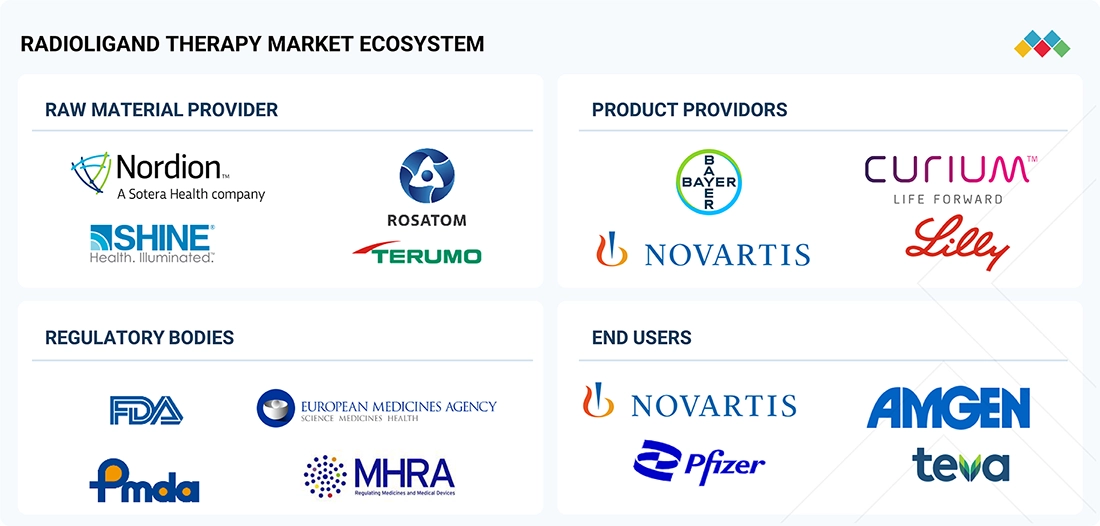
radioligand-therapy-rlt-market: COMMERCIAL USE CASES ACROSS INDUSTRIES
| COMPANY | USE CASE DESCRIPTION | BENEFITS |
|---|---|---|
 |
Novartis partners with ITM Isotope Technologies Munich for large-scale supply of Lutetium-177 (Lu-177) used in Pluvicto (PSMA-targeted therapy) and Lutathera (NET therapy).. | Ensures uninterrupted isotope availability for global RLT rollout; strengthens long-term supply chain resilience for high-demand oncology therapies |
 |
Bayer collaborates with Eckert & Ziegler to secure Actinium-225 and Gallium-68 supply for expanding its alpha-emitter RLT pipeline targeting prostate and lung cancers.. | Access to scalable alpha therapy isotope supply and accelerated development of next-generation RLT candidates.. |
 |
Telix partners with Cardinal Health for US nationwide radiopharmacy manufacturing and distribution of Illuccix (Ga-68 PSMA imaging agent) used prior to Lu-177 PSMA therapy. | Rapid same-day PET agent delivery; expanded reach to thousands of imaging sites, improving treatment eligibility and patient throughput. |
Logos and trademarks shown above are the property of their respective owners. Their use here is for informational and illustrative purposes only.
Related Ecosystem
Biotechnology
- Reagents
- Polymerase Chain Reaction (PCR)
- Stem Cells
- Assay Kits
- Flow Cytometers
- Thermo Fisher Scientific Inc.
- Merck KGaA
- Danaher Corporation
- Agilent Technologies, Inc.
- Bio-Rad Laboratories, Inc.
Pharmaceuticals
- Bioreactors
- Analytical Testing
- Bioanalytical Testing Services
- Cell Counters
- Data Management Services
- Thermo Fisher Scientific Inc.
- Merck KGaA
- SANOFI
- Pfizer Inc.
- NOVARTIS
Key Takeaways
- Germany's RLT market will grow from $141.27M (2025) to $668.87M (2030) at a 16.8% CAGR, outpacing global growth rates.
- Germany's advanced healthcare infrastructure and strong reimbursement policies drive rapid adoption of radioligand therapies.
- Increasing prevalence of neuroendocrine and prostate cancers in Germany fuels demand for precision oncology solutions.
- Germany is positioned as a European hub for RLT manufacturing, clinical trials, and radiopharmaceutical innovation through 2030.
Radioligand Therapy (RLT) Market Report Scope
| Report Metric | Details |
|---|---|
| Base Year | 2025 |
| Fastest Growing Segment | [LU-177]-PNT2002 (Product) |
| Forecast Period | 2025-2030 |
| Growth Rate | CAGR of 13.2% from 2025 to 2030 |
| Largest Segment | PROSTATE CANCER (Indication) |
| Market Size Base Year (Billions) | ~USD 3.16 (2025) |
| Revenue Forecast (Billions) | ~USD 5.87 (2030) |
| Segments Covered | Product, Target, Indication, End User |
Germany Radioligand Therapy (RLT) Market Report Segmentation
4 segment dimensions are covered across the global market.
By Product
- 225Ac-Psma-617
- 67Cusarbispsma
- [Lu-177]-Pnt2002
- Alphamedix (²¹²Pb-Dotamtate)
- Alphamedix(²¹²Pb-Dotamtate)
- Fpi-2265
- I-131-1095
- Lutetium-177 Dotatate
- Lutetium-177 Dotatate (Lutathera)
- Lutetium177 Vipivotide Tetraxetan
- Lutetium177 Vipivotide Tetraxetan (Pluvicto)
- Other Products
- Radium-223 Dichloride
- Radium-223 Dichloride (Xofigo)
- Tlx591 (177Lu Rosopatamab Tetraxetan)
By Target
- Other Indications
- Other Targets
- Prostate-Specific Membrane Antigen (Psma)
- Somatostatin Receptor (Sstr)
By Indication
- Neuroendocrine Tumor
- Neuroendocrine Tumors (Nets)
- Other Indications
- Prostate Cancer
By End User
- Other End Users
- Specialized Nuclear Medicine Centers
- Tertiary Care Academic/ Comprehensive Cancer Centers
GERMANY: RADIOLIGAND THERAPY MARKET, BY END USER, 2023–2035
| Segment | 2023 | 2024 | 2025 | 2026 | 2027 | 2028 | 2035 | CAGR (%) |
|---|---|---|---|---|---|---|---|---|
| OTHER END USERS | 12.6 | 19.53 | 26.48 | 35.83 | 42.57 | 55.46 | 136 | 17.8 |
| SPECIALIZED NUCLEAR MEDICINE CENTERS | 16.95 | 26.41 | 35.97 | 48.92 | 58.4 | 76.44 | 193.14 | 18.3 |
| TERTIARY CARE ACADEMIC/ COMPREHENSIVE CANCER CENTERS | 38.85 | 59.16 | 78.81 | 104.81 | 122.37 | 156.67 | 339.73 | 15.7 |
| TOTAL | 68.41 | 105.1 | 141.27 | 189.56 | 223.34 | 288.58 | 668.87 | 16.8 |
Target Audience
- Pharmaceutical & Biotech Companies : Develop market entry strategies and product commercialization plans for Germany's high-growth RLT market, leveraging country-specific regulatory and reimbursement data.
- Medical Device Manufacturers : Identify opportunities to expand radioligand therapy equipment and diagnostic solutions in Germany's advanced healthcare infrastructure with strong adoption of precision oncology.
- Healthcare Investors & PE Firms : Evaluate investment opportunities in German RLT companies and healthcare providers capitalizing on the market's 16.8% CAGR and expanding clinical applications.
- Hospital & Oncology Centers : Plan RLT service expansion and capital investments based on market growth projections, competitive landscape analysis, and patient demand forecasts specific to Germany.
- Healthcare Consultants & Analysts : Support client advisory work with comprehensive Germany market data, competitive benchmarking, and strategic recommendations for RLT market participants.
Reasons to Buy this Report
- Market-Specific Valuation Data : Access precise market sizing for Germany with 2025 baseline ($141.27M) and 2030 forecast ($668.87M), enabling accurate financial planning and investment decisions specific to the German market.
- Competitive Positioning Intelligence : Understand Germany's 16.8% CAGR advantage over global trends (13.2%), identifying growth drivers and competitive opportunities unique to the German healthcare landscape.
- Regulatory & Reimbursement Insights : Gain detailed knowledge of Germany's regulatory framework and insurance reimbursement policies that accelerate RLT adoption, critical for market entry and commercialization strategies.
- Regional Market Dynamics : Analyze Germany-specific factors including healthcare infrastructure, physician adoption patterns, and patient demographics to tailor product development and go-to-market strategies.
- Investment & Partnership Opportunities : Identify high-potential partnerships with German research institutions, hospitals, and biotech firms leveraging the country's innovation ecosystem and strong market growth trajectory.
Frequently asked questions
What is the current size of Germany's Radioligand Therapy market?
Germany's RLT market was valued at $141.27 million in 2025 and is expected to grow to $668.87 million by 2030.
What is the projected growth rate for Germany's RLT market?
Germany's RLT market is projected to grow at a compound annual growth rate (CAGR) of 16.8% from 2025 to 2030.
What factors are driving growth in Germany's RLT market?
Key drivers include rising prevalence of neuroendocrine and prostate cancers, strong healthcare infrastructure, robust reimbursement policies, and established nuclear medicine expertise in Germany.
How does Germany's RLT market compare to global trends?
Germany's 16.8% CAGR significantly exceeds the global RLT market CAGR of 13.2%, reflecting stronger adoption and market maturity in the German healthcare system.
What is Germany's role in the European RLT market?
Germany serves as a leading European hub for RLT development, manufacturing, clinical trials, and radiopharmaceutical innovation, driving regional market expansion.
RESEARCH METHODOLOGY
This research study extensively used secondary sources, directories, and databases to identify and collect valuable information to analyze the global radioligand therapy market. In-depth interviews were conducted with various primary respondents, including key industry participants, subject-matter experts, C-level executives of key market players, and industry consultants, to obtain and verify critical qualitative and quantitative information and assess the growth prospects of the market. The global market size estimated through secondary research was then triangulated with inputs from primary research to arrive at the final market size.
Secondary Research
Secondary research was used mainly to identify and collect information for the extensive, technical, market-oriented, and commercial study of the radioligand therapy market. The secondary sources used for this study include World Health Organization (WHO), National Institutes of Health (NIH), National Cancer Institute (NCI), US Food and Drug Administration (FDA), European Medicines Agency (EMA), and Centers for Drug Evaluation and Research (CDER), International Society for Pharmaceutical Engineering (ISPE), Innovative Medicines Initiative (IMI), Society of Nuclear Medicine and Molecular Imaging (SNMMI), European Association of Nuclear Medicine (EANM), PubMed, National Center for Biotechnology Information (NCBI), International Trade Centre (ITC), Press Releases, Company Websites, and Magazines & Proprietary Databases. Secondary sources include corporate and regulatory filings, such as annual reports, SEC filings, investor presentations, and financial statements; business magazines & research journals; press releases; trade, business, and professional associations; and MarketsandMarkets Analysis.
Primary Research
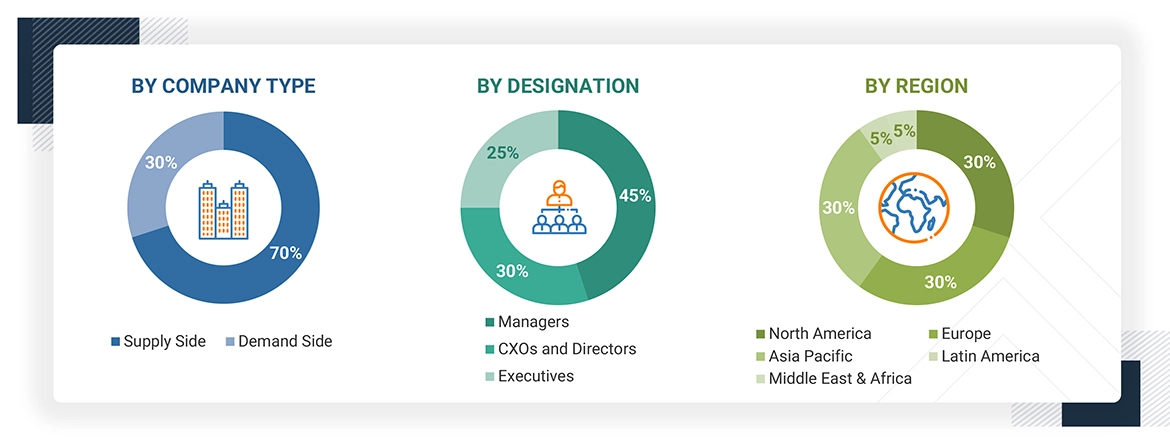
A comprehensive primary research was undertaken following an initial assessment of the global radioligand therapy market landscape through secondary research. This involved conducting in-depth interviews with market experts from the demand side, including stakeholders from pharmaceutical and biotechnology firms, CROs, CMOs, and academic and research institutions. Additionally, interviews were held with key supply-side participants, such as C-suite and senior executives, product managers, and marketing and sales leaders from prominent manufacturers, distributors, and channel partners. The research covered six major geographical regions: North America, Europe, Asia Pacific, Latin America, the Middle East, and Africa. Approximately 70% of the primary interviews were conducted with supply-side participants, while 30% involved demand-side experts. Data collection methods included structured questionnaires, email correspondence, online surveys, personal interviews, and telephonic discussions to understand the market dynamics comprehensively.
The following is a breakdown of the primary respondents:
To know about the assumptions considered for the study, download the pdf brochure
Market Size Estimation
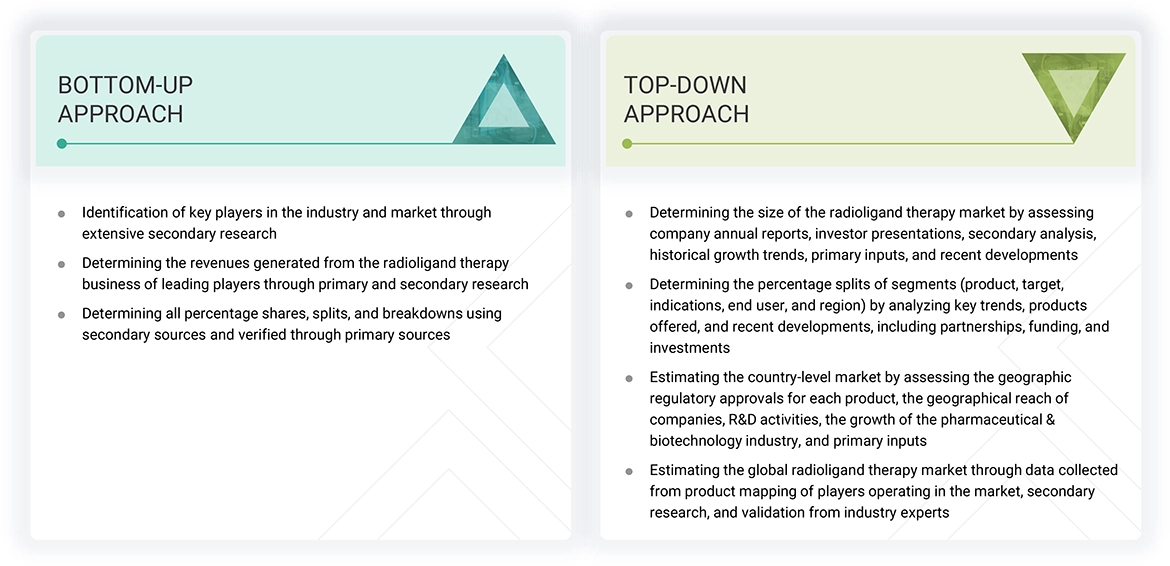
Both bottom-up and top-down approaches were used to estimate and validate the total size of the radioligand therapy market. These methods were also used extensively to estimate the size of various subsegments in the market. The research methodology used to estimate the market size includes the following:
- A list of the major global players operating in the radioligand therapy market was generated.
- The revenues generated from their radioligand therapy product have been determined through annual reports and secondary sources (including paid databases)
- The products were mapped according to the segments of the market. Percentage shares and splits were determined based on the revenue contributed to each segment. This was verified using secondary sources and by industry experts.
- All assumptions, approaches, and individual shares/revenue estimates were validated through expert interviews.
Radioligand Therapy Market : Top-Down and Bottom-Up Approach
Data Triangulation
After arriving at the market size from the estimation process explained above, the total market was divided into several segments and subsegments. To complete the overall market engineering process and arrive at the exact statistics for all segments and subsegments, data triangulation and market breakdown procedures were employed, wherever applicable. The data was triangulated by studying various factors and trends from both the demand and supply sides.
Market Definition
Radioligand therapy (RLT) is a form of precision oncology that delivers targeted radiation to cancer cells while minimizing damage to healthy cells. Once administered, the ligand guides the radioactive payload directly to cancer cells, allowing for precise radiation delivery while minimizing damage to surrounding healthy tissues.
Stakeholders
- Pharmaceutical Companies
- National and Regional Research Boards & Organizations
- Research & Development Companies
- Contract Research Organizations (CROs)
- Contract Manufacturing Organizations (CMOs)
- Contract Research Development & Manufacturing Organizations (CRDMOs)
- Medical Device Companies
- Biotechnology Companies
- Research Laboratories & Academic Institutes
- Market Research & Consulting Firms
- Regulatory Bodies
Report Objectives
- To define, describe, and forecast the radioligand therapy market based on product, target, indication, end user, and region
- To provide detailed information on the significant factors influencing market growth (such as drivers, restraints, opportunities, and challenges)
- To strategically analyze micromarkets concerning individual growth trends, prospects, and contributions to the radioligand therapy market
- To analyze the opportunities in the market for stakeholders and provide details of the competitive landscape for market leaders
- To forecast the size of the market segments concerning six regions—North America, Europe, the Asia Pacific, Latin America, the Middle East, and Africa
- To profile the key players in the global radioligand therapy market and comprehensively analyze their product portfolios, market positions, and core competencies
- To track and analyze competitive developments such as product approvals & launches, expansions, agreements, and collaborations in the radioligand therapy market
- To benchmark players within the radioligand therapy market using the company evaluation matrix framework, which analyzes market players based on various parameters within the broad categories of business and service strategy
Get the Full Radioligand Therapy (RLT) Market Report
Full forecast, segment splits, and company analysis for all Radioligand Therapy (RLT) Market.
- US Radioligand Therapy (RLT) Market
- Canada Radioligand Therapy (RLT) Market
- UK Radioligand Therapy (RLT) Market
- France Radioligand Therapy (RLT) Market
- Italy Radioligand Therapy (RLT) Market
- Spain Radioligand Therapy (RLT) Market
- China Radioligand Therapy (RLT) Market
- Japan Radioligand Therapy (RLT) Market
- India Radioligand Therapy (RLT) Market
- South Korea Radioligand Therapy (RLT) Market
- Australia Radioligand Therapy (RLT) Market
- Brazil Radioligand Therapy (RLT) Market
- Mexico Radioligand Therapy (RLT) Market
- Rest Of Europe Radioligand Therapy (RLT) Market
- Rest Of Asia Pacific Radioligand Therapy (RLT) Market
- Rest Of Latin America Radioligand Therapy (RLT) Market
- Kingdom Of Saudi Arabia (Ksa) Radioligand Therapy (RLT) Market
- Rest Of GCC Countries Radioligand Therapy (RLT) Market
- United Arab Emirates Radioligand Therapy (RLT) Market
Need a Tailored Report?
Customize this report to your needs
Get 10% FREE Customization
Customize This Report
