
Brazil Recycled Plastics Market (2026-2031)

The Brazil Recycled Plastics Market was valued at $499 Million in 2026 and projected to reach to $702 Million by 2031, representing a compound annual growth rate of 5.0%. Brazil's recycled plastics market is experiencing steady growth at a 5.0% CAGR, outpaced by the global market's 8.1% growth rate, yet representing significant opportunities within the Latin American context.


| Market Size in | USD 26.32 MN |
| Market Forecast in | |
| CAGR | |
| Forecast Period | |
| Units Considered | Value (USD MN) |
Brazil Recycled Plastics Market Trends and Insights
- Brazil's market expansion is driven by increasing regulatory pressure on plastic waste management, growing consumer demand for sustainable products, and expanding manufacturing capacity for recycled plastic applications.
- The country's position as a major plastic consumer in South America positions Brazil as a critical market for recycled plastics innovation and investment. Brazil's recycled plastics sector benefits from improving collection infrastructure and rising awareness among both industrial and consumer segments regarding circular economy principles.
- Between 2026 and 2031, Brazil is expected to see accelerated adoption of recycled plastics across packaging, automotive, and construction industries.
- Brazil's market growth, though moderate compared to global trends, reflects the country's transition toward sustainable material sourcing and compliance with emerging environmental regulations..
Key Market Statistics
- CAGR (2026-2031) 5.0% CAGR
- Market Size, 2026 ~USD 499 Million
- Forecast, 2031 ~USD 702 Million
- Country Brazil
Brazil Recycled Plastics Market Overview
Market Valuation :
Brazil's recycled plastics market is valued at USD 499.0 million in 2026 and is projected to reach USD 702.0 million by 2031, demonstrating strong growth potential in South America's largest economy.
Regulatory Drivers :
Increasing regulatory pressure on plastic waste management in Brazil is compelling manufacturers and businesses to adopt recycled plastic solutions, creating sustained market demand and compliance opportunities.
Consumer Sustainability Demand :
Growing consumer preference for sustainable products in Brazil is accelerating adoption of recycled plastics across packaging, consumer goods, and industrial applications, reshaping market dynamics.
Manufacturing Expansion :
Expanding manufacturing capacity for recycled plastic applications in Brazil is positioning the country as a regional hub for sustainable plastic production and innovation in Latin America.
Brazil Recycled Plastics Market Dynamics
- The market expansion is underpinned by strengthening environmental regulations, corporate sustainability commitments, and infrastructure investments in waste collection and processing.
- Manufacturing facilities are increasingly adopting advanced recycling technologies to meet both domestic demand and export opportunities. Looking ahead, Brazil's market trajectory will be shaped by government initiatives promoting circular economy principles, foreign investment in recycling infrastructure, and growing partnerships between multinational corporations and local recyclers.
- The convergence of regulatory mandates, consumer consciousness, and technological advancement positions Brazil as a critical growth market for recycled plastics in the region, with particular potential in packaging, automotive, and construction sectors..
Market Ecosystem
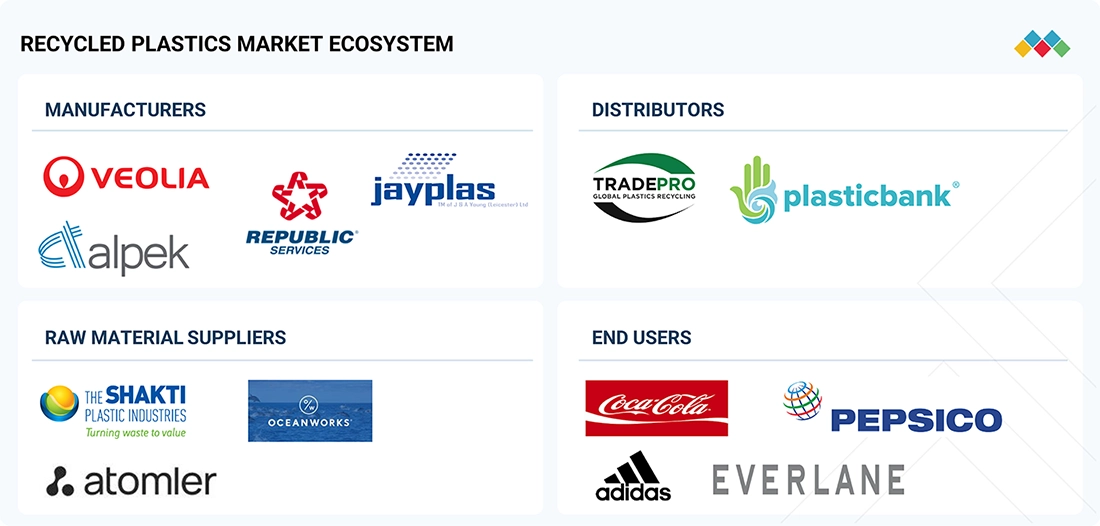
RECYCLED PLASTICS MARKET: COMMERCIAL USE CASES ACROSS INDUSTRIES
| COMPANY | USE CASE DESCRIPTION | BENEFITS |
|---|---|---|
 |
Operates large-scale recycling and reprocessing systems, converting post-consumer and industrial plastic waste into high-quality recycled polymers (rPET, rHDPE, rPP) | Supplies to packaging, automotive, and construction sectors, integrating advanced sorting and circular resource recovery technologies | Enhances plastic circularity, reduces landfill dependency, and supports clients in achieving sustainability and carbon reduction targets through a reliable recycled material supply |
 |
Produces advanced recycled PET (rPET) resins and flakes for use in packaging, textiles, and consumer goods through its global Indorama Ventures Recycling network, utilizing integrated collection systems and advanced processing technologies to ensure material quality and supply reliability | Provides consistent, food-grade recycled plastics with strong quality assurance | Supports brand owners in meeting recycled content goals and environmental compliance standards |
 |
Operates a growing network of material recovery facilities (MRFs) that collect, sort, and process post-consumer plastics into high-quality feedstock for resin producers and brand owners in North America and Asia | Strengthens regional recycling ecosystems, supports circular economy infrastructure, and ensures a steady supply of sorted plastics for advanced reprocessors |
 |
Manufactures and supplies packaging materials to the consumer, healthcare and industrial sectors | Emphasizes design for recycling and closed-loop systems | Reduces virgin plastic use, supports customer sustainability pledges, and enhances lifecycle performance through high recycled-content packaging solutions |
 |
Produces and distributes recycled PET resins through its Alpek Polyester division, integrating bottle-to-bottle recycling systems to supply major beverage and packaging companies globally | Enables high-purity, food-grade rPET supply, reduces carbon emissions, and promotes sustainable manufacturing aligned with circular economy commitments |
Logos and trademarks shown above are the property of their respective owners. Their use here is for informational and illustrative purposes only.
Related Ecosystem
Automotive Materials
- Light Commercial Vehicles (LCVs)
- Battery Electric Vehicle (BEV)
- Hybrid Electric Vehicle (HEV)
- Fuel Cell Electric Vehicle (FCEV)
- Agricultural Tractors
- GORKOVSKY AVTOMOBILNY ZAVOD
- AISIN CORPORATION
- Continental ag
- Basf se
- BOSCH LIMITED
Body Exterior Interior
- Battery Electric Vehicle (BEV)
- Fuel Cell Electric Vehicle (FCEV)
- Light Commercial Vehicles (LCVs)
- Hybrid Electric Vehicle (HEV)
- Agricultural Tractors
- AISIN CORPORATION
- Magna International Inc.
- GORKOVSKY AVTOMOBILNY ZAVOD
- BOCAR
- Continental ag
Resins And Polymers
- Polycarbonate
- Acrylonitrile Butadiene Styrene (ABS)
- Epoxy Resin
- Light Commercial Vehicles (LCVs)
- Polypropylene (PP)
- Basf se
- DOW CHEMICAL COMPANY
- Solvay sa
- Saudi arabia basic industries corporation (sabic)
- DuPont de Nemours, Inc.
Key Takeaways
- Brazil's recycled plastics market will grow from USD 499.0M (2026) to USD 702.0M (2031) at a 5.0% CAGR.
- Brazil's market is driven by regulatory mandates, improved waste collection infrastructure, and corporate sustainability commitments.
- Brazil's packaging and automotive sectors are primary demand drivers for recycled plastic materials.
- Brazil's moderate growth rate reflects ongoing infrastructure development and market maturation in the recycled plastics sector.
Recycled Plastics Market Report Scope
| Report Metric | Details |
|---|---|
| Base Year | 2026 |
| Fastest Growing Segment | PP (Plastic Type) |
| Forecast Period | 2026-2031 |
| Growth Rate | CAGR of 8.1% from 2026 to 2031 |
| Largest Segment | BOTTLES (Type) |
| Market Size Base Year (Billions) | ~USD 61.9 (2026) |
| Revenue Forecast (Billions) | ~USD 91.38 (2031) |
| Segments Covered | Type, Source, Plastic Type, End-Use Industry |
Brazil Recycled Plastics Market Report Segmentation
4 segment dimensions are covered across the global market.
By Type
- Bottles
- Fibers
- Films
- Foams
- Industrial Recyclates
- Other Sources
- Post-Consumer Recyclates
By Source
- Bottles
- Fibers
- Films
- Foams
- Other Sources
By Plastic Type
- Other Plastics
- Pe
- Pet
- Pp
- Ps
- Pvc
By End-Use Industry
- Automotive
- Building & Construction
- Electricals & Electronics
- Other End-Use Industries
- Packaging
- Textiles
Target Audience
- Plastic Manufacturers & Processors : Manufacturers need Brazil-specific market data to optimize production capacity, identify demand hotspots for recycled plastic inputs, and align product portfolios with local regulatory requirements and consumer preferences.
- Waste Management & Recycling Companies : Recycling operators require detailed market intelligence on Brazil's waste streams, collection infrastructure, and demand for recycled plastic outputs to justify capital investments and operational expansion.
- Packaging & Consumer Goods Companies : Brand owners and packaging manufacturers need Brazil market insights to source sustainable materials, meet sustainability commitments, and respond to growing consumer demand for recycled plastic packaging solutions.
- Investment & Private Equity Firms : Investors evaluating opportunities in Brazil's circular economy need comprehensive market data, growth projections, and regulatory context to assess risk-return profiles and identify acquisition targets.
- Government & Policy Makers : Brazilian policymakers and environmental agencies require market intelligence to design effective circular economy policies, infrastructure investments, and incentive programs for the recycled plastics sector.
Reasons to Buy this Report
- Market Size & Growth Projections : Access precise valuation data for Brazil's recycled plastics market (USD 499M in 2026 to USD 702M in 2031) to inform investment decisions, capacity planning, and market entry strategies with confidence.
- Regulatory Landscape Intelligence : Understand Brazil-specific regulatory drivers and compliance requirements shaping the recycled plastics market, enabling businesses to anticipate policy changes and align operations with emerging standards.
- Competitive Positioning : Benchmark your organization against Brazil's market dynamics and identify competitive advantages in a market growing at 5% CAGR, with insights into local manufacturing capacity and consumer preferences.
- Investment & Expansion Opportunities : Identify high-potential segments and geographic hotspots within Brazil for recycled plastic applications, manufacturing facilities, and distribution networks to maximize ROI and market penetration.
- Strategic Partnership Development : Leverage detailed Brazil market insights to identify and evaluate potential partners, suppliers, and acquisition targets in the recycled plastics ecosystem across the country.
Frequently asked questions
What is the current size of Brazil's recycled plastics market?
Brazil's recycled plastics market is valued at USD 499.0 million in 2026 and is expected to reach USD 702.0 million by 2031.
What is the projected growth rate for Brazil's recycled plastics market?
Brazil's recycled plastics market is projected to grow at a compound annual growth rate (CAGR) of 5.0% from 2026 to 2031.
Which industries drive demand for recycled plastics in Brazil?
Brazil's primary demand drivers include packaging, automotive, construction, and consumer goods manufacturing sectors seeking sustainable material alternatives.
What factors are accelerating Brazil's recycled plastics market growth?
Brazil's market growth is accelerated by stricter environmental regulations, improved waste collection infrastructure, corporate sustainability initiatives, and increasing consumer preference for eco-friendly products.
How does Brazil's recycled plastics market compare to global trends?
Brazil's 5.0% CAGR is lower than the global 8.1% CAGR, reflecting Brazil's developing infrastructure and market maturation relative to more established recycled plastics markets.
RESEARCH METHODOLOGY
The study involved four major activities in estimating the current market size of recycled plastics. Exhaustive secondary research was done to collect information on the market, the peer market, and the parent market. The next step was to validate these findings, assumptions, and sizes with industry experts across the value chain of recycled plastics through primary research. Both top-down and bottom-up approaches were employed to estimate the complete market size. After that, market breakdown and data triangulation were used to estimate the size of the segments and sub-segments of the market.
Secondary Research
The research methodology used to estimate and forecast the access control market begins with capturing data on the revenues of key vendors in the market through secondary research. In the secondary research process, various secondary sources, such as Hoovers, Bloomberg BusinessWeek, Factiva, World Bank, and Industry Journals, were referred to for identifying and collecting information for this study. These secondary sources included annual reports, press releases & investor presentations of companies; white papers; certified publications; articles by recognized authors; notifications by regulatory bodies; trade directories; and databases. Vendor offerings have also been taken into consideration to determine market segmentation.
Primary Research
The recycled plastics market comprises several stakeholders, such as raw material suppliers, processors, recycling companies, recycled plastic manufacturers, and regulatory organizations in the supply chain. Various primary sources from both the supply and demand sides of the market were interviewed to obtain qualitative and quantitative information. Primary sources from the supply side included industry experts such as Chief Executive Officers (CEOs), vice presidents, marketing directors, technology and innovation directors, and related key executives from various key companies and organizations operating in the recycled plastics market. Primary sources from the demand side included directors, marketing heads, and purchase managers from various sourcing industries. The following is the breakdown of the primary respondents:
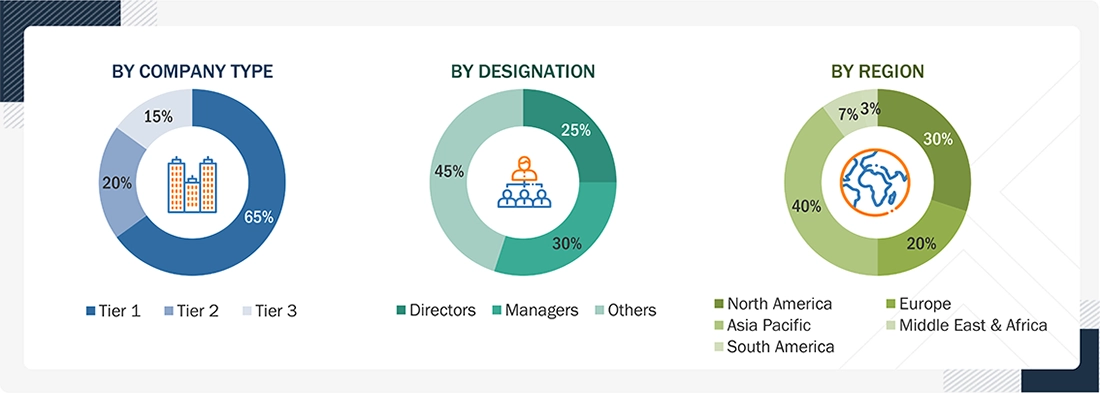
To know about the assumptions considered for the study, download the pdf brochure
Market Size Estimation
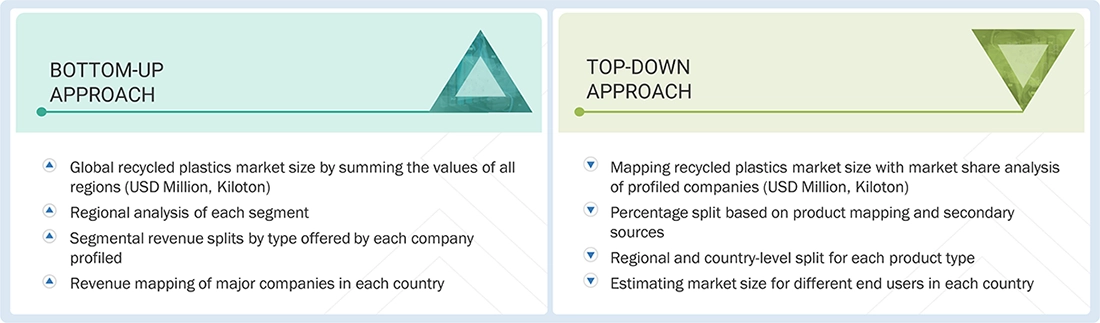
Both the top-down and bottom-up approaches have been used to estimate and validate the total size of the recycled plastics market. These approaches have also been used extensively to estimate the size of various dependent subsegments of the market. The research methodology used to estimate the market size included the following:
The following segments provide details about the overall market size estimation process employed in this study:
- The key players in the market were identified through secondary research.
- The market shares in the respective regions were identified through primary and secondary research.
- The value chain and market size of the recycled plastics market, in terms of value and volume, were determined through primary and secondary research.
- All percentage shares, splits, and breakdowns were determined using secondary sources and verified through primary sources.
- All possible parameters that affect the market covered in this research study were accounted for, viewed in extensive detail, verified through primary research, and analyzed to obtain the final quantitative and qualitative data.
- The research included the study of annual and financial reports of the top market players and interviews with industry experts, such as CEOs, VPs, directors, sales managers, and marketing executives.
Data Triangulation
After arriving at the overall market size using the market size estimation processes as explained above, the market was split into several segments and sub-segments. To complete the overall market engineering process and arrive at the exact statistics of each market segment and subsegment, the data triangulation and market breakdown procedures were employed, wherever applicable. The data was triangulated by studying various factors and trends from both the demand and supply sides in various sectors.
Market Definition
Recycled plastics are the materials that result from processing waste plastic materials. The use of recycled plastics leads to decreased landfill use while helping save natural resources, preventing plastic waste from entering the environment, and reducing greenhouse gas emissions. Recycled plastics derive their materials from multiple sources, which include plastic bottles, fibers, films, and foams. The recycling process uses mechanical or chemical methods to transform materials into two categories of recyclate, which include post-consumer and post-industrial materials that contain plastic pellets, flakes, sheets, and granules. The primary recycled plastics that recycling facilities handle include polyethylene terephthalate, polyethylene, polypropylene, polyvinyl chloride, and polystyrene.
Key Stakeholders
- Recycled plastic manufacturers
- Recycled plastic traders, distributors, and suppliers
- End-use market participants of recycled plastics
- Government and research organizations
- Associations and industrial bodies
- Research and consulting firms
- Research & development (R&D) institutions
- Environmental support agencies
- Investment banks and private equity firms
Report Objectives
- To analyze and forecast the market size of the recycled plastics market in terms of value and volume
- To provide detailed information regarding the major factors (drivers, restraints, challenges, and opportunities) influencing the market
- To analyze and forecast the global recycled plastics market on the basis of source, type, process, plastic type, end-use industry, and region
- To analyze the opportunities in the market for stakeholders and provide details of a competitive landscape for market leaders
- To forecast the size of various market segments based on five major regions: Asia Pacific, Europe, North America, the Middle East & Africa, and South America, along with their respective key countries
- To track and analyze the competitive developments, such as acquisitions, partnerships, collaborations, agreements, and expansions in the market
- To strategically profile the key players and comprehensively analyze their market shares and core competencies
Available customizations:
With the given market data, MarketsandMarkets offers customizations according to the client-specific needs.
The following customization options are available for the report:
- Additional country-level analysis of the recycled plastics market
- Profiling of additional market players (up to 5)
Product Analysis
- Product matrix, which gives a detailed comparison of the product portfolio of each company.
Get the Full Recycled Plastics Market Report
Full forecast, segment splits, and company analysis for all Recycled Plastics Market.
- China Recycled Plastics Market
- Japan Recycled Plastics Market
- India Recycled Plastics Market
- South Korea Recycled Plastics Market
- Germany Recycled Plastics Market
- UK Recycled Plastics Market
- France Recycled Plastics Market
- Italy Recycled Plastics Market
- Spain Recycled Plastics Market
- Canada Recycled Plastics Market
- Mexico Recycled Plastics Market
- US Recycled Plastics Market
- Saudi Arabia Recycled Plastics Market
- Iran Recycled Plastics Market
- South Africa Recycled Plastics Market
- Argentina Recycled Plastics Market
- Rest Of Europe Recycled Plastics Market
- Rest Of Asia Pacific Recycled Plastics Market
- Rest Of GCC Countries Recycled Plastics Market
- Rest Of South America Recycled Plastics Market
Need a Tailored Report?
Customize this report to your needs
Get 10% FREE Customization
Customize This Report
