
South Korea Recycling Inspection Market (2026-2031)

The South Korea Recycling Inspection Market was valued at $52.3 Million in 2026 and projected to reach to $83.4 Million by 2031, representing a compound annual growth rate of 9.8%. South Korea's recycling inspection market is poised for accelerated growth through 2031, driven by the nation's commitment to circular economy principles and increasingly stringent environmental regulations.


| Market Size in | USD 26.32 MN |
| Market Forecast in | |
| CAGR | |
| Forecast Period | |
| Units Considered | Value (USD MN) |
South Korea Recycling Inspection Market Trends and Insights
- This expansion reflects South Korea's commitment to circular economy principles and stringent environmental regulations that mandate comprehensive inspection protocols across recycling facilities.
- South Korea's advanced manufacturing base and high waste generation rates drive demand for sophisticated inspection technologies and compliance solutions. The market in South Korea is characterized by increasing adoption of automated inspection systems and digital monitoring platforms to ensure material quality and regulatory adherence.
- Between 2026 and 2031, South Korea's recycling inspection sector will benefit from government incentives, corporate sustainability initiatives, and the nation's position as a technology leader in Asia Pacific.
- South Korea's competitive advantage in sensor technology and AI-driven inspection solutions positions the country as a key growth hub within the regional market..
Key Market Statistics
- CAGR (2026-2031) 9.8% CAGR
- Market Size, 2026 ~USD 52.3 Million
- Forecast, 2031 ~USD 83.4 Million
- Country South Korea
South Korea Recycling Inspection Market Overview
Circular Economy Leadership :
South Korea is advancing its circular economy framework with mandatory recycling inspection protocols, positioning itself as a regional leader in sustainable material management and environmental compliance.
Regulatory Stringency :
Stringent environmental regulations across South Korean recycling facilities drive consistent demand for comprehensive inspection services, ensuring compliance with national waste management standards.
Advanced Manufacturing Integration :
South Korea's robust manufacturing base creates significant demand for recycling inspection services, as producers must verify material quality and traceability throughout the recycling supply chain.
Strong Market Expansion :
The market is projected to grow from USD 52.3 million in 2026 to USD 83.4 million by 2031, representing a 9.8% CAGR, outpacing the global average of 7.23%.
South Korea Recycling Inspection Market Dynamics
- The market's 9.8% CAGR reflects growing investments in inspection infrastructure and technology adoption across recycling facilities nationwide. The expansion is supported by South Korea's advanced manufacturing sector, which requires reliable recycling inspection services to maintain material quality standards and regulatory compliance.
- Government initiatives promoting sustainable practices and corporate environmental responsibility will continue to fuel market demand, positioning South Korea as a key growth market in the Asia-Pacific recycling inspection sector..
Market Ecosystem
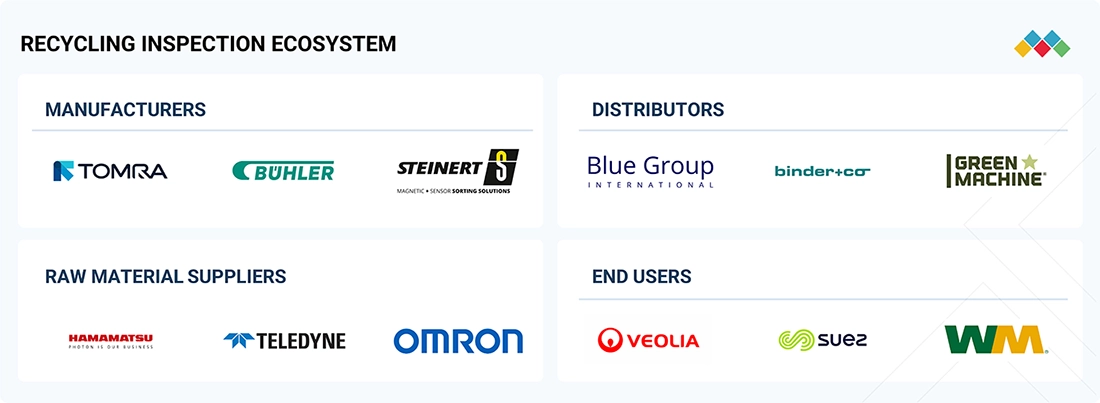
RECYCLING INSPECTION MARKET: COMMERCIAL USE CASES ACROSS INDUSTRIES
| COMPANY | USE CASE DESCRIPTION | BENEFITS |
|---|---|---|
 |
Implements large-scale recycling inspection across municipal and industrial waste streams within its material recovery facilities (MRFs) | Improves sorting efficiency, enhances recyclate quality, and ensures regulatory compliance |
 |
Uses advanced inspection systems in recycling plants to monitor, sort, and optimize recovery of plastics, metals, and paper from mixed waste streams | Increases recovery rates, reduces contamination, and improves operational efficiency |
 |
Deploys recycling inspection technologies across its MRF network to process residential and commercial waste streams | Enhances material purity, reduces landfill dependency, and boosts recycling throughput |
 |
Integrates inspection and sorting systems in recycling centers to improve segregation of recyclable materials from mixed waste | Drives higher recycling efficiency, lowers processing costs, and improves output quality |
 |
Utilizes inspection technologies in large-scale recycling operations for industrial, municipal, and hazardous waste streams | Ensures high-quality material recovery, supports compliance standards, and optimizes resource utilization |
Logos and trademarks shown above are the property of their respective owners. Their use here is for informational and illustrative purposes only.
Related Ecosystem
Equipment Machine And Tooling
- Wastewater Treatment
- Air Cooled Heat Exchangers
- Diaphragm Pumps
- Fiberglass
- HVAC System
- Alfa Laval Corporate AB
- Veolia
- Daikin Industries,Ltd.
- Johnson Controls International plc
- Parker-Hannifin Corporation
Key Takeaways
- South Korea's recycling inspection market will grow from USD 52.3M (2026) to USD 83.4M (2031), representing a 9.8% CAGR.
- South Korea's stringent environmental regulations and circular economy policies are primary drivers of market expansion.
- South Korea leads in automation and AI-powered inspection technologies, differentiating its market from regional competitors.
- South Korea's corporate sustainability commitments and government support will accelerate adoption through 2031.
Recycling Inspection Market Report Scope
| Report Metric | Details |
|---|---|
| Base Year | 2026 |
| Fastest Growing Segment | INTEGRATED RECYCLING PLANTS (End-Use Facility) |
| Forecast Period | 2026–2031 |
| Growth Rate | CAGR of 7.23% from 2026 to 2031 |
| Largest Segment | WASTE PLASTICS (Material Recycled) |
| Market Size Base Year (Billions) | ~USD 1.38 (2026) |
| Revenue Forecast (Billions) | ~USD 1.95 (2031) |
| Segments Covered | Material Recycled, Inspection Technology, End-Use Facility |
South Korea Recycling Inspection Market Report Segmentation
3 segment dimensions are covered across the global market.
By Material Recycled
- Glass
- Metals
- Other Materials Recycled
- Paper
- Waste Plastics
By Inspection Technology
- Metal Detection System
- Metal Detection Systems
- Near-Infrared Sorting
- Other Inspection Technologies
- Vision Inspection System
- Vision Inspection Systems
- X-Ray Inspection System
- X-Ray Inspection Systems
By End-Use Facility
- Integrated Recycling Plants
- Material Recovery Facilities
- Paper Recycling Plants
- Plastic Recycling Plants
Target Audience
- Recycling Facility Operators : Need market data to understand inspection service demand, regulatory requirements, and investment opportunities in South Korea's growing recycling infrastructure sector.
- Inspection Technology Providers : Require South Korea-specific market insights to develop localized solutions, identify customer segments, and plan product launches aligned with regional regulatory standards.
- Environmental Compliance Consultants : Seek detailed market analysis to advise clients on South Korea's inspection protocols, help businesses achieve compliance, and identify service expansion opportunities.
- Manufacturing & Supply Chain Managers : Need to understand recycling inspection requirements and market trends in South Korea to ensure material quality, regulatory compliance, and sustainable sourcing practices.
- Investment & Business Development Teams : Require market forecasts and growth projections for South Korea to evaluate investment opportunities, assess market viability, and make informed expansion decisions in the recycling sector.
Key Companies in the South Korea Recycling Inspection Market
| Company | HQ | Ownership | Strongest segments |
|---|---|---|---|
| TOMRA SYSTEMS ASA | Norway | Public Company | TOMRA Collection,TOMRA Recycling,TOMRA Food, |
| HEFEI MEYER OPTOELECTRONIC TECHNOLOGY INC. | China | Public Company | Food Safety (color sorters, x-ray, analyzers, digital solutions),Renewable Resources (recycling sorters),Healthcare (dental CBCT, intraoral, 2D panoramic, mobile CT, spinal robot), |
| MSS, LLC | United States | Public Company | Perishables (meat, seafood, vegetables, fruit),Non-perishable grocery (Asian pantry, snacks, beverages, liquor, cigarettes, lottery),General merchandise, beauty care, pharmacy, non-food, |
| AMP | United States | Public Company | Advice & Wealth Management,Asset Management (Columbia Threadneedle),Retirement & Protection Solutions, |
TOMRA SYSTEMS ASA
TOMRA SYSTEMS ASA is a Norwegian public company founded in 1972 with 5,800 employees. The company operates as a multinational organization headquartered in Norway.
HEFEI MEYER OPTOELECTRONIC TECHNOLOGY INC.
HEFEI MEYER OPTOELECTRONIC TECHNOLOGY INC. is a Chinese public company founded in 1993 with 1,360 employees. The company operates in the optoelectronic technology sector.
MSS, LLC
MSS, LLC is a United States public company founded in 2019 with 329 employees. The company is a recently established publicly traded organization.
AMP
AMP is a United States public company founded in 1894 with 13,600 employees. The company is a large, long-established publicly traded organization.
Reasons to Buy this Report
- Market-Specific Growth Projections : Access detailed forecasts for South Korea's recycling inspection market with precise valuations (USD 52.3M in 2026 to USD 83.4M in 2031), enabling accurate business planning and investment decisions.
- Regulatory Compliance Insights : Understand South Korea's stringent environmental regulations and mandatory inspection protocols that drive market demand, helping businesses align operations with local compliance requirements.
- Competitive Positioning Analysis : Gain intelligence on South Korea's advanced manufacturing base and its impact on recycling inspection demand, identifying opportunities to capture market share in this high-growth segment.
- Regional Performance Benchmarking : Compare South Korea's 9.8% CAGR against the global 7.23% average to understand relative market strength and prioritize resource allocation across Asia-Pacific operations.
- Strategic Market Entry Planning : Leverage South Korea-specific data to develop targeted market entry strategies, identify key stakeholders in the recycling sector, and capitalize on circular economy expansion opportunities.
Frequently asked questions
What is the current size of South Korea's recycling inspection market?
South Korea's recycling inspection market is valued at USD 52.3 million in 2026 and is expected to grow to USD 83.4 million by 2031.
What is the projected growth rate for South Korea's recycling inspection market?
South Korea's recycling inspection market is projected to grow at a compound annual growth rate (CAGR) of 9.8% from 2026 to 2031.
What factors are driving growth in South Korea's recycling inspection market?
South Korea's market growth is driven by stringent environmental regulations, circular economy initiatives, advanced manufacturing demand, and corporate sustainability commitments.
What technologies are being adopted in South Korea's recycling inspection sector?
South Korea is adopting automated inspection systems, AI-driven quality monitoring, digital platforms, and sensor-based technologies to enhance recycling facility compliance and material quality.
How does South Korea's recycling inspection market compare regionally?
South Korea's 9.8% CAGR outpaces the global average of 7.23%, positioning it as a high-growth market within Asia Pacific due to technological leadership and regulatory stringency.
RESEARCH METHODOLOGY
The study involved four major activities in estimating the market size for the recycling inspection market. Exhaustive secondary research was done to collect information on the market, the peer market, and the parent market. The next step was to validate these findings, assumptions, and sizing with industry experts across the value chain through primary research. Both top-down and bottom-up approaches were employed to estimate the complete market size. After that, the market breakdown and data triangulation procedures were used to estimate the market size of the segments and subsegments.
Secondary Research
Secondary sources used in this study included annual reports, press releases, and investor presentations of companies; white papers; certified publications; articles from recognized authors; and gold-standard and silver-standard websites, such as Factiva, ICIS, Bloomberg, and others. The findings of this study were verified through primary research, which involved conducting extensive interviews with key officials, including CEOs, VPs, directors, and other executives. The breakdown of profiles of the primary interviewees is illustrated in the figure below.
Primary Research
The recycling inspection market comprises several stakeholders, such as raw material suppliers, end-product manufacturers, and regulatory organizations in the supply chain. The demand side of this market is characterized by key opinion leaders in various end-use facilities for the recycling inspection market. The supply side is characterized by advancements in technology and diverse application facilities. Various primary sources from both the supply and demand sides of the market were interviewed to obtain qualitative and quantitative information.
BREAKDOWN OF PRIMARY PARTICIPANTS
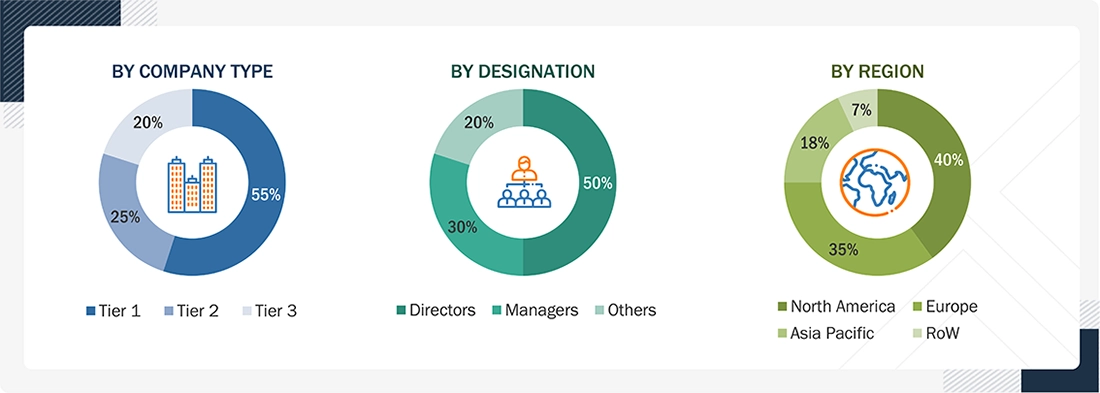
Note: Tier 1, Tier 2, and Tier 3 companies are classified based on their market revenue in 2024/2025, available in the public domain, product portfolios, and geographical presence.
|
COMPANY NAME |
DESIGNATION |
|
TOMRA Systems ASA |
Senior Manager |
|
STEINERT GmbH |
Innovation Manager |
|
Buhler Group |
Vice President |
|
Pellenc ST |
Production Supervisor |
|
MSS Inc. |
Sales Manager |
To know about the assumptions considered for the study, download the pdf brochure
Market Size Estimation
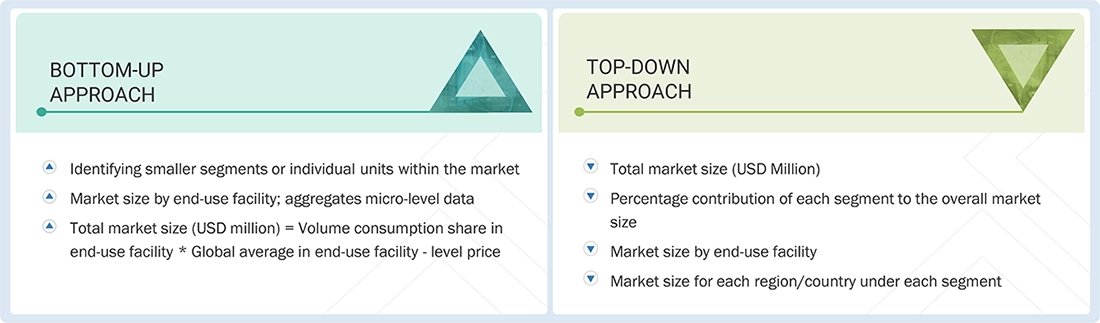
Both top-down and bottom-up approaches were used to estimate and validate the total size of the recycling inspection market. These methods were also used extensively to estimate the size of various subsegments in the market. The research methodology used to estimate the market size includes the following:
- The key players in the industry have been identified through extensive secondary research.
- The supply chain of the industry has been determined through primary and secondary research
- All percentage shares, splits, and breakdowns have been determined using secondary sources and verified through primary sources
- All possible parameters that affect the markets covered in this research study have been accounted for, viewed in extensive detail, verified through primary research, and analyzed to obtain the final quantitative and qualitative data
Recycling Inspection Market: Bottom-up Approach
Data Triangulation
After determining the overall market size using the market size estimation processes explained above, the market was divided into several segments and subsegments. To complete the overall market engineering process and determine the exact statistics for each market segment and subsegment, data triangulation and market breakdown procedures were employed, as applicable. The data was triangulated by studying various factors and trends from both the demand and supply sides in the recycling inspection industry.
Market Definition
Recycling inspection systems are advanced technologies, equipment, and integrated solutions. Their main function is to inspect, detect, and analyze recyclable materials while ensuring proper sorting, contamination removal, and quality control. By identifying the composition of materials and detecting impurities in the waste streams, these systems can greatly enhance the efficiency and accuracy of recycling processes. These systems include a range of technologies, such as X-ray inspection systems, metal detection systems, vision inspection systems, near-infrared (NIR) sorting systems, and other advanced sensor-based and automated inspection technologies. These technologies are implemented using processes such as automated sorting, real-time monitoring, and material classification to provide high accuracy, speed, and operational efficiency.
Key Stakeholders
- Recycling inspection system manufacturers
- Component and equipment suppliers
- Recycling facility operators
- System integrators and solution providers
- Waste management companies
- Distributors and service providers
- Industry associations and regulatory bodies
- End users
Report Objectives
- To analyze and forecast the size of the global recycling inspection market in terms of value and volume
- To provide detailed information about the important drivers, restraints, challenges, and opportunities influencing market growth
- To define, describe, and segment the market based on material recycled, inspection technology, end-use facility, and region
- To forecast the size of the market segments based on regions such as Asia Pacific, North America, Europe, Middle East & Africa, and South America
- To strategically analyze the segmented markets with respect to individual growth trends, prospects, and contributions to the overall market
- To identify and analyze opportunities for stakeholders in the market
- To analyze competitive developments such as expansions, partnerships, collaborations, mergers & acquisitions, agreements, and product launches in the market
- To strategically profile the key companies and comprehensively analyze their core competencies
Available customizations:
Along with the given market data, MarketsandMarkets offers customizations according to the company’s specific needs. The following customization options are available for the report:
Regional Analysis
-
Further breakdown of a region with respect to a particular country or additional application
Company Information
- Detailed analysis and profiles of additional market players (up to five)
Get the Full Recycling Inspection Market Report
Full forecast, segment splits, and company analysis for all Recycling Inspection Market.
- US Recycling Inspection Market
- Canada Recycling Inspection Market
- Mexico Recycling Inspection Market
- Germany Recycling Inspection Market
- UK Recycling Inspection Market
- France Recycling Inspection Market
- Italy Recycling Inspection Market
- Spain Recycling Inspection Market
- China Recycling Inspection Market
- Japan Recycling Inspection Market
- India Recycling Inspection Market
- South Africa Recycling Inspection Market
- Brazil Recycling Inspection Market
- Argentina Recycling Inspection Market
- Rest Of Europe Recycling Inspection Market
- Rest Of Asia Pacific Recycling Inspection Market
- GCC Countries Recycling Inspection Market
- –Rest Of GCC Countries Recycling Inspection Market
Need a Tailored Report?
Customize this report to your needs
Get 10% FREE Customization
Customize This Report
