
South Africa Refractories Market (2024-2029)

The South Africa Refractories Market was valued at $175.1 Million in 2024 and projected to reach to $198.6 Million by 2029, representing a compound annual growth rate of 2.56%. South Africa's refractories market is positioned for steady growth through 2029, supported by the country's robust mining and steel manufacturing sectors.


| Market Size in | USD 26.32 MN |
| Market Forecast in | |
| CAGR | |
| Forecast Period | |
| Units Considered | Value (USD MN) |
South Africa Refractories Market Trends and Insights
- South Africa's refractories sector is driven by demand from steel manufacturing, mining operations, and cement production industries that rely on high-temperature resistant materials.
- The market in South Africa reflects steady but moderate growth compared to global trends, supported by the country's established industrial base and ongoing infrastructure development. In South Africa, the refractories market benefits from the nation's position as a leading producer of minerals and metals, particularly iron ore and platinum.
- South Africa's industrial sectors-including foundries, glass manufacturing, and petrochemical facilities-continue to require specialized refractory materials for furnace linings and thermal management.
- Between 2024 and 2029, South Africa is expected to see incremental capacity additions and modernization investments that will sustain demand for premium refractory products..
Key Market Statistics
- CAGR (2024-2029) 2.56% CAGR
- Market Size, 2024 ~USD 175.1 Million
- Forecast, 2029 ~USD 198.6 Million
- Country South Africa
South Africa Refractories Market Overview
Market Valuation :
South Africa's refractories market is valued at USD 175.1 million in 2024, with projected growth to USD 198.6 million by 2029, representing a steady expansion in the regional market.
Growth Rate :
The South African refractories market is expanding at a CAGR of 2.56% from 2024 to 2029, demonstrating moderate but consistent growth driven by industrial demand.
Key End-Use Industries :
Steel manufacturing, mining operations, and cement production are the primary drivers of refractory material demand in South Africa, leveraging the country's strong industrial base.
Material Applications :
High-temperature resistant materials are critical for South Africa's industrial sectors, where refractories are essential for furnace linings, kiln operations, and thermal processing equipment.
South Africa Refractories Market Dynamics
- The demand for high-temperature resistant materials remains strong as industrial operations continue to modernize and expand capacity.
- However, growth is moderated by economic constraints and competition from imported materials. The market outlook for South Africa is shaped by infrastructure investments in mining and steel production, coupled with increasing focus on operational efficiency and equipment durability.
- As industries seek to optimize production costs and extend equipment lifespan, the adoption of advanced refractory solutions is expected to accelerate, supporting the projected 2.56% CAGR through 2029..
Market Ecosystem
Related Ecosystem
Ceramics And Glass
- Zirconia
- Alumina Ceramics
- Silicon Carbide
- Silicon Nitride
- Titanate Ceramics
- Saint-gobain
- 3M COMPANY
- Kyocera Corporation
- CERAMTEC GMBH
- COORSTEK INCORPORATED
Energy Circularity
- Epoxy Resin
- Progressive Cavity Pumps
- Amphoteric
- Bisphenol-A
- Cartridge Filters
- TotalEnergies SE
- ENEOS Holdings, Inc.
- Hess Corporation
- Baker Hughes Company
- Weatherford International plc
Key Takeaways
- South Africa's refractories market is valued at USD 175.1 million in 2024 and is forecast to reach USD 198.6 million by 2029.
- South Africa's market growth rate of 2.56% CAGR is driven by demand from mining, steel, and cement industries.
- South Africa's position as a major minerals and metals producer underpins sustained demand for high-temperature refractory materials.
- South Africa's refractories sector is supported by industrial modernization and capacity expansion in key end-use sectors through 2029.
Refractories Market Report Scope
| Report Metric | Details |
|---|---|
| Base Year | 2024 |
| Fastest Growing Segment | ACIDIC & NEUTRAL (Alkalinity) |
| Forecast Period | 2024-2029 |
| Growth Rate | CAGR of 4.4% from 2024 to 2029 |
| Largest Segment | STEEL (Type) |
| Market Size Base Year (Billions) | ~USD 34.19 (2024) |
| Revenue Forecast (Billions) | ~USD 42.4 (2029) |
| Segments Covered | Form, Alkalinity, End-Use Industry, Type |
South Africa Refractories Market Report Segmentation
4 segment dimensions are covered across the global market.
By Form
- Shaped Refractories
- Unshaped Refractories
By Alkalinity
- Acidic & Neutral
- Basic
By End-Use Industry
- Automotive & Transportation
- Building & Construction
- Cement
- Consumer Goods
- Glass
- Heavy Industry
- Iron & Steel
- Non-Ferrous Metal
- Other End-Use Industries
- Power Generation
By Type
- Iron
- Steel
Target Audience
- Refractory Manufacturers : Manufacturers need South Africa-specific market data to understand local demand patterns, identify key customer segments in steel and mining, and develop targeted expansion strategies.
- Industrial Equipment Suppliers : Suppliers of furnaces, kilns, and thermal processing equipment require insights into South Africa's refractory consumption to align product offerings with regional industrial requirements.
- Mining & Steel Companies : End-users in South Africa's mining and steel sectors need market intelligence to optimize refractory procurement, evaluate supplier options, and manage operational costs effectively.
- Investment & Private Equity Firms : Investors evaluating opportunities in South Africa's industrial materials sector need detailed market sizing, growth forecasts, and competitive landscape data for due diligence and valuation.
- Market Research & Consulting Firms : Research organizations require country-level refractories data for South Africa to support client advisory services, competitive analysis, and strategic recommendations in the region.
Reasons to Buy this Report
- Market Size & Growth Data : Access precise valuation figures for South Africa's refractories market (USD 175.1M in 2024) with detailed 5-year forecasts, enabling accurate investment planning and resource allocation decisions.
- Industry-Specific Insights : Understand demand drivers specific to South Africa's steel, mining, and cement sectors, allowing you to tailor product offerings and marketing strategies to regional industrial needs.
- Competitive Positioning : Benchmark your business against market trends in South Africa, identify growth opportunities, and develop strategies to capture market share in this moderately growing regional market.
- Strategic Planning : Leverage country-specific CAGR data (2.56%) and forecast projections to make informed decisions about market entry, expansion, or investment in South Africa's refractories sector.
- Risk Assessment : Evaluate market stability and growth potential in South Africa relative to global trends (4.4% CAGR), helping you assess regional risks and opportunities for long-term business sustainability.
Frequently asked questions
What is the current size of South Africa's refractories market?
South Africa's refractories market is valued at USD 175.1 million in 2024.
What is the projected market size for South Africa's refractories by 2029?
South Africa's refractories market is forecast to reach USD 198.6 million by 2029.
What is the CAGR for South Africa's refractories market?
South Africa's refractories market is expected to grow at a CAGR of 2.56% from 2024 to 2029.
Which industries drive demand for refractories in South Africa?
South Africa's refractories demand is primarily driven by steel manufacturing, mining operations, cement production, foundries, glass manufacturing, and petrochemical facilities.
Why is South Africa's refractories market important?
South Africa's refractories market is critical to supporting the country's mining and metals industries, which are among the largest in the world and require specialized high-temperature materials.
RESEARCH METHODOLOGY
The study involved four major activities for estimating the current global size of the refractories market. Exhaustive secondary research was conducted to gather information on the market, the peer market, and the parent market. The next step was to validate these findings, assumptions, and sizes with the industry experts across the value chain of refractories through primary research. Both the top-down and bottom-up approaches were employed to estimate the overall size of the refractories market. After that, market breakdown and data triangulation procedures were used to determine the size of different segments and sub-segments of the market.
Secondary Research
In the secondary research process, various secondary sources such as Hoovers, Factiva, Bloomberg BusinessWeek, and Dun & Bradstreet were referred to, to identify and collect information for this study on the refractories market. These secondary sources included annual reports, press releases & investor presentations of companies, white papers, certified publications, articles by recognized authors, regulatory bodies, trade directories, and databases.
Primary Research
Various primary sources from both the supply and demand sides of the refractories market were interviewed to obtain qualitative and quantitative information. The primary sources from the supply side included industry experts, such as Chief Executive Officers (CEOs), vice presidents, marketing directors, sales professionals, and related key executives from various leading companies and organizations operating in the refractories industry. The breakdown of the profiles of primary respondents is as follows:
Breakdown of Primary Interviews
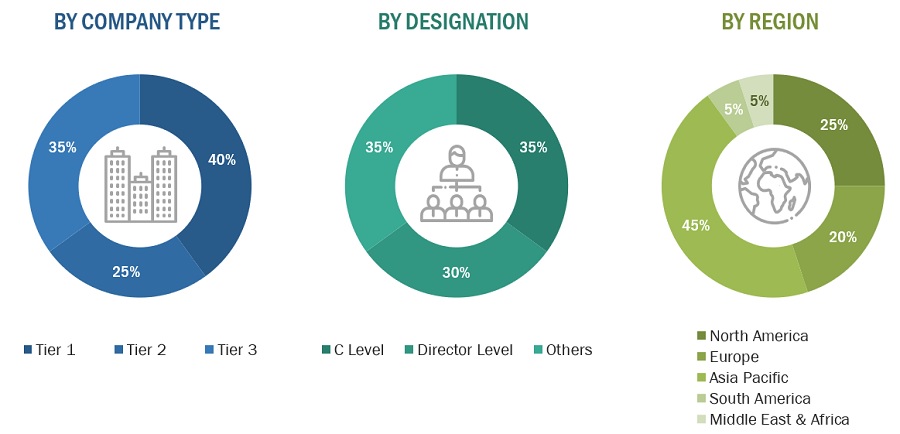
Notes: Companies are classified based on their revenue–Tier 1 = >USD 7 billion, Tier 2 = USD 500 million to USD 7 billion, and Tier 3 = <USD 500 million.
Others include sales, marketing, and product managers.
To know about the assumptions considered for the study, download the pdf brochure
Market Size Estimation
Both the top-down and bottom-up approaches were used to estimate and validate the global size of the refractories market. These approaches were also used extensively to estimate the size of various dependent segments of the market. The research methodology used to estimate the market size included the following details:
- The key players were identified through extensive secondary research.
- The industry’s supply chain and market size, in terms of value, were determined through primary and secondary research processes.
- All percentage shares, split, and breakdowns were determined using secondary sources and verified through primary sources.
- All possible parameters that affect the markets covered in this research study were accounted for, viewed in extensive detail, verified through primary research, and analysed to obtain the final quantitative and qualitative data.
- The research includes the study of reports, reviews, and newsletters of key industry players, along with extensive interviews with key officials, such as directors and marketing executives.
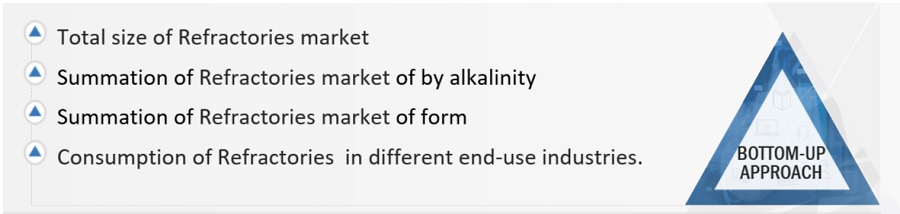
To know about the assumptions considered for the study, Request for Free Sample Report
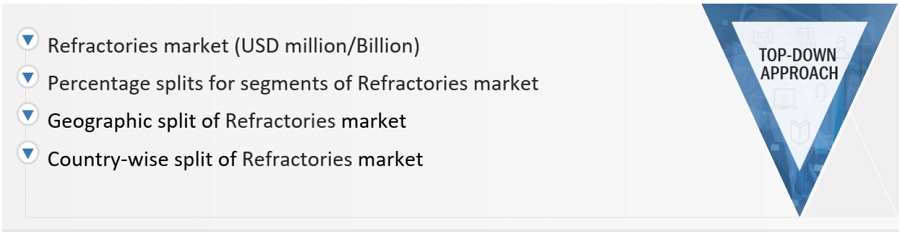
Data Triangulation
After arriving at the overall market size from the estimation process explained above, the total market was split into several segments and sub-segments. The data triangulation and market breakdown procedures were employed, wherever applicable, to complete the overall market engineering process and arrive at the exact statistics for all segments and sub-segments of the refractories market. The data was triangulated by studying various factors and trends from both the demand- and supply-side.
In addition, the market size was validated by using both the top-down and bottom-up approaches. Then, it was verified through primary interviews. Hence, for every data segment, there are three sources—top-down approach, bottom-up approach, and expert interviews. The data were assumed to be correct when the values arrived at from the three sources matched.
Market Definition
The refractories market refers to the economic domain encompassing the production, distribution, and consumption of specialized materials designed to withstand extremely high temperatures and harsh operating conditions in industrial processes. These materials, known as refractories, are essential components in industries such as steelmaking, glass production, cement manufacturing, and chemical processing. The market involves manufacturers producing refractory products, end-users purchasing these materials for their industrial operations, distributors facilitating the supply chain, and maintenance services ensuring the longevity and efficiency of refractory linings in industrial equipment.
Key Stakeholders
- Raw material suppliers
- Refractories manufacturers
- Government & regulatory bodies
- Research organizations
- Associations and industry bodies
- End use industries
- Traders and distributors
Research Objectives
- To estimate and forecast the refractories market, in terms of value and volume
- To provide detailed information about the major factors (drivers, restraints, opportunities, and challenges) influencing the market growth
- To define, describe, and forecast the market size, based on form, alkalinity, end-use industry, and region
- To forecast the market size along with segments and submarkets, in key regions: North America, Europe, Asia Pacific (APAC), Middle East & Africa (MEA), and South America along with their key countries
- To strategically analyze micro markets, with respect to individual growth trends, prospects, and their contribution to the total market
- To analyze growth opportunities in the market for stakeholders and provide details on the competitive landscape for market leaders
- To strategically profile key players and comprehensively analyze their market shares and core competencies
- To analyze competitive developments, such as merger & acquisition, expansion & investment, and agreements in the refractories market
Available Customizations
With the given market data, MarketsandMarkets offers customizations according to client-specific needs.
The following customization options are available for the refractories report:
Product Analysis
- Product matrix, which offers a detailed comparison of the product portfolio of companies
Regional Analysis
- Further analysis of the refractories market for additional countries
Company Information
- Detailed analysis and profiling of additional market players (up to five)
Get the Full Refractories Market Report
Full forecast, segment splits, and company analysis for all Refractories Market.
- China Refractories Market
- Japan Refractories Market
- India Refractories Market
- South Korea Refractories Market
- Australia Refractories Market
- Germany Refractories Market
- UK Refractories Market
- France Refractories Market
- Spain Refractories Market
- Italy Refractories Market
- Russia Refractories Market
- US Refractories Market
- Canada Refractories Market
- Mexico Refractories Market
- Brazil Refractories Market
- Argentina Refractories Market
- Turkey Refractories Market
- Rest Of Europe Refractories Market
- Rest Of Asia Pacific Refractories Market
- GCC Countries Refractories Market
- -Rest Of GCC Refractories Market
- Rest Of South America Refractories Market
Need a Tailored Report?
Customize this report to your needs
Get 10% FREE Customization
Customize This Report
