
Saudi Arabia Retail Platform Market (2025-2030)

The Saudi Arabia Retail Platform Market was valued at $442.7 Million in 2025 and projected to reach to $1187.4 Million by 2030, representing a compound annual growth rate of 21.8%. Saudi Arabia's retail platform market is poised for exceptional growth through 2030, driven by the kingdom's ambitious Vision 2030 agenda and substantial investments in digital infrastructure.


| Market Size in | USD 26.32 MN |
| Market Forecast in | |
| CAGR | |
| Forecast Period | |
| Units Considered | Value (USD MN) |
Saudi Arabia Retail Platform Market Trends and Insights
- This represents a compound annual growth rate of 21.8%, significantly outpacing global trends and reflecting the kingdom's digital transformation initiatives and rising e-commerce adoption.
- Saudi Arabia's strategic investments in technology infrastructure, coupled with increasing consumer preference for online shopping, are driving substantial market growth throughout the forecast period. The retail platform sector in Saudi Arabia is benefiting from favorable demographic trends, high smartphone penetration, and government support for digital commerce ecosystems.
- Saudi Arabia's young, tech-savvy population and growing middle class are accelerating the shift toward digital retail channels.
- Between 2025 and 2030, Saudi Arabia is expected to consolidate its position as a regional e-commerce leader, with retail platforms becoming increasingly central to the kingdom's retail landscape and contributing significantly to broader economic diversification goals..
Key Market Statistics
- CAGR (2025-2030) 21.8% CAGR
- Market Size, 2025 ~USD 442.7 Million
- Forecast, 2030 ~USD 1187.4 Million
- Country Saudi Arabia
Saudi Arabia Retail Platform Market Overview
Exceptional Growth Trajectory :
Saudi Arabia's retail platform market is expanding at 21.8% CAGR, significantly outpacing the global average of 19.5%, driven by Vision 2030 digital transformation initiatives and accelerating e-commerce adoption across the kingdom.
Substantial Market Valuation :
The market is valued at $442.7 million in 2025 with projections to reach $1,187.4 million by 2030, representing a 168% increase over five years and positioning Saudi Arabia as a critical growth hub in the Middle East retail technology sector.
Digital Infrastructure Investment :
Saudi Arabia's strategic focus on technology infrastructure development, coupled with government support for digital commerce, is creating favorable conditions for retail platform expansion and attracting both local and international market participants.
Rising Consumer E-Commerce Adoption :
Increasing internet penetration, growing smartphone usage, and changing consumer preferences toward online shopping are driving demand for advanced retail platforms across Saudi Arabia's urban and emerging markets.
Saudi Arabia Retail Platform Market Dynamics
- The 21.8% CAGR reflects strong consumer adoption of e-commerce, increased smartphone penetration, and government initiatives promoting digital transformation across retail sectors.
- Major retailers and emerging startups are rapidly deploying advanced platform technologies to capture market share. The forecast growth to $1,187.4 million by 2030 underscores Saudi Arabia's emergence as a regional e-commerce powerhouse.
- Key growth catalysts include rising disposable incomes, expanding logistics networks, and regulatory frameworks supporting digital commerce.
- Market participants should anticipate intensifying competition, technological innovation in payment solutions, and consolidation among platform providers as the market matures..
Market Ecosystem
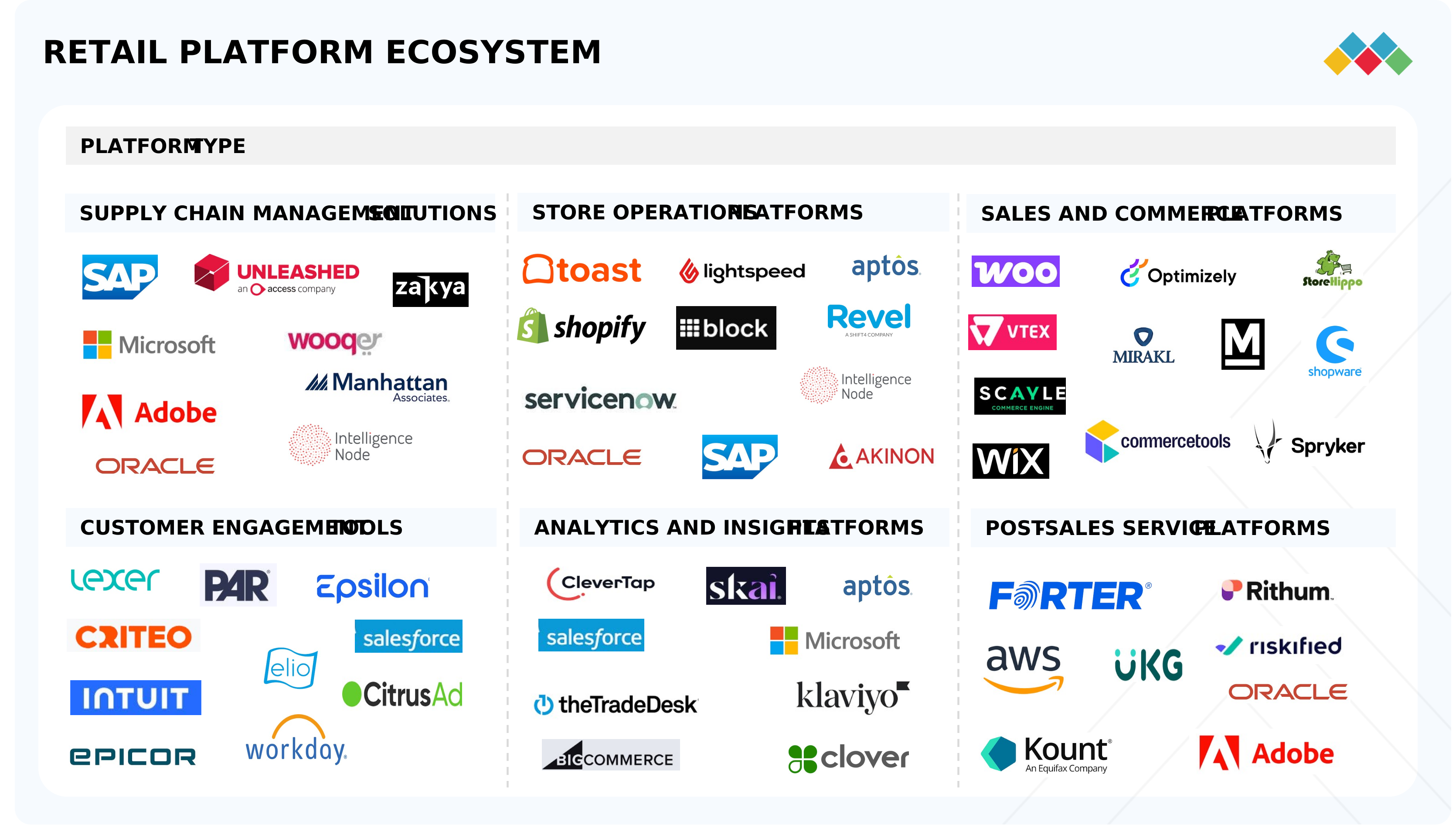
retail platform market: COMMERCIAL USE CASES ACROSS INDUSTRIES
| COMPANY | USE CASE DESCRIPTION | BENEFITS |
|---|---|---|
 |
Uber Eats achieves 15% incremental category revenue growth with Criteo’s retail solution | 27% rise in PDP share for a campaign with an alcohol brand, reflecting improved product visibility and consumer interest on the platform |
 |
Godrej & Boyce and Salesforce drive 10% faster opportunity-to-order conversions with one CRM | Use of Tableau with Salesforce data enables real-time predictive analytics, achieving up to an 80% lead-to-sale conversion probability in one business unit |
 |
ASOS enhances customer experience and accelerates AI innovation with Microsoft Azure AI Studio | AI experience engages customers in natural dialogue, learning preferences and curating product selections with up-to-date trend knowledge from internal and external sources, enhancing personalization |
 |
HanesBrands and Adobe drive 57% revenue growth with advanced personalization and data integration | The audience expanded by 1,000 customers weekly due to personalized marketing and targeted messaging |
Logos and trademarks shown above are the property of their respective owners. Their use here is for informational and illustrative purposes only.
Related Ecosystem
Software And Services
- Natural Language Processing (NLP)
- Machine Learning
- Supply Chain Management
- Predictive Analytics
- Image Sensors
- International Business Machines Corporation
- MICROSOFT CORPORATION
- Oracle Corporation
- SAP SE
- Amazon.com, Inc.
Retail Analytics
- Supply Chain Management
- Automatic Number Plate Recognition (ANPR)
- Customer Analytics
- Descriptive Analytics
- Face Recognition
- SAP SE
- MICROSOFT CORPORATION
- SAS INSTITUTE INC
- Zensar Technologies Limited
- Teradata Corporation
Retail Technology
- Supply Chain Management
- Active Tags
- Pallet Aggregation
- 2D Barcodes
- Augmented Reality
- MICROSOFT CORPORATION
- SAP SE
- Saison Information Systems Co., Ltd.
- Zebra Technologies Corporation
- International Business Machines Corporation
Key Takeaways
- Saudi Arabia's retail platform market will grow from $442.7M (2025) to $1,187.4M (2030), a 21.8% CAGR.
- Saudi Arabia's growth rate exceeds the global average, driven by digital transformation and e-commerce adoption.
- Saudi Arabia benefits from high smartphone penetration and a young, digitally-native consumer base.
- Saudi Arabia's government support for digital commerce is accelerating retail platform expansion through 2030.
Retail Platform Market Report Scope
| Report Metric | Details |
|---|---|
| Base Year | 2025 |
| Fastest Growing Segment | HEALTHCARE & LIFE SCIENCES (Enterprise End User) |
| Forecast Period | 2025–2030 |
| Growth Rate | CAGR of 19.5% from 2025 to 2030 |
| Largest Segment | ENTERPRISES (End User) |
| Market Size Base Year (Billions) | ~USD 39.18 (2025) |
| Revenue Forecast (Billions) | ~USD 95.49 (2030) |
| Segments Covered | Offering, Platform, Service, Professional Service, Deployment Mode, Retail Store Type, Industry Vertical Focus, End User, Application, Enterprise End User |
Saudi Arabia Retail Platform Market Report Segmentation
10 segment dimensions are covered across the global market.
By Offering
- Marketing
- Platform
- Platforms
- Sales
- Services
- Software
By Platform
- Analytics & Insights Platforms
- Customer Engagement Tools
- Other Platforms
- Post-Sale Service Platforms
- Post-Sales Service Platforms
- Sales & Commerce Platforms
- Sales And Commerce Platforms
- Store Operations Platforms
- Supply Chain Management Solutions
By Service
- Managed Services
- Professional Services
By Professional Service
- Support & Maintenance
- System Integration & Implementation
- Training & Consulting
By Deployment Mode
- Cloud
- On-Premises
By Retail Store Type
- Franchise/Chain Models
- In-Store/Physical Stores
- Marketplace Operators
- Omnichannel Retailers
- Online
By Industry Vertical Focus
- Beauty & Cosmetics
- Consumer Electronics
- Fashion & Apparel
- Food & Grocery Stores
- Furniture & Home Decor
- Other Industry Verticals
- Pharmacies & Health Retailers
- Restaurants & Qsrs
By End User
- Consumer
- Enterprises
- Individual Users
- Industrial
By Application
- Marketing Applications
- Sales Applications
By Enterprise End User
- Automotive
- Bfsi
- Education
- Healthcare & Life Sciences
- Manufacturing
- Media & Entertainment
- Other Enterprise End Users
- Retail & E-Commerce
- Technology & Software
- Telecommunications
- Travel & Hospitality
Target Audience
- E-Commerce Platform Operators : Retailers and platform providers need Saudi Arabia-specific market data to optimize expansion strategies, allocate resources effectively, and capitalize on the kingdom's 21.8% growth opportunity in the competitive regional landscape.
- Technology & Software Vendors : B2B technology providers require detailed insights into Saudi Arabia's retail platform infrastructure needs, technology adoption trends, and customer requirements to develop localized solutions and secure market contracts.
- Investment & Private Equity Firms : Investors evaluating opportunities in Middle Eastern retail technology need comprehensive Saudi Arabia market analysis, growth projections, and competitive intelligence to make confident capital allocation decisions.
- Logistics & Payment Solution Providers : Supply chain and fintech companies need Saudi Arabia-specific market insights to understand demand for integrated solutions, identify partnership opportunities, and develop region-appropriate service offerings.
- Market Research & Strategy Consultants : Consulting firms advising clients on Middle East expansion require validated Saudi Arabia retail platform data, forecasts, and market dynamics to develop credible strategic recommendations and competitive analyses.
Key Companies in the Saudi Arabia Retail Platform Market
| Company | HQ | Ownership | Strongest segments |
|---|---|---|---|
| CRITEO | France | Public Company | Retail Media Networks,Customer Engagement Tools,B2B Commerce Platform, |
| ORACLE | United States | ||
| SALESFORCE | United States | Public Company | Customer Engagement Tools,eCommerce Platform,B2B Commerce Platform, |
| ADOBE | United States | ||
| MICROSOFT | United States | ||
| SAP | Germany | ||
| INTUIT | United States | ||
| MANHATTAN ASSOCIATES | United States | ||
| SERVICENOW | United States | ||
| AWS | United States | ||
| SHOPIFY | Canada | ||
| BLOCK | United States | Public Company | Retail POS,Customer Engagement Tools,eCommerce Platform, |
| TOAST | United States | Public Company | Retail POS,Supply Chain Management Solutions - Inventory Management Systems,Supply Chain Management Solutions - Procurement Platforms, |
| LIGHTSPEED | Canada | Public Company | Retail POS,eCommerce Platform,Supply Chain Management Solutions (Inventory Management Systems, Procurement Platforms), |
CRITEO
Criteo is a French technology company founded in 2005 that operates as a public company with 3,649 employees. The company specializes in digital advertising and commerce solutions.
ORACLE
Oracle is a United States-based technology company providing enterprise software and cloud computing solutions.
SALESFORCE
Salesforce is a United States-based public company founded in 1999 with 83,334 employees, specializing in cloud-based customer relationship management (CRM) and business software solutions.
ADOBE
Adobe is a United States-based technology company that develops creative and digital marketing software solutions.
MICROSOFT
Microsoft is a United States-based technology company that develops software, cloud services, and computing solutions.
SAP
SAP is a Germany-based enterprise software company providing business management and data analytics solutions.
INTUIT
Intuit is a United States-based financial software company offering accounting, tax, and small business management solutions.
MANHATTAN ASSOCIATES
Manhattan Associates is a United States-based software company specializing in supply chain and retail management solutions.
SERVICENOW
ServiceNow is a United States-based software company providing cloud-based enterprise service management and workflow solutions.
AWS
AWS (Amazon Web Services) is a United States-based cloud computing platform offering infrastructure, storage, and application services.
SHOPIFY
Shopify is a Canada-based e-commerce platform enabling businesses to create and manage online stores.
BLOCK
Block is a United States-based public company founded in 2009 with 10,205 employees, providing financial services and payment processing solutions.
TOAST
Toast is a United States-based public company founded in 2011 with 6,500 employees, specializing in cloud-based point-of-sale and restaurant management software.
LIGHTSPEED
Lightspeed is a Canada-based public company founded in 2005 with 3,400 employees, offering cloud-based point-of-sale and e-commerce solutions for retail and hospitality businesses.
Reasons to Buy this Report
- Market-Specific Growth Intelligence : Gain detailed insights into Saudi Arabia's 21.8% CAGR trajectory, understanding localized growth drivers, consumer behavior patterns, and competitive dynamics specific to the kingdom's unique retail landscape.
- Strategic Investment Guidance : Make informed investment decisions with comprehensive market sizing ($442.7M to $1,187.4M) and forecasts through 2030, identifying optimal entry points and expansion opportunities in Saudi Arabia's high-growth retail platform sector.
- Competitive Positioning Analysis : Benchmark your organization against regional competitors and understand market consolidation trends, technology adoption rates, and emerging player strategies specific to Saudi Arabia's retail platform ecosystem.
- Vision 2030 Alignment Insights : Understand how government digital transformation initiatives, regulatory frameworks, and infrastructure investments are shaping the Saudi Arabian retail platform market and creating new business opportunities.
- Risk Mitigation & Market Validation : Reduce market entry risks with validated data on consumer adoption rates, payment infrastructure readiness, logistics capabilities, and regulatory compliance requirements specific to Saudi Arabia's retail platform operations.
Frequently asked questions
What is the current size of Saudi Arabia's retail platform market?
Saudi Arabia's retail platform market is valued at $442.7 million in 2025 and is expected to grow to $1,187.4 million by 2030.
What is the projected growth rate for Saudi Arabia's retail platform market?
Saudi Arabia's retail platform market is projected to grow at a compound annual growth rate (CAGR) of 21.8% from 2025 to 2030.
What factors are driving growth in Saudi Arabia's retail platform market?
Key drivers include digital transformation initiatives, high smartphone penetration, government support for e-commerce, a young tech-savvy population, and increasing consumer preference for online shopping in Saudi Arabia.
How does Saudi Arabia's retail platform market growth compare to global trends?
Saudi Arabia's 21.8% CAGR significantly outpaces the global retail platform market CAGR of 19.5%, reflecting the kingdom's accelerated digital adoption and e-commerce expansion.
What is the forecast market size for Saudi Arabia's retail platform market in 2030?
Saudi Arabia's retail platform market is forecasted to reach $1,187.4 million by 2030, representing a 168% increase from the 2025 baseline of $442.7 million.
RESEARCH METHODOLOGY
This research study on the retail platform market involved extensive secondary sources, directories, IEEE Communication-efficient Algorithms and Systems, International Journal of Innovation and Technology Management, and paid databases. Primary sources were mainly industry experts from the core and related industries, preferred retail platform providers, third-party service providers, consulting service providers, end users, and other commercial enterprises. In-depth interviews with primary respondents, including key industry participants and subject matter experts, were conducted to obtain and verify critical qualitative and quantitative information and assess the market’s prospects.
Secondary Research
In the secondary research process, various sources were referred to identify and collect information for this study. Secondary sources included annual reports, press releases, and investor presentations of companies; white papers, journals, and certified publications; and articles from recognized authors, directories, and databases. The data was also collected from other secondary sources, such as journals, government websites, blogs, and vendors’ websites. Additionally, the retail platform spending of various countries was extracted from the respective sources.
Primary Research
In the primary research process, various sources from the supply and demand sides were interviewed to obtain qualitative and quantitative information on the market. The primary sources from the supply side included various industry experts, such as Chief Experience Officers (CXOs), Vice Presidents (VPs), and directors specializing in business development, marketing, and retail platform providers. It also included key executives from retail platform solution and service vendors, system integrators (SIs), professional service providers, industry associations, and other key opinion leaders.
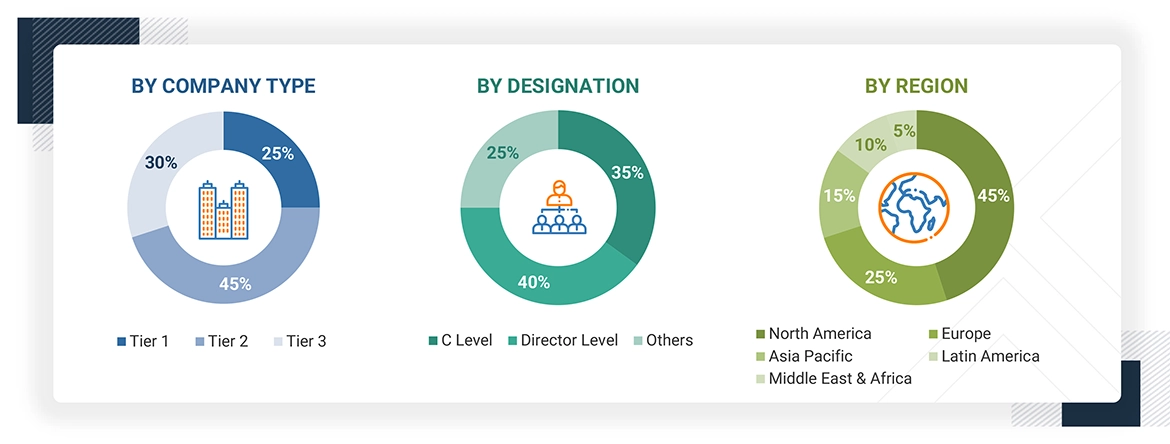
Note: Tier 1 companies’ revenues are more than USD 10 billion; tier 2 companies’ revenues range between USD 1 and 10 billion;
and tier 3 companies’ revenues range between USD 500 million and USD 1 billion. Other designations
include sales managers, marketing managers, and product managers.
Source: Industry Experts
To know about the assumptions considered for the study, download the pdf brochure
Market Size Estimation
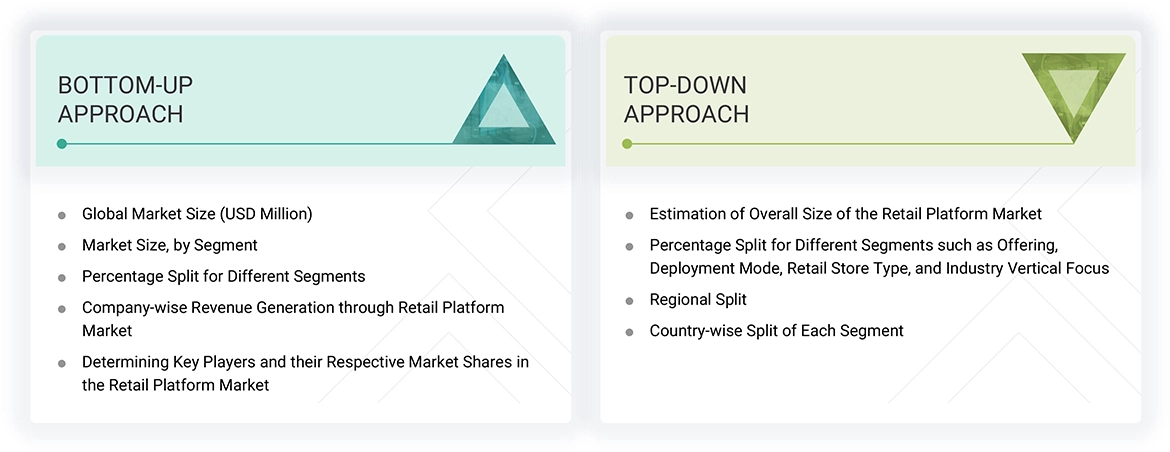
Multiple approaches were adopted to estimate and forecast the retail platform market. The first approach involved estimating the market size by companies’ revenue generated through the sale of retail platform products.
Market Size Estimation Methodology- Top-down approach
In the top-down approach, an exhaustive list of all the vendors offering products in the retail platform market was prepared. The revenue contribution of the market vendors was estimated through annual reports, press releases, funding, investor presentations, paid databases, and primary interviews. Each vendor’s offerings were evaluated based on offering, deployment mode, retail store type, industry vertical focus, and region. The markets were triangulated through primary and secondary research. The primary procedure included extensive interviews for key insights from industry leaders, such as CIOs, CEOs, VPs, directors, and marketing executives. The market numbers were further triangulated with the existing MarketsandMarkets’ repository for validation.
Market Size Estimation Methodology-Bottom-up approach
In the bottom-up approach, the main contributor to market share was identified as the adoption rate of retail platform products across various verticals in key countries within their respective regions. Cross-validation revealed the adoption of retail platform products among enterprises and various use cases by region. For the market size calculation, use cases identified in different regions were given weightage.
Based on the market numbers, the regional split was determined by primary and secondary sources. The procedure included analyzing the retail platform market’s regional penetration. Based on secondary research, the regional spending on Information and Communications Technology (ICT), socio-economic analysis of each country, strategic vendor analysis of major retail platform providers, and organic and inorganic business development activities of regional and global players were estimated.
Retail Platform Market : Top-Down and Bottom-Up Approach
Data Triangulation
After determining the overall market size using the market size estimation processes as explained above, the market was split into several segments and subsegments. Data triangulation and market breakup procedures were employed, wherever applicable, to complete the overall market engineering process and determine the exact statistics of each market segment and subsegment. The overall market size was used in the top-down procedure to estimate the size of other individual markets via percentage splits of the market segmentation.
Market Definition
According to Lexer, a retail platform is a retail solution that can help businesses create a seamless shopping experience for customers across tightly connected channels. A retail platform enables retailers to use customer data to improve in-store customer experience, provide better service, and increase sales. An omnichannel retail platform is a business model that ensures customer information, product inventories, and sales orders are updated in real-time across multiple channels.
This approach enables merchants to offer customers a consistent and coordinated shopping experience. Some retail platforms come with customizable built-in templates, allowing users to create websites with e-commerce capabilities. In addition, other platforms provide analytics and real-time reporting features, helping merchants make informed decisions about their store operations.
Stakeholders
- Retail platform providers
- Distributors and value-added resellers (VARs)
- Independent software vendors (ISV)
- Service providers
- Support & maintenance service providers
- System integrators (SIs)
- Technology providers
- Sales & marketing teams
- Retail store managers
- Customer experience (CX) teams
- Revenue operations teams
Report Objectives
- To define, describe, and forecast the retail platform market by offering, deployment mode, retail store type, industry vertical focus, and region
- To provide detailed information related to major factors (drivers, restraints, opportunities, and industry-specific challenges) influencing market growth
- To analyze micro markets concerning individual growth trends, prospects, and their contribution to the total market
- To analyze the opportunities in the market for stakeholders by identifying the high-growth segments of the retail platform market
- To analyze opportunities in the market and provide details of the competitive landscape for stakeholders and market leaders
- To forecast the market size of segments for North America, Europe, Asia Pacific, the Middle East & Africa, and Latin America
- To profile the key players and comprehensively analyze their market ranking and core competencies
- To analyze competitive developments, such as partnerships, product launches, mergers, and acquisitions, in the retail platform market.
Available Customizations
With the given market data, MarketsandMarkets offers customizations to meet the company’s specific needs. The following customization options are available for the report:
Product/Brand Comparative Analysis
- Brand comparative analysis of additional vendors, including a detailed comparison of the product portfolio of each company
Geographic Analysis as per Feasibility
- Further breakup of additional European country-level splits by retail store type, deployment mode, and industry vertical focus in the retail platform market.
- Further breakup of additional Asia Pacific country-level splits by retail store type, deployment mode, and industry vertical focus in the retail platform market.
- Further breakup of additional Middle East & Africa country-level splits by retail store type, deployment mode, and industry vertical focus in the retail platform market.
- Further breakup of additional Latin America country-level splits by retail store type, deployment mode, and industry vertical focus in the retail platform market.
Company Information
- Detailed analysis and profiling of additional market players (up to five)
Get the Full Retail Platform Market Report
Full forecast, segment splits, and company analysis for all Retail Platform Market.
- Singapore Retail Platform Market
- Canada Retail Platform Market
- US Retail Platform Market
- UK Retail Platform Market
- Germany Retail Platform Market
- France Retail Platform Market
- Italy Retail Platform Market
- Spain Retail Platform Market
- China Retail Platform Market
- Japan Retail Platform Market
- India Retail Platform Market
- South Korea Retail Platform Market
- UAE Retail Platform Market
- Qatar Retail Platform Market
- South Africa Retail Platform Market
- Brazil Retail Platform Market
- Mexico Retail Platform Market
- Rest Of Europe Retail Platform Market
- Asean Retail Platform Market
- Rest Of Asia Pacific Retail Platform Market
- Rest Of Latin America Retail Platform Market
- Indonesia Retail Platform Market
- Malaysia Retail Platform Market
- Rest Of Asean Retail Platform Market
Need a Tailored Report?
Customize this report to your needs
Get 10% FREE Customization
Customize This Report
