
Brazil Retrieval-augmented Generation (RAG) Market (2025-2030)

The Brazil Retrieval-augmented Generation (RAG) Market was valued at $27.7 Million in 2025 and projected to reach to $120.8 Million by 2030, representing a compound annual growth rate of 34.3%. Brazil's Retrieval-augmented Generation market is positioned for exceptional growth as enterprises across the nation prioritize AI-driven digital transformation.


| Market Size in | USD 26.32 MN |
| Market Forecast in | |
| CAGR | |
| Forecast Period | |
| Units Considered | Value (USD MN) |
Brazil Retrieval-augmented Generation (RAG) Market Trends and Insights
- This represents a compound annual growth rate (CAGR) of 34.3%, significantly driven by Brazil's increasing adoption of AI-powered enterprise solutions and digital transformation initiatives across financial services, healthcare, and e-commerce sectors.
- Brazil's growing tech talent pool and investment in cloud infrastructure are positioning the country as a key hub for RAG deployment in Latin America. The RAG market in Brazil is benefiting from rising demand for intelligent document processing, customer service automation, and knowledge management systems.
- Organizations in Brazil are increasingly recognizing the value of combining large language models with proprietary data sources to enhance accuracy and reduce hallucinations in AI applications.
- By 2030, Brazil is expected to capture a substantial share of Latin American RAG spending, driven by regulatory compliance requirements, competitive pressures, and the need for localized AI solutions that understand Portuguese language nuances..
Key Market Statistics
- CAGR (2025-2030) 34.3% CAGR
- Market Size, 2025 ~USD 27.7 Million
- Forecast, 2030 ~USD 120.8 Million
- Country Brazil
Brazil Retrieval-augmented Generation (RAG) Market Overview
Market Valuation Growth :
Brazil's RAG market is valued at USD 27.7 million in 2025 and is projected to expand to USD 120.8 million by 2030, representing a 336% increase over the five-year forecast period.
Strong CAGR Performance :
With a CAGR of 34.3% through 2030, Brazil's RAG market growth significantly outpaces many emerging markets, driven by accelerating AI adoption and enterprise digital transformation initiatives.
Financial Services Leadership :
Brazil's financial services sector is spearheading RAG adoption, leveraging retrieval-augmented generation for enhanced customer intelligence, fraud detection, and personalized banking solutions across major institutions.
Healthcare & Enterprise Expansion :
Healthcare providers and large enterprises in Brazil are increasingly implementing RAG solutions to improve operational efficiency, patient outcomes, and data-driven decision-making capabilities.
Brazil Retrieval-augmented Generation (RAG) Market Dynamics
- The country's robust financial services sector, combined with expanding healthcare digitalization efforts, creates substantial demand for RAG solutions that enhance data retrieval accuracy and operational intelligence.
- Government initiatives supporting technology adoption and increasing venture capital investment in AI startups further accelerate market penetration. Looking ahead to 2030, Brazil's RAG market will likely benefit from localized AI solutions tailored to Portuguese-language processing and regional compliance requirements.
- As organizations recognize RAG's competitive advantages in customer experience and operational efficiency, adoption will extend beyond financial services into retail, manufacturing, and public sector applications, solidifying Brazil's position as a key Latin American AI innovation hub..
Market Ecosystem
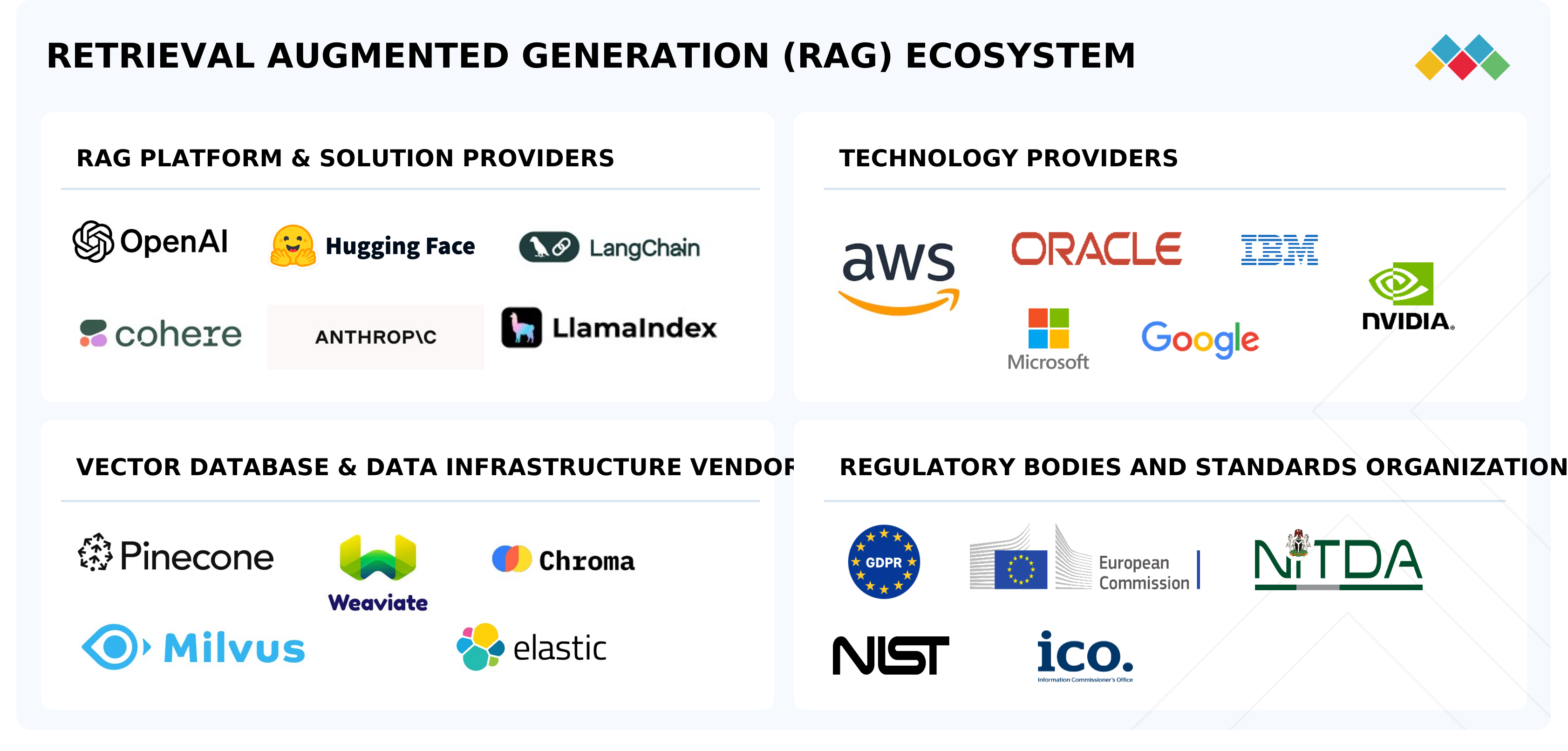
Retrieval Augmented Generation Market: COMMERCIAL USE CASES ACROSS INDUSTRIES
| COMPANY | USE CASE DESCRIPTION | BENEFITS |
|---|---|---|
 |
Filevine and Zilliz Cloud implemented a vector database for legal case management, enabling semantic search and AI-powered information retrieval across millions of legal documents. | Attorneys save 60–80% of time on data search, improve decision-making, ensure complete case context, and maintain enterprise-grade security and compliance. |
 |
Weaviate implemented a vector database for Neople Assistants to power real-time AI-driven customer service, managing company-specific knowledge and supporting hybrid search and reranking capabilities. | Faster and more accurate responses to customer queries, reduced developer overhead, and improved user experience with scalable and reliable AI infrastructure. |
 |
Qdrant enabled Dust to deploy context-aware AI assistants for employees using RAG over company data, integrating multiple internal data sources like Notion, Google Drive, and Slack. | Improved employee productivity through low-latency, scalable AI responses, reduced memory footprint, and cost savings while maintaining high accuracy and performance. |
Logos and trademarks shown above are the property of their respective owners. Their use here is for informational and illustrative purposes only.
Related Ecosystem
Software And Services
- Natural Language Processing (NLP)
- Machine Learning
- Supply Chain Management
- Predictive Analytics
- Image Sensors
- International Business Machines Corporation
- MICROSOFT CORPORATION
- Oracle Corporation
- SAP SE
- Amazon.com, Inc.
Key Takeaways
- Brazil's RAG market is valued at USD 27.7 million in 2025 and is forecast to grow to USD 120.8 million by 2030, representing a 34.3% CAGR.
- Financial services, healthcare, and e-commerce sectors in Brazil are primary drivers of RAG adoption and investment.
- Brazil's expanding tech ecosystem and Portuguese-language AI capabilities are creating competitive advantages for localized RAG solutions.
- Regulatory compliance and data privacy requirements in Brazil are accelerating enterprise investment in RAG technologies for secure knowledge management.
Retrieval-augmented Generation (RAG) Market Report Scope
| Report Metric | Details |
|---|---|
| Base Year | 2025 |
| Fastest Growing Segment | MULTIMODAL (Data Modality) |
| Forecast Period | 2025–2030 |
| Growth Rate | CAGR of 38.4% from 2025 to 2030 |
| Largest Segment | ENTERPRISES (End User) |
| Market Size Base Year (Billions) | ~USD 1.94 (2025) |
| Revenue Forecast (Billions) | ~USD 9.84 (2030) |
| Segments Covered | Offering, Solution, Service, Professional Service, Type, Application, Deployment Type, End User, 0Ffering, Data Modality, Architecture, Modality, Model Size |
Brazil Retrieval-augmented Generation (RAG) Market Report Segmentation
13 segment dimensions are covered across the global market.
By Offering
- Infrastructure
- Services
- Software
- Solutions
By Solution
- Data Management And Indexing Layer
- Other Solutions
- Rag-Enabled Platforms
- Retrieval & Search Models
By Service
- Managed Services
- Professional Services
By Professional Service
- Consulting & Customization
- Consulting And Customization
- Support And Maintenance
- Training And Development
By Type
- Agentic & Adaptive Rag
- Foundational & Enhanced Rag
- Knowledge-Structured & Memory-Based Rag
- Other Types
- Privacy-Preserving & Distributed Rag
By Application
- Automation & Integration
- Business Intelligence & Visualization
- Code & Developer Productivity
- Code Generation
- Content Generation & Curation
- Content Management
- Content Summarization & Generation
- Customer Service Automation
- Data Analysis & Bi
- Domain-Specific Data Synthesis
- Enterprise Search
- Generative Design AI
- Information Retrieval
- Language Translation & Localization
- Other Applications
- Personalized Recommendations & Insights
- Search & Discovery
- Synthetic Data Management
By Deployment Type
- Cloud
- On-Premises
By End User
- Bfsi
- Consumers
- Education
- Enterprises
- Financial Services
- Healthcare & Life Sciences
- It & Ites
- Law Firms
- Manufacturing
- Media & Entertainment
- Other End User
- Other End Users
- Retail & E-Commerce
- Retail & Ecommerce
- Telecommunications
By 0Ffering
- Services
- Solutions
By Data Modality
- Audio & Speech
- Code
- Image
- Multimodal
- Text
- Video
By Architecture
- Autoencoding Language Models
- Autoregressive Language Models
- Hybrid Language Models
By Modality
- Code
- Image
- Text
- Video
By Model Size
- 1 Billion To 10 Billion Parameters
- 10 Billion To 50 Billion Parameters
- 100 Billion To 200 Billion Parameters
- 200 Billion To 500 Billion Parameters
- 50 Billion To 100 Billion Parameters
- Above 500 Billion Parameters
- Below 1 Billion Parameters
BRAZIL: RETRIEVAL-AUGMENTED GENERATION (RAG) MARKET, BY END USER, 2024–2030
| Segment | 2024 | 2025 | 2026 | 2027 | 2028 | 2029 | 2030 | CAGR (%) |
|---|---|---|---|---|---|---|---|---|
| EDUCATION | 1.8 | 2.5 | 3.4 | 4.6 | 6 | 7.8 | 10.1 | 31.8 |
| FINANCIAL SERVICES | 3 | 4.2 | 5.7 | 7.6 | 10.1 | 13.2 | 17.1 | 32.5 |
| HEALTHCARE & LIFE SCIENCES | 5.1 | 7.1 | 9.7 | 13 | 17.3 | 22.8 | 29.6 | 33.1 |
| MEDIA & ENTERTAINMENT | 2.4 | 3.6 | 5.2 | 7.5 | 10.5 | 14.6 | 19.9 | 40.8 |
| OTHER END USERS | 1.8 | 2.4 | 3.1 | 4 | 5 | 6.1 | 7.4 | 25.3 |
| RETAIL & E-COMMERCE | 3.6 | 5 | 7 | 9.5 | 12.9 | 17.3 | 22.9 | 35.6 |
| TELECOMMUNICATIONS | 2 | 2.9 | 4 | 5.6 | 7.6 | 10.3 | 13.8 | 36.8 |
| TOTAL | 19.9 | 27.7 | 38.1 | 51.7 | 69.5 | 92.2 | 120.8 | 34.3 |
Target Audience
- Enterprise Technology Leaders : CIOs and digital transformation officers in Brazil seeking to understand RAG market maturity, vendor landscape, and implementation best practices for their organizations.
- AI Solution Providers : Software vendors and AI startups targeting Brazil's market need detailed insights into demand drivers, customer segments, and competitive positioning to optimize market entry strategies.
- Financial Services Executives : Banking and fintech leaders in Brazil require market data to justify RAG investments, benchmark against peers, and identify use cases for enhanced customer intelligence and operational efficiency.
- Investment & Private Equity Firms : Investors evaluating opportunities in Brazil's AI and technology sectors need comprehensive market sizing and growth projections to assess portfolio companies and acquisition targets.
- Healthcare & Government Agencies : Public and private healthcare organizations and government bodies in Brazil need market insights to guide technology procurement decisions and digital modernization initiatives.
Key Companies in the Brazil Retrieval-augmented Generation (RAG) Market
| Company | HQ | Ownership | Strongest segments |
|---|---|---|---|
| MICROSOFT | United States | Public Company | RAG-enabled platforms (Azure AI, Copilot, Microsoft 365 and Dynamics integrations),Data management and indexing layers (Azure AI Search, vector stores, connectors),Retrieval & search models (embedding models, hybrid search, ranking), |
| United States | Public Company | RAG-enabled platforms (Vertex AI, Gemini enterprise, Google Cloud AI solutions),Data management and indexing layers (BigQuery, vector stores, content indexing),Retrieval & search models (enterprise search, custom retrieval models), | |
| IBM | United States | Public Company | RAG-enabled platforms,Data management and indexing layers,Retrieval & search models, |
| NVIDIA | United States | Public Company | Data center GPUs for RAG training and inference,High-speed networking and interconnect for RAG clusters,AI software stack (CUDA, libraries, NIM, NeMo, enterprise tools), |
| COHERE | United States | Public Company | Networking (optical transceivers, modules, and datacenter components for AI/RAG workloads),Lasers and laser systems for semiconductor, electronics, and precision manufacturing supporting AI hardware,Engineered materials, optics, and thermoelectric components for AI and advanced instrumentation, |
| ELASTIC | Netherlands | Public Company | RAG-enabled platforms (Search & AI, Elasticsearch Platform used for RAG),Data management and indexing layers,Retrieval & search models, |
| MONGODB | United States | Public Company | MongoDB Atlas (RAG-related consumption),MongoDB Enterprise Advanced (RAG in self-managed and hybrid),Professional Services (consulting and training for RAG), |
| PROGRESS SOFTWARE | United States | Public Company | Agentic RAG platform,Data management and indexing (MarkLogic, Semaphore, DataDirect),Developer tools and RAG-enabled application platforms (OpenEdge, Sitefinity, Developer Tools), |
MICROSOFT
Microsoft is a multinational technology company founded in 1975 that develops software, cloud services, and hardware products. With 228,000 employees, it operates as a public company and serves enterprise and consumer markets globally.
Google is a multinational technology company founded in 1998 that specializes in search, advertising, cloud services, and artificial intelligence. As a public company with 194,668 employees, it is one of the world's largest internet and software companies.
IBM
IBM is a multinational information technology company founded in 1911 that provides hardware, software, and IT services to enterprise clients. Operating as a public company with 264,300 employees, it is one of the world's oldest and largest technology corporations.
NVIDIA
NVIDIA is a semiconductor and artificial intelligence computing company founded in 1993 with 42,000 employees. As a public company, it designs and manufactures GPUs and processors widely used in gaming, data centers, and AI applications.
COHERE
Cohere is a public company founded in 1971 with 30,216 employees that operates in the technology sector. The company serves various markets through its diverse business operations and global workforce.
ELASTIC
Elastic is a public company founded in 2012 with 4,019 employees headquartered in the Netherlands. The company develops search and analytics software solutions for enterprise customers worldwide.
MONGODB
MongoDB is a public company founded in 2007 with 5,636 employees that develops a popular NoSQL database platform. The company provides data infrastructure solutions for developers and enterprises building modern applications.
PROGRESS SOFTWARE
Progress Software is a public company founded in 1981 with 2,801 employees that develops application development and digital experience software. The company serves enterprise customers across various industries with infrastructure and productivity solutions.
Reasons to Buy this Report
- Localized Market Intelligence : Gain Brazil-specific insights into RAG adoption patterns, competitive landscape, and regional barriers to entry that generic global reports cannot provide.
- Financial Services Opportunity Mapping : Identify high-value segments within Brazil's banking and fintech sectors where RAG solutions are generating measurable ROI and competitive differentiation.
- Growth Trajectory Validation : Validate the 34.3% CAGR projection with detailed market drivers, customer segments, and expansion catalysts specific to Brazil's economic and technological landscape.
- Strategic Entry Planning : Develop informed go-to-market strategies for Brazil with data on regulatory requirements, key decision-makers, and partnership opportunities in emerging AI ecosystems.
- Competitive Positioning : Benchmark your RAG solutions against local and international competitors operating in Brazil, identifying white-space opportunities and differentiation strategies.
Frequently asked questions
What is the current size of the RAG market in Brazil?
Brazil's RAG market is valued at USD 27.7 million in 2025 and is expected to grow significantly over the forecast period.
What is the projected market size for RAG in Brazil by 2030?
Brazil's RAG market is projected to reach USD 120.8 million by 2030, growing at a CAGR of 34.3%.
Which industries are driving RAG adoption in Brazil?
Financial services, healthcare, and e-commerce are the primary sectors driving RAG adoption and investment in Brazil.
Why is Brazil becoming a key RAG market in Latin America?
Brazil's growing tech talent pool, cloud infrastructure investments, and demand for Portuguese-language AI solutions are positioning it as a regional RAG hub.
What factors are accelerating RAG market growth in Brazil?
Regulatory compliance requirements, digital transformation initiatives, and the need for accurate enterprise AI solutions are key growth drivers in Brazil.
RESEARCH METHODOLOGY
This research study involved the extensive use of secondary sources, directories, and databases, such as Dun & Bradstreet (D&B) Hoovers and Bloomberg BusinessWeek, to identify and collect information useful for a technical, market-oriented, and commercial study of the retrieval-augmented generation (RAG) market. The primary sources have been mainly industry experts from the core and related industries and preferred suppliers, manufacturers, distributors, service providers, technology developers, alliances, and organizations related to all segments of the value chain of this market. In-depth interviews have been conducted with various primary respondents, including key industry participants, subject matter experts, C-level executives of key market players, and industry consultants, to obtain and verify critical qualitative and quantitative information.
Secondary Research
The market size of companies offering retrieval-augmented generation (RAG) worldwide was arrived at based on secondary data available through paid and unpaid sources. It was also arrived at by analyzing the product portfolio of major companies and rating them based on their performance and quality. In the secondary research process, various secondary sources were referred to identify and collect information for the study. The secondary sources included annual reports, press releases, and investor presentations of companies; white papers, journals, and certified publications; and articles from recognized authors, directories, and databases.
Secondary research was mainly used to obtain key information about the industry’s value chain and supply chain and to identify key players through various solutions and services, market classification and segmentation according to offerings of major players, industry trends related to technologies, applications, and regions, and key developments from both market-oriented and technology-oriented perspectives.
Primary Research
In the primary research process, various primary sources from the supply and demand sides were interviewed to obtain qualitative and quantitative information on the market. The primary sources from the supply side included various industry experts, including Chief Experience Officers (CXOs); Vice Presidents (VPs); directors from business development, marketing, and product development/innovation teams; related key executives from RAG solution vendors, professional service providers, and industry associations; and key opinion leaders.
Primary interviews were conducted to gather insights, such as market statistics, revenue data collected from solutions and services, market breakups, market size estimations, market forecasts, and data triangulation. Primary research also helped in understanding various trends related to technologies, applications, deployments, and regions. Stakeholders from the demand side, such as Chief Information Officers (CIOs), Chief Technology Officers (CTOs), Chief Strategy Officers (CSOs), and end users using RAG solutions, were interviewed to understand the buyer’s perspective on suppliers, products, service providers, and their current usage of RAG solutions, which would impact the overall retrieval-augmented generation (RAG) market.
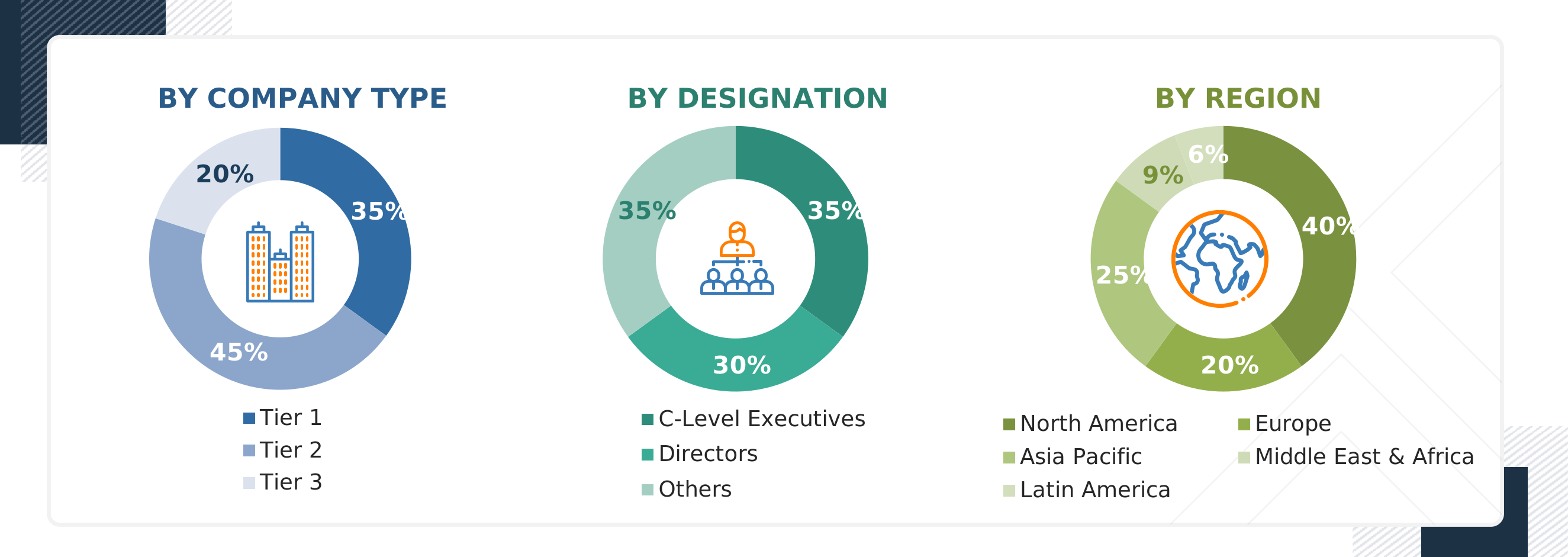
Note: Tier 1 companies’ revenue is more than USD 1 billion; Tier 2 companies’ revenue ranges between USD 500 million
and USD 1 billion; and Tier 3 companies’ revenue ranges between USD 100 million and USD 500 million. Other designations include sales
managers, marketing managers, and product managers
To know about the assumptions considered for the study, download the pdf brochure
Market Size Estimation
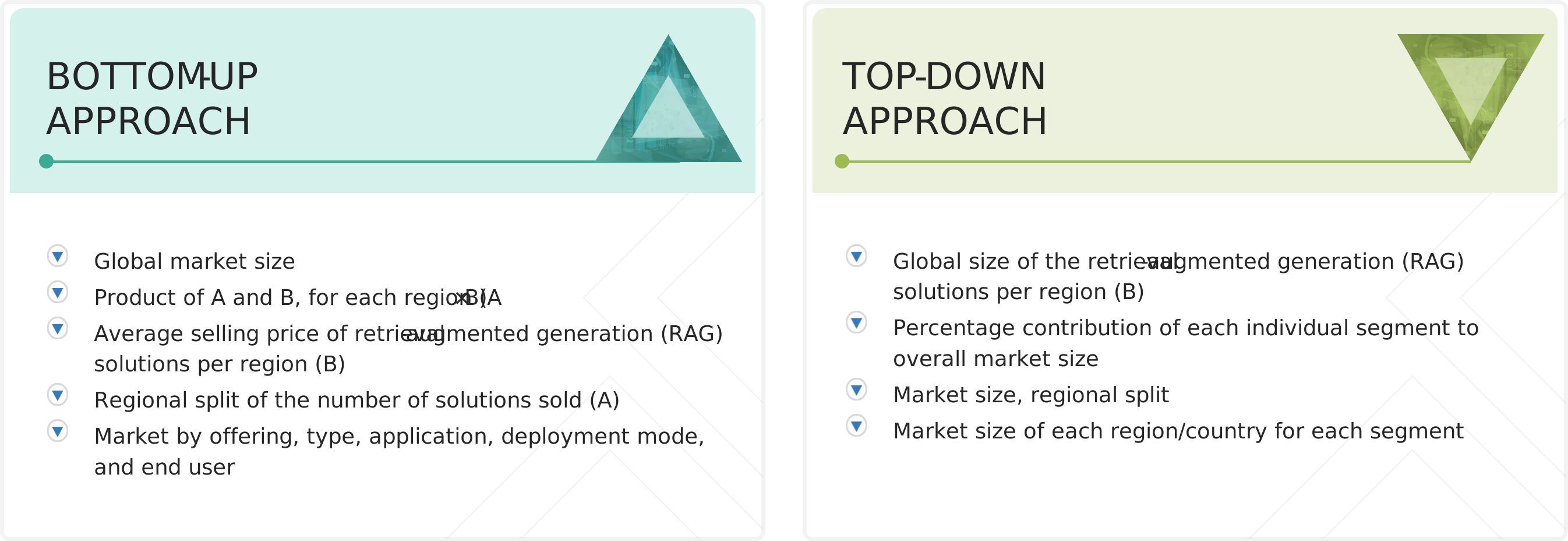
Multiple approaches were adopted to estimate and forecast the size of the retrieval-augmented generation (RAG) market. The first approach involves estimating market size by summing up the revenue generated by companies through the sale of RAG solutions. Top-down and bottom-up approaches were used to estimate and validate the total size of the retrieval-augmented generation (RAG) market. These methods were also extensively used to estimate the size of various market segments. The research methodology used to evaluate the market size is listed below.
- Key players in the market were identified through extensive secondary research.
- In terms of value, the industry’s supply chain and market size were determined through primary and secondary research processes.
- All percentage shares, splits, and breakups were determined using secondary sources and verified through primary sources.
Retrieval-augmented Generation (RAG) Market : Top-Down and Bottom-Up Approach
Data Triangulation
After determining the overall market size, the retrieval-augmented generation (RAG) market was divided into several segments and subsegments. A data triangulation procedure was used to complete the overall market engineering process and arrive at the exact statistics for all segments and subsegments, wherever applicable. The data was triangulated by studying various factors and trends from the demand and supply sides. Along with data triangulation and market breakdown, the market size was validated by the top-down and bottom-up approaches.
Market Definition
Retrieval-augmented generation (RAG) is an AI approach that combines generative models, such as large language models (LLMs), with external knowledge retrieval mechanisms to produce contextually accurate, relevant, and up-to-date outputs. Unlike traditional generative models that rely solely on pre-trained data, RAG systems dynamically fetch information from structured or unstructured sources—such as databases, documents, or knowledge bases—before generating responses, ensuring both factual correctness and human-like language generation.
Stakeholders
- Retrieval-augmented Generation (RAG) Solution and Service Providers
- Government Organizations, Forums, Alliances, and Associations
- Consulting Service Providers
- End Users
- System Integrators
- Research Organizations
- Consulting Companies
- Infrastructure Providers
- Open-source Communities
Report Objectives
- To determine and forecast the global retrieval-augmented generation (RAG) market by offering, type, application, end user, deployment type, and region
- To forecast the size of the market segments for North America, Europe, Asia Pacific, Latin America, and the Middle East & Africa
- To provide detailed information about the major factors (drivers, restraints, opportunities, and challenges) influencing the growth of the market
- To analyze each submarket concerning individual growth trends, prospects, and contributions to the overall market
- To analyze the opportunities in the market for stakeholders by identifying the high-growth segments of the market
- To profile the key market players; provide a comparative analysis based on business overviews, regional presence, product offerings, business strategies, and key financials; and illustrate the market’s competitive landscape
- To track and analyze competitive developments in the market, such as mergers and acquisitions, product development, partnerships and collaborations, and research and development (R&D) activities
Available Customizations
With the given market data, MarketsandMarkets offers customizations to meet the company’s specific needs. The following customization options are available for the report:
Geographic Analysis as per Feasibility
- Analysis for additional countries (up to five)
Company Information
- Detailed analysis and profiling of additional market players (up to 5)
Get the Full Retrieval-augmented Generation (RAG) Market Report
Full forecast, segment splits, and company analysis for all Retrieval-augmented Generation (RAG) Market.
- Rest Of Mea Retrieval-augmented Generation (RAG) Market
- US Retrieval-augmented Generation (RAG) Market
- Canada Retrieval-augmented Generation (RAG) Market
- UK Retrieval-augmented Generation (RAG) Market
- Germany Retrieval-augmented Generation (RAG) Market
- France Retrieval-augmented Generation (RAG) Market
- Italy Retrieval-augmented Generation (RAG) Market
- China Retrieval-augmented Generation (RAG) Market
- India Retrieval-augmented Generation (RAG) Market
- Japan Retrieval-augmented Generation (RAG) Market
- South Korea Retrieval-augmented Generation (RAG) Market
- Mexico Retrieval-augmented Generation (RAG) Market
- UAE Retrieval-augmented Generation (RAG) Market
- South Africa Retrieval-augmented Generation (RAG) Market
- Rest Of Europe Retrieval-augmented Generation (RAG) Market
- Anz Retrieval-augmented Generation (RAG) Market
- Rest Of Asia Pacific Retrieval-augmented Generation (RAG) Market
- Rest Of Latin America Retrieval-augmented Generation (RAG) Market
- Kas Retrieval-augmented Generation (RAG) Market
Need a Tailored Report?
Customize this report to your needs
Get 10% FREE Customization
Customize This Report
