
Europe Rotary and RF Rotary Joints Market (2024-2029)

The Europe Rotary and RF Rotary Joints Market was valued at $347.5 Million in 2024 and projected to reach to $439.9 Million by 2029, representing a compound annual growth rate of 4.8%. Europe's rotary and RF rotary joints market demonstrates steady growth momentum, supported by robust investments in 5G infrastructure, satellite communications, and aerospace technologies across the region.


| Market Size in | USD 26.32 MN |
| Market Forecast in | |
| CAGR | |
| Forecast Period | |
| Units Considered | Value (USD MN) |
Europe Rotary and RF Rotary Joints Market Trends and Insights
- Europe maintains a significant position in the global semiconductor and electronics supply chain, with demand for rotary and RF rotary joints driven by advanced telecommunications infrastructure, aerospace applications, and industrial automation across the region.
- The European market benefits from strong manufacturing capabilities, stringent quality standards, and increasing investment in 5G and satellite communication technologies that require high-performance rotary joint solutions. Key European markets including Germany, France, the United Kingdom, and Scandinavia are experiencing steady adoption of rotary and RF rotary joints in medical devices, defense systems, and renewable energy applications.
- Europe's focus on sustainability and Industry 4.0 initiatives is accelerating the integration of precision rotary components into next-generation equipment.
- The forecast period from 2024 to 2029 reflects Europe's commitment to technological innovation and its role as a critical hub for high-reliability component manufacturing in the semiconductor and electronics sector..
Key Market Statistics
- CAGR (2024-2029) 4.8% CAGR
- Market Size, 2024 ~USD 347.5 Million
- Forecast, 2029 ~USD 439.9 Million
- Geography Europe
Europe Rotary and RF Rotary Joints Market Overview
Market Valuation :
Europe's rotary and RF rotary joints market is valued at USD 347.5 million in 2024, representing a significant segment of the global semiconductor and electronics industry with strong infrastructure investments.
Growth Trajectory :
The European market is projected to reach USD 439.9 million by 2029, expanding at a CAGR of 4.8%, driven by increasing demand from telecommunications, aerospace, and defense sectors across the region.
Regional Leadership :
Germany leads European demand with USD 144.3 million in market size, followed by the UK (USD 116.6 million) and France (USD 110.9 million), reflecting strong industrial and technological capabilities in these nations.
Strategic Importance :
Europe maintains a critical position in the global semiconductor supply chain, with advanced telecommunications infrastructure and aerospace applications driving sustained demand for high-performance rotary and RF rotary joint solutions.
Europe Rotary and RF Rotary Joints Market Dynamics
- The 4.8% CAGR reflects strong demand from telecommunications providers upgrading network capabilities and defense contractors modernizing equipment.
- Germany, UK, and France collectively account for the majority of European consumption, leveraging their advanced manufacturing ecosystems and R&D capabilities. Looking ahead to 2029, the European market will benefit from accelerating digital transformation initiatives, increased space exploration activities, and the expansion of IoT and edge computing applications.
- Regulatory support for advanced telecommunications infrastructure and growing investments in renewable energy systems will further propel market expansion.
- The region's focus on technological sovereignty and supply chain resilience positions it favorably for sustained growth in rotary and RF joint technologies..
Market Ecosystem
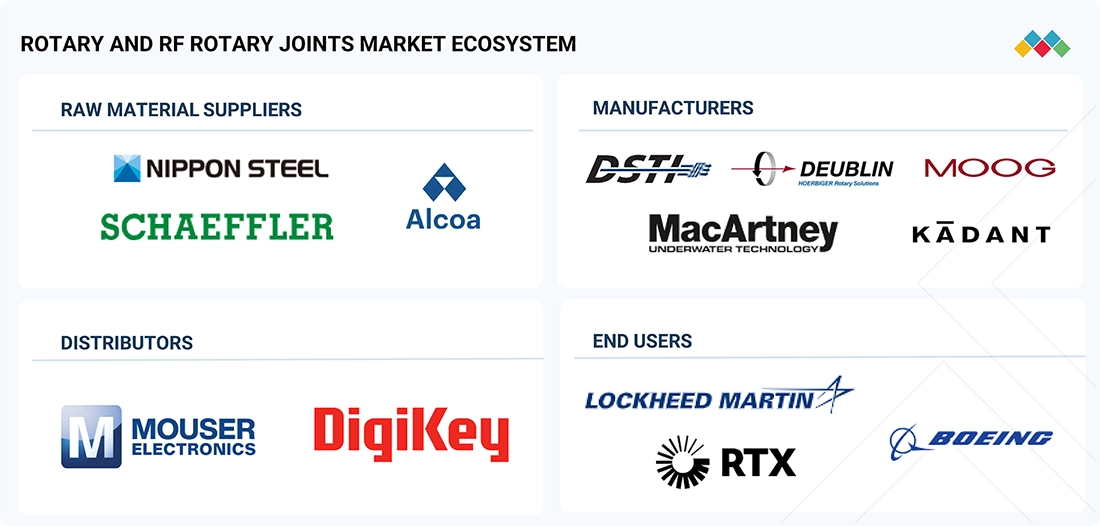
ROTARY AND RF ROTARY JOINTS MARKET SIZE, SHARE & GROWTH: COMMERCIAL USE CASES ACROSS INDUSTRIES
| COMPANY | USE CASE DESCRIPTION | BENEFITS |
|---|---|---|
 |
Integration of high-precision rotary joints and RF rotary joints into aerospace, defense radar platforms, and satellite communication systems requiring continuous 360° rotation with low-loss signal transfer. | Ensures reliable data and power transfer in mission-critical environments, enhances radar accuracy, improves antenna performance, and supports long-term operational stability. |
 |
Deployment of advanced rotary unions for industrial machinery, robotics, semiconductor tools, and high-speed manufacturing lines requiring efficient transfer of air, coolant, hydraulic media, and steam | Improves equipment uptime, increases thermal and fluid efficiency, reduces leakage, and enhances productivity in automated and high-speed production environments.. |
 |
Use of heavy-duty rotary joints in material-handling equipment, lifting systems, and automated hoists to support rotational movement while transferring hydraulic power. | Enhances operational safety, supports smooth rotational motion, reduces mechanical stress, and improves durability in industrial and warehouse systems. |
 |
Integration of engineered rotary joints for paper manufacturing, chemical processing, and energy systems requiring high-temperature steam transfer and multi-pass fluid handling | Improves heat-transfer efficiency, extends lifecycle of rotating machinery, minimizes downtime, and increases operational performance of process equipment. |
 |
Use of custom rotary-sealing joints and high-pressure rotary unions for oil & gas tools, defense platforms, and extreme-environment industrial systems.. | Provides enhanced sealing reliability, resists harsh conditions, reduces leakage risk, and supports stable performance in high-pressure, high-speed rotating applications.. |
Logos and trademarks shown above are the property of their respective owners. Their use here is for informational and illustrative purposes only.
Related Ecosystem
Electronics System And Components
- Sensors
- Temperature Sensors
- Pressure Sensors
- Actuators
- Image Sensors
- Lenovo
- Samsung
- Texas Instruments Incorporated
- HONEYWELL INTERNATIONAL INC.
- Teledyne Technologies Incorporated
Electronic Warfare
- Antennas
- Automated Test Equipment
- Military Helicopters
- Signal Generators
- Special Mission Aircraft
- L3Harris Technologies, Inc.
- Northrop Grumman Corporation
- Thales group
- LOCKHEED MARTIN CORPORATION
- BAE Systems plc
Communication And Connectivity Technology
- Sensors
- Smart Card & Readers
- Cellular Network
- Femtocell
- Image Sensors
- Cisco Systems, Inc.
- HUAWEI TECHNOLOGIES CO LTD
- Lenovo
- CommScope Holding Company, Inc.
- Texas Instruments Incorporated
Key Takeaways
- Europe's rotary and RF rotary joints market is valued at USD 347.5 million in 2024 and is expected to reach USD 439.9 million by 2029.
- Europe is experiencing a 4.8% CAGR, driven by 5G infrastructure, aerospace, and industrial automation demand.
- Key European nations including Germany, France, and the UK are leading adoption in telecommunications and defense applications.
- Europe's emphasis on Industry 4.0 and sustainability is accelerating precision component integration in advanced manufacturing.
Rotary and RF Rotary Joints Market Report Scope
| Report Metric | Details |
|---|---|
| Base Year | 2024 |
| Fastest Growing Segment | HYBRID (Type) |
| Forecast Period | 2024-2029 |
| Growth Rate | CAGR of 5.4% from 2024 to 2029 |
| Largest Segment | MULTI-PASSAGE (Channel) |
| Market Size Base Year (Billions) | ~USD 1.46 (2024) |
| Revenue Forecast (Billions) | ~USD 1.9 (2029) |
| Segments Covered | Channel, End Use, Type, Application |
Europe Rotary and RF Rotary Joints Market Report Segmentation
4 segment dimensions are covered across the global market.
By Channel
- Multi-Passage
- Single Passage
By End Use
- Aerospace
- Energy & Power
- Food & Beverage
- Food & Beverages
- Healthcare
- Industrial Automation
- Medical
- Oil & Gas
- Semiconductor
- Semiconductors
By Type
- Coaxial
- Contact-Based
- Contactless
- Fiber Optic Rotary Joints
- Hybrid
- Hydraulic Rotary Joints
- Multi-Mode
- Multi-Passage
- Pneumatic Rotary Joints
- Single Passage
- Single-Mode
- Slip Rings
- Water And Steam Rotary Joints
- Waveguide
By Application
- Commercial
- Military
EUROPE: RF ROTARY JOINTS MARKET, BY APPLICATION, 2024–2029
| Segment | 2024 | 2025 | 2026 | 2027 | 2028 | 2029 | CAGR (%) |
|---|---|---|---|---|---|---|---|
| COMMERCIAL | 20.7 | 21.9 | 23.3 | 24.7 | 26.3 | 28 | 6.3 |
| MILITARY | 14.4 | 15.7 | 17.1 | 18.7 | 20.4 | 22.3 | 9.2 |
| TOTAL | 35.1 | 37.6 | 40.4 | 43.4 | 46.7 | 50.3 | 7.5 |
Target Audience
- Electronics Manufacturers : European electronics manufacturers need detailed market data to optimize product portfolios, identify growth opportunities in rotary and RF joint applications, and align production capacity with regional demand trends.
- Telecommunications Providers : Telecom operators expanding 5G and advanced network infrastructure across Europe require market intelligence to evaluate component suppliers, forecast capital expenditures, and plan technology upgrades.
- Aerospace & Defense Contractors : A&D companies operating in Europe need country-specific market data to support procurement strategies, supplier qualification, and compliance with regional supply chain requirements and regulations.
- Component Suppliers & Distributors : Rotary and RF joint suppliers targeting European markets require granular market sizing and growth forecasts to optimize inventory, plan distribution networks, and identify high-potential customer segments.
- Investment & Strategy Consultants : Consultants advising on European semiconductor and electronics investments need comprehensive market analysis to support M&A due diligence, market entry strategies, and portfolio optimization recommendations.
Countries within Europe - compare and drill down
| Country | 2025 size (native) |
|---|---|
| Germany | USD 144.3 Million |
| UK | USD 116.6 Million |
| France | USD 110.9 Million |
| Rest Of Europe | USD 68.2 Million |
Country market size visualization
Reasons to Buy this Report
- Country-Level Market Insights : Access detailed market sizing for Germany (USD 144.3M), UK (USD 116.6M), and France (USD 110.9M), enabling precise regional strategy development and competitive positioning across Europe's key markets.
- Growth Forecasting Through 2029 : Leverage comprehensive projections showing European market expansion to USD 439.9 million by 2029, supporting long-term investment decisions and capacity planning for European operations.
- Sector-Specific Demand Analysis : Understand demand drivers specific to European telecommunications, aerospace, and defense sectors, identifying high-growth application areas and customer segments within the region.
- Competitive Landscape Assessment : Benchmark your European market position against regional competitors and identify opportunities in underserved markets like Rest of Europe (USD 68.2M), which presents expansion potential.
- Strategic Market Entry Planning : Develop targeted go-to-market strategies for Europe with data-driven insights on regional preferences, regulatory environments, and technology adoption rates across major European economies.
Frequently asked questions
What is the current market size of rotary and RF rotary joints in Europe?
Europe's rotary and RF rotary joints market is valued at USD 347.5 million in 2024, with verified data from market analysis.
What is the projected market size for Europe by 2029?
Europe's rotary and RF rotary joints market is forecast to reach USD 439.9 million by 2029, representing significant growth over the forecast period.
What is the CAGR for Europe's rotary and RF rotary joints market?
Europe's market is growing at a compound annual growth rate (CAGR) of 4.8% from 2024 to 2029.
Which European countries are driving demand for rotary and RF rotary joints?
Germany, France, the United Kingdom, and Scandinavian countries are leading European markets, driven by telecommunications, aerospace, and industrial automation sectors.
What applications are fueling growth in Europe's rotary and RF rotary joints market?
5G infrastructure, satellite communications, aerospace systems, medical devices, defense applications, and renewable energy solutions are primary growth drivers in Europe.
RESEARCH METHODOLOGY
The study used four major activities to estimate the market size of the rotary and RF rotary joints. Exhaustive secondary research was conducted to gather information on the market and its peer and parent markets. The next step was to validate these findings, assumptions, and sizing with industry experts across the value chain through primary research. Both top-down and bottom-up approaches were employed to estimate the total market size. Finally, market breakdown and data triangulation methods were utilized to estimate the market size for different segments and subsegments.
Secondary Research
In the secondary research process, various sources were referred to identify and collect information on the rotary and RF rotary joints market for this study. Secondary sources for this research study include corporate filings (such as annual reports, investor presentations, and financial statements), trade, business, and professional associations, white papers, certified publications, articles by recognized authors, directories, and databases. The secondary data was collected and analyzed to determine the overall market size, further validated through primary research.
List of key secondary sources
|
SOURCE NAME |
WebLink |
|
Multidisciplinary Digital Publishing Institute (MDPI) |
https://www.mdpi.com/ |
|
Institute of Electrical and Electronics Engineers (IEEE) |
https://www.ieee.org/ |
|
Texas A&M University |
https://www.tamu.edu/ |
|
University of Victoria (UVic) |
https://www.uvic.ca/ |
Primary Research
Primary interviews were conducted to gather insights on market statistics, revenue data, market breakdowns, size estimations, and forecasting. Additionally, primary research was used to comprehend the various technology, application, vertical, and regional trends. Interviews with stakeholders from the demand side, including CIOs, CTOs, CSOs, and customers/end-users using rotary and RF rotary joints, were also conducted to understand their perspective on suppliers, products, component providers, and their current and future use of rotary and RF rotary joints, which will impact the overall market. Several primary interviews were conducted across major countries of North America, Europe, Asia Pacific, the Middle East & Africa, and Latin America.

To know about the assumptions considered for the study, download the pdf brochure
Market Size Estimation
To estimate and validate the size of the rotary and RF rotary joints market size and its submarkets, both top-down and bottom-up approaches were utilized. Secondary research was conducted to identify the key players in the market, and primary and secondary research was used to determine their market share in specific regions. The entire process involved studying top players' annual and financial reports and conducting extensive interviews with industry leaders such as CEOs, VPs, directors, and marketing executives. Secondary sources were used to determine all percentage shares and breakdowns, which were verified through primary sources. All parameters that could impact the markets covered in this research study were accounted for, analyzed in detail, verified through primary research, and consolidated to obtain the final quantitative and qualitative data.
Global Rotary and RF Rotary Joints Market Size: Botton Up Approach and Top Down
- Companies offering rotary and RF rotary joints have been identified, and their mapping with respect to different parameters, such as channel, type, application, and industry has been carried out.
- The market size has been estimated based on the demand for different rotary and RF rotary joints for different applications. The anticipated change in demand for rotary and RF rotary joints offered by these companies and company revenues have been analyzed and estimated.
- Primary research has been conducted with a few major players operating in the rotary and RF rotary joints market to validate the global market size.
- The size of the rotary and RF rotary joints market has been validated through secondary sources, which include the International Trade Centre (ITC), the World Trade Organization, and the World Economic Forum.
- The CAGR of the rotary and RF rotary joints market size has been calculated considering the historical and future market trends by understanding the adoption rate of rotary and RF rotary joints for different applications.
- The estimates at every level have been verified and cross-checked through discussions with key opinion leaders, such as corporate executives (CXOs), directors, and sales heads, and with the domain experts in MarketsandMarkets.
- Various paid and unpaid information sources, such as company websites, annual reports, press releases, research journals, magazines, white papers, and databases, have also been studied.
The top-down approach has been used to estimate and validate the total size of the rotary and RF rotary joints market.
- Focusing initially on R&D investments and expenditures being made in the ecosystem of the rotary and RF rotary joints market size ; further splitting the market on the basis of rotary joint channel, rotary joint type, RF rotary joint type, RF rotary joint application, rotary joint industry and region and listing key developments
- Identifying leading players in the rotary and RF rotary joints market size through secondary research and verifying them through brief discussions with industry experts
- Analyzing revenue, product mix, geographic presence, and key applications for which all identified players serve products to estimate and arrive at percentage splits for all key segments
- Discussing splits with industry experts to validate the information and identify key growth pockets across all key segments
- Breaking down the total market based on verified splits and key growth pockets across all segments.

Data Triangulation
Once the overall size of the rotary and RF rotary joints market size was determined using the methods described above, it was divided into multiple segments and subsegments. Market engineering was performed for each segment and subsegment using market breakdown and data triangulation methods, as applicable, to obtain accurate statistics. To triangulate the data, various factors and trends from the demand and supply sides were studied. The market was validated using both top-down and bottom-up approaches.
Market Definition
A rotary joint, otherwise designated as a rotary union or rotating union, is a type of rotary sealing device interconnecting rotating equipment to stationary piping for the transfer of steam, water, thermal oil, coolant, hydraulic oil, air, and other media. While rotary joints come in a wide range of shapes, sizes, and configurations, all of them comprise four fundamental components: a housing unit, a shaft, mechanical bearings, and a seal. RF Rotary Joints are considered to be the most essential components in systems that require transmission of RF signals between stationary and rotating parts. The importance of these electromechanical devices has especially been realized since very early days of RF and microwave technology, particularly within radar systems.
Key Stakeholders
- Original equipment manufacturers (OEMs)
- Raw material suppliers
- Technology investors
- Electronic hardware equipment manufacturers
- Research organizations and consulting companies
- Government bodies such as regulatory authorities and policymakers
- Venture capitalists and private equity firms
- Associations, organizations, and alliances related to rotary and RF rotary joints
Report Objectives
- To describe and forecast the rotary and RF rotary joints market size , by rotary joint channel, rotary joint type, RF rotary joint type, RF rotary joint application, rotary joint industry and region, in terms of value
- To describe and forecast the market for various segments across four central regions, namely, North America, Europe, Asia Pacific, and Rest of the World (RoW), in terms of value
- To strategically analyze the micro markets with regard to the individual growth trends, prospects, and contribution to the market
- To provide detailed information regarding drivers, restraints, opportunities, and challenges influencing the growth of the market
- To analyze opportunities for stakeholders by identifying high-growth segments in the market
- To provide a detailed overview of the value chain
- To strategically analyze the ecosystem, regulatory landscape, patent landscape, Porter’s five forces, import and export scenarios trade landscape, and case studies pertaining to the market under study
- To strategically profile key players in the rotary and RF rotary joints market and comprehensively analyze their market shares and core competencies
- To strategically profile the key players and provide a detailed competitive landscape of the market
- To analyze competitive developments such as partnerships, acquisitions, expansions, collaborations, and product launches, along with research and development (R&D) in the rotary and RF rotary joints market
Available customizations:
With the given market data, MarketsandMarkets offers customizations according to the specific requirements of companies. The following customization options are available for the report:
- Detailed analysis and profiling of additional market players (up to 5)
- Additional country-level analysis of the rotary and RF rotary joints market
Product Analysis
- Product matrix, which provides a detailed comparison of the product portfolio of each company in the rotary and RF rotary joints market.
Get the Full Rotary and RF Rotary Joints Market Report
Full forecast, segment splits, and company analysis for all Rotary and RF Rotary Joints Market.
- US Rotary and RF Rotary Joints Market
- Canada Rotary and RF Rotary Joints Market
- Mexico Rotary and RF Rotary Joints Market
- Germany Rotary and RF Rotary Joints Market
- UK Rotary and RF Rotary Joints Market
- France Rotary and RF Rotary Joints Market
- Rest Of Europe Rotary and RF Rotary Joints Market
- China Rotary and RF Rotary Joints Market
- Japan Rotary and RF Rotary Joints Market
- South Korea Rotary and RF Rotary Joints Market
- Rest Of Asia Pacific Rotary and RF Rotary Joints Market
Need a Tailored Report?
Customize this report to your needs
Get 10% FREE Customization
Customize This Report
