
Russia Satellite Solar Cell Materials Market (2024-2029)

The Russia Satellite Solar Cell Materials Market was valued at $3.6 Million in 2024 and projected to reach to $7.8 Million by 2029, representing a compound annual growth rate of 13.8%. Russia's satellite solar cell materials market is positioned for sustained growth through 2029, driven by increased government investment in space programs and satellite technology modernization.


| Market Size in | USD 26.32 MN |
| Market Forecast in | |
| CAGR | |
| Forecast Period | |
| Units Considered | Value (USD MN) |
Russia Satellite Solar Cell Materials Market Trends and Insights
- This growth trajectory reflects Russia's increasing investment in space infrastructure and satellite technology development.
- Russia's market expansion is driven by domestic space programs and the strategic importance of advanced materials for satellite applications in the competitive aerospace sector. The satellite solar cell materials sector in Russia is characterized by rising demand for high-efficiency photovoltaic solutions tailored to space environments.
- Russia's market growth from 2024 to 2029 underscores the nation's commitment to technological advancement in satellite systems.
- Russia's 13.8% compound annual growth rate positions the country as a significant player in the European satellite materials landscape, supported by both government initiatives and private sector innovation..
Key Market Statistics
- CAGR (2024-2029) 13.8% CAGR
- Market Size, 2024 ~USD 3.6 Million
- Forecast, 2029 ~USD 7.8 Million
- Country Russia
Russia Satellite Solar Cell Materials Market Overview
Market Valuation Growth :
Russia's satellite solar cell materials market is valued at $3.6 million in 2024, with projections reaching $7.8 million by 2029, representing a 116.7% increase over the five-year forecast period.
Consistent CAGR Performance :
Russia's market is expanding at a 13.8% CAGR, closely aligned with the global growth rate of 13.7%, demonstrating the country's competitive positioning in satellite solar cell materials development.
Domestic Space Program Drivers :
Russia's expanding space infrastructure investments and satellite technology initiatives are primary catalysts for market growth, supporting both government and commercial space missions.
Strategic Material Advancement :
The market expansion reflects Russia's focus on developing advanced materials for satellite applications, enhancing technological capabilities in space exploration and communications infrastructure.
Russia Satellite Solar Cell Materials Market Dynamics
- The country's strategic focus on space infrastructure development creates consistent demand for high-performance solar cell materials.
- Domestic manufacturers are expanding production capabilities to support both national space agencies and emerging commercial satellite ventures.
- The market's 13.8% CAGR indicates strong momentum, with opportunities emerging in advanced material formulations and efficiency improvements.
- Russia's commitment to technological self-sufficiency in space applications further supports long-term market expansion and material innovation initiatives..
Market Ecosystem
Related Ecosystem
Ceramics And Glass
- Zirconia
- Alumina Ceramics
- Silicon Carbide
- Silicon Nitride
- Titanate Ceramics
- Saint-gobain
- 3M COMPANY
- Kyocera Corporation
- CERAMTEC GMBH
- COORSTEK INCORPORATED
Decarbonization
- Battery Electric Vehicle (BEV)
- Energy Management Systems
- Fuel Cell
- Fuel Cell Electric Vehicle (FCEV)
- Geographical Information System (GIS)
- TotalEnergies SE
- Siemens ag
- Mitsui & Co., Ltd.
- General Electric Company
- Thyssenkrupp ag
Defence Platforms And Systems
- Sensors
- Unmanned Ground Vehicles (UGV)
- Fighter Aircraft
- Special Mission Aircraft
- Antennas
- BAE Systems plc
- Thales group
- LOCKHEED MARTIN CORPORATION
- Northrop Grumman Corporation
- L3Harris Technologies, Inc.
Key Takeaways
- Russia's satellite solar cell materials market is valued at $3.6 million in 2024 and is forecast to double to $7.8 million by 2029.
- Russia demonstrates a strong 13.8% CAGR, outpacing global growth and reflecting strategic investment in space technology.
- Russia's market expansion is driven by domestic satellite programs and the critical need for advanced photovoltaic materials in aerospace applications.
- Russia's growth trajectory positions the country as a key regional player in Europe's satellite materials supply chain.
Satellite Solar Cell Materials Market Report Scope
| Report Metric | Details |
|---|---|
| Base Year | 2024 |
| Fastest Growing Segment | GALLIUM ARSENIDE (GAAS) (Material Type) |
| Forecast Period | 2024-2029 |
| Growth Rate | CAGR of 13.7% from 2024 to 2029 |
| Largest Segment | SOLAR PANEL (Components) |
| Market Size Base Year (Billions) | ~USD 0.04 (2024) |
| Revenue Forecast (Billions) | ~USD 0.08 (2029) |
| Segments Covered | Material Type, Orbit, Application, Tracking, Components |
Russia Satellite Solar Cell Materials Market Report Segmentation
5 segment dimensions are covered across the global market.
By Material Type
- Copper Indium Gallium Selenide (Cigs)
- Gallium Arsenide (Gaas)
- Other Material Type
- Other Material Types
- Silicon
- Silicon Solar Cells
By Orbit
- Geostationary Orbit (Geo)
- Highly Elliptical Orbit (Heo)
- Low Earth Orbit (Leo)
- Medium Earth Orbit (Meo)
- Polar Orbit
By Application
- Other Applications
- Rovers
- Satellites
- Space Stations
By Tracking
- Fixed/Static Solar Tracking
- Tracking Solar Cells
By Components
- Electric Connections & Interfaces
- Satellite Photovoltaic Cell Market
- Solar Cell
- Solar Panel
RUSSIA: SATELLITE SOLAR CELL MATERIALS MARKET, BY APPLICATION, 2024–2030
| Segment | 2024 | 2025 | 2026 | 2027 | 2028 | 2029 | 2030 | CAGR (%) |
|---|---|---|---|---|---|---|---|---|
| OTHER APPLICATIONS | 0.49 | 0.57 | 0.67 | 0.8 | 0.95 | 1.13 | 1.01 | 12.7 |
| ROVERS | 0.72 | 0.86 | 1.02 | 1.23 | 1.47 | 1.78 | 1.59 | 14 |
| SATELLITES | 1.56 | 1.85 | 2.2 | 2.64 | 3.18 | 3.85 | 3.43 | 14 |
| SPACE STATIONS | 0.8 | 0.95 | 1.13 | 1.35 | 1.62 | 1.95 | 1.74 | 13.7 |
| TOTAL | 3.58 | 4.23 | 5.03 | 6.01 | 7.22 | 8.7 | 7.77 | 13.8 |
Target Audience
- Space Technology Manufacturers : Russian and international satellite manufacturers require detailed market data to assess material sourcing strategies, supplier relationships, and production capacity planning for domestic space programs.
- Materials Science Companies : Solar cell material producers need Russia-specific demand forecasts and application requirements to develop targeted product portfolios and establish manufacturing partnerships in the region.
- Government Space Agencies : Russian space program planners and procurement officials utilize market intelligence for budget allocation, technology roadmap development, and domestic supplier capability assessment.
- Investment & Private Equity Firms : Investors evaluating opportunities in Russian aerospace and space technology sectors require market sizing and growth projections to assess portfolio companies and identify acquisition targets.
- Strategic Consultants & Analysts : Business consultants advising clients on space technology expansion, market entry, or competitive positioning in Russia need authoritative market data and growth forecasts for strategic recommendations.
Reasons to Buy this Report
- Quantified Market Sizing : Access precise valuation data for Russia's satellite solar cell materials market with verified 2024 baseline ($3.6M) and 2029 forecasts ($7.8M), enabling accurate investment planning and resource allocation.
- Growth Trajectory Intelligence : Understand Russia's 13.8% CAGR performance relative to global benchmarks, identifying market acceleration patterns and timing opportunities for market entry or expansion strategies.
- Domestic Program Insights : Gain detailed understanding of Russia's space program investments and satellite technology initiatives driving demand, supporting competitive positioning and partnership development strategies.
- Material Technology Trends : Identify emerging advanced material requirements and efficiency standards specific to Russian satellite applications, informing product development and innovation roadmaps.
- Strategic Market Positioning : Leverage Russia-specific market analysis to evaluate competitive landscape, identify supply chain opportunities, and develop localized go-to-market strategies for space technology stakeholders.
Frequently asked questions
What is the current market size of satellite solar cell materials in Russia?
Russia's satellite solar cell materials market was valued at $3.6 million in 2024 and is expected to grow to $7.8 million by 2029.
What is the projected growth rate for Russia's satellite solar cell materials market?
Russia's market is projected to grow at a compound annual growth rate (CAGR) of 13.8% from 2024 to 2029.
What factors are driving growth in Russia's satellite solar cell materials market?
Russia's market growth is driven by increased investment in domestic space programs, satellite technology development, and demand for high-efficiency photovoltaic materials for aerospace applications.
How does Russia's market compare to the global satellite solar cell materials market?
Russia's 13.8% CAGR slightly exceeds the global average of 13.7%, demonstrating Russia's strong regional performance in satellite materials innovation.
What applications drive demand for satellite solar cell materials in Russia?
Russia's demand is primarily driven by satellite power systems, space infrastructure projects, and government-backed aerospace initiatives requiring advanced photovoltaic solutions.
RESEARCH METHODOLOGY
The study involved four major activities in estimating the market size of the Satellite solar cell materials market. Exhaustive secondary research was done to collect information on the market, the peer market, and the parent market. The next step was to validate these findings, assumptions, and sizing with industry experts across the value chain through primary research. Both top-down and bottom-up approaches were employed to estimate the complete market size. Thereafter, the market breakdown and data triangulation procedures were used to estimate the market size of the segments and subsegments.
Secondary Research
In the secondary research process, various secondary sources have been referred to for identifying and collecting information for this study. These secondary sources include annual reports, press releases, investor presentations of companies, white papers, certified publications, trade directories, articles from recognized authors, the gold standard and silver standard websites, and databases.
Secondary research has been used to obtain key information about the value chain of the industry, the monetary chain of the market, the total pool of key players, market classification, and segmentation according to industry trends to the bottom-most level and regional markets. It was also used to obtain information about the key developments from a market-oriented perspective.
Primary Research
The satellite solar cell materials market comprises several stakeholders in the value chain, which include raw material suppliers, research & development, fabricators/applicators, distribution and logistics, and end users. Various primary sources from the supply and demand sides of the satellite solar cell materials market have been interviewed to obtain qualitative and quantitative information. The primary interviewees from the demand side include key opinion leaders in end-use sectors. The primary sources from the supply side include manufacturers, associations, and institutions involved in the satellite solar cell materials industry.
Primary interviews were conducted to gather insights such as market statistics, data on revenue collected from the products and services, market breakdowns, market size estimations, market forecasting, and data triangulation. Primary research also helped in understanding the various trends related to form, type, application, end-use industry and region. Stakeholders from the demand side, such as CIOs, CTOs, and CSOs, were interviewed to understand the buyer’s perspective on the suppliers, products, fabricators, and their current usage of satellite solar cells materials and the outlook of their business, which will affect the overall market.
The breakdown of profiles of the primary interviewees is illustrated in the figure below:
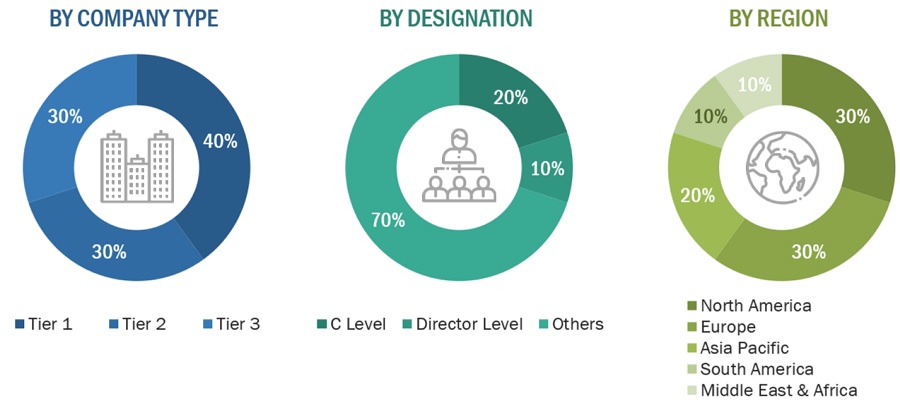
Note: Tier 1, Tier 2, and Tier 3 companies are classified based on their market revenue in 2022, available in the public domain, product portfolios, and geographical presence.
Other designations include consultants and sales, marketing, and procurement managers.
To know about the assumptions considered for the study, download the pdf brochure
|
Company name |
Designation |
|
Spectrolab (US) |
Individual Industry Expert |
|
AZUR SPACE Solar Power GmbH (Germany) |
Director Sales and Marketing |
|
ROCKET LAB USA (US) |
Manager |
|
Sharp Corporation (Japan) |
Marketing Manager |
|
CESI S.p.A (Italy) |
Senior Scientist |
Market Size Estimation
The top-down and bottom-up approaches have been used to estimate and validate the size of the Satellite solar cell materials market.
- The key players in the industry have been identified through extensive secondary research.
- The industry's supply chain has been determined through primary and secondary research.
- All percentage shares, splits, and breakdowns have been determined using secondary sources and verified through primary sources.
- All possible parameters that affect the markets covered in this research study have been accounted for, viewed in extensive detail, verified through primary research, and analyzed to obtain the final quantitative and qualitative data.
- The research includes the study of reports, reviews, and newsletters of the key market players, along with extensive interviews for opinions with leaders such as directors and marketing executives.
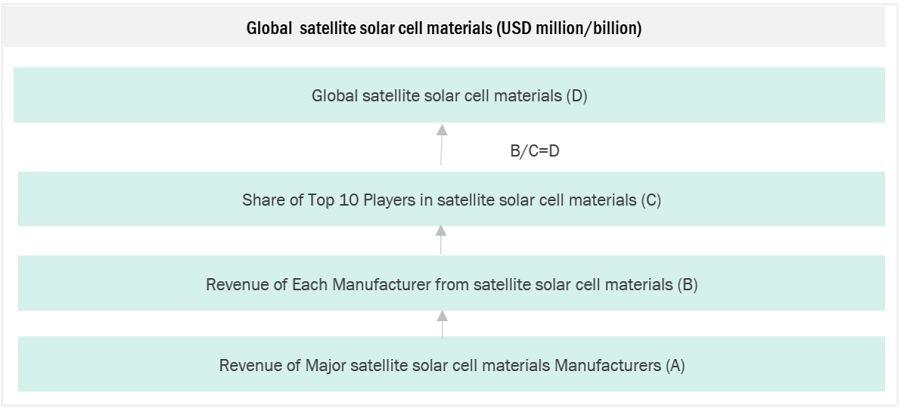
Note: All the shares are based on the global market size.
Source: Secondary Research, Interviews with Experts, and MarketsandMarkets Analysis
To know about the assumptions considered for the study, Request for Free Sample Report
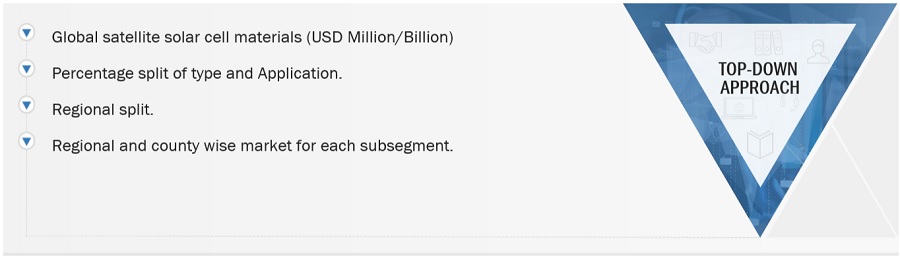
Satellite Solar Cells Materials Market: Top-Down Approach
Data Triangulation
After arriving at the total market size from the estimation process explained above, the overall market has been split into several segments and sub-segments. To complete the overall market engineering process and arrive at the exact statistics for all the segments and sub-segments, the data triangulation and market breakdown procedures have been employed, wherever applicable. The data has been triangulated by studying various factors and trends from both the demand and supply sides. Along with this, the market size has been validated by using both the top-down and bottom-up approaches and primary interviews. Hence, for every data segment, there have been three sources—top-down approach, bottom-up approach, and expert interviews. The data was assumed correct when the values arrived from the three sources matched.
Market Definition
The satellite solar cell materials market pertains to the array of materials involved in the production of solar cells specifically designed for use in satellites. These materials play a pivotal role in constructing solar cells capable of harnessing solar energy in the harsh and demanding conditions of outer space. The market encompasses a range of advanced materials, including materials like silicon and GaAs, which are carefully selected for their ability to withstand extreme temperatures, radiation, and vacuum conditions prevalent in space environments. Key components such as coverglass and interconnected cells contribute to the durability and efficiency of these solar cells. The market is characterized by the stringent requirements of the space industry, demanding materials that ensure reliability, longevity, and optimal energy conversion in space applications. As space exploration, satellite deployment, and communication activities continue to rise, the demand for high-performance satellite solar cell materials is expected to grow, making this market integral to the success of various space missions and satellite technologies. Companies operating in this market focus on developing cutting-edge materials to meet the rigorous standards of the space industry, catering to the evolving needs of satellite manufacturers and space agencies worldwide.
Key Stakeholders
- Satellite solar cells materials manufacturers
- Satellite solar cells materials traders, distributors, and suppliers
- End-use industry participants of different segments of the satellite solar cells materials market
- Government and research organizations
- Associations and industrial bodies
- Research and consulting firms.
- Research & development (R&D) institutions.
- Environmental support agencies.
Report Objectives
- To define, describe, and forecast the size of the satellite solar cell materials market, in terms of value and volume.
- To provide detailed information regarding the major factors (drivers, opportunities, restraints, and challenges) influencing the growth of the market
- To estimate and forecast the market size based on material types, application, orbit and region.
- To forecast the size of the market with respect to major regions, namely, Europe, North America, Asia Pacific, Rest of the world, along with their key countries.
- To strategically analyze micromarkets1 with respect to individual growth trends, prospects, and their contribution to the overall market.
- To analyze opportunities in the market for stakeholders and provide a competitive landscape of market leaders.
- To track and analyze recent developments such as expansions, new product launches, partnerships & agreements, and acquisitions in the market.
- To strategically profile key market players and comprehensively analyze their core competencies.
Available Customizations
Along with the given market data, MarketsandMarkets offers customizations according to the company’s specific needs. The following customization options are available for the report:
Regional Analysis
- Further breakdown of a region with respect to a particular country or additional application
Company Information
- Detailed analysis and profiles of additional market players
Get the Full Satellite Solar Cell Materials Market Report
Full forecast, segment splits, and company analysis for all Satellite Solar Cell Materials Market.
- Italy Satellite Solar Cell Materials Market
- Spain Satellite Solar Cell Materials Market
- Canada Satellite Solar Cell Materials Market
- Mexico Satellite Solar Cell Materials Market
- US Satellite Solar Cell Materials Market
- Brazil Satellite Solar Cell Materials Market
- South Africa Satellite Solar Cell Materials Market
- Rest Of Europe Satellite Solar Cell Materials Market
- Rest Of Asia Pacific Satellite Solar Cell Materials Market
- China Satellite Solar Cell Materials Market
- Japan Satellite Solar Cell Materials Market
- India Satellite Solar Cell Materials Market
- South Korea Satellite Solar Cell Materials Market
- Germany Satellite Solar Cell Materials Market
- UK Satellite Solar Cell Materials Market
- France Satellite Solar Cell Materials Market
Need a Tailored Report?
Customize this report to your needs
Get 10% FREE Customization
Customize This Report
