
UK SCADA Market (2025-2030)

The UK SCADA Market was valued at $425.7 Million in 2025 and projected to reach to $644.6 Million by 2030, representing a compound annual growth rate of 8.7%. The UK SCADA market is positioned for sustained growth through 2030, driven by accelerating industrial automation adoption and critical infrastructure modernization efforts.


| Market Size in | USD 26.32 MN |
| Market Forecast in | |
| CAGR | |
| Forecast Period | |
| Units Considered | Value (USD MN) |
UK SCADA Market Trends and Insights
- The UK's SCADA sector is driven by increasing industrial automation, critical infrastructure modernization, and digital transformation initiatives across utilities, manufacturing, and energy sectors.
- The UK's investment in smart grid technologies and renewable energy integration is accelerating SCADA adoption among operators seeking real-time monitoring and control capabilities. The UK SCADA market benefits from strong regulatory frameworks, including compliance requirements for critical national infrastructure protection.
- The UK's aging industrial base is undergoing significant upgrades, with legacy systems being replaced by advanced SCADA solutions that offer enhanced cybersecurity, cloud connectivity, and IoT integration.
- Between 2025 and 2030, the UK market will be shaped by the country's net-zero commitments and the need for intelligent grid management across distributed energy resources..
Key Market Statistics
- CAGR (2025-2030) 8.7% CAGR
- Market Size, 2025 ~USD 425.7 Million
- Forecast, 2030 ~USD 644.6 Million
- Country UK
UK SCADA Market Overview
Market Valuation Growth :
The UK SCADA market is valued at $425.7 million in 2025, with a projected expansion to $644.6 million by 2030, representing a robust 8.7% CAGR over the forecast period.
Industrial Automation Expansion :
UK manufacturing and industrial sectors are increasingly adopting SCADA systems to enhance operational efficiency, reduce downtime, and improve real-time monitoring capabilities across production facilities.
Critical Infrastructure Modernization :
UK utilities and energy providers are prioritizing SCADA upgrades to modernize aging infrastructure, strengthen grid resilience, and support the transition to renewable energy sources and smart grid technologies.
Digital Transformation Initiatives :
Government and private sector investments in digital transformation across UK industries are driving demand for advanced SCADA solutions that enable remote monitoring, predictive maintenance, and integrated control systems.
UK SCADA Market Dynamics
- Key growth catalysts include the UK's commitment to renewable energy integration, smart grid deployment, and Industry 4.0 initiatives across manufacturing sectors.
- Utilities and energy companies are prioritizing SCADA system upgrades to enhance operational efficiency and grid stability.
- The market will benefit from increased cybersecurity investments and regulatory compliance requirements.
- Digital transformation across water management, transportation, and healthcare sectors further expands SCADA applications.
- With a 8.7% CAGR, the UK market reflects strong demand for real-time monitoring and control solutions that support sustainability goals and operational excellence..
Market Ecosystem
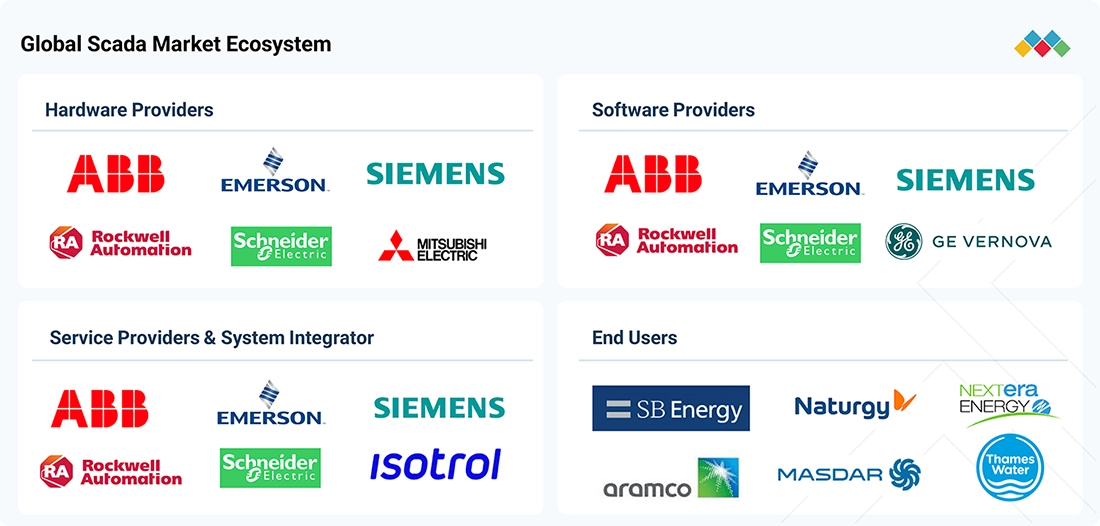
SCADA MARKET SIZE, SHARE & TRENDS: COMMERCIAL USE CASES ACROSS INDUSTRIES
| COMPANY | USE CASE DESCRIPTION | BENEFITS |
|---|---|---|
 |
Rockwell Automation provides FactoryTalk SCADA and HMI solutions for manufacturing, enabling real-time monitoring, process visualization, alarm management, and integration of plant automation systems | Improves production visibility | Enables faster decision-making | Supports scalable plant monitoring | Reduces troubleshooting time |
 |
ABB provides Symphony Plus SCADA for monitoring and controlling distributed infrastructure across water, hydropower, and renewable energy applications, integrating data from remote field devices and control systems. | Enables centralized asset monitoring | Improves operational reliability | Supports secure remote operations | Enhances visibility across distributed assets |
 |
Schneider Electric offers EcoStruxure Geo SCADA Expert for remote monitoring and control across energy, water, chemicals, and renewable energy applications, with real-time data and alarm management. | Enables reliable remote control | Improves alarm management | Supports multi-protocol integration | Enhances operational visibility |
 |
Siemens provides SIMATIC WinCC SCADA systems for monitoring and controlling automated processes across manufacturing, infrastructure, and process industries, with plant-wide visualization and data integration. | Improves process visibility | Supports IT/OT integration | Enhances operational efficiency | Enables scalable monitoring |
 |
GE Vernova provides iFIX and CIMPLICITY SCADA solutions for electric utilities, enabling real-time monitoring and supervisory control across substations, distribution networks, and control centers. | Improves grid visibility | Enables faster response to disturbances | Enhances operational reliability | Supports scalable utility operations |
Logos and trademarks shown above are the property of their respective owners. Their use here is for informational and illustrative purposes only.
Related Ecosystem
Automotive Electronics And Electrical Equipment
- Battery Electric Vehicle (BEV)
- Light Commercial Vehicles (LCVs)
- Fuel Cell Electric Vehicle (FCEV)
- Sensors
- Hybrid Electric Vehicle (HEV)
- BOSCH LIMITED
- Continental ag
- DENSO Corporation
- Panasonic Holdings Corporation
- Texas Instruments Incorporated
Industrial Automation
- Sensors
- Image Sensors
- Manufacturing Execution System (MES)
- Actuators
- Flow Sensors
- ABB India Limited
- Siemens ag
- Emerson Electric Co.
- HONEYWELL INTERNATIONAL INC.
- SCHNEIDER ELECTRIC SE
Industrial Iot
- Sensors
- Pressure Sensors
- Flow Sensors
- Gas Sensors
- Image Sensors
- Siemens ag
- ABB India Limited
- HONEYWELL INTERNATIONAL INC.
- Emerson Electric Co.
- SCHNEIDER ELECTRIC SE
Key Takeaways
- The UK SCADA market will grow from $425.7M (2025) to $644.6M (2030), representing an 8.7% CAGR.
- The UK's critical infrastructure protection regulations and net-zero energy targets are primary growth catalysts for SCADA modernization.
- The UK market is transitioning from legacy systems to cloud-enabled, cybersecure SCADA solutions with IoT integration capabilities.
- The UK's renewable energy expansion and smart grid initiatives require advanced SCADA systems for distributed resource management.
SCADA Market Report Scope
| Report Metric | Details |
|---|---|
| Base Year | 2025 |
| Fastest Growing Segment | CLOUD-BASED (Software) |
| Forecast Period | 2025–2030 |
| Growth Rate | CAGR of 9.2% from 2025 to 2030 |
| Largest Segment | UTILITIES (End User) |
| Market Size Base Year (Billions) | ~USD 12.91 (2025) |
| Revenue Forecast (Billions) | ~USD 20.05 (2030) |
| Segments Covered | Offering, Component, Hardware Type, Software, Service, End User, Process Industries, Utilities, Discrete Manufacturing |
UK SCADA Market Report Segmentation
9 segment dimensions are covered across the global market.
By Offering
- Hardware
- Services
- Software
By Component
- Communication System
- Human Machine Interface (Hmi)
- Programmable Logic Controller (Plc)
- Remote Terminal Unit (Rtu)
By Hardware Type
- Remote Terminal Unit (Rtu)
By Software
- Cloud-Based
- On-Premises
By Service
- Managed Services
- Professional Services
By End User
- Discrete Manufacturing
- Process Industries
- Utilities
By Process Industries
- Chemicals
- Food & Beverages
- Oil & Gas
- Other Process Industries
- Pharmaceuticals
By Utilities
- Power
- Telecommunications
- Transportation
- Water & Wastewater
By Discrete Manufacturing
- Automotive
- Other Discrete Manufacturing
- Semiconductor & Electronics
UK: SCADA MARKET, BY END USER, 2025–2030
| Segment | 2025 | 2026 | 2027 | 2028 | 2029 | 2030 | CAGR (%) |
|---|---|---|---|---|---|---|---|
| DISCRETE MANUFACTURING | 104.6 | 113.5 | 123.7 | 135.5 | 149.2 | 165 | 9.5 |
| PROCESS INDUSTRIES | 147.8 | 157.5 | 168.7 | 181.5 | 196.4 | 213.5 | 7.6 |
| UTILITIES | 173.3 | 187 | 202.8 | 220.9 | 241.9 | 266.2 | 9 |
| TOTAL | 425.7 | 458 | 495.2 | 538 | 587.5 | 644.6 | 8.7 |
Target Audience
- UK Industrial Manufacturers : Need SCADA market intelligence to evaluate automation investments, assess competitive positioning, and identify technology partners for modernizing production facilities and improving operational efficiency.
- UK Utilities & Energy Providers : Require detailed market insights to plan infrastructure upgrades, smart grid implementations, and renewable energy integration strategies while understanding market growth and technology trends.
- SCADA Solution Vendors : Seek UK-specific market data to develop localized sales strategies, identify customer segments, forecast revenue potential, and benchmark against regional competitors in the British market.
- UK Government & Policy Makers : Need market analysis to inform digital transformation policies, infrastructure investment decisions, and regulatory frameworks supporting industrial automation and critical infrastructure modernization.
- Investment & Private Equity Firms : Require comprehensive UK SCADA market data to evaluate investment opportunities, assess portfolio company growth potential, and identify acquisition targets in the British automation and control systems sector.
Key Companies in the UK SCADA Market
| Company | HQ | Ownership | Strongest segments |
|---|---|---|---|
| TECH MAHINDRA LIMITED | India | Public Company | Application development, modernization, and digital engineering,Cloud and infrastructure services,AI, analytics, and AIOps platforms, |
| LENOVO | China | Public Company | Small form factor PCs and embedded signage controllers,Thin clients and dedicated media players,Tablets and smart devices for kiosks/PoS, |
| SCHNEIDER ELECTRIC | Canada | Public Company | Low- and Medium-Voltage Electrical Distribution (switchgear, control gear, wiring devices),Building Management, Power Metering, and Smart Controls,Industrial Automation, Drives, and Microgrids, |
| SIEMENS | Germany | Public Company | Digital Industries (automation, PLM, industrial software),Smart Infrastructure (electrification, buildings, grid),Mobility (rail, rolling stock, automation, services), |
| ABB | India | Public Company | Electrification,Motion,Automation, |
| ROCKWELL AUTOMATION | United States | Public Company | Intelligent Devices,Software & Control,Lifecycle Services, |
| EMERSON ELECTRIC CO. | United States | Public Company | Final Control,Measurement & Analytical,Control Systems & Software, |
| GE VERNOVA | United States | Public Company | Power (gas, nuclear, hydro, steam),Wind (onshore and offshore),Electrification (grid, power conversion, solar and storage, software), |
| HONEYWELL INTERNATIONAL INC. | United States | Public Company | Industrial Automation,Building Automation,Energy and Sustainability Solutions (UOP and related), |
| MITSUBISHI ELECTRIC CORPORATION | Japan | Public Company | Factory Automation (FA) systems and FA digital solutions,Building systems, air conditioning, refrigeration, and life-related equipment,Energy systems, public utility, and power transmission and distribution, |
| OMRON CORPORATION | Japan | Public Company | Industrial Automation (sensors, safety, motion, robotics, panel, vision, software),Device & Module Solutions (relays, switches, connectors, components),Healthcare (cardiovascular, respiratory, pain management, remote monitoring), |
| YOKOGAWA ELECTRIC CORPORATION | Japan | Public Company | Control Business (DCS, PLCs, software, lifecycle services),Field Instruments (flow, pressure, analyzers, recorders),Measuring Instruments (waveform, optical, power, signal), |
TECH MAHINDRA LIMITED
Tech Mahindra Limited is a large Indian public company founded in 1986 with 119,337 employees, operating as a major IT services provider.
LENOVO
Lenovo is a Chinese public company founded in 1984, operating as a global leader in computing and technology solutions.
SCHNEIDER ELECTRIC
Schneider Electric is a Canadian public company with roots dating back to 1836, employing 158,122 people in energy management and automation.
SIEMENS
Siemens is a German multinational public company founded in 1847 with 310,312 employees, operating across industrial automation, digitalization, and infrastructure sectors.
ABB
ABB is an Indian public company with origins dating to 1883, employing 111,900 people in power and automation technology.
ROCKWELL AUTOMATION
Rockwell Automation is a United States-based public company founded in 1903 with 26,000 employees, specializing in industrial automation and digital transformation.
EMERSON ELECTRIC CO.
Emerson Electric Co. is a United States public company established in 1890 with 71,000 employees, providing process management and automation solutions.
GE VERNOVA
GE Vernova is a United States public company founded in 2023 with 78,000 employees, focused on energy and industrial technology.
HONEYWELL INTERNATIONAL INC.
Honeywell International Inc. is a United States public company founded in 1885 with 101,000 employees, operating in aerospace, building technologies, and industrial solutions.
MITSUBISHI ELECTRIC CORPORATION
Mitsubishi Electric Corporation is a Japanese public company established in 1921 with 150,386 employees, operating across industrial automation, power systems, and electronics.
OMRON CORPORATION
Omron Corporation is a Japanese public company founded in 1933 with 26,050 employees, specializing in automation and sensing technology.
YOKOGAWA ELECTRIC CORPORATION
Yokogawa Electric Corporation is a Japanese public company established in 1915 with 18,313 employees, focused on industrial automation and control systems.
Reasons to Buy this Report
- UK-Specific Market Sizing : Access precise valuation data for the UK SCADA market with verified 2025 baseline ($425.7M) and 2030 forecast ($644.6M), enabling accurate budget allocation and investment planning for UK operations.
- Regional Growth Trajectory : Understand the 8.7% CAGR specific to the UK market, allowing you to benchmark performance against regional trends and identify growth opportunities within the British industrial and utility sectors.
- Sector-Specific Insights : Gain detailed intelligence on SCADA adoption across UK manufacturing, energy, utilities, and critical infrastructure sectors, with actionable insights on modernization priorities and investment patterns.
- Competitive Positioning : Develop UK-focused go-to-market strategies by understanding local market dynamics, regulatory requirements, and customer preferences specific to British industrial automation and smart grid initiatives.
- Strategic Decision Support : Make informed decisions on market entry, expansion, or product development in the UK by leveraging comprehensive market analysis, growth drivers, and forecast data tailored to the British economy.
Frequently asked questions
What is the current size of the UK SCADA market?
The UK SCADA market is valued at $425.7 million in 2025 and is projected to reach $644.6 million by 2030.
What is the growth rate of the UK SCADA market?
The UK SCADA market is expected to grow at a compound annual growth rate (CAGR) of 8.7% from 2025 to 2030.
What are the main drivers of SCADA adoption in the UK?
Key drivers include industrial automation needs, critical infrastructure modernization, renewable energy integration, smart grid deployment, and regulatory compliance requirements for cybersecurity and operational resilience.
Which sectors are driving UK SCADA market growth?
The UK utilities, energy, water management, manufacturing, and oil & gas sectors are primary drivers, with particular emphasis on smart grid and renewable energy applications.
How is the UK SCADA market responding to net-zero commitments?
The UK SCADA market is expanding to support distributed renewable energy management, grid balancing, and real-time monitoring of decentralized energy resources required to meet net-zero targets.
RESEARCH METHODOLOGY
The research process for this study involved the systematic gathering, recording, and analysis of data on customers and companies operating in the SCADA market. This process involved the extensive use of secondary sources, directories, and databases (Factiva and OANDA) to identify and collect valuable information for the comprehensive, technical, market-oriented, and commercial study of the SCADA market. In-depth interviews were conducted with primary respondents, including experts from core and related industries, as well as preferred manufacturers, to obtain and verify critical qualitative and quantitative information and assess growth prospects. Key players in the SCADA market were identified through secondary research, and their market rankings were determined through a combination of primary and secondary research. This research involved studying the annual reports of top players and conducting interviews with key industry experts, including CEOs, directors, and marketing executives.
Secondary Research
Various sources were utilized in the secondary research process to identify and collect information relevant to this study. These include company annual reports, press releases, investor presentations, white papers, technology journals, certified publications, articles by recognized authors, directories, and databases.
Secondary research was primarily used to gather key information on the industry’s value chain, the total pool of market players, market classification by industry trends at the most detailed level, regional markets, and key developments from both market- and technology-oriented perspectives.
Primary Research
Primary research was also conducted to identify the segmentation types, key players, competitive landscape, and key market dynamics, including drivers, restraints, opportunities, challenges, and industry trends, as well as the key strategies adopted by players operating in the SCADA market. Extensive qualitative and quantitative analyses were conducted across the complete market engineering process to present key information and insights throughout the report.
Extensive primary research has been conducted following the acquisition of knowledge about the SCADA market scenarios through secondary research. Several primary interviews were conducted with experts from the demand side (industry and region) and the supply side (product type, price tier, distribution channel, technology) across four major geographic regions: North America, Europe, Asia Pacific, and RoW. Approximately 60% and 40% of the primary interviews were conducted from the supply and demand sides, respectively.
These primary data have been collected through questionnaires, emails, and telephonic interviews.
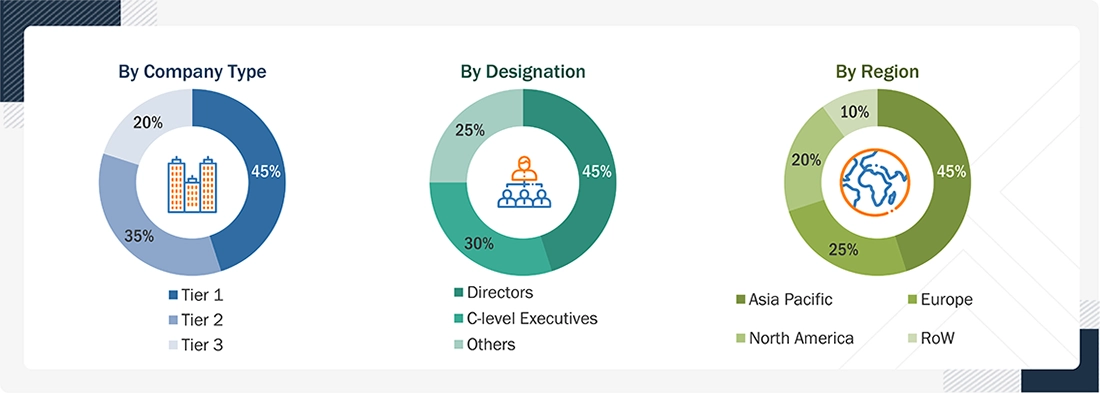
Notes: The three tiers of companies have been defined based on their total/segmental revenue as of 2025: Tier 1 = > USD 1 billion, Tier 2 = USD 1 billion–USD 100 million, and Tier 3 = < USD 100 million.
Other designations include sales, marketing, and product managers.
To know about the assumptions considered for the study, download the pdf brochure
Market Size Estimation
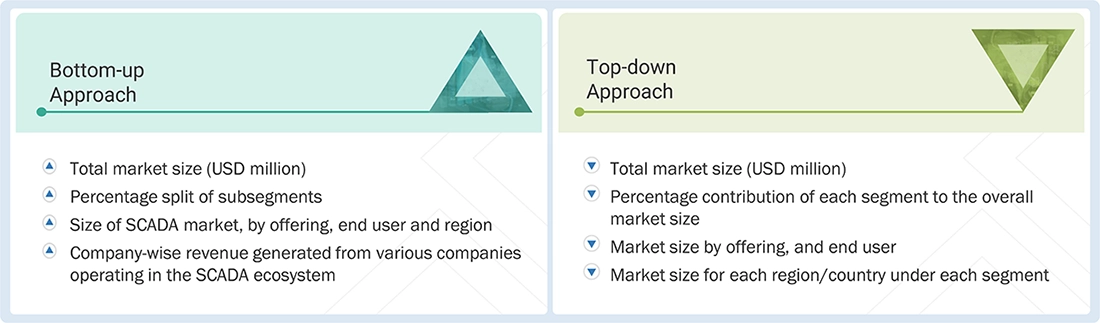
In the complete market engineering process, top-down and bottom-up approaches, along with several data triangulation methods, were used to estimate and validate the size of the SCADA market and various other dependent submarkets. Key players in the market were identified through secondary research, and their market share in each region was determined through a combination of primary and secondary research. This research methodology involved analyzing the annual and financial reports of the top players and conducting interviews with experts (including CEOs, VPs, directors, and marketing executives) to gather key insights (both quantitative and qualitative).
All percentage shares, splits, and breakdowns were determined using secondary sources and verified through primary sources. All possible parameters affecting the markets covered in this study were accounted for, examined in detail, verified through primary research, and analyzed to obtain final quantitative and qualitative data. This data was consolidated and supplemented with detailed inputs and analysis from MarketsandMarkets and presented in this report.
SCADA Market : Top-Down and Bottom-Up Approach
Data Triangulation
After determining the overall market size through the estimation process, as explained above, the total market was divided into several segments and subsegments. To complete the overall market engineering process and obtain precise statistics for all segments and subsegments, the data triangulation procedure was employed, as applicable. The data was triangulated by studying various factors and trends from the demand and supply sides. Additionally, the market has been validated using both top-down and bottom-up approaches.
Market Definition
The SCADA (Supervisory Control and Data Acquisition) market comprises integrated hardware and software systems designed to monitor, control, and optimize industrial and infrastructure operations through real-time data acquisition and centralized supervision. These solutions are widely deployed across process industries such as oil & gas, chemicals, pharmaceuticals, food & beverage; discrete manufacturing sectors including automotive, semiconductor, and electronics; and utility segments encompassing power, water & wastewater treatment, telecommunications, and transportation. SCADA systems utilize components such as programmable logic controllers (PLCs), remote terminal units (RTUs), and human-machine interfaces (HMIs), and are increasingly supported by technologies like industrial IoT, cloud platforms, and advanced analytics.
Key Stakeholders
- Application providers
- Automation consultants
- Integrators of automation systems
- Distributors and providers of SCADA
- Companies developing and integrating industrial software
- Companies providing industrial control systems (ICS) cybersecurity
- Vendors of SCADA software packages
- Suppliers of SCADA components
- Providers of professional services/solutions
- Research organizations and consulting companies
- Technology investors
- Technology standards organizations, forums, alliances, and associations
Report Objectives
- To describe and forecast the SCADA market, in terms of value, based on offering and end user
- To define and forecast the market size, in terms of value, with regard to four main regions: North America, Europe, Asia Pacific, and RoW (Rest of the World)
- To describe and forecast the market size for SCADA, by offering and region, in terms of volume
- To provide detailed information regarding drivers, restraints, opportunities, and challenges influencing the growth of the market
- To understand the impact of artificial intelligence (AI) on the market
- To strategically analyze micromarkets with respect to individual growth trends, prospects, and contributions to the total market
- To analyze opportunities for various stakeholders by identifying high-growth segments of the market
- To strategically profile key players and comprehensively analyze their market position in terms of ranking and core competencies, along with detailing the competitive landscape of the market
- To analyze competitive developments, such as acquisitions, product launches, developments, and partnerships in the market
- To provide a detailed overview of the ecosystem analysis, case study analysis, patent analysis, trade analysis, technology analysis, average selling price (ASP) analysis, AI/Gen AI impact analysis, Porter’s five forces analysis, macroeconomic outlook, and regulatory landscape pertaining to the SCADA market.
Available customizations:
With the given market data, MarketsandMarkets offers customizations according to the company’s specific needs. The following customization options are available for the report:
Get the Full SCADA Market Report
Full forecast, segment splits, and company analysis for all SCADA Market.
- US SCADA Market
- Canada SCADA Market
- Mexico SCADA Market
- Germany SCADA Market
- France SCADA Market
- Italy SCADA Market
- Spain SCADA Market
- China SCADA Market
- Japan SCADA Market
- South Korea SCADA Market
- India SCADA Market
- Australia SCADA Market
- Rest Of Europe SCADA Market
- Rest Of Asia Pacific SCADA Market
Need a Tailored Report?
Customize this report to your needs
Get 10% FREE Customization
Customize This Report
