
Australia Sleep Apnea Oral Appliances Market (2025-2030)

The Australia Sleep Apnea Oral Appliances Market was valued at $3.2 Million in 2025 and projected to reach to $5.2 Million by 2030, representing a compound annual growth rate of 10.2%. Australia's sleep apnea oral appliances market is positioned for sustained growth through 2030, driven by heightened awareness of obstructive sleep apnea and the therapeutic benefits of oral appliances.


| Market Size in | USD 26.32 MN |
| Market Forecast in | |
| CAGR | |
| Forecast Period | |
| Units Considered | Value (USD MN) |
Australia Sleep Apnea Oral Appliances Market Trends and Insights
- This expansion reflects increasing awareness of obstructive sleep apnea (OSA) diagnosis and treatment options across Australia, where oral appliances serve as a non-invasive alternative to continuous positive airway pressure (CPAP) therapy.
- Australia's healthcare infrastructure and rising patient preference for comfortable, portable treatment solutions are driving adoption of mandibular advancement devices and other oral appliances. The 10.2% compound annual growth rate (CAGR) in Australia outpaces the global average of 9.8%, indicating strong regional momentum.
- Australia's aging population, coupled with lifestyle factors contributing to sleep apnea prevalence, supports sustained demand for oral appliance therapy.
- Dental professionals and sleep medicine specialists in Australia are increasingly integrating these devices into treatment protocols, enhancing market penetration and patient accessibility throughout the forecast period..
Key Market Statistics
- CAGR (2025-2030) 10.2% CAGR
- Market Size, 2025 ~USD 3.2 Million
- Forecast, 2030 ~USD 5.2 Million
- Country Australia
Australia Sleep Apnea Oral Appliances Market Overview
Market Valuation Growth :
Australia's sleep apnea oral appliances market is valued at $3.2 million in 2025, with projections reaching $5.2 million by 2030, representing a robust 10.2% CAGR over the forecast period.
Rising OSA Awareness :
Increasing diagnosis rates of obstructive sleep apnea across Australia are driving demand for oral appliances as healthcare providers and patients seek non-invasive treatment alternatives to traditional CPAP therapy.
Non-Invasive Treatment Preference :
Australian patients increasingly prefer oral appliances due to improved comfort and compliance compared to CPAP devices, positioning them as a viable first-line or alternative treatment option in the local market.
Outpacing Global Growth :
Australia's market CAGR of 10.2% exceeds the global average of 9.8%, indicating stronger regional adoption and market penetration of oral appliance technology within the Australian healthcare system.
Australia Sleep Apnea Oral Appliances Market Dynamics
- The Australian healthcare sector is increasingly recognizing oral appliances as a preferred alternative to CPAP therapy, particularly among patients seeking improved comfort and treatment adherence.
- Expanding diagnostic capabilities and growing patient education initiatives across major Australian cities are expected to accelerate market adoption.
- Additionally, supportive reimbursement policies and integration of oral appliances into sleep medicine protocols will further strengthen market expansion.
- The projected growth from $3.2 million to $5.2 million reflects both increased patient demand and healthcare provider confidence in oral appliance efficacy within the Australian market..
Market Ecosystem
Related Ecosystem
Dental Devices
- Dental Implants
- Dental Bone Grafts
- Dental Crowns
- Dental Prosthetics
- Zirconium Implants
- DENTSPLY SIRONA Inc.
- Henry Schein, Inc.
- KAVO KERR GROUP
- PLANMECA GROUP
- Patterson Companies, Inc.
Medical Devices
- Polymerase Chain Reaction (PCR)
- Magnetic Resonance Imaging (MRI)
- Disposable Autoinjectors
- Pulse Oximeters
- Blood Pressure Monitors
- Medtronic plc
- Abbott Laboratories
- Stryker Corporation
- Becton, Dickinson and Company
- JOHNSON & JOHNSON
Key Takeaways
- Australia's sleep apnea oral appliances market is valued at $3.2 million in 2025 and expected to reach $5.2 million by 2030.
- Australia's market growth rate of 10.2% CAGR exceeds the global average, reflecting strong regional demand and healthcare adoption.
- Increasing OSA awareness and patient preference for non-invasive alternatives are key drivers of oral appliance uptake in Australia.
- Australia's aging demographic and integrated dental-sleep medicine approach support sustained market expansion through 2030.
Sleep Apnea Oral Appliances Market Report Scope
| Report Metric | Details |
|---|---|
| Base Year | 2025 |
| Fastest Growing Segment | ONLINE PHARMACIES (Distribution Channel) |
| Forecast Period | 2025–2030 |
| Growth Rate | CAGR of 9.8% from 2025 to 2030 |
| Largest Segment | MANDIBULAR ADVANCEMENT DEVICES (Product) |
| Market Size Base Year (Billions) | ~USD 0.5 (2025) |
| Revenue Forecast (Billions) | ~USD 0.8 (2030) |
| Segments Covered | Product, Type, Purchase Type, Gender, Age Group, Distribution Channel, End User |
Australia Sleep Apnea Oral Appliances Market Report Segmentation
7 segment dimensions are covered across the global market.
By Product
- Daytime-Nighttime Appliances
- Mandibular Advancement Devices
- Tongue-Retaining Devices
By Type
- Custom-Made Mads
- Ready-Made Mads
By Purchase Type
- Online Otc Oral Appliances
- Physician-Prescribed/Customized Oral Appliances
By Gender
- Female Patients
- Male Patients
By Age Group
- Above 60 Years
- Below 40 Years
- Between 40-60 Years
By Distribution Channel
- Hospital Pharmacies
- Hospital Pharmacies & Dental Clinics
- Online Pharmacies
- Retail Pharmacies
By End User
- Dental Clinics
- Home Care Settings/Individuals
- Hospitals
AUSTRALIA: SLEEP APNEA ORAL APPLIANCES MARKET, BY END USER, 2022–2030
| Segment | 2022 | 2023 | 2024 | 2025 | 2026 | 2028 | 2029 | 2030 | CAGR (%) |
|---|---|---|---|---|---|---|---|---|---|
| DENTAL CLINICS | 0.3 | 0.3 | 0.3 | 0.4 | 0.4 | 0.5 | 0.5 | 0.6 | 8.4 |
| HOME CARE SETTINGS/INDIVIDUALS | 1.8 | 2 | 2.1 | 2.4 | 2.6 | 3.1 | 3.5 | 3.9 | 10.4 |
| HOSPITALS | 0.6 | 0.7 | 0.8 | 0.8 | 0.9 | 1.1 | 1.2 | 1.3 | 10.2 |
| TOTAL | 2.7 | 3 | 3.2 | 3.6 | 3.9 | 4.7 | 5.2 | 5.8 | 10.1 |
Target Audience
- Medical Device Manufacturers : Manufacturers need Australia-specific market data to assess market potential, develop localized product strategies, and identify distribution opportunities in this growing oral appliance segment.
- Healthcare Providers & Sleep Clinics : Australian sleep medicine practitioners require market insights to understand patient demand trends, competitive offerings, and clinical adoption patterns to optimize treatment protocols and patient outcomes.
- Dental Professionals : Dentists and orthodontists need market intelligence on oral appliance adoption rates and patient preferences in Australia to expand sleep apnea treatment services and revenue streams.
- Healthcare Investors & Consultants : Investment firms and management consultants require detailed Australia market analysis to evaluate investment opportunities, assess growth potential, and develop market entry or expansion strategies.
- Government & Health Policy Bodies : Australian health authorities and policymakers need market data to inform reimbursement decisions, healthcare resource allocation, and evidence-based policy development for sleep apnea management.
Key Companies in the Australia Sleep Apnea Oral Appliances Market
| Company | HQ | Ownership | Strongest segments |
|---|---|---|---|
| LIVANOVA PLC | United Kingdom | Public Company | Mandibular Advancement Devices (MAD),Tongue-Retaining Devices (TRD),Implantable Sleep Apnea Neuromodulation (aura6000), |
| COLGATE | United States | Public Company | Mandibular Advancement Devices (MAD),Tongue-Retaining Devices (TRD),Physician-prescribed (all products), |
| SOMNOMED | Australia | Public Company | Mandibular Advancement Devices (SomnoDent Avant, Classic, Flex, Fusion and related MADs),Tongue-Retaining Devices (TRD) and other oral sleep devices,Adjacencies (SomMorning Repositioner, SomnoBrux splints, SomTabs and accessories), |
| RESMED | United States | Public Company | Mandibular Advancement Devices (MAD),Tongue-Retaining Devices (TRD),Physician-prescribed (all oral appliances), |
| PROSOMNUS SLEEP TECHNOLOGIES | United States | Private Company | Mandibular Advancement Devices (MAD),Tongue-Retaining Devices (TRD),Other custom intraoral OSA devices / accessories, |
| VIVOS THERAPEUTICS, INC. | United States | Public Company | Mandibular Advancement Devices (MAD),Tongue-Retaining Devices (TRD),Physician-prescribed programs and services (screening, home sleep test, treatment planning), |
| ORAVANOSA | Mandibular Advancement Devices (MAD),Tongue-Retaining Devices (TRD),Physician-prescribed channel, |
LIVANOVA PLC
LivaNova PLC is a United Kingdom-based medical device company founded in 2015 with 3,300 employees. Operating as a public company, it develops innovative healthcare solutions.
COLGATE
Colgate is a United States-based consumer goods company founded in 1806 with 33,600 employees. As a public company, it is a global leader in oral care and personal hygiene products.
SOMNOMED
SomnoMed is an Australian medical device company founded in 1987 with 300 employees. Operating as a public company, it specializes in sleep and respiratory solutions.
RESMED
ResMed is a United States-based medical device and software company founded in 1989 with 10,600 employees. As a public company, it focuses on digital health and cloud-connected medical devices.
PROSOMNUS SLEEP TECHNOLOGIES
ProSomnus Sleep Technologies is a United States-based private company founded in 2016 with 136 employees. It develops innovative solutions for sleep and airway management.
VIVOS THERAPEUTICS, INC.
Vivos Therapeutics, Inc. is a United States-based public company founded in 2016 with 270 employees. It develops medical devices and therapeutics for sleep apnea and airway management.
ORAVANOSA
Insufficient data available for company description.
Reasons to Buy this Report
- Market Size & Growth Data : Access precise valuation figures for Australia's oral appliances market ($3.2M in 2025) with detailed 5-year forecasts and CAGR analysis to support strategic planning and investment decisions.
- Competitive Landscape Intelligence : Understand Australia-specific market dynamics, key players, and competitive positioning to identify opportunities for market entry, partnerships, or expansion within the local healthcare ecosystem.
- Patient Demand Insights : Gain actionable intelligence on Australian patient preferences for oral appliances over CPAP therapy, including adoption drivers and demographic trends specific to the Australian market.
- Regulatory & Reimbursement Analysis : Obtain detailed information on Australian healthcare policies, reimbursement frameworks, and regulatory requirements affecting oral appliance market growth and commercialization strategies.
- Regional Growth Opportunity : Leverage Australia's above-global-average CAGR (10.2% vs. 9.8%) to identify high-growth market segments and develop targeted strategies for capturing market share in this expanding region.
Frequently asked questions
What is the current market size of sleep apnea oral appliances in Australia?
Australia's sleep apnea oral appliances market was valued at $3.2 million in 2025 and is projected to grow to $5.2 million by 2030.
What is the expected growth rate for Australia's oral appliances market?
Australia's market is expected to grow at a compound annual growth rate (CAGR) of 10.2% from 2025 to 2030, outpacing the global average.
Why is Australia's oral appliances market growing faster than the global average?
Australia's above-average growth is driven by increasing OSA awareness, an aging population, strong healthcare infrastructure, and rising patient preference for non-invasive treatment alternatives.
What types of oral appliances are used in Australia?
Australia utilizes mandibular advancement devices (MADs), tongue-retaining devices, and other custom-fitted oral appliances as alternatives to CPAP therapy for sleep apnea treatment.
Who are the key healthcare providers offering oral appliances in Australia?
Dental professionals, sleep medicine specialists, and respiratory physicians in Australia collaborate to prescribe and fit oral appliances for sleep apnea patients.
RESEARCH METHODOLOGY
This study involved the extensive use of both primary and secondary sources. The research process involved the study of various factors affecting the industry to identify the segmentation types, industry trends, key players, competitive landscape, fundamental market dynamics, and key player strategies.
Secondary Research
The secondary research process involves the widespread use of secondary sources, directories, databases (such as Bloomberg Businessweek, Factiva, and D&B Hoovers), white papers, annual reports, investor presentations, SEC filings of companies and publications from government sources [such as National Institutes of Health (NIH), US FDA, US Census Bureau, World Health Organization (WHO), Global Burden of Disease Study, and Centers for Medicare and Medicaid Services (CMS) were referred to identify and collect information for the global sleep apnea oral appliances market study. It was used to gather vital information about key players, classify and segment the market according to industry trends, down to the most detailed level, and highlight key developments related to market and technological perspectives. A database of the key industry leaders was also prepared using secondary research.
Primary Research
In the primary research process, we interviewed various supply and demand sources to gather qualitative and quantitative information for this report. The supply-side sources included industry experts such as CEOs, vice presidents, marketing and sales directors, technology and innovation directors, and other key executives from prominent companies and organizations within the sleep apnea oral appliances market. On the demand side, we gathered insights from sleep clinics, dental clinics, hospitals, and academic institutions. This primary research was conducted to validate market segmentation, identify key players in the industry, and gain insights into important industry trends and market dynamics.
A breakdown of the primary respondents is provided below:
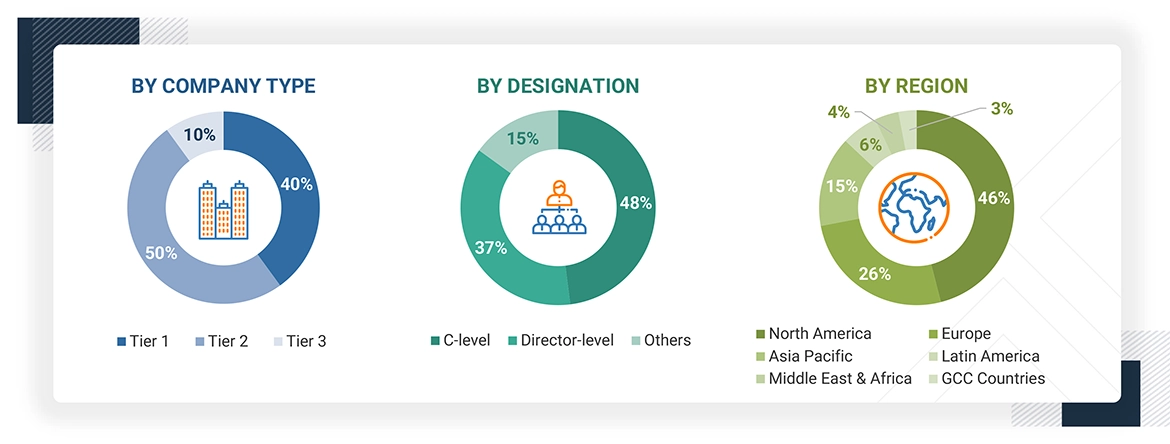
Note 1: C-level primaries include CEOs, CFOs, COOs, and VPs.
Note 2: Others include sales managers, marketing managers, business development managers, product managers, distributors, and suppliers.
Note 3: Companies are classified into tiers based on their total revenue. As of 2024, Tier 1 = >USD 10.00 billion, Tier 2 = USD 1.00 billion to USD 10.00 billion, and Tier 3 = < USD 1.00 billion.
Source: MarketsandMarkets Analysis
To know about the assumptions considered for the study, download the pdf brochure
Market Size Estimation
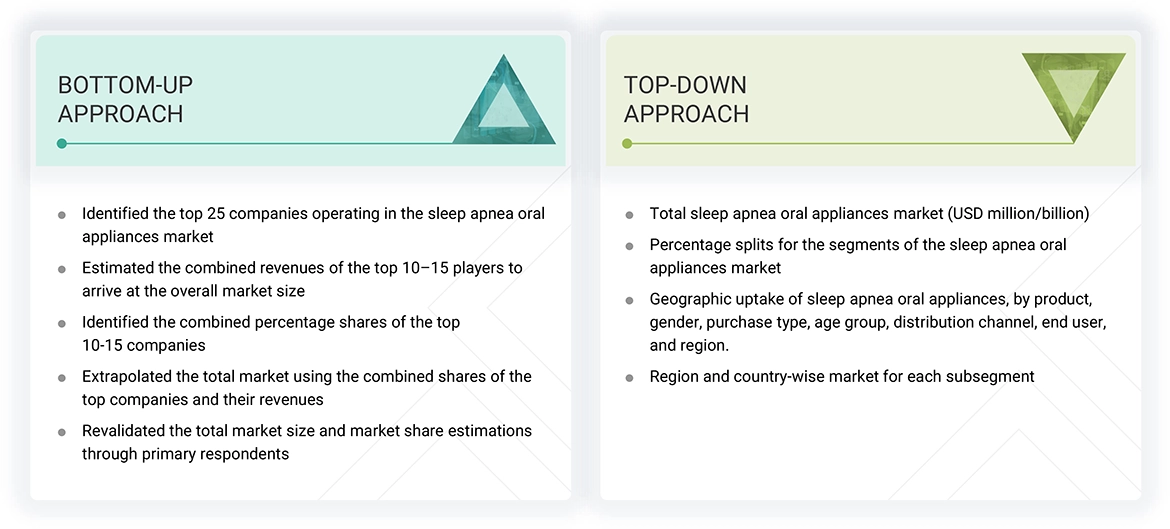
For the global market value, annual revenues were calculated based on the revenue mapping of major product manufacturers and OEMs active in the global sleep apnea oral appliances market. All the leading service providers were identified at the global/country/regional level. Revenue mapping for the respective business segments/subsegments was conducted for the major players. Also, the global sleep apnea oral appliances market was split into various segments and subsegments based on the following:
- List of primary players operating in the products market at the regional and/or country level
- Product mapping of sleep apnea oral appliance providers at the regional and/or country level
- Mapping of annual revenue generated by listed major players from sleep apnea oral appliances (or the nearest reported business unit/product category)
- Extrapolation of the revenue mapping of the listed major players to derive the global market value of the respective segments/subsegments
- Summation of the market value of all segments/subsegments to arrive at the global sleep apnea oral appliances market
The above data was consolidated and added with detailed inputs and analysis from MarketsandMarkets and presented in this report.
Market Size Estimation (Bottom-up approach & Top-down approach)
Data Triangulation
After arriving at the overall size of the global sleep apnea oral appliances market through the methodology mentioned above, this market was split into several segments and subsegments. Where applicable, the data triangulation and market breakdown procedures were employed to complete the overall market engineering process and arrive at the exact market value data for the key segments and subsegments. The extrapolated market data was triangulated by studying various macro indicators and regional trends from both demand- and supply-side participants.
Market Definition
Sleep apnea is a common sleep disorder that usually goes undiagnosed but has severe and life-threatening effects. The most common type of sleep apnea is obstructive sleep apnea. Due to patient non-compliance with positive airway pressure (PAP) devices, oral appliances are gaining popularity in treating sleep apnea. Oral appliance therapy (OAT) treats snoring and obstructive sleep apnea (OSA) patients. OAT can be an effective treatment for patients who prefer oral appliances over continuous positive airway pressure (CPAP) or those unable to tolerate CPAP.
Stakeholders
- Manufacturers & distributors of sleep apnea oral appliances
- Hospitals
- Dental clinics
- Healthcare corporations
- Medical service providers
- Ambulatory surgery centers
- Appliance suppliers
- Consulting firms
- Government associations
- Venture capitalists & investors
Report Objectives
- To define, describe, segment, and forecast the global sleep apnea oral appliances market by product, gender, purchase type, age group, distribution channel, end user, and region
- To provide detailed information regarding the major factors influencing market growth (such as drivers, restraints, opportunities, challenges, and trends)
- To analyze the micromarkets with respect to individual growth trends, prospects, and contributions to the overall sleep apnea oral appliances market
- To analyze market opportunities for stakeholders and provide details of the competitive landscape for key players
- To forecast the size of the market segments concerning six regions: North America, Europe, the Asia Pacific, Latin America, the Middle East & Africa, and the GCC Countries
- To profile the key players and comprehensively analyze their product portfolios, market positions, and core competencies
- To benchmark players within the market using the proprietary Company Evaluation Matrix framework, which analyzes market players on various parameters within the broad categories of business and product excellence
Get the Full Sleep Apnea Oral Appliances Market Report
Full forecast, segment splits, and company analysis for all Sleep Apnea Oral Appliances Market.
- US Sleep Apnea Oral Appliances Market
- Canada Sleep Apnea Oral Appliances Market
- Germany Sleep Apnea Oral Appliances Market
- UK Sleep Apnea Oral Appliances Market
- France Sleep Apnea Oral Appliances Market
- Italy Sleep Apnea Oral Appliances Market
- Spain Sleep Apnea Oral Appliances Market
- China Sleep Apnea Oral Appliances Market
- Japan Sleep Apnea Oral Appliances Market
- Rest Of Europe Sleep Apnea Oral Appliances Market
- Rest Of Asia Pacific Sleep Apnea Oral Appliances Market
Need a Tailored Report?
Customize this report to your needs
Get 10% FREE Customization
Customize This Report
