
Asia Pacific Small Caliber Ammunition Market (2024-2029)

The Asia Pacific Small Caliber Ammunition Market was valued at $2274.6 Million in 2024 and projected to reach to $2831.5 Million by 2029, representing a compound annual growth rate of 4.5%. The Asia Pacific small caliber ammunition market is poised for steady expansion driven by robust defense budget allocations and military modernization initiatives across the region.


| Market Size in | USD 26.32 MN |
| Market Forecast in | |
| CAGR | |
| Forecast Period | |
| Units Considered | Value (USD MN) |
Asia Pacific Small Caliber Ammunition Market Trends and Insights
- Asia Pacific's market growth is driven by increasing military modernization programs, rising defense budgets across key nations, and heightened geopolitical tensions that have elevated demand for ammunition stockpiles.
- The region's expanding law enforcement and civilian shooting sports sectors further contribute to sustained market expansion. Asia Pacific's small caliber ammunition market benefits from robust manufacturing capabilities and supply chain integration within the region.
- Strategic investments in defense infrastructure and procurement initiatives by governments across India, China, Japan, South Korea, and Southeast Asian nations are accelerating market penetration.
- The forecast period through 2029 reflects Asia Pacific's critical role in global defense spending and its emergence as a significant production hub for ammunition manufacturing..
Key Market Statistics
- CAGR (2024-2029) 4.5% CAGR
- Market Size, 2024 ~USD 2274.6 Million
- Forecast, 2029 ~USD 2831.5 Million
- Geography Asia Pacific
Asia Pacific Small Caliber Ammunition Market Overview
Market Valuation & Growth :
Asia Pacific's small caliber ammunition market is valued at USD 2,274.6 million in 2024, with a projected CAGR of 4.5% through 2029, reaching USD 2,831.5 million. This outpaces the global CAGR of 4.3%, positioning the region as a key growth driver.
Military Modernization Catalyst :
Accelerating defense modernization programs across China, India, Japan, and South Korea are significantly boosting demand for advanced small caliber ammunition systems and training munitions.
Geopolitical Tensions Impact :
Heightened regional tensions and territorial disputes in the South China Sea and Indo-Pacific have prompted increased defense spending and ammunition procurement among Asia Pacific nations.
Rising Defense Budgets :
Major Asia Pacific economies are substantially increasing military expenditures, with India and China leading investments in ammunition manufacturing capacity and procurement initiatives.
Asia Pacific Small Caliber Ammunition Market Dynamics
- China and India, as the largest markets, continue to invest heavily in indigenous ammunition production capabilities and advanced munitions technologies.
- Regional security concerns, including maritime disputes and cross-border tensions, are compelling governments to strengthen their defense arsenals and upgrade military capabilities. Looking ahead to 2029, the market will benefit from increased training exercises, ammunition stockpiling programs, and technological advancements in ammunition manufacturing.
- The region's growing emphasis on self-reliance in defense production and domestic ammunition manufacturing will further support market growth.
- Strategic partnerships between regional defense contractors and international ammunition manufacturers are expected to enhance product availability and innovation across Asia Pacific..
Market Ecosystem
Related Ecosystem
Defence Platforms And Systems
- Sensors
- Unmanned Ground Vehicles (UGV)
- Fighter Aircraft
- Special Mission Aircraft
- Antennas
- BAE Systems plc
- Thales group
- LOCKHEED MARTIN CORPORATION
- Northrop Grumman Corporation
- L3Harris Technologies, Inc.
Key Takeaways
- Asia Pacific small caliber ammunition market grows at 4.5% CAGR from 2024 to 2029, reaching USD 2,831.5 million.
- Military modernization and rising defense budgets across Asia Pacific nations are primary growth catalysts for the ammunition market.
- Asia Pacific's manufacturing infrastructure and supply chain capabilities position the region as a key global production center.
- Geopolitical tensions and law enforcement demand sustain robust market expansion throughout the forecast period in Asia Pacific.
Small Caliber Ammunition Market Report Scope
| Report Metric | Details |
|---|---|
| Base Year | 2024 |
| Fastest Growing Segment | 7.62 MM (Caliber Type) |
| Forecast Period | 2024-2029 |
| Growth Rate | CAGR of 4.3% from 2024 to 2029 |
| Largest Segment | MILITARY (Application) |
| Market Size Base Year (Billions) | ~USD 5.67 (2024) |
| Revenue Forecast (Billions) | ~USD 7 (2029) |
| Segments Covered | Application, Bullet Type, Caliber Type, Lethality |
Asia Pacific Small Caliber Ammunition Market Report Segmentation
4 segment dimensions are covered across the global market.
By Application
- Homeland Security
- Military
By Bullet Type
- Brass
- Copper
- Other Bullet Types
- Steel
By Caliber Type
- .338 Lapua Magnum
- .338 Norma Magnum
- 12.7 Mm
- 14.5 Mm
- 5.56 Mm
- 7.62 Mm
- 9 Mm Parabellum
- Other Caliber Types
By Lethality
- Less Lethal
- Less-Lethal
- Lethal
Target Audience
- Defense Contractors & Manufacturers : Ammunition producers and defense contractors need Asia Pacific market intelligence to identify expansion opportunities, assess competitive threats, and develop region-specific product strategies.
- Government & Military Procurement : Defense ministries and military procurement agencies require market data to benchmark ammunition costs, evaluate supplier capabilities, and plan strategic ammunition stockpiling initiatives.
- Investment & Private Equity Firms : Investors seeking exposure to Asia Pacific defense sectors need comprehensive market analysis to identify acquisition targets, assess growth potential, and evaluate investment returns in ammunition manufacturing.
- Supply Chain & Logistics Providers : Distributors and logistics companies require regional market insights to optimize supply chains, identify demand hotspots, and develop efficient distribution networks across Asia Pacific.
- Strategic Consultants & Analysts : Business consultants and market analysts need detailed Asia Pacific data to support client advisory services, competitive benchmarking, and strategic planning in the defense ammunition sector.
Countries within Asia Pacific - compare and drill down
| Country | 2025 size (native) |
|---|---|
| China | USD 1387.5 Million |
| India | USD 734.6 Million |
| Japan | USD 129.9 Million |
| South Korea | USD 235.5 Million |
| Australia | USD 41.5 Million |
| Singapore | USD 15.5 Million |
| Indonesia | USD 173.6 Million |
| Malaysia | USD 22.7 Million |
| New Zealand | USD 4.3 Million |
| Philippines | USD 40.3 Million |
| Taiwan | USD 46.3 Million |
Country market size visualization
Reasons to Buy this Report
- Regional Market Segmentation : Gain detailed insights into country-specific market dynamics, including China, India, Japan, South Korea, and Southeast Asian nations, enabling targeted market entry and expansion strategies.
- Competitive Landscape Analysis : Understand key players, market consolidation trends, and competitive positioning specific to Asia Pacific, including domestic manufacturers and international suppliers operating in the region.
- Growth Driver Identification : Identify region-specific growth catalysts including military modernization programs, defense budget allocations, and geopolitical factors unique to Asia Pacific that influence ammunition demand.
- Investment Opportunity Assessment : Evaluate market entry opportunities, manufacturing partnerships, and distribution channel strategies tailored to Asia Pacific's regulatory environment and defense procurement processes.
- Forecast Accuracy & Reliability : Access Asia Pacific-specific forecasts through 2029 with granular country-level projections, enabling precise business planning and resource allocation for regional operations.
Frequently asked questions
What is the current market size of small caliber ammunition in Asia Pacific?
The Asia Pacific small caliber ammunition market is valued at USD 2,274.6 million in 2024.
What is the projected market size for Asia Pacific small caliber ammunition by 2029?
Asia Pacific's small caliber ammunition market is forecast to reach USD 2,831.5 million by 2029.
What is the CAGR for Asia Pacific small caliber ammunition market?
The Asia Pacific small caliber ammunition market is expected to grow at a CAGR of 4.5% between 2024 and 2029.
Which factors are driving growth in Asia Pacific's small caliber ammunition market?
Key drivers include military modernization programs, rising defense budgets, geopolitical tensions, law enforcement demand, and civilian shooting sports expansion across Asia Pacific.
Why is Asia Pacific significant in the global small caliber ammunition market?
Asia Pacific holds strategic importance due to its robust manufacturing capabilities, large defense spending, geopolitical significance, and emerging role as a global production hub for ammunition.
RESEARCH METHODOLOGY
This research study conducted on the small caliber ammunition market involved extensive use of secondary sources, directories, and databases such as D&B Hoovers, the Global Firepower, the Small Arms Survey, UN COMTRADE, and Factiva to identify and collect information relevant to the market. Details regarding the procurement and consumption patterns of military and homeland security applications in terms of contracts, supply agreements, and joint ventures, among others, were also available only for a limited set of countries.
Thus, manufacturer websites and annual reports, published news articles, defense blogs, government publications of different countries, and documents published by RAND Corporation (US), among others, were also referred to and used as a part of secondary research during the course of the study.
Primary sources considered included industry experts from the concerned market as well as preferred suppliers, manufacturers, solution providers, technology developers, alliances, and organizations related to all segments of the value chain of this industry. Small Caliber Ammunition is a sensitive topic, and therefore, several challenges were faced while conducting primary research.
Secondary Research
Secondary sources that were referred to for this research study on the small caliber ammunition market included government sources such as the US Department of Defense (DoD); defense budgets; military modernization program documents; corporate filings such as annual reports, investor presentations, and financial statements; and trade, business, and professional associations. The secondary data was collected and analyzed to arrive at the overall size of the small caliber ammunition market, which was further validated by primary respondents.
Primary Research
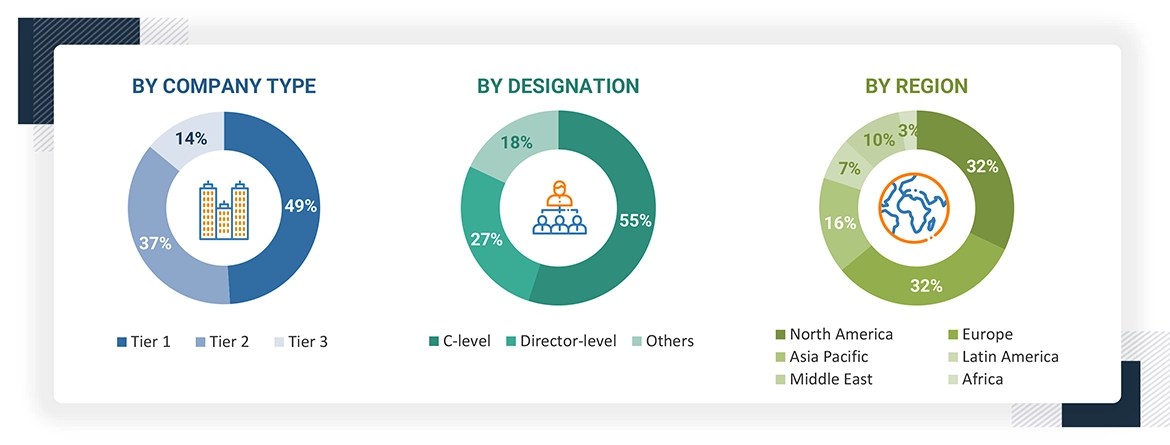
In the primary research process, various sources from the supply and demand sides were interviewed to obtain qualitative and quantitative information on the market. The primary sources from the supply side included industry experts such as chief X officers (CXOs), vice presidents (VPs), directors, regional managers, and business development and product development teams, distributors, and vendors.
Extensive primary research was conducted after obtaining information about the current scenario of the ammunition market through secondary research. Several primary interviews were conducted with market experts from both demand and supply sides across major countries of North America, Europe, Asia Pacific, the Middle East, Latin America, and Africa. This primary data was collected through questionnaires, emails, and telephonic interviews.
To know about the assumptions considered for the study, download the pdf brochure
Market Size Estimation
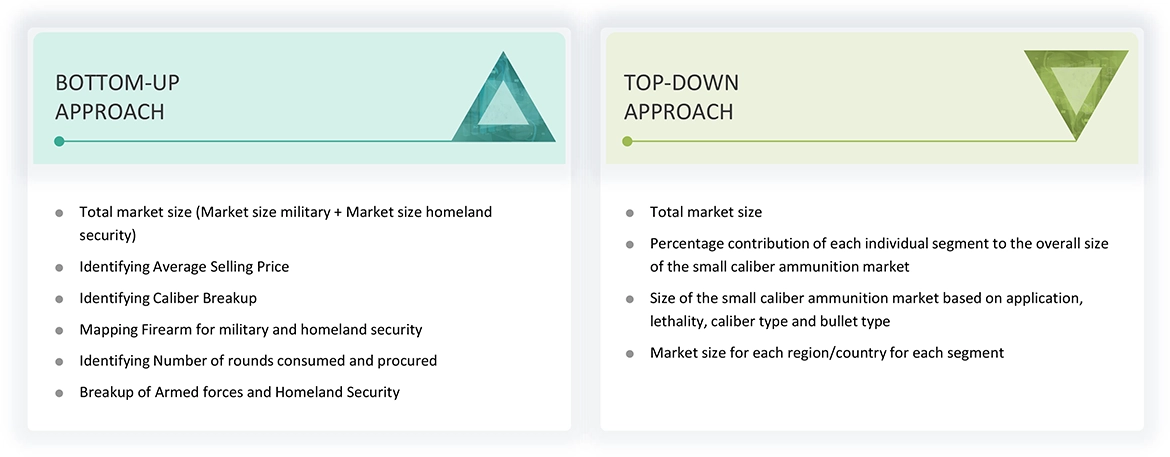
Both top-down and bottom-up approaches were used to estimate and validate the size of the small caliber ammunition market. The research methodology used to estimate the market size included the following details:
- Key players in the small caliber ammunition market were identified through secondary research, and their market share was determined through primary and secondary research. This included the study of annual and financial reports of top market players and extensive interviews of leaders such as Chief Executive Officers (CEOs), directors, and marketing executives of leading companies operating in the ammunition market.
- All percentage shares, splits, and breakdowns were determined using secondary sources and verified through primary sources.
- All possible parameters that affect the markets covered in this research study were accounted for, viewed in extensive detail, verified through primary research, and analyzed to obtain the final quantitative and qualitative data on the small caliber ammunition market. This data was consolidated, enhanced with detailed inputs, analyzed by MarketsandMarkets, and presented in this report.
Data Triangulation
After arriving at the overall size of the small caliber ammunition market from the market size estimation process explained above, the total market was split into several segments and subsegments. The data triangulation and market breakdown procedures explained below were implemented wherever applicable to complete the overall market engineering process and arrive at the exact statistics for various market segments and subsegments.
The data was triangulated by studying various factors and trends from both the demand and supply sides. Along with this, the market size was validated using both top-down and bottom-up approaches. The following figure indicates the market breakdown structure and data triangulation procedure that was implemented in the market engineering process to make this report on the small caliber ammunition market.
Market Definition
Ammunition (informally known as ‘ammo’) is the material fired, scattered, dropped, or detonated from a weapon. Small arms ammunition is primarily cartridge-based. Described in military terms as a 'round' of ammunition, it comprises a cartridge case, bullet, propellant, and primer. Ammunition is available in a range of sizes and types and is often designed to work only in specific weapon systems. Small caliber ammunition is ammunition of .50 caliber and below and varies in size or caliber. Contemporary military ammunition follows standards originally set by NATO or the former Warsaw Pact. This study focuses on small caliber ammunition such as 4.6x30mm, 9x19mm Parabellum, 5.56x45mm, 7.62x51mm, 12.7x99mm, .223 Remington, .300 Winchester Magnum, .308 Winchester, .338 Lapua Magnum, .338 Norma Magnum, and .50 BMG.
Small caliber ammunition refers to rounds that are typically used in handheld small arms and light weapons including diameters up to 14.5mm. This category includes various types such as rimfire and centerfire cartridges, which are used in a wide array of applications from civilian sport shooting and hunting to military and law enforcement operations. The market includes the production, distribution, and technological development of the small caliber ammunition types, focusing on advancements in bullet design, accuracy, and materials to meet specific user requirements while adhering to regulatory standards
Key Stakeholders
- Armed Forces
- Defense Regulatory Bodies
- Law Enforcement Agencies
- Home Ministries/Ministries of Interior
- Ammunition Manufacturers
- Component Manufacturers
- Distributors and Suppliers
- Research Organizations, Forums, Alliances, and Associations
Report Objectives
- To define, describe, segment, and forecast the size of the small caliber ammunition market based on application, caliber type, bullet type, lethality, and region
- To forecast the size of different segments of the market with respect to various regions, including North America, Europe, Asia Pacific, Middle East, Latin America and Africa along with key countries in each of these regions
- To identify and analyze key drivers, opportunities, and challenges influencing the growth of the market
- To identify technology trends that are currently prevailing in the small caliber ammunition market
- To provide an overview of the regulatory landscape with respect to ammunition regulations across regions
- To analyze micromarkets1 with respect to individual growth trends, prospects, and their contribution to the overall market
- To analyze opportunities in the market for stakeholders by identifying key market trends
- To profile key market players and comprehensively analyze their market share and core competencies2
- To analyze the degree of competition in the market by identifying key growth strategies, such as acquisitions, new product launches, new service launches, contracts, and partnerships, adopted by leading market players
- To identify detailed financial positions, key products, and unique selling points of leading companies in the market
- To provide a detailed competitive landscape of the small caliber ammunition market, along with a ranking analysis, market share analysis, and revenue analysis of key players
Available customizations
Along with the market data, MarketsandMarkets offers customizations as per the specific needs of companies. The following customization options are available for the report:
Product Analysis
- Product matrix, which gives a detailed comparison of the product portfolio of each company
Regional Analysis
- Further breakdown of the market segments at country-level
Company Information
- Detailed analysis and profiling of additional market players (up to 5)
Get the Full Small Caliber Ammunition Market Report
Full forecast, segment splits, and company analysis for all Small Caliber Ammunition Market.
- Argentina Small Caliber Ammunition Market
- Saudi Arabia Small Caliber Ammunition Market
- UAE Small Caliber Ammunition Market
- Kuwait Small Caliber Ammunition Market
- Israel Small Caliber Ammunition Market
- Turkey Small Caliber Ammunition Market
- Jordan Small Caliber Ammunition Market
- South Africa Small Caliber Ammunition Market
- Egypt Small Caliber Ammunition Market
- Algeria Small Caliber Ammunition Market
- US Small Caliber Ammunition Market
- Canada Small Caliber Ammunition Market
- UK Small Caliber Ammunition Market
- France Small Caliber Ammunition Market
- Germany Small Caliber Ammunition Market
- Italy Small Caliber Ammunition Market
- Spain Small Caliber Ammunition Market
- Russia Small Caliber Ammunition Market
- Poland Small Caliber Ammunition Market
- Denmark Small Caliber Ammunition Market
- Norway Small Caliber Ammunition Market
- Sweden Small Caliber Ammunition Market
- China Small Caliber Ammunition Market
- India Small Caliber Ammunition Market
- Japan Small Caliber Ammunition Market
- South Korea Small Caliber Ammunition Market
- Australia Small Caliber Ammunition Market
- Singapore Small Caliber Ammunition Market
- Indonesia Small Caliber Ammunition Market
- Malaysia Small Caliber Ammunition Market
- New Zealand Small Caliber Ammunition Market
- Philippines Small Caliber Ammunition Market
- Taiwan Small Caliber Ammunition Market
- Brazil Small Caliber Ammunition Market
- Mexico Small Caliber Ammunition Market
Need a Tailored Report?
Customize this report to your needs
Get 10% FREE Customization
Customize This Report
