
Germany Smart Infrastructure Market (2024-2029)

The Germany Smart Infrastructure Market was valued at $64260 Million in 2024 and projected to reach to $140780 Million by 2029, representing a compound annual growth rate of 17.0%. Germany's smart infrastructure market is positioned for sustained growth as the nation accelerates its digital transformation agenda and Industrie 4.0 initiatives.


| Market Size in | USD 26.32 MN |
| Market Forecast in | |
| CAGR | |
| Forecast Period | |
| Units Considered | Value (USD MN) |
Germany Smart Infrastructure Market Trends and Insights
- Germany's position as Europe's leading industrial economy drives significant investment in digital transformation, IoT integration, and intelligent city solutions across utilities, transportation, and public services.
- The country's strong manufacturing base and commitment to Industry 4.0 initiatives position Germany as a key hub for smart infrastructure innovation and deployment. Driven by regulatory frameworks supporting sustainability and digital modernization, Germany is accelerating adoption of connected devices, data analytics platforms, and automation technologies throughout its infrastructure ecosystem.
- Between 2024 and 2029, Germany's market expansion reflects increasing demand for smart grid solutions, intelligent traffic management systems, and integrated urban mobility platforms.
- Germany's emphasis on energy efficiency and carbon neutrality further catalyzes investment in smart infrastructure technologies that optimize resource consumption and enhance operational resilience across critical sectors..
Key Market Statistics
- CAGR (2024-2029) 17.0% CAGR
- Market Size, 2024 ~USD 64260 Million
- Forecast, 2029 ~USD 140780 Million
- Country Germany
Germany Smart Infrastructure Market Overview
Market Valuation :
Germany's smart infrastructure market reached $64.26 billion in 2024, with projections to exceed $140.78 billion by 2029, driven by industrial digitalization and government smart city initiatives.
Industrial Leadership :
As Europe's largest industrial economy, Germany leads in IoT adoption, Industry 4.0 implementations, and intelligent infrastructure solutions across manufacturing, utilities, and transportation sectors.
Growth Trajectory :
The German market demonstrates a 17% CAGR through 2029, slightly below the global average of 18%, reflecting mature market dynamics and high baseline investments in digital infrastructure.
Key Investment Areas :
Primary growth drivers include smart grid modernization, connected transportation systems, intelligent building management, and IoT-enabled utility networks across Germany's industrial heartland.
Germany Smart Infrastructure Market Dynamics
- Government support through funding programs and regulatory frameworks promoting energy efficiency and smart city development will continue to drive market expansion.
- The country's strong manufacturing base and technological expertise create significant opportunities for IoT solutions, smart grid technologies, and intelligent transportation systems. Key growth catalysts include Germany's commitment to renewable energy integration, urban digitalization projects in major cities, and increasing demand for real-time infrastructure monitoring.
- Investment in 5G networks and edge computing infrastructure will further enable smart infrastructure deployment.
- However, market maturity and high implementation costs may moderate growth rates compared to emerging markets, positioning Germany as a quality-focused, innovation-driven segment within Europe's smart infrastructure landscape..
Market Ecosystem
Related Ecosystem
Software And Services
- Natural Language Processing (NLP)
- Machine Learning
- Supply Chain Management
- Predictive Analytics
- Image Sensors
- International Business Machines Corporation
- MICROSOFT CORPORATION
- Oracle Corporation
- SAP SE
- Amazon.com, Inc.
Aviation
- Narrow Body Aircraft
- Wide Body Aircraft
- Military Helicopters
- Special Mission Aircraft
- Fighter Aircraft
- HONEYWELL INTERNATIONAL INC.
- COLLINS AEROSPACE
- Thales group
- Safran group
- HEICO Corporation
Digitalization And Iot
- Sensors
- Remote Monitoring
- Supply Chain Management
- Passenger Information System (PIS)
- Platform as A Service (PaaS)
- International Business Machines Corporation
- Cisco Systems, Inc.
- MICROSOFT CORPORATION
- Oracle Corporation
- HUAWEI TECHNOLOGIES CO LTD
Key Takeaways
- Germany's smart infrastructure market will nearly double from $64.26B (2024) to $140.78B (2029) at a 17.0% CAGR.
- Germany's industrial leadership and Industry 4.0 commitment drive accelerated adoption of IoT and automation technologies.
- Regulatory support for sustainability and digital transformation in Germany fuels investment in smart grid and intelligent city solutions.
- Germany's focus on energy efficiency and carbon neutrality positions smart infrastructure as critical to achieving climate objectives.
Smart Infrastructure Market Report Scope
| Report Metric | Details |
|---|---|
| Base Year | 2024 |
| Fastest Growing Segment | SMART HEALTHCARE (Type) |
| Forecast Period | 2024-2029 |
| Growth Rate | CAGR of 18% from 2024 to 2029 |
| Largest Segment | HARDWARE (Offering) |
| Market Size Base Year (Billions) | ~USD 922.08 (2024) |
| Revenue Forecast (Billions) | ~USD 2109.5 (2029) |
| Segments Covered | Offering, Service, Professional Service, Focus Area, End User, Type, Transportation Mode |
Germany Smart Infrastructure Market Report Segmentation
7 segment dimensions are covered across the global market.
By Offering
- Hardware
- Services
- Software
By Service
- Managed Services
- Professional Services
By Professional Service
- Consulting & Implementation
- Support & Maintenance
- Training & Education
By Focus Area
- Other Focus Areas
- Smart Agriculture
- Smart Buildings
- Smart Citizen Services
- Smart Government
- Smart Healthcare
- Smart Hospitality
- Smart Manufacturing
- Smart Transportation
- Smart Utilities
By End User
- Commercial
- Government & Defense
- Industrial
- Residential
By Type
- Egovernance
- Services
- Smart Education
- Smart Healthcare
- Smart Public Safety
- Smart Street Lighting
- Solutions
By Transportation Mode
- Airway
- Maritime
- Railway
- Roadway
Target Audience
- Technology Solution Providers : IoT, smart grid, and intelligent infrastructure vendors need Germany-specific market data to develop localized go-to-market strategies and identify high-potential customer segments in Europe's largest industrial market.
- Infrastructure & Utilities Companies : German and European utilities, transportation operators, and infrastructure managers require detailed market insights to guide digital transformation investments and competitive positioning in smart infrastructure deployment.
- Investment & Private Equity Firms : Investors evaluating opportunities in German smart infrastructure need comprehensive market sizing, growth forecasts, and sector analysis to support due diligence and portfolio strategy decisions.
- Government & Policy Makers : German federal and municipal authorities benefit from market intelligence to inform smart city initiatives, infrastructure modernization programs, and digital economy policy development.
- Management Consultants & Analysts : Strategy consultants and research firms require Germany-specific market data and forecasts to support client advisory work, competitive analysis, and industry benchmarking across smart infrastructure sectors.
Reasons to Buy this Report
- Market Size & Growth Data : Access precise valuation metrics for Germany's $64.26B market with detailed 2024-2029 forecasts, enabling accurate investment planning and competitive positioning in Europe's largest industrial economy.
- Sector-Specific Insights : Gain deep understanding of smart infrastructure adoption across German utilities, transportation, manufacturing, and smart city initiatives with localized trend analysis and opportunity identification.
- Competitive Intelligence : Benchmark against German market leaders and understand regional competitive dynamics, technology preferences, and vendor strategies specific to the German smart infrastructure ecosystem.
- Investment Decision Support : Leverage comprehensive market analysis to support M&A decisions, market entry strategies, and capital allocation for businesses targeting Germany's high-value smart infrastructure segment.
- Regulatory & Policy Context : Understand Germany-specific regulatory frameworks, government incentives, and policy drivers shaping smart infrastructure investments in energy, transportation, and urban development sectors.
Frequently asked questions
What is the current size of Germany's smart infrastructure market?
Germany's smart infrastructure market was valued at $64.26 billion in 2024 and is projected to grow to $140.78 billion by 2029.
What is the expected growth rate for Germany's smart infrastructure market?
Germany's smart infrastructure market is expected to grow at a compound annual growth rate (CAGR) of 17.0% from 2024 to 2029.
What are the primary drivers of smart infrastructure adoption in Germany?
Germany's adoption is driven by Industry 4.0 initiatives, regulatory frameworks supporting sustainability, digital transformation mandates, and the country's commitment to carbon neutrality and energy efficiency.
Which sectors are leading smart infrastructure investment in Germany?
Key sectors include utilities (smart grids), transportation (intelligent traffic management), public services, and manufacturing, all supported by Germany's industrial and digital modernization priorities.
How does Germany's smart infrastructure market compare to Europe?
Germany represents Europe's largest smart infrastructure market, leveraging its position as the continent's leading industrial economy and its advanced digital infrastructure capabilities.
RESEARCH METHODOLOGY
The study involved four major activities in estimating the current size of the global smart infrastructure market. Exhaustive secondary research was done to collect information on the market, peer market, and parent market. The next step was to validate these findings, assumptions, and sizing with industry experts across the value chain through primary research. Both top-down and bottom-up approaches were employed to estimate the total smart infrastructure market size. After that, the market breakup and data triangulation techniques were used to estimate the market size of segments and subsegments.
Secondary Research
Various secondary sources, such as Bloomberg and BusinessWeek, were referred to in the secondary research process to identify and collect information for this study. The secondary sources included company annual reports, press releases, and investor presentations; white papers; journals, such as Linux Journal and Container Journal; and articles from recognized authors, directories, and databases.
Primary Research
Various primary sources from supply and demand sides were interviewed to obtain qualitative and quantitative information for this report. The primary sources from the supply side included industry experts, such as Chief Executive Officers (CEOs), Chief Marketing Officers (CMO), Vice Presidents (VPs), Managing Directors (MDs), technology and innovation directors, and related key executives from various key companies and organizations operating in the smart infrastructure market along with the associated service providers, and system integrators operating in the targeted regions. All possible parameters that affect the market covered in this research study have been accounted for, viewed in extensive detail, verified through primary research, and analyzed to get the final quantitative and qualitative data. Following is the breakup of primary respondents.
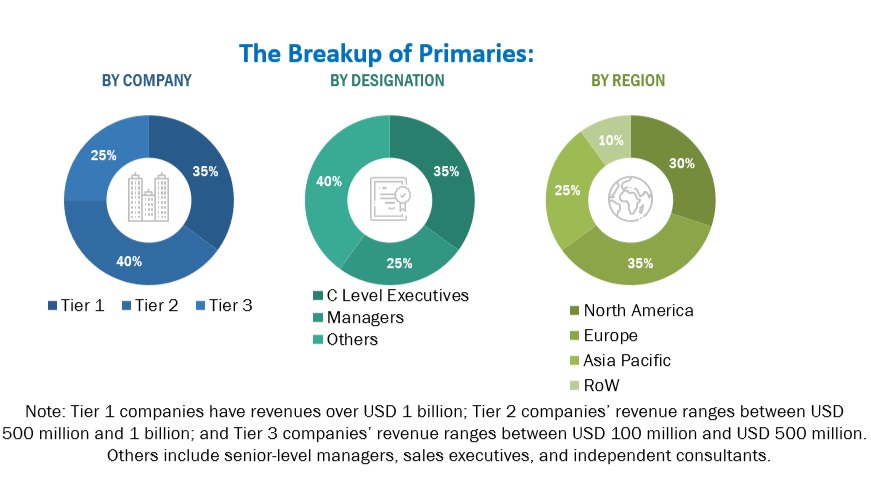
To know about the assumptions considered for the study, download the pdf brochure
|
Company Name |
Designation |
|
Siemens |
Senior Manager |
|
Sense |
VP |
|
Hitachi |
Business Executive |
Market Size Estimation
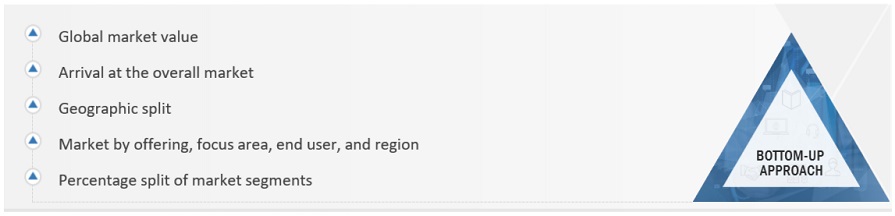
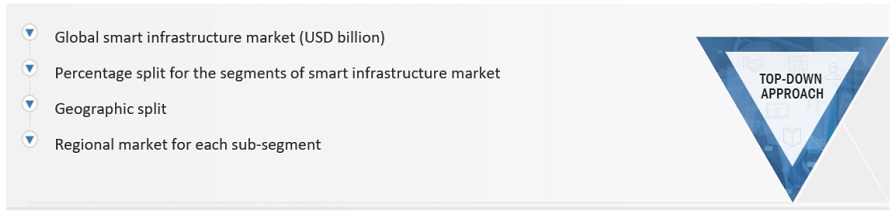
The top-down and bottom-up approaches were used to make market estimates and forecast the smart infrastructure market and other dependent submarkets. The bottom-up procedure was used to arrive at the overall market size of the global smart infrastructure market using key companies’ revenue and their offerings in the market. The research methodology used to estimate the market size includes the following:
- The key players in the Smart Infrastructure Market have been identified through extensive secondary research.
- The market size, in terms of value, has been determined through primary and secondary research processes.
- All percentage shares, splits, and breakups have been determined using secondary sources and verified through primary sources.
Smart Infrastructure Market Size: Bottom-Up Approach
To know about the assumptions considered for the study, Request for Free Sample Report
Smart infrastructure market Size: Top-Down Approach
Data Triangulation
This study determined and confirmed the exact value of the overall parent market size through data triangulation and validation through primary interviews. The overall market size was then used in the top-down procedure to estimate the size of other individual markets via percentage splits of the market segmentation.
Market Definition
Smart infrastructure encompasses advanced technologies and solutions designed to improve the efficiency, sustainability, and functionality of infrastructure systems. These systems include transportation, buildings, energy, water, waste management, public services, etc. Smart infrastructure integrates various digital technologies, such as IoT (Internet of Things), AI (Artificial Intelligence), big data analytics, and cloud computing, among others, to create interconnected, intelligent systems that enhance the quality of life, economic efficiency, and environmental sustainability.
Key Stakeholders
- Network infrastructure enablers
- Technology vendors
- Real-estate Developers
- Telecom Service Providers (TSPs)
- Communication Service Providers (CSPs)
- System Integrators (SIs)
- Platform Providers
- Compliance regulatory authorities
- Government authorities
- Investment firms
- Independent Software Vendors (ISVs)
- Smart Infrastructure Alliances/Groups
- Utility Companies
- Transportation Service Providers
Report Objectives
- To determine, segment, and forecast the global smart infrastructure market based on offering, focus area, end user, and region in terms of value.
- To forecast the size of the market segments to five main regions: North America, Europe, Asia Pacific, Middle East & Africa, and Latin America.
- To provide detailed information about the major factors (drivers, opportunities, threats, and challenges) influencing the growth of the smart infrastructure market.
- To study the complete value chain and related industry segments and perform a value chain analysis of the smart infrastructure market landscape.
- To strategically analyze the macro and micro markets to individual growth trends, prospects, and contributions to the total smart infrastructure market.
- To analyze the industry trends, patents, and innovations related to the smart infrastructure market.
- To analyze the opportunities for stakeholders by identifying the high-growth segments of the smart infrastructure market.
- To profile the key players in the market and comprehensively analyze their market share/ranking and core competencies.
- To track and analyze competitive developments, such as mergers & acquisitions, product launches & developments, partnerships, agreements, collaborations, business expansions, and Research & Development (R&D) activities.
Available Customizations
With the given market data, MarketsandMarkets offers customizations as per the company’s specific needs. The following customization options are available for the report:
Company Information
- Detailed analysis and profiling of an additional two market players
Get the Full Smart Infrastructure Market Report
Full forecast, segment splits, and company analysis for all Smart Infrastructure Market.
- Canada Smart Infrastructure Market
- US Smart Infrastructure Market
- UK Smart Infrastructure Market
- China Smart Infrastructure Market
- Japan Smart Infrastructure Market
- India Smart Infrastructure Market
- UAE Smart Infrastructure Market
- Brazil Smart Infrastructure Market
- France Smart Infrastructure Market
- Italy Smart Infrastructure Market
- Rest Of Europe Smart Infrastructure Market
- Rest Of Asia Pacific Smart Infrastructure Market
- Mexico Smart Infrastructure Market
- Rest Of Latin America Smart Infrastructure Market
- Ksa Smart Infrastructure Market
- Rest Of GCC Countries Smart Infrastructure Market
Need a Tailored Report?
Customize this report to your needs
Get 10% FREE Customization
Customize This Report
