
Latin America Smart Infrastructure Market (2024-2029)

The Latin America Smart Infrastructure Market was valued at $39390 Million in 2024 and projected to reach to $89200 Million by 2029, representing a compound annual growth rate of 17.8%. Latin America's smart infrastructure market is positioned for sustained growth as governments prioritize digital transformation and sustainable urban development.


| Market Size in | USD 26.32 MN |
| Market Forecast in | |
| CAGR | |
| Forecast Period | |
| Units Considered | Value (USD MN) |
Latin America Smart Infrastructure Market Trends and Insights
- This 17.8% compound annual growth rate reflects Latin America's accelerating digital transformation across urban planning, energy management, and transportation systems.
- Latin America is increasingly adopting IoT, cloud computing, and AI-driven solutions to modernize aging infrastructure and address urbanization challenges. The growth trajectory in Latin America is driven by government initiatives promoting smart city development, rising private sector investment, and growing demand for sustainable infrastructure solutions.
- Latin America's expanding middle class and digital connectivity are creating favorable conditions for smart infrastructure deployment.
- By 2029, Latin America is expected to emerge as a significant regional hub for intelligent infrastructure technologies, with particular momentum in Brazil, Mexico, and Colombia..
Key Market Statistics
- CAGR (2024-2029) 17.8% CAGR
- Market Size, 2024 ~USD 39390 Million
- Forecast, 2029 ~USD 89200 Million
- Geography Latin America
Latin America Smart Infrastructure Market Overview
Rapid Market Expansion :
Latin America's smart infrastructure market is growing at 17.8% CAGR, reaching $89.2 billion by 2029 from $39.4 billion in 2024, driven by urbanization and digital transformation initiatives across the region.
IoT & AI Integration :
Latin American cities are increasingly deploying IoT sensors, cloud computing, and AI-driven solutions for real-time monitoring and optimization of urban infrastructure, energy grids, and transportation networks.
Brazil's Market Leadership :
Brazil dominates Latin America's smart infrastructure sector with $41.9 billion in market value, leveraging its large population and economic scale to drive adoption of intelligent city solutions.
Government & Private Investment :
Rising government initiatives for smart city development and increased private sector participation in infrastructure modernization are accelerating technology adoption across Latin American nations.
Latin America Smart Infrastructure Market Dynamics
- The region's expanding middle class, coupled with increasing urbanization pressures, creates strong demand for intelligent solutions in energy management, water systems, and public transportation.
- Investment in 5G connectivity and cloud infrastructure is enabling deployment of advanced monitoring and analytics capabilities. Key growth drivers include regulatory support for green infrastructure, rising energy efficiency requirements, and private sector innovation in smart city technologies.
- Mexico and Brazil are leading adoption, while emerging markets across Central and South America present significant expansion opportunities.
- The convergence of IoT, AI, and edge computing will unlock new use cases in predictive maintenance and resource optimization throughout the region..
Market Ecosystem
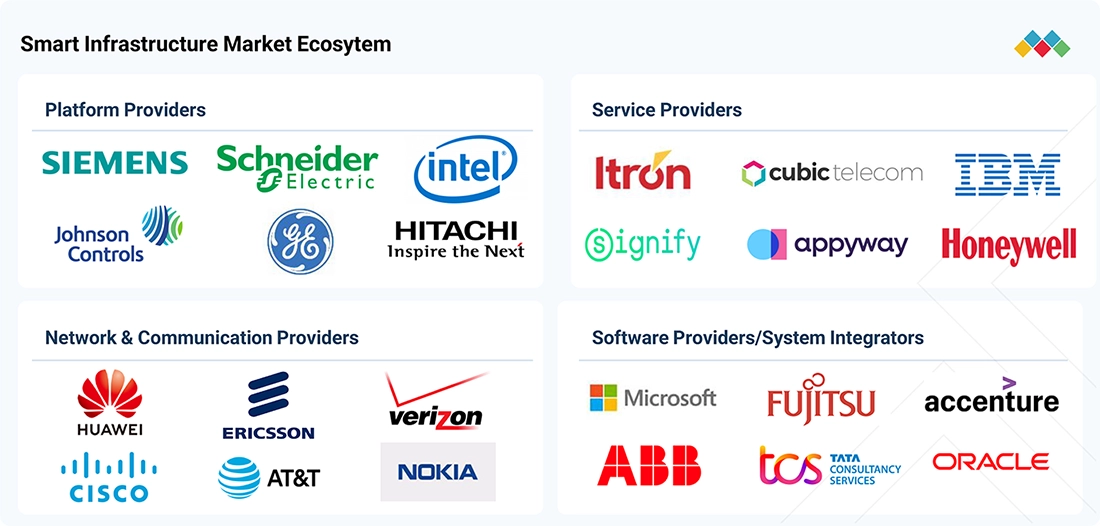
SMART INFRASTRUCTURE MARKET: COMMERCIAL USE CASES ACROSS INDUSTRIES
| COMPANY | USE CASE DESCRIPTION | BENEFITS |
|---|---|---|
 |
Hurlburt Field Air Base, US: Schneider Electric modernized energy infrastructure across more than 300 facilities, integrating solar generation, battery storage, microgrid controls, and energy-efficiency improvements to strengthen grid stability and mission-critical power resilience. | The project was expected to reduce energy costs by 17.7%, generating approximately USD 1.5 million in annual savings over the 22-year contract term | The energy savings performance contract was valued at USD 22.6 million. |
 |
Stonehouse Manufacturing Facility, UK: ABB deployed its ABB Ability Building Analyzer platform to monitor and analyze electricity, gas, and water consumption | The solution uses connected meters and data analytics to identify energy-saving opportunities across the facility. | ABB set a target to improve energy efficiency by 20% against a 2019 baseline | The company reported that actions identified through initial analysis were expected to save 20% of electricity usage in the first year. |
 |
Madrid City Council, Spain: IBM Maximo Application Suite supports MiNT, Madrid’s integrated urban services platform, by unifying asset inventories, maintenance workflows, inspections, and service-provider performance data across city infrastructure. | The platform supports a unified inventory of nearly 5 million assets, processes approximately 2.5 million work orders annually, and enables around 70,000 automated inspections each month, improving infrastructure visibility, maintenance coordination, and service accountability. |
Logos and trademarks shown above are the property of their respective owners. Their use here is for informational and illustrative purposes only.
Related Ecosystem
Software And Services
- Natural Language Processing (NLP)
- Machine Learning
- Supply Chain Management
- Predictive Analytics
- Image Sensors
- International Business Machines Corporation
- MICROSOFT CORPORATION
- Oracle Corporation
- SAP SE
- Amazon.com, Inc.
Aviation
- Narrow Body Aircraft
- Wide Body Aircraft
- Military Helicopters
- Special Mission Aircraft
- Fighter Aircraft
- HONEYWELL INTERNATIONAL INC.
- COLLINS AEROSPACE
- Thales group
- Safran group
- HEICO Corporation
Digitalization And Iot
- Sensors
- Remote Monitoring
- Supply Chain Management
- Passenger Information System (PIS)
- Platform as A Service (PaaS)
- International Business Machines Corporation
- Cisco Systems, Inc.
- MICROSOFT CORPORATION
- Oracle Corporation
- HUAWEI TECHNOLOGIES CO LTD
Key Takeaways
- Latin America's smart infrastructure market will more than double from $39.4B (2024) to $89.2B (2029), representing a 17.8% CAGR.
- Latin America is prioritizing smart city initiatives and sustainable infrastructure to address rapid urbanization and aging systems.
- Latin America's digital transformation is accelerated by government policy support and increasing private sector investment in IoT and AI technologies.
- Latin America's key markets-Brazil, Mexico, and Colombia-are leading regional adoption of intelligent infrastructure solutions.
Smart Infrastructure Market Report Scope
| Report Metric | Details |
|---|---|
| Base Year | 2024 |
| Fastest Growing Segment | SMART HEALTHCARE (Type) |
| Forecast Period | 2024-2029 |
| Growth Rate | CAGR of 18% from 2024 to 2029 |
| Largest Segment | HARDWARE (Offering) |
| Market Size Base Year (Billions) | ~USD 922.08 (2024) |
| Revenue Forecast (Billions) | ~USD 2109.5 (2029) |
| Segments Covered | Offering, Service, Professional Service, Focus Area, End User, Type, Transportation Mode |
Latin America Smart Infrastructure Market Report Segmentation
7 segment dimensions are covered across the global market.
By Offering
- Hardware
- Services
- Software
By Service
- Managed Services
- Professional Services
By Professional Service
- Consulting & Implementation
- Support & Maintenance
- Training & Education
By Focus Area
- Other Focus Areas
- Smart Agriculture
- Smart Buildings
- Smart Citizen Services
- Smart Government
- Smart Healthcare
- Smart Hospitality
- Smart Manufacturing
- Smart Transportation
- Smart Utilities
By End User
- Commercial
- Government & Defense
- Industrial
- Residential
By Type
- Egovernance
- Services
- Smart Education
- Smart Healthcare
- Smart Public Safety
- Smart Street Lighting
- Solutions
By Transportation Mode
- Airway
- Maritime
- Railway
- Roadway
Target Audience
- Infrastructure Technology Vendors : Smart infrastructure solution providers need Latin America market data to develop region-specific strategies, identify high-potential countries like Brazil and Mexico, and tailor offerings to local regulatory requirements.
- Government & Municipal Planners : City administrators and government agencies require market intelligence to justify smart infrastructure investments, benchmark against peer cities, and align budgets with regional growth trends.
- Private Equity & Investment Firms : Investors seeking exposure to Latin America's digital transformation need detailed market sizing, growth forecasts, and competitive dynamics to evaluate acquisition targets and fund allocation decisions.
- Telecommunications & Utility Companies : Telecom operators and energy utilities expanding into smart infrastructure services require market data to assess revenue opportunities, competitive positioning, and technology investment priorities in Latin America.
- Consulting & Systems Integrators : Professional services firms advising on smart city implementations need comprehensive market research to support client proposals, validate business cases, and identify emerging opportunities across Latin American markets.
Countries within Latin America - compare and drill down
| Country | 2025 size (native) |
|---|---|
| Brazil | USD 41900 Million |
| Mexico | USD 28100 Million |
| Rest Of Latin America | USD 19200 Million |
Country market size visualization
Reasons to Buy this Report
- Regional Market Sizing & Forecasts : Obtain precise market valuations for Latin America ($39.4B in 2024) and country-level breakdowns including Brazil and Mexico, with detailed 5-year projections to 2029.
- Growth Driver Analysis : Understand the specific factors accelerating 17.8% CAGR in Latin America, including urbanization trends, government policies, and private investment patterns unique to the region.
- Competitive Landscape Insights : Identify leading technology providers, infrastructure operators, and solution vendors capturing market share across Latin American smart infrastructure segments.
- Investment Opportunity Assessment : Evaluate emerging markets and high-growth segments within Latin America to identify optimal entry points and partnership opportunities for expansion strategies.
- Technology Adoption Trends : Analyze deployment patterns of IoT, AI, cloud computing, and 5G infrastructure across Latin American cities to benchmark against global best practices and identify gaps.
Frequently asked questions
What is the current size of Latin America's smart infrastructure market?
Latin America's smart infrastructure market was valued at $39.4 billion in 2024 and is expected to grow to $89.2 billion by 2029.
What is the projected growth rate for smart infrastructure in Latin America?
Latin America's smart infrastructure market is projected to grow at a compound annual growth rate (CAGR) of 17.8% from 2024 to 2029.
Which countries are driving smart infrastructure adoption in Latin America?
Brazil, Mexico, and Colombia are the primary drivers of smart infrastructure adoption in Latin America, supported by government initiatives and private investment.
What technologies are being deployed in Latin America's smart infrastructure?
Latin America is deploying IoT sensors, cloud computing platforms, artificial intelligence, and data analytics to modernize urban planning, energy management, and transportation systems.
What factors are accelerating smart infrastructure growth in Latin America?
Latin America's growth is driven by urbanization pressures, government smart city policies, rising digital connectivity, sustainability demands, and increasing private sector investment.
RESEARCH METHODOLOGY
The research study involved four major activities to estimate the smart infrastructure market size. Extensive secondary research was conducted to collect relevant information about the smart infrastructure market and related technologies. The findings and assumptions were subsequently validated through primary research with industry experts across the smart infrastructure value chain. Top-down and bottom-up approaches were used to estimate the market size, followed by data triangulation to validate the estimates and determine the sizes of individual segments and subsegments.
Secondary Research
The market size of companies offering smart infrastructure solutions and services to various end users was determined using secondary data from paid and publicly available sources. The research involved analyzing product portfolios, service offerings, geographical presence, and competitive positioning of major market participants. The study consulted various sources to identify and collect relevant information, including company annual reports, official websites, press releases, investor presentations, product announcements, white papers, industry publications, certified reports, and publications from recognized industry associations, regulatory bodies, and government agencies. Particular attention was given to smart building management, intelligent transportation, connected utilities, infrastructure automation, predictive maintenance, IoT-enabled monitoring, digital twins, AI-powered analytics, and infrastructure sustainability.
Secondary research was primarily used to obtain critical information about industry trends, market drivers and restraints, the market value chain, the competitive landscape, and the overall pool of key players. It also supported market classification and segmentation by offering, focus area, end user, and region, along with the identification of key developments, including product launches, technological advancements, strategic partnerships, mergers and acquisitions, and investments in the smart infrastructure market.
Primary Research
In the primary research process, various stakeholders from the supply and demand sides of the smart infrastructure market were considered to obtain qualitative and quantitative information for the report. These included Chief Executive Officers (CEOs), Chief Technology Officers (CTOs), Chief Information Officers (CIOs), Vice Presidents (VPs), and directors from business development, marketing, product development, and innovation teams, along with key executives from AI solution providers, energy utilities, power generation companies, renewable energy developers, grid operators, system integrators, cloud service providers, consulting firms, industry associations, independent consultants, and key opinion leaders.
Primary interviews were conducted to gather insights, including market statistics; revenue data from platforms and services; market breakdowns; market size estimates; market forecasts; and data triangulation. Stakeholders from the demand side, such as Chief Information Officers (CIOs), Chief Financial Officers (CFOs), Chief Strategy Officers (CSOs), and the installation team of end users who use smart infrastructure solutions, were interviewed to understand buyers’ perspectives on suppliers, products, service providers, and their use of smart infrastructure solutions, which is expected to affect the overall smart infrastructure market growth.
Breakup of Primary Profiles:
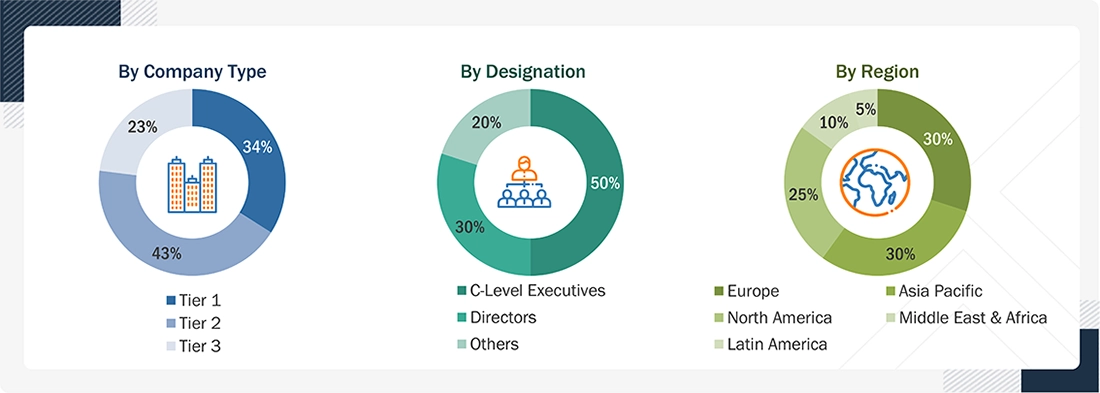
Note 1: Tier 1 companies have revenues over USD 1 billion, Tier 2 companies have revenues between USD 500 million and 1 billion, and Tier 3 companies have revenues less than USD 500 million.
Note 2: Other designations include sales, marketing, and product managers.
Source: Industry Experts
To know about the assumptions considered for the study, download the pdf brochure
Market Size Estimation
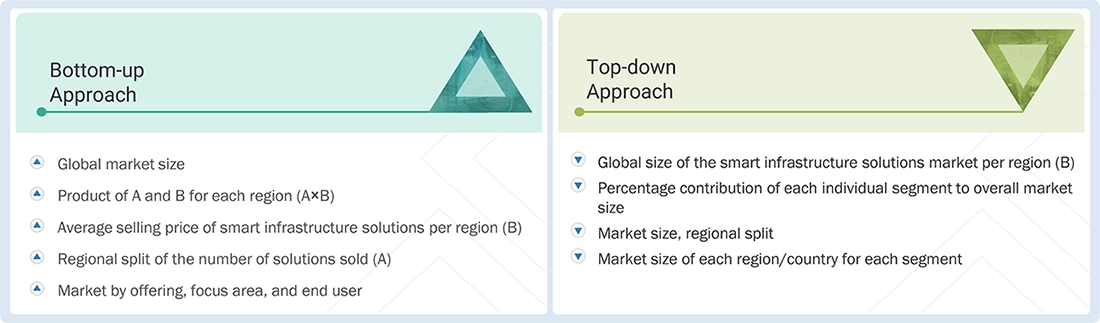
Both top-down and bottom-up approaches were used to estimate and validate the total size of the smart infrastructure market. These methods were also used extensively to estimate the size of various market subsegments.
Smart Infrastructure Market: Top-Down and Bottom-Up Approach
Data Triangulation
The smart infrastructure market was split into several segments and subsegments after determining the overall market size from the above estimation process. To complete the overall market engineering process and arrive at the exact statistics for all segments and subsegments, data triangulation and market breakdown procedures were used, wherever applicable. The data was triangulated by analyzing factors and trends from the demand and supply sides. The smart infrastructure market size was validated using top-down and bottom-up approaches.
Market Definition
Smart infrastructure encompasses advanced technologies and solutions designed to improve the efficiency, sustainability, and functionality of infrastructure systems. These systems include transportation, buildings, energy, water, waste management, and public services. Smart infrastructure integrates digital technologies such as the Internet of Things (IoT), Artificial Intelligence (AI), big data analytics, and cloud computing to create interconnected, intelligent systems that improve quality of life, economic efficiency, and environmental sustainability.
Key Stakeholders
- Network infrastructure enablers
- Technology vendors
- Real-estate developers
- Telecom service providers (TSPs)
- Communication service providers (CSPs)
- System integrators (SIs)
- Platform providers
- Compliance regulatory authorities
- Government authorities
- Investment firms
- Independent software vendors (ISVs)
- Smart infrastructure alliances/groups
- Utility companies
- Transportation service providers
Report Objectives
- To determine, segment, and forecast the global smart infrastructure market by offering, focus area, end user, and region, in terms of value
- To forecast the size of the market segments in five main regions: North America, Europe, Asia Pacific, the Middle East & Africa, and Latin America
- To provide detailed information on the major factors (drivers, opportunities, threats, and challenges) influencing smart infrastructure market growth
- To study the complete value chain and related industry segments and perform a value chain analysis of the smart infrastructure market landscape
- To strategically analyze the macro- and micromarkets for individual growth trends, prospects, and contributions to the total smart infrastructure market
- To analyze industry trends, patents, and innovations in the smart infrastructure market
- To analyze stakeholder opportunities by identifying high-growth segments of the smart infrastructure market
- To profile the key players in the market and comprehensively analyze their market share/ranking and core competencies
- To track and analyze competitive developments, such as mergers & acquisitions, product launches & developments, partnerships, agreements, collaborations, business expansions, and research & development (R&D) activities
Available customizations:
Based on the provided market data, MarketsandMarkets offers customizations to meet the company’s specific needs. The following customization options are available for the report:
Geographic Analysis
- Further break-up of the Asia Pacific market into countries contributing 75% to the regional market size
- Further break-up of the North American market into countries contributing 75% to the regional market size
- Further break-up of the Latin American market into countries contributing 75% to the regional market size
- Further break-up of the Middle East & African market into countries contributing 75% to the regional market size
- Further break-up of the European market into countries contributing 75% to the regional market size
Company Information
- Detailed analysis and profiling of additional market players (up to five)
Get the Full Smart Infrastructure Market Report
Full forecast, segment splits, and company analysis for all Smart Infrastructure Market.
- Canada Smart Infrastructure Market
- US Smart Infrastructure Market
- UK Smart Infrastructure Market
- Germany Smart Infrastructure Market
- China Smart Infrastructure Market
- Japan Smart Infrastructure Market
- India Smart Infrastructure Market
- UAE Smart Infrastructure Market
- Brazil Smart Infrastructure Market
- France Smart Infrastructure Market
- Italy Smart Infrastructure Market
- Rest Of Europe Smart Infrastructure Market
- Rest Of Asia Pacific Smart Infrastructure Market
- Mexico Smart Infrastructure Market
- Rest Of Latin America Smart Infrastructure Market
- Ksa Smart Infrastructure Market
- Rest Of GCC Countries Smart Infrastructure Market
Need a Tailored Report?
Customize this report to your needs
Get 10% FREE Customization
Customize This Report
