
UAE Smart Shopping Cart Market (2025-2030)

The UAE Smart Shopping Cart Market was valued at $2.54 Million in 2025 and projected to reach to $10.58 Million by 2030, representing a compound annual growth rate of CAGR 33.0%. The UAE smart shopping cart market is poised for substantial growth through 2030, driven by the nation's strategic focus on retail innovation and digital transformation.


| Market Size in | USD 26.32 MN |
| Market Forecast in | |
| CAGR | |
| Forecast Period | |
| Units Considered | Value (USD MN) |
UAE Smart Shopping Cart Market Trends and Insights
- This represents a compound annual growth rate (CAGR) of 33.0%, reflecting strong adoption of retail automation technologies across the UAE's modernizing retail sector.
- The UAE's position as a regional retail hub and its investment in smart city infrastructure are driving demand for intelligent shopping solutions that enhance customer experience and operational efficiency. Retailers in the UAE are increasingly deploying smart shopping carts equipped with IoT sensors, digital payment systems, and AI-powered inventory tracking to meet evolving consumer expectations.
- Between 2025 and 2030, the UAE market is anticipated to expand significantly as major shopping centers and hypermarkets integrate these technologies into their operations.
- The growth trajectory reflects the UAE's commitment to digital transformation and the region's high consumer spending power, positioning the market as a key growth engine within the Middle East and Africa segment..
Key Market Statistics
- CAGR (2025-2030) CAGR 33.0%
- Market Size, 2025 ~USD 2.54 Million
- Forecast, 2030 ~USD 10.58 Million
- Country UAE
UAE Smart Shopping Cart Market Overview
Market Valuation :
The UAE smart shopping cart market is valued at USD 2.54 million in 2025, with projections reaching USD 10.58 million by 2030, demonstrating exceptional growth potential in the region's retail sector.
Strong Growth Trajectory :
At a CAGR of 33%, the UAE market is experiencing rapid expansion, driven by increasing retail automation adoption and the nation's commitment to smart city infrastructure development.
Regional Retail Hub Status :
The UAE's position as a leading regional retail and commerce center accelerates smart shopping cart adoption, with major retailers investing in advanced technologies to enhance customer experience and operational efficiency.
Smart City Integration :
Government initiatives supporting smart city development and digital transformation in retail create favorable conditions for smart shopping cart deployment across UAE's modern shopping centers and hypermarkets.
UAE Smart Shopping Cart Market Dynamics
- Major retailers across Dubai, Abu Dhabi, and other emirates are increasingly adopting smart shopping technologies to streamline operations and improve customer engagement.
- The market benefits from high consumer spending power, advanced infrastructure, and government support for smart city initiatives. Key growth drivers include rising labor costs prompting automation investments, consumer demand for seamless shopping experiences, and integration with mobile payment systems.
- The UAE's position as a regional commerce hub and its tech-savvy population create ideal conditions for smart shopping cart proliferation.
- Continued expansion of retail infrastructure and increasing competition among retailers will further accelerate market adoption through 2030..
Market Ecosystem
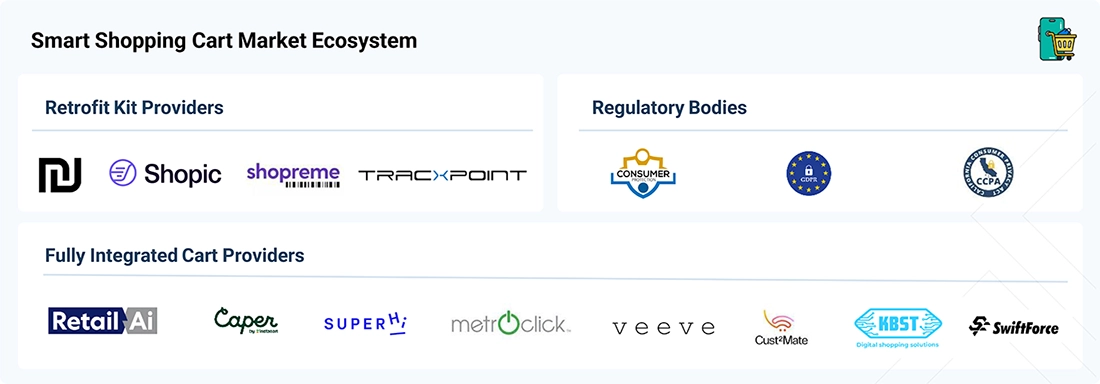
SMART SHOPPING CART MARKET: COMMERCIAL USE CASES ACROSS INDUSTRIES
| COMPANY | USE CASE DESCRIPTION | BENEFITS |
|---|---|---|
 |
Schnucks deployed Caper Carts to give customers AI-powered product recognition, running basket totals, digital coupons, and checkout directly in the cart. Caper also enables location-based promotions and advertising as shoppers move through the store. (Instacart) | Improves shopping convenience, supports personalized promotions, and creates opportunities to increase basket sizes and generate retail media revenue. |
 |
Shufersal deployed Shopic's smart cart solution across its stores using Shopic's modular clip-on technology. The solution was designed to provide automated product recognition, personalized engagement, and a faster shopping experience without replacing the retailer's existing cart fleet. Shopic reported an 8% increase in shoppers' monthly spending during the case study and said Shufersal planned deployment across about 200 large branches. (Shopic) | Supports larger basket values, customer engagement, and scalable deployment while reducing the need for retailers to replace existing shopping carts. |
 |
Yochananof, a major Israeli supermarket chain, deployed Cust2Mate smart carts across its stores to address checkout queues and improve store automation. The carts let shoppers scan and pay for products during their shopping trip while providing personalized ads, coupons, and shopping information. Cust2Mate reports that the deployment served thousands of customers daily and eliminated five cashier lines per store. (Cust2Mate) | Reduces checkout congestion and labor requirements while supporting larger basket sizes, personalized promotions, and improved shopper engagement. |
Logos and trademarks shown above are the property of their respective owners. Their use here is for informational and illustrative purposes only.
Related Ecosystem
Key Takeaways
- The UAE smart shopping cart market is projected to grow from USD 2.54 million in 2025 to USD 10.58 million by 2030, representing a 33.0% CAGR.
- UAE retailers are adopting smart shopping carts to enhance customer experience and streamline operations in a highly competitive retail environment.
- The UAE's digital transformation initiatives and smart city investments are accelerating the deployment of intelligent retail technologies.
- Strong consumer spending power and a mature retail infrastructure position the UAE as a leading market for smart shopping solutions in the Middle East and Africa region.
Smart Shopping Cart Market Report Scope
| Report Metric | Details |
|---|---|
| Base Year | 2025 |
| Fastest Growing Segment | DISTRIBUTOR (Mode Of Sale) |
| Forecast Period | 2025–2030 |
| Growth Rate | CAGR of 34.4% from 2025 to 2030 |
| Largest Segment | DIRECT (Mode Of Sale) |
| Market Size Base Year (Billions) | ~USD 0.32 (2025) |
| Revenue Forecast (Billions) | ~USD 1.42 (2030) |
| Segments Covered | Cart Type, Application Area, Mode Of Sale |
UAE Smart Shopping Cart Market Report Segmentation
3 segment dimensions are covered across the global market.
By Cart Type
- Fully Integrated Cart
- Fully Integrated Carts
- Retrofit Kits
By Application Area
- Other Application Areas
- Shopping Malls
- Supermarkets
By Mode Of Sale
- Direct
- Distributor
UAE: SMART SHOPPING CART MARKET, BY APPLICATION AREA, 2025–2030
| Segment | 2025 | 2026 | 2027 | 2028 | 2029 | 2030 | CAGR (%) |
|---|---|---|---|---|---|---|---|
| OTHER APPLICATION AREAS | 0.13 | 0.23 | 0.33 | 0.4 | 0.44 | 0.44 | 27.5 |
| SHOPPING MALLS | 0.88 | 1.58 | 2.31 | 2.9 | 3.3 | 3.49 | 31.9 |
| SUPERMARKETS | 1.53 | 2.81 | 4.17 | 5.33 | 6.17 | 6.64 | 34.1 |
| TOTAL | 2.54 | 4.61 | 6.81 | 8.63 | 9.91 | 10.58 | 33 |
Target Audience
- Retail Technology Vendors : Smart shopping cart manufacturers and retail automation solution providers need UAE market data to identify growth opportunities, understand local requirements, and develop region-specific product strategies.
- Retail Chains & Hypermarkets : Major retailers operating in the UAE require market insights to evaluate smart shopping cart investments, assess ROI potential, and make informed technology adoption decisions for their stores.
- Investment & Private Equity Firms : Investors seeking opportunities in UAE's retail technology sector need comprehensive market analysis to evaluate investment potential, assess market growth, and identify promising portfolio companies.
- Government & Economic Development Bodies : UAE government agencies and economic development authorities use market data to support smart city initiatives, retail sector modernization, and technology adoption policy development.
- Consulting & Strategy Firms : Business consultants advising retail clients in the UAE require detailed market intelligence to develop strategic recommendations, competitive analyses, and technology implementation roadmaps.
Key Companies in the UAE Smart Shopping Cart Market
| Company | HQ | Ownership | Strongest segments |
|---|---|---|---|
| AMAZON | United States | Public Company | Fully Integrated Carts,Retrofit Kits,Shopping Malls, |
| SUPERHII | Singapore | Public Company | Fully Integrated Carts,Retrofit Kits, |
| CUST2MATE | Canada | Public Company | Fully Integrated Carts,Retrofit Kits,Software, Data & Maintenance Services, |
| SHEKEL | Israel | Private Company | Retrofit Kits,Fully Integrated Carts,Embedded Weighing for OEM Carts, |
| KBST | South Korea | Public Investment Firm | Fully Integrated Carts,Retrofit Kits, |
AMAZON
Amazon is a public company founded in 1994 in the United States with 1,576,000 employees. It operates as a multinational technology and e-commerce corporation.
SUPERHII
Superhii is a public company founded in 2022 in Singapore with 14,003 employees.
CUST2MATE
Cust2Mate is a public company founded in Canada with 201 employees.
SHEKEL
Shekel is a private company founded in 1971 in Israel.
KBST
KBST is a public investment firm based in South Korea.
Reasons to Buy this Report
- Market Entry Strategy : Gain comprehensive insights into UAE's smart shopping cart market dynamics, competitive landscape, and growth opportunities to develop effective market entry and expansion strategies in this high-growth region.
- Investment Decision Support : Access detailed market sizing, forecasts, and growth drivers specific to the UAE to make informed investment decisions in retail technology infrastructure and smart shopping solutions.
- Competitive Intelligence : Understand the UAE retail automation landscape, identify key players, and analyze competitive positioning to benchmark your offerings against regional market leaders and emerging competitors.
- Technology Adoption Trends : Discover UAE-specific adoption patterns, consumer preferences, and technology integration requirements to align product development and marketing strategies with local market demands.
- Revenue Forecasting : Utilize accurate market projections and CAGR data for the UAE to forecast revenue potential, plan resource allocation, and set realistic growth targets for retail technology initiatives.
Frequently asked questions
What is the current size of the UAE smart shopping cart market?
The UAE smart shopping cart market was valued at USD 2.54 million in 2025 and is expected to reach USD 10.58 million by 2030.
What is the growth rate of the smart shopping cart market in the UAE?
The UAE smart shopping cart market is growing at a compound annual growth rate (CAGR) of 33.0% from 2025 to 2030.
What factors are driving smart shopping cart adoption in the UAE?
Key drivers include the UAE's digital transformation initiatives, smart city infrastructure investments, high consumer spending power, and retailers' focus on enhancing customer experience through automation.
Which retailers in the UAE are leading smart shopping cart adoption?
Major shopping centers and hypermarkets across the UAE are increasingly integrating smart shopping cart technologies to improve operational efficiency and customer engagement.
What technologies are integrated into UAE smart shopping carts?
UAE smart shopping carts typically feature IoT sensors, digital payment systems, AI-powered inventory tracking, and real-time customer engagement capabilities.
RESEARCH METHODOLOGY
This research study relied heavily on secondary sources, directories, and databases, including Dun & Bradstreet (D&B), Hoovers, and Bloomberg Businessweek, to identify and collect information relevant to a technical, market-oriented, and commercial study of the smart shopping cart market. The primary sources have consisted primarily of industry experts from core and related industries, as well as preferred suppliers, manufacturers, distributors, service providers, technology developers, alliances, and organizations related to all segments of the value chain of this market. In-depth interviews were conducted with primary respondents, including key industry participants, subject matter experts, C-level executives of key market players, and industry consultants, to obtain and verify critical qualitative and quantitative information.
Secondary Research
The market size of companies offering smart shopping carts worldwide was arrived at based on secondary data available through paid and unpaid sources. It was also determined by analyzing the product portfolio of major companies and rating them based on their performance and quality. In the secondary research process, various secondary sources were referred to identify and collect information for the study. These sources included annual reports, press releases, company investor presentations, white papers, certified publications, and articles from recognized associations and government publishing sources. Several journals and associations, such as The Grocer & Progressive Grocer and the International Journal of Retail & Distribution Management, were also referenced. Secondary research was used to gather key information on industry insights, the market’s value chain, the overall pool of key players, market classification, and segmentation based on industry trends, regional markets, and key developments from both market- and technology-oriented perspectives.
Secondary research was mainly used to obtain key information about the industry’s value chain and supply chain and to identify key players through various solutions and services, market classification and segmentation according to offerings of major players, industry trends related to technologies, applications, and regions, and key developments from both market-oriented and technology-oriented perspectives.
Primary Research
During the primary research process, various primary sources from both the supply and demand sides were interviewed to gather qualitative and quantitative information on the market. The primary sources from the supply side included various industry experts, including Chief Experience Officers (CXOs), Vice Presidents (VPs), directors from business development, marketing, and product development/innovation teams, related key executives from smart shopping cart solution vendors, professional service providers, and industry associations, and key opinion leaders.
Primary interviews gathered insights, including market statistics, revenue data from solutions and services, market segmentation, market size estimates, market forecasts, and data triangulation. Primary research also helped in understanding various trends related to technologies, applications, deployments, and regions. Stakeholders from the demand side, such as Chief Information Officers (CIOs), Chief Technology Officers (CTOs), Chief Strategy Officers (CSOs), and end users using smart shopping cart solutions, were interviewed to understand the buyer’s perspective on suppliers, products, service providers, and their current usage of smart shopping cart solutions, which would impact the overall Smart shopping cart market.
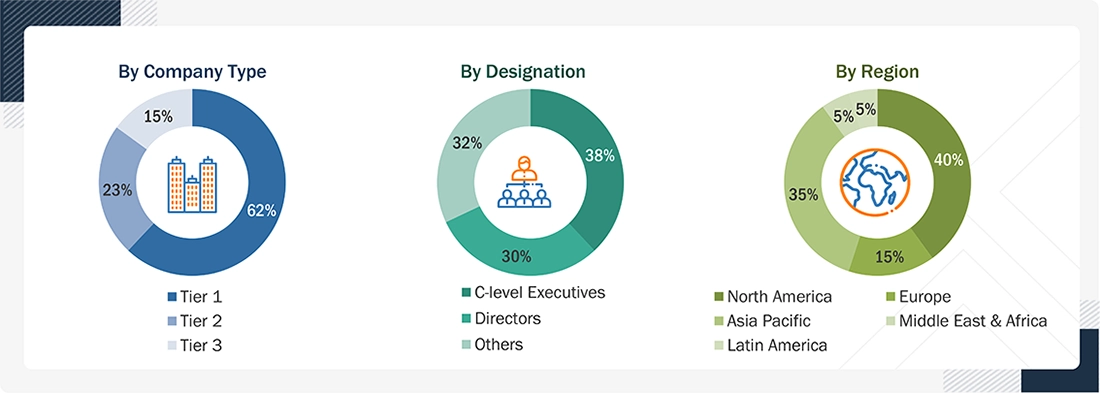
Others include sales managers, marketing managers, and product managers.
Note: Tier 1 companies’ revenue is more than USD 1 billion; Tier 2 companies’ revenue ranges between USD 500 million and USD 1 billion; and Tier 3 companies’ revenue ranges between USD 100 million and USD 500 million
To know about the assumptions considered for the study, download the pdf brochure
Market Size Estimation
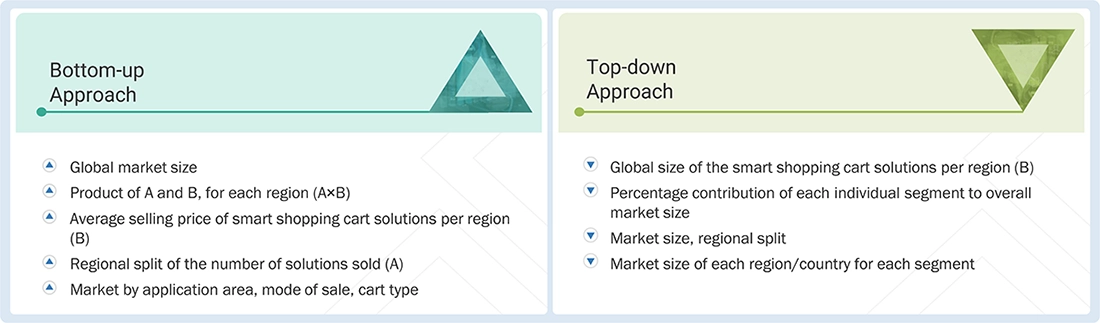
Multiple approaches were adopted to estimate and forecast the size of the smart shopping cart market. The first approach estimates market size by summing up the revenue generated by companies from sales of smart shopping cart solutions.
The report used top-down and bottom-up approaches to estimate and validate the total size of the smart shopping cart market. These methods were also extensively used to estimate the size of various market segments. The research methodology used to evaluate the market size is listed below.
- Key players in the market have been identified through extensive secondary research.
- For value, the industry’s supply chain and market size were determined through a combination of primary and secondary research.
- All percentage shares, splits, and breakups have been determined using secondary sources and verified through primary sources.
Smart Shopping Cart Market : Top-Down and Bottom-Up Approach
Data Triangulation
After determining the overall market size, the smart shopping cart market was segmented into several categories and subcategories. A data triangulation procedure was employed to complete the overall market engineering process and derive the precise statistics for all segments and subsegments, as applicable. The data was triangulated by examining factors and trends from both the demand and supply sides. In addition to data triangulation and market breakdown, the market size was validated using both top-down and bottom-up approaches.
Market Definition
A smart shopping cart is an Internet of Things (IoT) enabled retail device that integrates advanced hardware and software, such as barcode scanners, computer vision cameras, weight sensors, and touchscreens, directly into the physical shopping trolley. This technology lets customers scan, weigh, and pay for items directly at the cart, bypassing traditional checkout lines while giving retailers real-time data on shopping behavior and inventory levels.
Key Stakeholders
- Technology & Hardware Providers
- Retailers
- End Users
- Infrastructure & Enablers
- Regulatory & Governance Organizations
- Software and Connectivity Providers
- Consulting and Advisory Firms
- Investors and Venture Capitalists
- Independent Software Vendors (ISVs)
- Value-added Resellers (VARs) and Distributors
Report Objectives
- To determine and forecast the global smart shopping cart market by application area, mode of sale, cart type, and region
- To forecast the size of the market segments for North America, Europe, Asia Pacific, Latin America, and the Middle East & Africa
- To provide detailed information about the major factors (drivers, restraints, opportunities, and challenges) influencing the growth of the smart shopping cart market
- To analyze each submarket concerning individual growth trends, prospects, and contributions to the overall smart shopping cart market
- To analyze the opportunities in the market for stakeholders by identifying the high-growth segments of the smart shopping cart market
- To profile the key market players, provide a comparative analysis based on business overviews, regional presence, product offerings, business strategies, and key financials, and illustrate the market’s competitive landscape
- Track and analyze competitive developments in the market, such as mergers and acquisitions, product development, partnerships and collaborations, and research and development (R&D) activities
Available customizations:
With the given market data, MarketsandMarkets offers customizations to meet the company’s specific needs. The following customization options are available for the report:
Country-wise information
- Analysis for additional countries (up to five)
Company Information
- Detailed analysis and profiling of additional market players (up to 5)
Get the Full Smart Shopping Cart Market Report
Full forecast, segment splits, and company analysis for all Smart Shopping Cart Market.
- US Smart Shopping Cart Market
- Canada Smart Shopping Cart Market
- UK Smart Shopping Cart Market
- Germany Smart Shopping Cart Market
- France Smart Shopping Cart Market
- Italy Smart Shopping Cart Market
- China Smart Shopping Cart Market
- India Smart Shopping Cart Market
- Japan Smart Shopping Cart Market
- Israel Smart Shopping Cart Market
- South Africa Smart Shopping Cart Market
- Chile Smart Shopping Cart Market
- Mexico Smart Shopping Cart Market
- Rest Of Europe Smart Shopping Cart Market
- Anz Smart Shopping Cart Market
- Rest Of Asia Pacific Smart Shopping Cart Market
- Rest Of Latin America Smart Shopping Cart Market
Need a Tailored Report?
Customize this report to your needs
Get 10% FREE Customization
Customize This Report
