
Australia Smoke Detector Market (2024-2029)

The Australia Smoke Detector Market was valued at $43.7 Million in 2024 and projected to reach to $60 Million by 2029, representing a compound annual growth rate of 6.5%. Australia's smoke detector market is positioned for consistent growth through 2029, supported by stringent building regulations and increasing fire safety consciousness among property owners.


| Market Size in | USD 26.32 MN |
| Market Forecast in | |
| CAGR | |
| Forecast Period | |
| Units Considered | Value (USD MN) |
Australia Smoke Detector Market Trends and Insights
- This 6.5% compound annual growth rate reflects increasing regulatory compliance, rising residential construction activity, and heightened fire safety awareness across Australia.
- The market is driven by mandatory installation requirements in Australian buildings and growing adoption of interconnected and smart smoke detection systems. In Australia, the smoke detector market benefits from stringent building codes and fire safety standards that mandate detector installation in residential and commercial properties.
- Between 2024 and 2029, Australia is expected to see accelerated demand for advanced detection technologies, including wireless and IoT-enabled devices.
- The Australian market's growth trajectory is supported by renovation activities, new housing developments, and government initiatives promoting fire safety awareness throughout the country. Australia's smoke detector sector is characterized by a mix of established manufacturers and emerging technology providers competing to meet evolving safety standards.
- The market in Australia continues to shift toward premium products offering enhanced features such as dual-sensor technology and smartphone connectivity, positioning the country as a key growth market within the Asia Pacific region..
Key Market Statistics
- CAGR (2024-2029) 6.5% CAGR
- Market Size, 2024 ~USD 43.7 Million
- Forecast, 2029 ~USD 60 Million
- Country Australia
Australia Smoke Detector Market Overview
Market Valuation :
Australia's smoke detector market is valued at $43.7 million in 2024, with projections reaching $60.0 million by 2029, representing a steady 6.5% CAGR over the forecast period.
Regulatory Compliance Drivers :
Mandatory installation requirements under Australian building codes and fire safety regulations are primary growth catalysts, ensuring consistent demand across residential and commercial sectors.
Construction Activity Surge :
Rising residential construction activity in Australia, particularly in urban centers like Sydney and Melbourne, is driving increased smoke detector installations in new builds and renovation projects.
Fire Safety Awareness :
Heightened community awareness of fire safety risks and insurance incentives for compliant installations are accelerating market adoption across Australian households and businesses.
Australia Smoke Detector Market Dynamics
- The 6.5% CAGR reflects steady demand from both new residential construction and retrofit installations in existing properties.
- Government initiatives promoting fire safety standards and insurance requirements for compliant systems continue to strengthen market fundamentals. The market outlook remains positive as urbanization accelerates and building codes become more stringent.
- Smart smoke detector adoption is emerging as a growth segment, with connected devices gaining traction in Australian homes.
- Continued investment in fire prevention infrastructure and regulatory enforcement will sustain market expansion, making Australia a stable market for smoke detector manufacturers and distributors..
Market Ecosystem
Related Ecosystem
Electronics System And Components
- Sensors
- Temperature Sensors
- Pressure Sensors
- Actuators
- Image Sensors
- Lenovo
- Samsung
- Texas Instruments Incorporated
- HONEYWELL INTERNATIONAL INC.
- Teledyne Technologies Incorporated
Security And Surveillance
- Face Recognition
- Video Surveillance as A Service (VSaaS)
- Voice Recognition
- Fingerprint Recognition
- IRIS Recognition
- HONEYWELL INTERNATIONAL INC.
- Thales group
- HID-GLOBAL
- Lenovo
- AXIS COMMUNICATIONS
Sensors And Control
- Sensors
- Temperature Sensors
- Image Sensors
- Pressure Sensors
- Flow Sensors
- BAUMER ELECTRIC AG
- HONEYWELL INTERNATIONAL INC.
- Stmicroelectronics
- Lenovo
- Texas Instruments Incorporated
Key Takeaways
- Australia's smoke detector market is valued at $43.7 million in 2024 and is projected to reach $60.0 million by 2029, representing a 6.5% CAGR.
- Stringent building codes and mandatory fire safety regulations in Australia drive consistent demand for smoke detection systems across residential and commercial sectors.
- Australia is witnessing a shift toward smart and interconnected smoke detectors with advanced features such as wireless connectivity and IoT integration.
- The Australian market benefits from active residential construction, renovation activities, and government-backed fire safety awareness campaigns throughout the forecast period.
Smoke Detector Market Report Scope
| Report Metric | Details |
|---|---|
| Base Year | 2024 |
| Fastest Growing Segment | MAINTENANCE SERVICES (Service) |
| Forecast Period | 2024-2029 |
| Growth Rate | CAGR of 7% from 2024 to 2029 |
| Largest Segment | PRODUCTS (Offering) |
| Market Size Base Year (Billions) | ~USD 2.68 (2024) |
| Revenue Forecast (Billions) | ~USD 3.76 (2029) |
| Segments Covered | Offering, Type, End User, Service, Power Source, Commercial End User, Industrial End User |
Australia Smoke Detector Market Report Segmentation
7 segment dimensions are covered across the global market.
By Offering
- Products
- Services
By Type
- Aspirating Smoke Detector
- Aspirating Smoke Detectors
- Beam Smoke Detectors
- Dual Sensor Smoke Detectors
- Dual-Sensor Smoke Detectors
- Duct Smoke Detectors
- Ionization Smoke Detectors
- Photoelectric Smoke Detectors
By End User
- Commercial
- Industrial
- Residential
By Service
- Engineering Services
- Installation & Design Services
- Maintenance Services
- Managed Services
- Other Services
By Power Source
- Wired
- Wireless
By Commercial End User
- Academia & Institutional
- Bfsi
- Government & Office Buildings
- Healthcare
- Hospitality
- Retail
By Industrial End User
- Energy & Power
- It & Telecommunications
- Manufacturing
- Oil & Gas And Mining
- Other Industries
- Pharmaceuticals
- Transportation & Logistics
Target Audience
- Smoke Detector Manufacturers : Manufacturers need Australia-specific market data to develop compliant products, identify distribution opportunities, and establish competitive positioning in this regulated market.
- Building & Construction Companies : Builders and developers require insights into mandatory fire safety requirements and market trends to ensure code compliance and optimize procurement strategies for new projects.
- Distributors & Retailers : Distribution partners need market forecasts and demand drivers to stock appropriate inventory levels, identify growth segments, and plan sales strategies for Australian customers.
- Insurance & Risk Management Firms : Insurance providers benefit from market intelligence on fire safety compliance rates and detector adoption trends to inform underwriting policies and risk assessment in Australia.
- Government & Regulatory Bodies : Policy makers and fire safety regulators use market data to evaluate compliance effectiveness, assess safety infrastructure gaps, and develop evidence-based fire prevention initiatives.
Reasons to Buy this Report
- Regulatory Compliance Insights : Understand mandatory Australian building codes and fire safety standards that drive market demand, enabling compliant product development and market entry strategies.
- Growth Opportunity Assessment : Identify high-growth segments within Australia's 6.5% CAGR market, including smart detectors and retrofit installations, to optimize investment and product positioning decisions.
- Construction Market Correlation : Analyze linkages between Australian residential construction activity and smoke detector demand to forecast market trends and plan distribution strategies effectively.
- Competitive Landscape Analysis : Gain detailed insights into key players, market share distribution, and competitive strategies specific to the Australian market for informed business planning.
- Regional Market Forecasting : Access precise 2024-2029 market projections for Australia ($43.7M to $60M) to support financial planning, resource allocation, and revenue forecasting.
Frequently asked questions
What is the current size of Australia's smoke detector market?
Australia's smoke detector market was valued at $43.7 million in 2024 and is expected to grow to $60.0 million by 2029.
What is the projected growth rate for Australia's smoke detector market?
Australia's smoke detector market is projected to grow at a compound annual growth rate (CAGR) of 6.5% from 2024 to 2029.
What are the main drivers of growth in Australia's smoke detector market?
Key growth drivers in Australia include mandatory building code compliance, increased residential construction, adoption of smart detection technologies, and government fire safety initiatives.
What types of smoke detectors are gaining popularity in Australia?
Australia is seeing increased adoption of smart smoke detectors with wireless connectivity, IoT integration, dual-sensor technology, and smartphone alert capabilities.
How do regulatory requirements impact Australia's smoke detector market?
Australia's stringent building codes and fire safety regulations mandate smoke detector installation in residential and commercial properties, creating consistent baseline demand across the market.
RESEARCH METHODOLOGY
The study involved four major activities in estimating the current size of the smoke detectors market. Exhaustive secondary research has been done to collect information on the market, peer market, and parent market. To validate these findings, assumptions, and sizing with industry experts across the value chain through primary research has been the next step. Both top-down and bottom-up approaches have been employed to estimate the complete market size. After that, market breakdown and data triangulation methods have been used to estimate the market size of segments and subsegments. Two sources of information—secondary and primary—have been used to identify and collect information for an extensive technical and commercial study of the smoke detectors market.
Secondary Research
Various secondary sources have been referred to in the secondary research process to identify and collect information important for this study. The secondary sources include annual reports, press releases, and investor presentations of companies; white papers; journals and certified publications; and articles from recognized authors, websites, directories, and databases. Secondary research has been conducted to obtain key information about the industry’s supply chain, the market’s value chain, the total pool of key players, market segmentation according to the industry trends (to the bottom-most level), regional markets, and key developments from market- and technology-oriented perspectives. The secondary data has been collected and analyzed to determine the overall market size, further validated by primary research.
Primary Research
Extensive primary research was conducted after gaining knowledge about the current scenario of the smoke detectors market through secondary research. Several primary interviews were conducted with experts from the demand and supply sides across four major regions—North America, Europe, Asia Pacific and RoW. This primary data was collected through questionnaires, emails, and telephonic interviews.
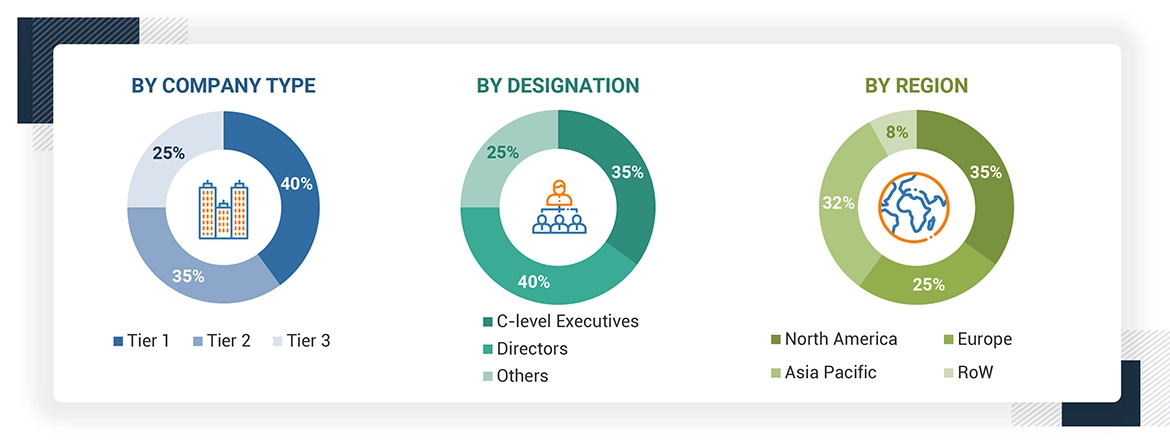
Note: The three tiers of the companies are defined based on their total revenue in 2023: Tier 1 - revenue greater than or equal to USD 1 billion; Tier 2 - revenue between USD 100 million and USD 1 billion; and Tier 3 revenue less than or equal to USD 100 million. Other designations include sales managers, marketing managers, and product managers.
To know about the assumptions considered for the study, download the pdf brochure
Market Size Estimation
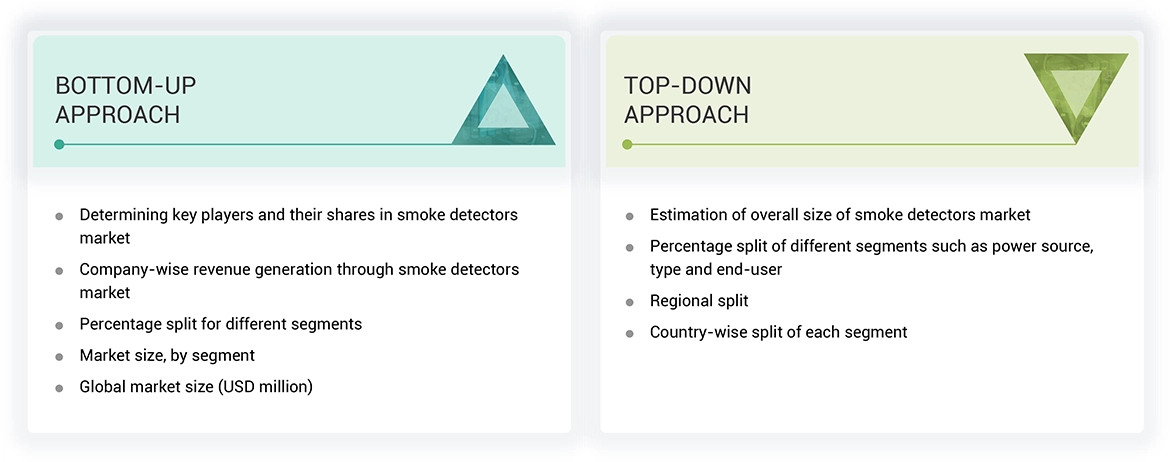
Both top-down and bottom-up approaches have been used to estimate and validate the total size of the smoke detectors market. These methods have also been used extensively to estimate the size of various subsegments in the market. The following research methodology has been used to estimate the market size:
- Major players in the industry and markets have been identified through extensive secondary research.
- The industry’s value chain and market size (in terms of value) have been determined through primary and secondary research processes.
- All percentage shares, splits, and breakdowns have been determined using secondary sources and verified through primary sources.
Smoke Detector Market : Top-Down and Bottom-Up Approach
Data Triangulation
After arriving at the overall size of the smoke detectors market from the market size estimation process explained above, the total market has been split into several segments and subsegments. Data triangulation and market breakdown procedures have been employed, wherever applicable, to complete the overall market engineering process and arrive at the exact statistics for all segments and subsegments of the market. The data has been triangulated by studying various factors and trends from both the demand and supply sides. Along with this, the market size has been validated using both top-down and bottom-up approaches.
Market Definition
The smoke detector market is involved in the designing, manufacturing, and marketing of devices that detect smoke as an early sign of fire to provide safety to households, commercial buildings, and industries. There are several types of smoke detectors that are offered in the market, including ionization smoke detectors, photoelectric smoke detectors, dual sensor smoke detectors, duct smoke detectors, beam smoke detectors and aspirating smoke detectors, and each is equipped with a different kind of technology to ensure good detection. With growing stringent regulations, rapid development in technology, and an expanding awareness of fire safety concerns, the smoke detector market has emerged as one essential driver of fire prevention worldwide.
Key Stakeholders
- Raw material and manufacturing equipment suppliers
- Electronic design automation (EDA) and design tool vendors
- Integrated device manufacturers (IDMs)
- Smoke detector technology platform developers
- Smoke detectors semiconductor device manufacturers
- Component manufacturers
- Product manufacturers (ODMs)
- Original equipment manufacturers (OEMs)
- ODM and OEM technology solution providers
- Assembly, testing, and packaging vendors
- Distributors and traders
- Research organizations
- Organizations, forums, alliances, and associations
Report Objectives
- To define, describe and forecast the smoke detectors market, in terms of power source, type, end-user and region.
- To describe and forecast the market, in terms of value, with regard to four main regions: North America, Europe, Asia Pacific, and Rest of the World (RoW) along with their respective countries
- To provide detailed information regarding major factors influencing the market growth (drivers, restraints, opportunities, and challenges)
- To provide a detailed overview of the value chain of smoke detectors market.
- To strategically analyze micromarkets with respect to individual growth trends, prospects, and contributions to the smoke detectors market
- To analyze opportunities in the market for stakeholders by identifying high-growth segments of the smoke detectors market.
- To strategically profile key players and comprehensively analyze their market position in terms of ranking and core competencies, along with detailing the competitive landscape for market leaders
- To analyze competitive strategies, such as product launches, expansions, mergers and acquisitions, adopted by key market players in the smoke detectors market.
Available Customizations
With the given market data, MarketsandMarkets offers customizations according to the company’s specific needs. The following customization options are available for the report:
Company Information:
- Detailed analysis and profiling of additional market players (up to 5)
Get the Full Smoke Detector Market Report
Full forecast, segment splits, and company analysis for all Smoke Detector Market.
- UK Smoke Detector Market
- France Smoke Detector Market
- US Smoke Detector Market
- Canada Smoke Detector Market
- Germany Smoke Detector Market
- Mexico Smoke Detector Market
- Italy Smoke Detector Market
- Rest Of Europe Smoke Detector Market
- Spain Smoke Detector Market
- India Smoke Detector Market
- Rest Of Asia Pacific Smoke Detector Market
- China Smoke Detector Market
- Japan Smoke Detector Market
- South Korea Smoke Detector Market
- Rest Of GCC Smoke Detector Market
- Saudi Arabia Smoke Detector Market
- UAE Smoke Detector Market
Need a Tailored Report?
Customize this report to your needs
Get 10% FREE Customization
Customize This Report
