
Rest Of Africa Solar Container Market (2025-2030)

The Rest Of Africa Solar Container Market was valued at $3620 Million in 2025 and projected to reach to $8630 Million by 2030, representing a compound annual growth rate of 19.0%. Rest Of Africa's solar container market is positioned for substantial growth as the region addresses its expanding energy needs through renewable solutions.


| Market Size in | USD 26.32 MN |
| Market Forecast in | |
| CAGR | |
| Forecast Period | |
| Units Considered | Value (USD MN) |
Rest Of Africa Solar Container Market Trends and Insights
- This 19.0% compound annual growth rate reflects increasing adoption of portable and modular solar energy solutions across the region.
- Rest Of Africa is capitalizing on rising energy demand, improving grid infrastructure investments, and growing interest in off-grid renewable energy systems to power remote communities and industrial applications. The solar container segment in Rest Of Africa addresses critical energy access challenges while supporting the region's transition toward sustainable power generation.
- Rest Of Africa's market growth is driven by declining solar technology costs, supportive government policies, and private sector investments in clean energy infrastructure.
- Between 2025 and 2030, Rest Of Africa is expected to see accelerated deployment of containerized solar solutions in both utility-scale and distributed generation projects, positioning the region as an emerging hub for renewable energy innovation..
Key Market Statistics
- CAGR (2025-2030) 19.0% CAGR
- Market Size, 2025 ~USD 3620 Million
- Forecast, 2030 ~USD 8630 Million
- Country Rest Of Africa
Rest Of Africa Solar Container Market Overview
Rapid Market Expansion :
Rest Of Africa's solar container market is projected to grow from USD 3,620 million in 2025 to USD 8,630 million by 2030, representing a 19% CAGR and demonstrating strong regional momentum in renewable energy adoption.
Energy Access Solutions :
Portable and modular solar containers are addressing critical energy gaps across Rest Of Africa, providing decentralized power solutions to remote communities and industrial facilities with limited grid connectivity.
Infrastructure Development :
Improving grid infrastructure and rising energy demand across Rest Of Africa are creating favorable conditions for solar container deployment, supporting both utility-scale and off-grid applications.
Regional Growth Drivers :
Increasing investment in renewable energy projects, government incentives, and growing awareness of sustainable energy solutions are propelling the adoption of solar containers throughout Rest Of Africa.
Rest Of Africa Solar Container Market Dynamics
- The 19% CAGR through 2030 reflects accelerating adoption of modular solar systems that offer flexibility and rapid deployment capabilities.
- Key drivers include rising electricity demand, improving infrastructure investments, and the cost-effectiveness of containerized solar solutions for both urban and rural applications. The market outlook remains positive as Rest Of Africa continues to prioritize energy security and sustainability.
- Solar containers are increasingly recognized as viable alternatives to traditional power generation, particularly in areas with unreliable grid access.
- With supportive regulatory frameworks and declining solar technology costs, the region is expected to see increased penetration across industrial, commercial, and residential sectors, driving sustained market expansion through 2030..
Market Ecosystem
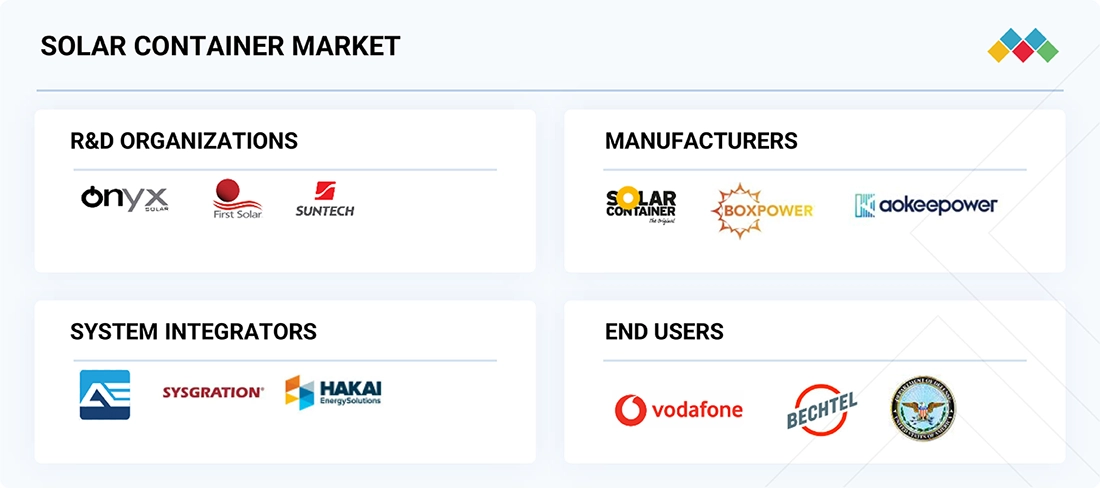
Solar Container Market: COMMERCIAL USE CASES ACROSS INDUSTRIES
| COMPANY | USE CASE DESCRIPTION | BENEFITS |
|---|---|---|
 |
Develops modular solar container systems integrating PV panels, battery storage, and inverters for off-grid and hybrid energy supply in construction, mining, and emergency applications | Scalable and portable renewable systems | Rapid deployment | Reliable power for remote or temporary sites | High durability under extreme climates |
 |
Designs autonomous plug-and-play solar containers and solar trailers with hybrid power capabilities (PV + storage + diesel backup) for humanitarian aid, defense, and off-grid communities | Complete off-grid energy solution | Easy transport and setup | Fuel cost reduction | Sustainable operations for mobile users |
 |
Provides containerized solar and hybrid power units for telecom, healthcare, and industrial customers, integrating smart monitoring systems and cloud-based energy management | Remote performance monitoring | Reduced OPEX via hybrid optimization | Reliable telecom and site backup power | Seamless scalability |
 |
Manufactures prefabricated solar + battery containers with advanced control software for microgrids and emergency backup power. Focus on disaster relief, rural electrification, and critical infrastructure | Quick installation (within hours) | Grid independence | Automated power balancing | High resilience in extreme events |
 |
Specializes in customizable solar containers built for energy storage, EV charging, and mobile power applications, combining modular steel construction with integrated PV and inverter systems | Customizable configurations | Modular scalability | Dual-use design (power + shelter) | Suitable for temporary and permanent installations |
Logos and trademarks shown above are the property of their respective owners. Their use here is for informational and illustrative purposes only.
Related Ecosystem
Electronics System And Components
- Sensors
- Temperature Sensors
- Pressure Sensors
- Actuators
- Image Sensors
- Lenovo
- Samsung
- Texas Instruments Incorporated
- HONEYWELL INTERNATIONAL INC.
- Teledyne Technologies Incorporated
Key Takeaways
- Rest Of Africa's solar container market will grow from USD 3,620M (2025) to USD 8,630M (2030), representing a 19.0% CAGR.
- Rest Of Africa is leveraging containerized solar solutions to address energy access gaps in remote and underserved communities.
- Rest Of Africa's market expansion is supported by declining solar costs, policy incentives, and increased private investment in renewable infrastructure.
- Rest Of Africa is positioned as an emerging leader in modular and portable solar energy deployment across Sub-Saharan Africa.
Solar Container Market Report Scope
| Report Metric | Details |
|---|---|
| Base Year | 2025 |
| Fastest Growing Segment | AGRICULTURE & IRRIGATION (Application) |
| Forecast Period | 2025-2030 |
| Growth Rate | CAGR of 23.8% from 2025 to 2030 |
| Largest Segment | OFF-GRID (Installation Type) |
| Market Size Base Year (Billions) | ~USD 0.29 (2025) |
| Revenue Forecast (Billions) | ~USD 0.83 (2030) |
| Segments Covered | Installation Type, Type, Application, Component, Power Capacity |
Rest Of Africa Solar Container Market Report Segmentation
5 segment dimensions are covered across the global market.
By Installation Type
- Off-Grid
- On-Grid
By Type
- Fixed
- Portable
By Application
- Agriculture & Irrigation
- Energy Companies
- Mining & Military
- Other Applications
- Remote Charging Stations
By Component
- Batteries
- Energy Management Systems
- Inverters
- Monitoring Systems
- Other Components
- Solar Panels
By Power Capacity
- 10-50 Kw
- Above 50 Kw
- Below 10 Kw
Target Audience
- Solar Equipment Manufacturers : Manufacturers need Rest Of Africa market data to assess demand for containerized solar systems, identify distribution opportunities, and develop region-specific product variants aligned with local energy requirements.
- Energy Project Developers : Project developers require detailed market insights for Rest Of Africa to evaluate feasibility of solar container installations, forecast ROI, and secure financing for renewable energy initiatives across the region.
- Investment & Private Equity Firms : Investors need Rest Of Africa market forecasts and growth metrics to identify promising solar container companies, assess portfolio opportunities, and make informed capital deployment decisions in the renewable energy sector.
- Government & Policy Makers : Policymakers require Rest Of Africa market analysis to develop supportive regulatory frameworks, allocate resources for renewable energy infrastructure, and establish targets for sustainable energy adoption.
- Utility & Energy Companies : Utilities need Rest Of Africa-specific market data to evaluate solar container integration into grid infrastructure, plan capacity expansion, and develop strategies for improving energy access and reliability.
Reasons to Buy this Report
- Market Size & Growth Data : Access precise market valuations for Rest Of Africa (USD 3,620M in 2025, USD 8,630M in 2030) with detailed CAGR analysis to support investment decisions and business planning in the region.
- Regional Opportunity Assessment : Identify high-potential segments and geographic pockets within Rest Of Africa where solar container adoption is accelerating, enabling targeted market entry and expansion strategies.
- Competitive Intelligence : Understand Rest Of Africa-specific market dynamics, key players, and competitive positioning to develop differentiated strategies and capture market share in this emerging region.
- Investment & Funding Insights : Leverage market forecasts and growth projections for Rest Of Africa to attract investors, secure funding, and justify capital allocation for solar container projects and ventures.
- Strategic Planning Support : Use Rest Of Africa-specific data to inform product development, supply chain optimization, and go-to-market strategies tailored to regional energy demands and infrastructure conditions.
Frequently asked questions
What is the current market size of solar containers in Rest Of Africa?
Rest Of Africa's solar container market is valued at USD 3,620 million in 2025 and is expected to grow to USD 8,630 million by 2030.
What is the projected growth rate for Rest Of Africa's solar container market?
Rest Of Africa's solar container market is projected to grow at a compound annual growth rate (CAGR) of 19.0% from 2025 to 2030.
What factors are driving growth in Rest Of Africa's solar container market?
Rest Of Africa's market growth is driven by rising energy demand, declining solar technology costs, supportive government policies, and increased private sector investment in renewable energy infrastructure.
How are solar containers being deployed in Rest Of Africa?
Rest Of Africa is deploying containerized solar solutions for off-grid power generation, remote community electrification, and utility-scale renewable energy projects.
What is the forecast market size for Rest Of Africa's solar container market by 2030?
Rest Of Africa's solar container market is forecasted to reach USD 8,630 million by 2030, up from USD 3,620 million in 2025.
RESEARCH METHODOLOGY
This research study involved four major activities in estimating the solar container market size. Exhaustive secondary research was carried out to collect important information about the market and peer markets. The next step involved validating these findings and assumptions and sizing them with the help of primary research with industry experts across the value chain. Both top-down and bottom-up approaches were used to estimate the market size. The market breakdown and data triangulation procedures were adopted to estimate the market sizes of segments and sub-segments.
Secondary Research
Various secondary sources were referred to in the secondary research process to identify and collect information required for this study. These sources included annual reports, press releases, investor presentations of companies, white papers, and articles from recognized authors. Secondary research was mainly conducted to obtain key information about the market’s value chain, the pool of key market players, market segmentation according to industry trends, regional outlook, and developments from both market and technology perspectives.
Primary Research
In primary research, various sources from both the supply and demand sides were interviewed to obtain the qualitative and quantitative insights required for this report. Primary sources from the supply side included experts such as CEOs, vice presidents, marketing directors, manufacturers, technology and innovation directors, end users, and related executives from multiple key companies and organizations operating in the solar container market ecosystem. After interacting with industry experts, brief sessions were conducted with highly experienced independent consultants to reinforce the findings from primary research. This, along with the in-house subject matter experts’ opinions, led to the findings as described in the report. The breakdown of primary respondents is as follows:
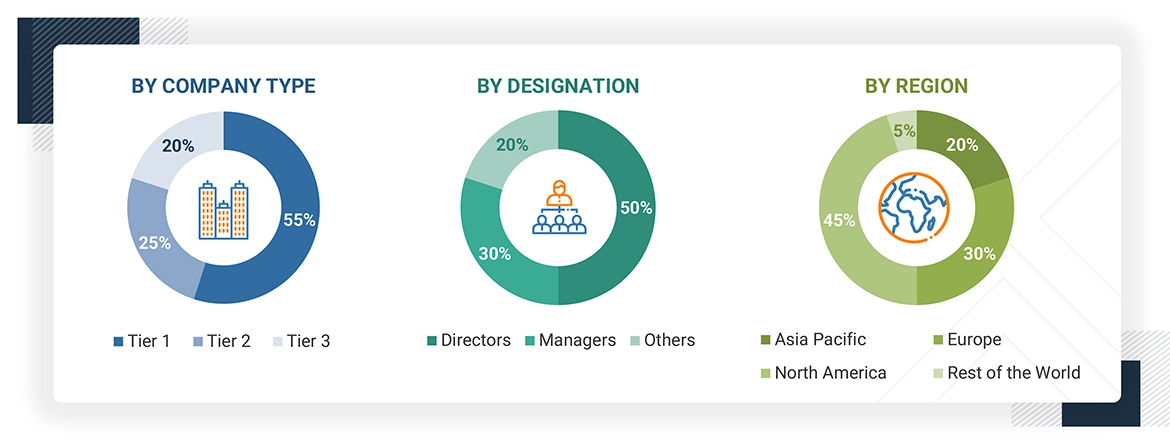
Note: Other designations include sales, marketing, and product managers
To know about the assumptions considered for the study, download the pdf brochure
Market Size Estimation
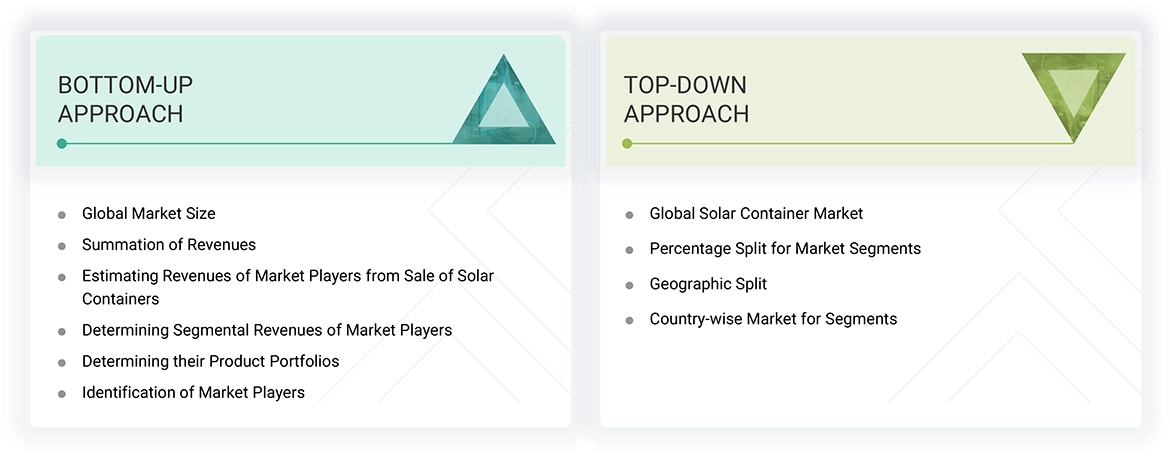
In the market engineering process, both top-down and bottom-up approaches and data triangulation methods were used to estimate and validate the size of the solar container market and other dependent submarkets. The research methodology used to estimate the market sizes included the following:
The bottom-up procedure was employed to arrive at the overall size of the solar container market.
- Major companies that provide solar containers were identified. This included analyzing company portfolios, product offerings, and presence across various regions.
- The segment-specific revenues of the companies, particularly those related to solar containers, were determined.
- The product-specific revenues of the companies, particularly those related to solar containers, were determined.
- These individual revenue figures were compiled to determine the total revenue generated across the identified companies within the sector.
- The global market size for solar containers was obtained using this consolidated data.
The top-down approach was used to estimate and validate the total size of the solar container market.
- Identified top-line investments and spending in the ecosystem and major market developments to consider segment-level splits
- Estimated the overall solar container market size, then segmented the global market by allocating shares based on the segments considered
- Distributed the segment-level markets into regions and countries by aligning regional solar container activity with economic indicators, solar container manufacturing presence, and national development initiatives
Solar Container Market : Top-Down and Bottom-Up Approach
Data Triangulation
After arriving at the overall market size using the market size estimation processes as explained above, the market was split into several segments and subsegments. Data triangulation and market breakdown procedures were employed to complete the entire market engineering process and arrive at the exact statistics of each market segment and subsegment. The data was triangulated by studying various factors and trends from the demand and supply sides of the solar container market.
Market Definition
The solar container market focuses on the development and deployment of containerized solar power systems designed to deliver portable, scalable, and sustainable energy solutions. These systems integrate solar technology within modular containers, enabling a reliable electricity supply across diverse applications and remote locations. Solar containers combine photovoltaic panels, battery storage, inverters, and intelligent control systems within a modular containerized unit, enabling rapid installation and reliable off-grid power generation. These systems are essential for addressing energy access challenges in remote areas, supporting disaster relief operations, and delivering clean electricity for defense and construction. Key components of solar containers include solar PV modules, hybrid energy systems, advanced battery management, and IoT-enabled monitoring platforms. These technologies are integrated to ensure efficient energy generation, storage, and distribution while enabling real-time performance tracking and optimization. The adoption of solar containers is driven by the rising global demand for decentralized renewable energy, government initiatives promoting clean power, and the need for emission-free and portable energy systems. With the increasing integration of smart technologies, declining costs of solar panels and storage, and expanding rural electrification efforts, solar containers are evolving to support hybrid energy applications, sustainable infrastructure development, and climate-resilient power solutions. Solar containers play a vital role in bridging the energy gap, enhancing resilience in emergencies, reducing carbon emissions, and supporting the transition toward a sustainable and decentralized energy future.
Key Stakeholders
- Solar container manufacturers
- Solar PV panel and battery suppliers
- Energy storage solution providers
- Inverter and power electronics manufacturers
- Hybrid system integrators
- Distributors
- Government and regulatory bodies
- Research and development institutions
Report Objectives
- To define, describe, segment, and forecast the solar container market size by component, type, installation type, power capacity, application, and region, in terms of value
- To assess the solar container market size in four key regions: North America, Europe, Asia Pacific, and the Rest of the World, in terms of value
- To provide detailed information regarding the key factors such as drivers, restraints, opportunities, and challenges influencing the growth of the market
- To analyze the solar container value chain and ecosystem, along with the average selling price by component and region
- To strategically study the regulatory landscape, tariffs, standards, patents, Porter’s Five Forces, import & export scenarios, trade values, and case studies pertaining to the market under study
- To understand micromarkets with regard to individual growth trends, prospects, and contributions to the overall market
- To assess opportunities in the market for stakeholders by identifying high-growth segments
- To analyze the impact of AI/Gen AI on the solar container market
- To outline the macroeconomic outlook for the regions under study
- To analyze strategies such as product launches, collaborations, acquisitions, and partnerships adopted by players in the solar container market
- To profile key market players and comprehensively analyze their ranking based on their revenue, market share, and core competencies
Customization Options:
With the given market data, MarketsandMarkets offers customizations according to the specific requirements of companies. The following customization options are available for the report:
Country-wise Information:
- Country-wise breakdown for North America, Europe, Asia Pacific, and the Rest of the World
Company Information:
- Detailed analysis and profiling of additional market players (up to five)
Get the Full Solar Container Market Report
Full forecast, segment splits, and company analysis for all Solar Container Market.
- Italy Solar Container Market
- Spain Solar Container Market
- Poland Solar Container Market
- China Solar Container Market
- Japan Solar Container Market
- India Solar Container Market
- South Korea Solar Container Market
- Australia Solar Container Market
- Indonesia Solar Container Market
- Malaysia Solar Container Market
- Thailand Solar Container Market
- Vietnam Solar Container Market
- Rest Of Asia Pacific Solar Container Market
- Nordics Solar Container Market
- Rest Of Europe Solar Container Market
- Bahrain Solar Container Market
- Kuwait Solar Container Market
- Oman Solar Container Market
- Qatar Solar Container Market
- Rest Of Middle East Solar Container Market
- Saudi Arabia Solar Container Market
- UAE Solar Container Market
- South Africa Solar Container Market
- Canada Solar Container Market
- Mexico Solar Container Market
- US Solar Container Market
- UK Solar Container Market
- Germany Solar Container Market
- France Solar Container Market
Need a Tailored Report?
Customize this report to your needs
Get 10% FREE Customization
Customize This Report
