
US Space Cybersecurity Market (2024-2029)

The US Space Cybersecurity Market was valued at $1956.5 Million in 2024 and projected to reach to $2738.6 Million by 2029, representing a compound annual growth rate of 7.0%. The US space cybersecurity market is positioned for sustained growth through 2029, driven by escalating satellite constellation deployments and stringent government cybersecurity mandates.


| Market Size in | USD 26.32 MN |
| Market Forecast in | |
| CAGR | |
| Forecast Period | |
| Units Considered | Value (USD MN) |
US Space Cybersecurity Market Trends and Insights
- The US market is driven by increasing satellite proliferation, critical infrastructure protection mandates, and heightened geopolitical tensions that demand advanced threat detection and mitigation capabilities.
- US government investments in space defense and commercial space sector expansion are accelerating demand for integrated cybersecurity solutions across launch facilities, ground stations, and orbital assets. The US maintains a dominant position in space cybersecurity innovation, with defense contractors and technology firms investing heavily in zero-trust architectures and AI-driven threat intelligence platforms.
- By 2029, the US market is expected to capture significant share of North American demand as regulatory frameworks tighten and space-based systems become increasingly critical to national security.
- The 7.0% compound annual growth rate reflects sustained US commitment to securing both military and commercial space operations against evolving cyber threats..
Key Market Statistics
- CAGR (2024-2029) 7.0% CAGR
- Market Size, 2024 ~USD 1956.5 Million
- Forecast, 2029 ~USD 2738.6 Million
- Country US
US Space Cybersecurity Market Overview
Market Valuation :
The US space cybersecurity market is valued at $1,956.5 million in 2024, with a projected CAGR of 7% through 2029, reaching $2,738.6 million by forecast end.
Government Investment Drivers :
US government mandates for critical infrastructure protection and increased federal spending on space defense initiatives are primary catalysts accelerating market adoption and technology development.
Satellite Proliferation Impact :
Rapid expansion of US commercial and military satellite constellations creates heightened cybersecurity vulnerabilities, driving demand for advanced threat detection and real-time mitigation solutions.
Geopolitical Security Concerns :
Escalating geopolitical tensions and emerging space-based threats from adversarial nations are compelling US defense agencies and commercial operators to prioritize robust cybersecurity infrastructure investments.
US Space Cybersecurity Market Dynamics
- Federal agencies and commercial space operators are increasingly allocating resources to advanced threat detection, encryption, and resilience capabilities.
- The market benefits from strong DoD and intelligence community funding, alongside private sector investments from major aerospace contractors and emerging space technology firms. Looking ahead, the US market will be shaped by evolving regulatory frameworks, integration of AI-driven security solutions, and collaborative public-private defense initiatives.
- As space becomes increasingly critical to national security and economic infrastructure, cybersecurity investments will remain a top priority, supporting consistent market expansion and innovation in threat prevention technologies..
Market Ecosystem
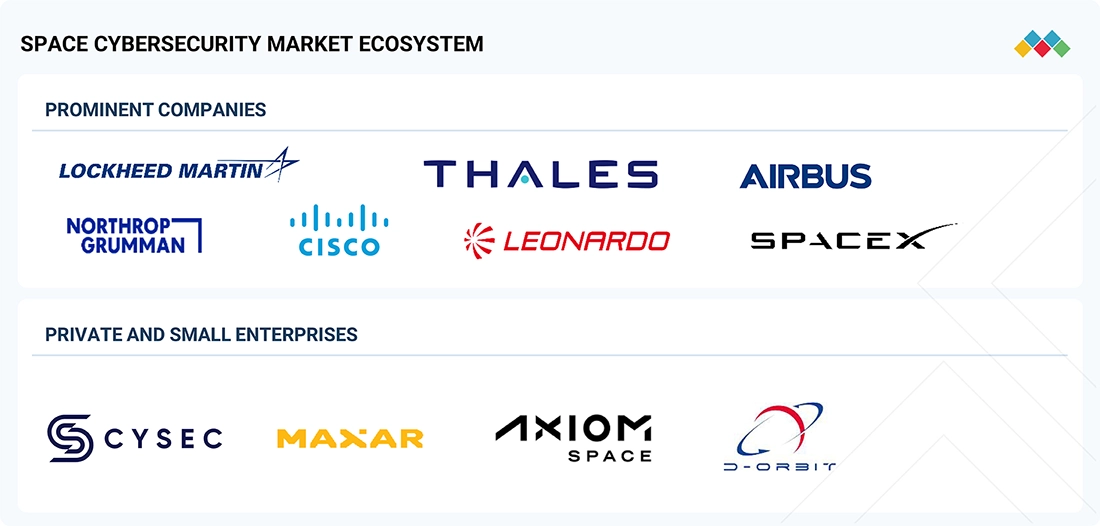
Space Cybersecurity Market: COMMERCIAL USE CASES ACROSS INDUSTRIES
| COMPANY | USE CASE DESCRIPTION | BENEFITS |
|---|---|---|
 |
Partnered with Bitsight for real-time monitoring of vendors’ cybersecurity risks. | Improved efficiency, reduced oversight by 50%, and strengthened mission data protection. |
 |
Upgraded IT and cloud security with Snap Tech IT to meet defense standards. | Lowered IT risks and costs while boosting security and agility. |
 |
Deployed SpiderOak’s OrbitSecure for encrypted, decentralized satellite communications. | Secured military and commercial data, ensuring confidentiality and cyber resilience. |
 |
Partnered with Thales Alenia Space and Telespazio to build the Iris2 secure satellite network for the EU. | Strengthened Europe’s cybersecurity and established a sovereign alternative to non-European constellations. |
Logos and trademarks shown above are the property of their respective owners. Their use here is for informational and illustrative purposes only.
Related Ecosystem
Space
- C-Band
- Small Satellite
- Antennas
- Ka-Band
- Microsatellite
- AIRBUS
- L3Harris Technologies, Inc.
- Thales group
- Northrop Grumman Corporation
- LOCKHEED MARTIN CORPORATION
Key Takeaways
- The US space cybersecurity market will grow from $1,956.5M (2024) to $2,738.6M (2029) at a 7.0% CAGR.
- US government space defense initiatives and commercial satellite expansion are primary growth catalysts.
- The US leads in advanced threat detection, zero-trust architecture, and AI-powered security solutions.
- Regulatory compliance and critical infrastructure protection drive sustained US market investment through 2029.
Space Cybersecurity Market Report Scope
| Report Metric | Details |
|---|---|
| Base Year | 2024 |
| Fastest Growing Segment | SERVICES (Offering) |
| Forecast Period | 2024–2029 |
| Growth Rate | CAGR of 9% from 2024 to 2029 |
| Largest Segment | SOLUTIONS (Offering) |
| Market Size Base Year (Billions) | ~USD 4.52 (2024) |
| Revenue Forecast (Billions) | ~USD 6.96 (2029) |
| Segments Covered | Offering, Solution, Type, Service, Platform, Satellite Orbit, End User, Launch Vehicle |
US Space Cybersecurity Market Report Segmentation
8 segment dimensions are covered across the global market.
By Offering
- Services
- Solutions
By Solution
- Application Security
- Cloud Security
- Data Backup & Recovery
- Encryption & Tokenization
- Endpoint Security
- Identity & Access Management
- Log Management & Siem
- Network Security
- Other Platforms
- Other Solutions
By Type
- Antivirus & Anti-Malware
- Cloud Access Security Broker
- Design, Consulting, And Implementation
- Endpoint Detection & Response
- Intrusion Detection & Prevention Systems
- Medium & Heavy Launch Vehicles
- Network Access Control
- Network Firewall
- Other Application Security Solutions
- Other Endpoint & IoT Security Solutions
- Other Network Security Solutions
- Patch Management
- Risk & Threat Management
- Secure Development Tools
- Security Posture Management
- Small Lift Launch Vehicles
- Support & Maintenance
- Training & Education
- Virtual Private Network
- Web Application Firewall
By Service
- Managed Services
- Professional Services
By Platform
- Command & Control Centers
- Ground Stations
- Launch Vehicles
- Other Platforms
- Satellites
- Spaceports & Launch Facilities
By Satellite Orbit
- Geo
- Leo
- Meo
By End User
- Commercial
- Defense
- Government
By Launch Vehicle
- Medium & Heavy Launch Vehicles
- Small Lift Launch Vehicles
US: SPACE CYBERSECURITY MARKET, BY END USER, 2024–2029
| Segment | 2024 | 2025 | 2026 | 2027 | 2028 | 2029 | CAGR (%) |
|---|---|---|---|---|---|---|---|
| COMMERCIAL | 687.2 | 740.4 | 797.9 | 860.3 | 927.8 | 1001 | 7.8 |
| DEFENSE | 980 | 1040.1 | 1104.3 | 1172.9 | 1246.1 | 1324.4 | 6.2 |
| GOVERNMENT | 289.3 | 310.7 | 333.7 | 358.3 | 384.8 | 413.2 | 7.4 |
| TOTAL | 1956.5 | 2091.2 | 2235.9 | 2391.4 | 2558.7 | 2738.6 | 7 |
Target Audience
- Defense Contractors & Aerospace Firms : Need comprehensive US market data to develop space cybersecurity product portfolios, secure government contracts, and align R&D investments with DoD and intelligence community priorities.
- Cybersecurity Solution Providers : Require detailed US market insights to identify satellite operator clients, understand federal compliance requirements, and position specialized threat detection and mitigation solutions effectively.
- Government & Military Agencies : Utilize market intelligence to assess vendor capabilities, benchmark cybersecurity spending, and inform procurement strategies for protecting critical space-based national security assets.
- Commercial Space Operators : Need market analysis to evaluate cybersecurity investment requirements, identify best-in-class solution providers, and understand regulatory compliance obligations for satellite constellation operations.
- Investment & Private Equity Firms : Require market sizing and growth forecasts to identify high-potential space cybersecurity companies for investment, assess portfolio company positioning, and evaluate acquisition targets in the US market.
Key Companies in the US Space Cybersecurity Market
| Company | HQ | Ownership | Strongest segments |
|---|---|---|---|
| THALES | France | Public Company | Defence & Security Systems (air defence, C4ISR, EW, mission systems),Aerospace & Air Traffic Management,Digital Identity & Security (banking, IAM, biometrics, secure IoT), |
| LOCKHEED MARTIN CORPORATION | United States | Public Company | Aeronautics,Missiles and Fire Control,Rotary and Mission Systems, |
| LEONARDO S.P.A. | Italy | Public Company | Helicopters,Defense Electronics and Security,Aircraft and Aerostructures, |
| SPACEX | United States | Public Company | Launch Services (Falcon 9 / Falcon Heavy / Dragon missions),Starlink Connectivity (consumer, enterprise, government),AI Platform & X (Grok, enterprise AI, ad and subscription revenue), |
| BOOZ ALLEN HAMILTON INC. | United States | Public Company | AI Solutions for Federal Missions,Cyber Solutions and Operations,Cloud, Data Platforms, and Software Modernization, |
| NORTHROP GRUMMAN | United States | Public Company | Space Systems,Mission Systems,Aeronautics Systems, |
| AIRBUS | Netherlands | Public Company | Commercial Aircraft (Airbus segment),Helicopters,Defence and Space, |
| BAE SYSTEMS | United Kingdom | Public Company | Electronic Systems,Air,Platforms & Services, |
| OHB SE | Germany | Public Company | Space Systems (satellites and payloads),Access to Space (assembly and space/aviation products),Digital (mechatronics, launch procurement, IT services), |
| MAXAR TECHNOLOGIES | United States | Private Company | Satellite imagery and access programs (WorldView, Vivid, Access Programs),Geospatial analytics and AI platforms (Tensorglobe, Cortex, Forge, Nexus),3D terrain, digital twins, and modeling/simulation (Vivid Terrain, 3D models, digital twin solutions), |
| GENERAL DYNAMICS CORPORATION | United States | Public Company | Aerospace (business jets and services),Marine Systems (submarines and surface combatants),Combat Systems (land systems and munitions), |
| CISCO SYSTEMS, INC. | United States | Public Company | Networking (campus, data center, branch, wireless, interconnect),Security (network security, SASE, identity, threat detection and response),Collaboration (WEBEX suite, devices, contact center, CPaaS), |
| LEIDOS | United States | Public Company | National Security & Digital (AI/ML mission software, cyber, intel, logistics, digital modernization),Defense Systems (air and missile defense, ISR, space payloads, threat systems),Health & Civil (air traffic control, health mission software, managed health, civil IT and logistics), |
THALES
Thales is a French multinational defense and aerospace company founded in 1893, employing 82,111 people. Operating as a public company, Thales provides advanced technologies and services across defense, security, and aerospace sectors.
LOCKHEED MARTIN CORPORATION
Lockheed Martin Corporation is a U.S.-based defense contractor founded in 1912 with 123,000 employees. As a public company, it is a leading provider of advanced aerospace, defense, and security solutions.
LEONARDO S.P.A.
Leonardo S.p.A. is an Italian defense and aerospace company established in 1948 with 65,455 employees. The public company specializes in advanced technologies for defense, security, and space applications.
SPACEX
SpaceX is a U.S. aerospace manufacturer and space transportation company founded in 2002 with 22,000 employees. Operating as a public company, SpaceX develops rockets and spacecraft for commercial and government missions.
BOOZ ALLEN HAMILTON INC.
Booz Allen Hamilton Inc. is a U.S.-based management and technology consulting firm founded in 1914 with 30,900 employees. As a public company, it provides consulting, analytics, and digital solutions to government and commercial clients.
NORTHROP GRUMMAN
Northrop Grumman is a U.S. defense and aerospace company founded in 1939 with 95,000 employees. The public company specializes in advanced systems, technologies, and services for defense, security, and space markets.
AIRBUS
Airbus is a multinational aerospace corporation founded in 1998 with 166,876 employees, headquartered in the Netherlands. As a public company, Airbus is a leading manufacturer of commercial aircraft, helicopters, and defense systems.
BAE SYSTEMS
BAE Systems is a British multinational defense, security, and aerospace company founded in 1979 with 111,400 employees. As a public company, BAE Systems provides advanced defense technologies and services globally.
OHB SE
OHB SE is a German aerospace and technology company founded in 1993 with 3,974 employees. The public company focuses on space systems, satellite technology, and aerospace solutions.
MAXAR TECHNOLOGIES
Maxar Technologies is a U.S. space technology and intelligence company founded in 1957 with 4,600 employees. Operating as a private company, Maxar provides satellite imagery, geospatial intelligence, and space infrastructure solutions.
GENERAL DYNAMICS CORPORATION
General Dynamics Corporation is a U.S. defense contractor founded in 1899 with 117,000 employees. As a public company, General Dynamics provides advanced technologies and systems for aerospace, defense, and security applications.
CISCO SYSTEMS, INC.
Cisco Systems, Inc. is a U.S. technology company founded in 1984 with 86,200 employees. As a public company, Cisco designs, manufactures, and sells networking equipment and IT infrastructure solutions.
LEIDOS
Leidos is a U.S. science and technology company founded in 1969 with 50,000 employees. Operating as a public company, Leidos provides engineering, IT, and research solutions to government and commercial clients.
Reasons to Buy this Report
- Strategic Market Sizing : Obtain precise US market valuation ($1,956.5M in 2024) and 5-year forecast data to support investment decisions, competitive positioning, and resource allocation in the space cybersecurity sector.
- Government Spending Insights : Understand federal defense budgets, DoD procurement priorities, and critical infrastructure mandates specific to US space cybersecurity, enabling targeted business development and partnership strategies.
- Competitive Landscape Analysis : Identify leading US-based and international players competing in space cybersecurity, their market share, capabilities, and differentiation strategies to inform competitive strategy and M&A opportunities.
- Technology Trend Forecasting : Access detailed analysis of emerging US market trends including AI-driven threat detection, satellite constellation security, and next-generation encryption technologies shaping future demand.
- Risk and Opportunity Assessment : Evaluate geopolitical factors, regulatory developments, and market barriers specific to the US space cybersecurity landscape to mitigate risks and capitalize on emerging growth opportunities.
Frequently asked questions
What is the current size of the US space cybersecurity market?
The US space cybersecurity market was valued at $1,956.5 million in 2024 and is projected to reach $2,738.6 million by 2029.
What is the growth rate of the US space cybersecurity market?
The US space cybersecurity market is expected to grow at a compound annual growth rate (CAGR) of 7.0% from 2024 to 2029.
What are the main drivers of growth in the US space cybersecurity market?
Key drivers include satellite proliferation, government space defense investments, commercial space sector expansion, critical infrastructure protection mandates, and geopolitical security concerns.
Which sectors are driving US space cybersecurity demand?
The US defense sector, commercial satellite operators, space launch providers, and government agencies are primary demand drivers for space cybersecurity solutions.
What technologies are leading the US space cybersecurity market?
Zero-trust architectures, AI-driven threat intelligence, advanced threat detection systems, and integrated ground station security solutions are leading technology trends in the US market.
RESEARCH METHODOLOGY
The research study on the space cybersecurity market involved secondary sources, directories, and databases, such as D&B Hoovers, Bloomberg, and Factiva, to identify and collect relevant information. Primary sources included industry experts from the market, as well as suppliers, manufacturers, solution providers, technology developers, alliances, and organizations related to all segments of the industry’s value chain. In-depth interviews of various primary respondents, including industry participants, subject matter experts, industry consultants, and C-level executives, were conducted to obtain and verify critical qualitative and quantitative information pertaining to the market and assess the market’s growth prospects. A deductive approach, also known as the bottom-up approach, combined with the top-down approach, was used to forecast the market size of different segments.
Secondary Research
The share of companies in the space cybersecurity market was determined based on secondary data made available through paid and unpaid sources and an analysis of the product portfolios of major companies. These companies were rated based on their performance and quality. These data points were further validated by primary sources. Secondary sources for this research study included corporate filings, such as annual reports, investor presentations, and financial statements from trade, business, and professional associations. The secondary data was collected and analyzed to determine the overall market size.
Primary Research
After obtaining information about the current scenario of the space cybersecurity market through secondary research, extensive primary research was conducted. Several primary interviews were conducted with market experts across different regions from the demand and supply sides. This primary data was collected through questionnaires, emails, and telephone interviews.
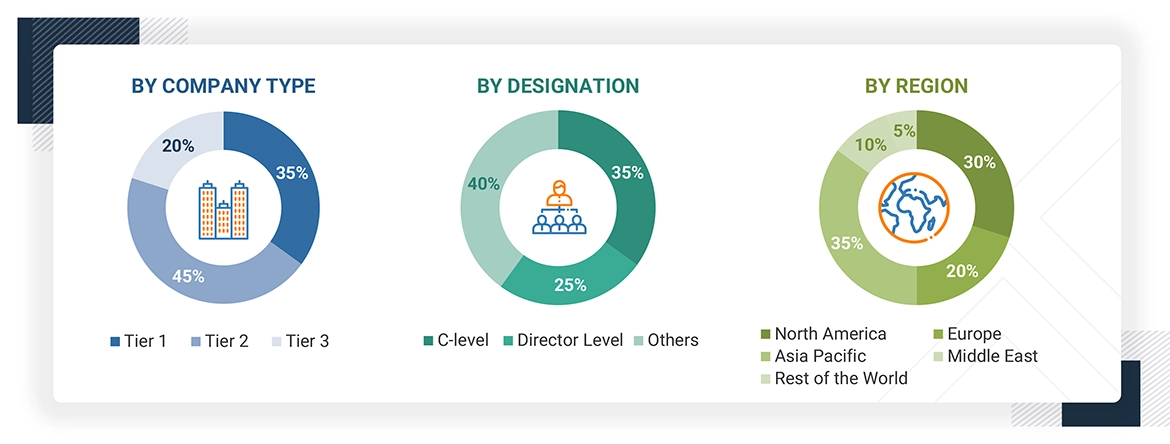
Note: The tiers of companies are based on their revenue in 2023: tier 1 = company revenue greater than USD 1 billion; tier 2 = company revenue between USD 100 million and USD 1 billion; and tier 3 = company revenue less than USD 100 million.
To know about the assumptions considered for the study, download the pdf brochure
Market Size Estimation
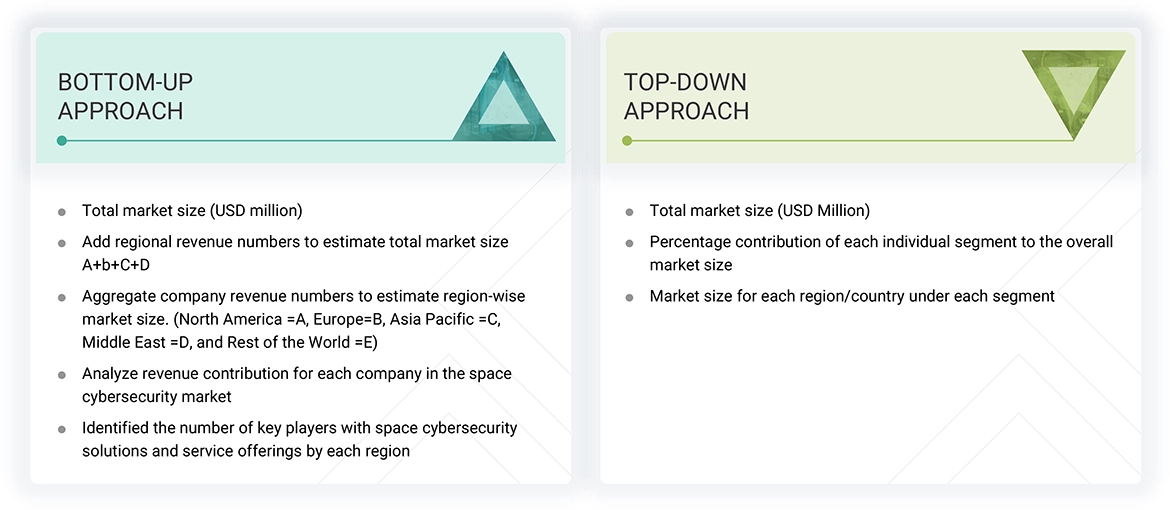
The top-down and bottom-up approaches were used to estimate and validate the size of the space cybersecurity market. The research methodology used to estimate the market size includes the following details.
Key market players were identified through secondary research, and their market share was determined through primary and secondary research. This included a study of the annual and financial reports of top players and extensive interviews with industry stakeholders such as CEOs, technical advisors, military experts, and SMEs of leading companies operating in the space cybersecurity market.
All percentage shares, splits, and breakdowns were determined using secondary sources and verified through primary sources. All possible parameters that affect the markets covered in this research study were accounted for, viewed in extensive detail, verified through primary research, and analyzed to obtain the final quantitative and qualitative data on the space cybersecurity market. This data was consolidated, enhanced with detailed inputs, analyzed by MarketsandMarkets, and presented in this report.
Space Cybersecurity Market : Top-Down and Bottom-Up Approach
Data Triangulation
After arriving at the overall size of the space cybersecurity market from the estimation process explained above, the total market was split into several segments and subsegments. The data triangulation and market breakdown procedures explained below were implemented, wherever applicable, to complete the overall market engineering process and arrive at the exact statistics for various market segments and subsegments. The data was triangulated by studying various factors and trends from the demand and supply sides. The space cybersecurity market size was also validated using the top-down and bottom-up approaches.
Market Definition
Space cybersecurity refers to measures and technologies designed to protect space-based assets such as satellites, ground stations, and other space infrastructure from cyber threats. This market covers the development and deployment of solutions that ensure the security of data transmission, communication networks, and mission-critical operations. It addresses the unique challenges posed by the space environment, making cybersecurity crucial to military, commercial, and government space missions. As space technology becomes integral to various sectors, the scope of this market continues to expand, encompassing a wide range of applications from secure satellite communication to the protection of space infrastructure from cyberattacks.
Key Stakeholders
- Government and regulatory agencies
- Satellite and spacecraft manufacturers
- Cybersecurity solution providers
- Satellite operators and service providers
- Ground station infrastructure providers
- System integrators and service contractors
- End users and customers
- Investors and venture capitalists
- Industry associations
Report Objectives
- To define, describe, segment, and forecast the size of the space cybersecurity market based on offering, platform, end user, and region
- To forecast the size of various market segments with respect to five major regions: North America, Europe, Asia Pacific, the Middle East, and the Rest of the World
- To identify and analyze key drivers, restraints, opportunities, and challenges influencing market growth
- To provide an overview of the regulatory landscape with respect to space cybersecurity regulations globally
- To analyze micro markets with respect to individual growth trends, prospects, and their contribution to the overall market
- To analyze opportunities in the market for stakeholders by identifying market trends
- To profile key market players and comprehensively analyze their market share and core competencies
- To analyze the degree of competition in the market by identifying key growth strategies, such as acquisitions, product launches, contracts, and partnerships, adopted by leading market players
- To identify detailed financial positions, key products, and unique selling points of leading companies in the market
- To provide a detailed competitive landscape of the market, along with market ranking analysis, market share analysis, and revenue analysis of key players
Available Customizations
Along with the market data, MarketsandMarkets offers customizations that meet the specific needs of companies. The following customization options are available for the report:
Solution Analysis
- Product matrix, which involves a detailed comparison of the product portfolio of each company
Regional Analysis
- Further breakdown of market segments at the country level
Company Information
- Detailed analysis and profiling of five additional market players
Get the Full Space Cybersecurity Market Report
Full forecast, segment splits, and company analysis for all Space Cybersecurity Market.
- Canada Space Cybersecurity Market
- UK Space Cybersecurity Market
- Germany Space Cybersecurity Market
- France Space Cybersecurity Market
- Italy Space Cybersecurity Market
- Japan Space Cybersecurity Market
- India Space Cybersecurity Market
- Australia Space Cybersecurity Market
- Malaysia Space Cybersecurity Market
- Israel Space Cybersecurity Market
- Rest Of Europe Space Cybersecurity Market
- Rest Of Asia Pacific Space Cybersecurity Market
- GCC Space Cybersecurity Market
Need a Tailored Report?
Customize this report to your needs
Get 10% FREE Customization
Customize This Report
