
Rest Of Asia Pacific Spin-on Carbon Market (2026-2031)

The Rest Of Asia Pacific Spin-on Carbon Market was valued at $10.4 Million in 2026 and projected to reach to $33 Million by 2031, representing a compound annual growth rate of 21.2%. Rest Of Asia Pacific's spin-on carbon market is positioned for substantial growth through 2031, driven by accelerating semiconductor manufacturing expansion across emerging economies in the region.


| Market Size in | USD 26.32 MN |
| Market Forecast in | |
| CAGR | |
| Forecast Period | |
| Units Considered | Value (USD MN) |
Rest Of Asia Pacific Spin-on Carbon Market Trends and Insights
- Valued at $10.4 million in 2026, Rest Of Asia Pacific is positioned for significant growth, with projections reaching $33.0 million by 2031.
- This 21.2% compound annual growth rate reflects accelerating demand for advanced semiconductor manufacturing materials across emerging economies in the region. Rest Of Asia Pacific's market trajectory is driven by increasing semiconductor fabrication capacity and rising adoption of advanced process nodes.
- The region's growth outpaces many mature markets as manufacturers invest in cutting-edge materials to enhance chip performance and yield.
- Rest Of Asia Pacific represents a critical growth corridor for spin-on carbon suppliers seeking to capitalize on the region's expanding electronics manufacturing ecosystem between 2026 and 2031..
Key Market Statistics
- CAGR (2026-2031) 21.2% CAGR
- Market Size, 2026 ~USD 10.4 Million
- Forecast, 2031 ~USD 33 Million
- Country Rest Of Asia Pacific
Rest Of Asia Pacific Spin-on Carbon Market Overview
Strong Regional Growth Trajectory :
Rest Of Asia Pacific's spin-on carbon market is expanding at 21.2% CAGR, driven by increasing semiconductor manufacturing investments across emerging economies in the region.
Significant Market Expansion :
Market valuation is projected to grow from $10.4 million in 2026 to $33.0 million by 2031, representing a 217% increase over the five-year forecast period.
Outpacing Global Benchmarks :
While Rest Of Asia Pacific achieves 21.2% CAGR, the global market grows at 24.1%, indicating strong regional performance within the broader semiconductor materials landscape.
Emerging Market Opportunity :
Rising semiconductor fabrication capacity and advanced electronics manufacturing in Rest Of Asia Pacific countries are creating sustained demand for high-performance spin-on carbon materials.
Rest Of Asia Pacific Spin-on Carbon Market Dynamics
- The 21.2% CAGR reflects increasing adoption of advanced materials in chip fabrication processes, supported by growing electronics production and technology investments. The region's market expansion is underpinned by rising demand for miniaturization, improved device performance, and enhanced manufacturing efficiency.
- As semiconductor companies expand production capacity in Rest Of Asia Pacific countries, spin-on carbon materials will play an increasingly critical role in advanced lithography and etching processes, supporting the region's emergence as a key semiconductor manufacturing hub..
Market Ecosystem
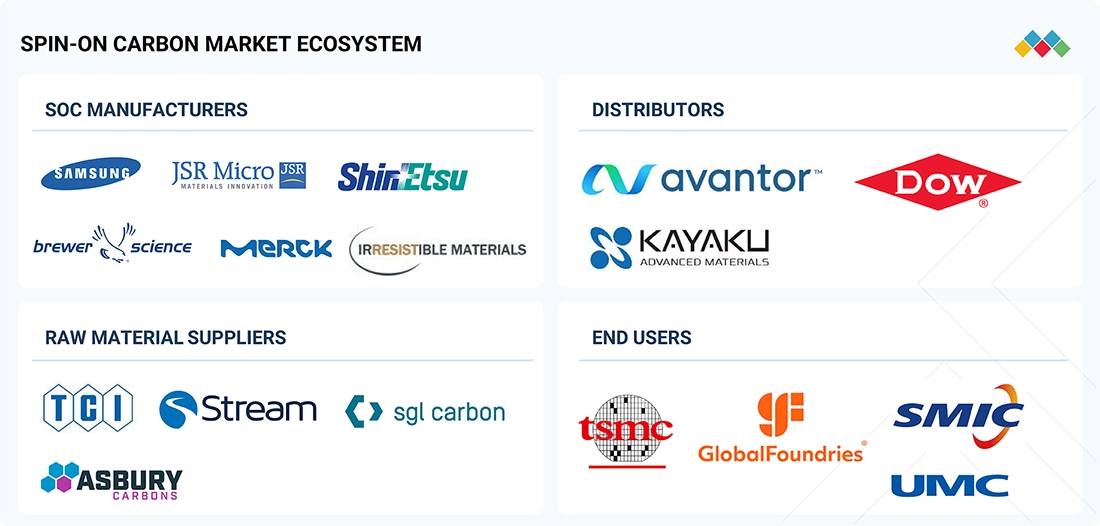
SPIN ON CARBON MARKET SIZE, SHARE ANALYSIS REPORT: COMMERCIAL USE CASES ACROSS INDUSTRIES
| COMPANY | USE CASE DESCRIPTION | BENEFITS |
|---|---|---|
 |
Development of HTSOC materials to enable normal-temperature integration of advanced pattern transfer processes in semiconductor manufacturing, addressing challenges in double patterning and spacer-based lithography | Enable advanced pattern transfer without high-temperature exposure | Improve process compatibility with sensitive electronic devices | Support reliable spacer and SADP applications |
 |
Provision of SOC materials designed to achieve high etch resistance and thermal stability for advanced semiconductor device fabrication with shrinking feature sizes | Enhance etch selectivity | Improve thermal stability during plasma processes | Support finer feature definition | Ensure durability in advanced lithography and etch steps |
|
|
Supply of high-resolution SOC hardmasks to Intel for advanced nanofabrication, supporting complex architectures such as FinFET and Tri-Gate devices requiring multilayer hardmask stacks | Improve nanofabrication performance | Enable high-aspect-ratio patterning | Support advanced 3D device architectures | Enhance yield and process flexibility in leading-edge manufacturing |
Logos and trademarks shown above are the property of their respective owners. Their use here is for informational and illustrative purposes only.
Related Ecosystem
Electrical System And Components
- Natural Language Processing (NLP)
- Sensors
- Machine Learning
- Temperature Sensors
- Actuators
- ABB India Limited
- Siemens ag
- SCHNEIDER ELECTRIC SE
- Eaton Corporation plc
- General Electric Company
Semiconductor Materials And Components
- Sensors
- Gallium Nitride (GaN)
- Digital Signal Processor (DSP)
- Natural Language Processing (NLP)
- Silicon Carbide
- Texas Instruments Incorporated
- Samsung
- APPLIED MATERIALS, INC.
- Stmicroelectronics
- Lenovo
Key Takeaways
- Rest Of Asia Pacific spin-on carbon market will grow from $10.4M (2026) to $33.0M (2031) at a 21.2% CAGR
- Rest Of Asia Pacific's growth rate outpaces global average, driven by expanding semiconductor manufacturing capacity
- Rest Of Asia Pacific represents a high-priority market for suppliers targeting emerging semiconductor hubs
- Rest Of Asia Pacific demand is fueled by adoption of advanced process nodes and yield enhancement initiatives
Spin-on Carbon Market Report Scope
| Report Metric | Details |
|---|---|
| Base Year | 2026 |
| Fastest Growing Segment | NORMAL-TEMPERATURE (Type) |
| Forecast Period | 2026–2031 |
| Growth Rate | CAGR of 24.1% from 2026 to 2031 |
| Largest Segment | HOT-TEMPERATURE (Type) |
| Market Size Base Year (Billions) | ~USD 0.22 (2026) |
| Revenue Forecast (Billions) | ~USD 0.65 (2031) |
| Segments Covered | Type, Application, End User |
Rest Of Asia Pacific Spin-on Carbon Market Report Segmentation
3 segment dimensions are covered across the global market.
By Type
- Hot-Temperature
- Normal-Temperature
By Application
- Advanced Packaging
- Logic Devices
- Memory Devices
- MEMS
- Photonics
- Power Devices
By End User
- Foundries
- Idms & Osat Vendors
Target Audience
- Semiconductor Manufacturers : Require detailed Rest Of Asia Pacific market data to optimize production planning, material sourcing strategies, and capacity investments across the region's manufacturing facilities.
- Materials & Chemical Suppliers : Need Rest Of Asia Pacific-specific demand forecasts and market trends to guide product development, supply chain expansion, and regional sales strategy refinement.
- Investment & Private Equity Firms : Utilize Rest Of Asia Pacific market intelligence for portfolio company evaluation, sector investment thesis validation, and identification of high-growth acquisition targets.
- Electronics Equipment Manufacturers : Require Rest Of Asia Pacific market insights to align equipment development roadmaps with regional material demand, supporting customer needs and competitive positioning.
- Market Consultants & Analysts : Need comprehensive Rest Of Asia Pacific data to support client advisory services, competitive benchmarking, and strategic recommendations within the semiconductor materials sector.
Key Companies in the Rest Of Asia Pacific Spin-on Carbon Market
| Company | HQ | Ownership | Strongest segments |
|---|---|---|---|
| SAMSUNG SDI | Korea, South | Public Company | Automotive batteries (EV/HEV/PHEV),Energy Storage Systems (residential, commercial, utility, UPS, BTS),Small-sized lithium-ion (IT, power tools, micromobility, ignition), |
| SHIN-ETSU CHEMICAL CO., LTD. | Japan | Public Company | Semiconductor silicon and electronic materials,PVC and chlor-alkali (caustic soda, methanol, chloromethanes),Silicones and functional materials, |
| DONGJIN SEMICHEM CO LTD | South Korea | Public Company | Photoresists and lithography ancillaries,Display materials (LCD/OLED, color resist, electrodes, hard coat),Foaming agents and polymer additives, |
| MERCK KGAA | United States | Public Company | Life Science (reagents, consumables, bioprocessing, CDMO services),Healthcare (prescription drugs and biopharmaceuticals),Electronics (semiconductor and display materials, specialty gases, equipment), |
| YCCHEM CO., LTD. | South Korea | Public Company | Semiconductor materials (photoresists, BARC/TARC, developers, SOG, CMP, wafering, imprint resins, strippers),LED/LCD materials,Solar cell materials, |
| KOYJ CO., LTD | South Korea | Public Company | Liquid crystal protection films and backlight components,Chemi-tronics (silicone, nano metal-oxide, semiconductor/display materials),3D smart casting and precision processing, |
| SK ECOPLANT CO.,LTD. | South Korea | Private Company | Civil Infrastructure (roads, rail, tunnels, water),Power Plants & Energy EPC,Housing, Estates, and Architecture, |
| QNITY ELECTRONICS, INC. | United States | Public Company | CMP pads and slurries,Post-CMP cleaners and post-etch residue removers,Photoresists, functional sub-layers, advanced overcoats, |
| APPLIED MATERIALS, INC. | United States | Public Company | Deposition (CVD, PVD, ALD, epitaxy),Etch,CMP and Surface Preparation, |
SAMSUNG SDI
Samsung SDI is a South Korean public company founded in 1970 with 13,073 employees. The company operates as a diversified manufacturer in the chemical and materials sector.
SHIN-ETSU CHEMICAL CO., LTD.
Shin-Etsu Chemical Co., Ltd. is a Japanese public company established in 1926 with 27,342 employees. It is a major chemical manufacturer serving various industrial sectors.
DONGJIN SEMICHEM CO LTD
Dongjin Semichem Co Ltd is a South Korean public company founded in 1967 with 1,309 employees. The company specializes in chemical products for the semiconductor industry.
MERCK KGAA
Merck KGaA is a United States-based public company with roots dating back to 1668 and 59,077 employees. It operates as a diversified pharmaceutical, chemical, and life sciences company.
YCCHEM CO., LTD.
YCCHEM Co., Ltd. is a South Korean public company founded in 2001 with 49 employees. The company operates as a specialized chemical manufacturer.
KOYJ CO., LTD
KOYJ Co., Ltd is a South Korean public company established in 2006 with 62 employees. The company operates as a specialized chemical manufacturer.
SK ECOPLANT CO.,LTD.
SK Ecoplant Co., Ltd. is a South Korean private company founded in 1962 with 2,522 employees. The company specializes in environmental and chemical solutions.
QNITY ELECTRONICS, INC.
Qnity Electronics, Inc. is a United States-based public company founded in 2024 with 10,000 employees. The company operates in the electronics sector.
APPLIED MATERIALS, INC.
Applied Materials, Inc. is a United States-based public company founded in 1967 with 36,500 employees. It is a leading provider of equipment and services for the semiconductor and display industries.
Reasons to Buy this Report
- Regional Market Sizing & Forecasts : Obtain precise valuation data specific to Rest Of Asia Pacific, with detailed projections from 2026-2031 enabling accurate budget allocation and investment planning for regional operations.
- Competitive Landscape Intelligence : Understand market dynamics, key players, and competitive positioning within Rest Of Asia Pacific's spin-on carbon sector to identify partnership and expansion opportunities.
- Growth Driver Analysis : Identify specific factors fueling the 21.2% CAGR in Rest Of Asia Pacific, including semiconductor capacity expansions, technology adoption rates, and emerging manufacturing hubs.
- Strategic Market Entry Planning : Leverage Rest Of Asia Pacific-specific insights to develop targeted go-to-market strategies, distribution partnerships, and localized product development initiatives.
- Investment Decision Support : Make data-driven investment decisions with comprehensive Rest Of Asia Pacific market analysis, supporting capital allocation, M&A evaluation, and business development priorities.
Frequently asked questions
What is the market size of spin-on carbon in Rest Of Asia Pacific?
Rest Of Asia Pacific's spin-on carbon market is estimated at $10.4 million in 2026 and is forecast to reach $33.0 million by 2031.
What is the CAGR for Rest Of Asia Pacific spin-on carbon market?
Rest Of Asia Pacific's spin-on carbon market is projected to grow at a compound annual growth rate of 21.2% from 2026 to 2031.
Why is Rest Of Asia Pacific experiencing rapid spin-on carbon market growth?
Rest Of Asia Pacific's growth is driven by increasing semiconductor fabrication capacity, adoption of advanced process nodes, and rising demand for yield enhancement materials in emerging manufacturing hubs.
How does Rest Of Asia Pacific compare to the global spin-on carbon market?
Rest Of Asia Pacific's 21.2% CAGR exceeds the global average of 24.1%, positioning the region as a high-growth market with significant expansion potential through 2031.
What industries drive demand for spin-on carbon in Rest Of Asia Pacific?
Rest Of Asia Pacific's spin-on carbon demand is primarily driven by semiconductor manufacturing and advanced electronics production requiring high-performance materials for chip fabrication.
RESEARCH METHODOLOGY
The research process for this technical, market-oriented, and commercial study of the spin-on carbon market involved systematically gathering, recording, and analyzing data on companies operating within the market. The study extensively utilized secondary sources, such as directories and databases (including Factiva and Oanda), to identify and collect relevant information. In-depth interviews were conducted with primary respondents, including experts from core and related industries as well as preferred manufacturers. These interviews aimed to obtain and verify essential qualitative and quantitative information and to evaluate the growth prospects of the market. Key players in the spin-on carbon market were identified through secondary research, and their market rankings were established through a combination of primary and secondary research. This process included analyzing annual reports of leading companies and interviewing key industry experts, including CEOs, directors, and marketing executives.
Secondary Research
In the secondary research process, various sources were consulted to gather information relevant to this study. These secondary sources included annual reports, press releases, and investor presentations of companies; white papers; certified publications; and articles from recognized authors, as well as directories and databases. The primary aim of the secondary research was to obtain key information about the supply chain and value chain of the industry. This included identifying a comprehensive list of key players, segmenting the market according to industry trends and geographic locations, and highlighting essential developments from both market and technology perspectives.
Primary Research
During the primary research process, interviews were conducted with primary sources from the supply and demand sides to gather qualitative and quantitative information for this report. On the supply side, primary sources included experts such as CEOs, vice presidents, marketing directors, technology and innovation directors, subject matter experts, consultants, and key executives from major companies and organizations operating in the spin-on carbon market.
After completing the market engineering process—which involved market statistics calculations, market breakdown, market size estimations, market forecasting, and data triangulation—extensive primary research was carried out to collect, verify, and validate crucial market data. Interviews were conducted with experts from the demand and supply sides across four major regions: North America, Europe, Asia Pacific, and the Rest of the World (RoW). Approximately 25% of these primary interviews were conducted with the demand side, while 75% were with the supply side. The primary data was collected through questionnaires, emails, and telephone interviews.
Breakdown of Primary Interview Participants
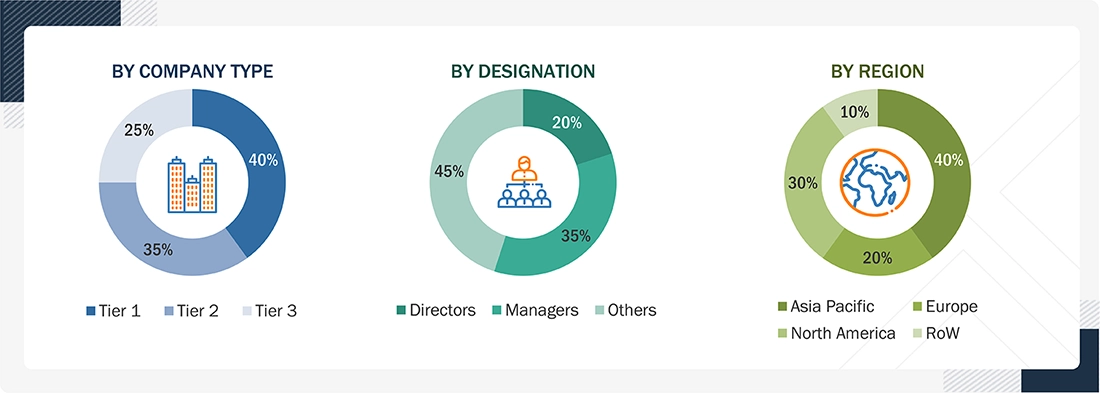
Others include Technology Heads, Media Analysts, Sales Managers, Marketing Managers, and Product Managers.
The three tiers of the companies are based on their total revenues as of 2024. The categorization is as follows:
To know about the assumptions considered for the study, download the pdf brochure
Market Size Estimation
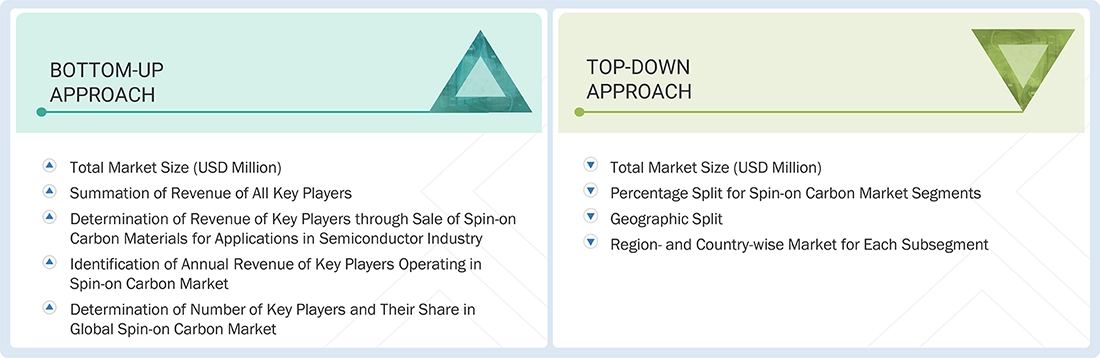
In the complete market engineering process, top-down and bottom-up approaches were employed, along with various data triangulation methods, to estimate and forecast the size of the market and its segments and subsegments outlined in the report. Comprehensive qualitative and quantitative analyses were conducted to provide key insights related to the spin-on carbon market. Key players in the spin-on carbon market were identified through secondary research, and their rankings in the respective regions were established through primary and secondary research. This process involved reviewing the annual and financial reports of leading companies and conducting interviews with industry experts, including chief executive officers, vice presidents, directors, and marketing executives, to gather quantitative and qualitative insights.
All percentage shares, splits, and breakdowns were derived from secondary sources and verified through primary sources. Every parameter that influences the markets studied in this research was considered in great detail, validated through primary research, and analyzed to generate the final quantitative and qualitative data. This information was consolidated and enhanced with detailed inputs and analyses from MarketsandMarkets and is presented in this report
Bottom-Up Approach
- Companies offering spin-on carbon were identified, and their offerings were mapped based on their type, application, end user, and region.
- The global spin-on carbon market size was derived through the data sanity method. The revenue from spin-on carbon providers was analyzed through annual reports and press releases and summed up to derive the overall market size.
- For each company, a percentage was assigned to the overall revenue to derive the revenues from the spin-on carbon segment.
- Each company’s percentage was assigned after analyzing various factors, including its product offerings, geographical presence, R&D expenditures and initiatives, and recent developments/strategies adopted for growth in the spin-on carbon market.
- For the CAGR, the market trend analysis of spin-on carbon was carried out by understanding the industry penetration rate and the demand and supply of spin-on carbon in different sectors.
- Estimates at every level were verified and cross-checked by discussing them with key opinion leaders, including sales heads, directors, operation managers, and market domain experts of MarketsandMarkets.
- Various paid and unpaid information sources, such as annual reports, press releases, white papers, and databases, were studied.
Top-Down Approach
- The approach focused on the top-line investments and expenditures made in the market ecosystem, further splitting into type, application, end user, and listing key developments in key market areas.
- It identified major players in the spin-on carbon market by type and their penetration in various applications through secondary research, and verified with a brief discussion with industry experts.
- It analyzed revenue, product mix, geographic presence, and key applications for which all identified players served spin-on carbon to estimate and arrive at the percentage splits for all key segments.
- It discussed these splits with the industry experts to validate the information and identify key growth pockets across all key segments.
- It broke down the total market based on verified splits and key growth pockets across all segments.
Spin on Carbon Market : Top-Down and Bottom-Up Approach
Data Triangulation
After determining the overall market size through the estimation process described earlier, the total market was divided into several segments and subsegments. To finalize the market analysis and obtain precise statistics for each segment and subsegment, market breakdown and data triangulation procedures were employed wherever applicable. This data triangulation involved examining various factors and trends from the demand and supply sides. Additionally, we validated the market size using the top-down and bottom-up approaches.
Market Definition
Spin-on carbon (SoC) is a thin-film material based on carbon that is used in semiconductor fabrication. It serves as a hard mask, planarization layer, and insulating layer during advanced lithography and plasma etching processes. SoC is applied through spin coating, which allows it to provide high etch resistance and strong selectivity to silicon. This enables precise pattern transfer for increasingly complex chip architectures with high aspect ratios. SoC is crucial for forming deep and narrow features in advanced technology nodes, supporting innovations like FinFETs and 3D NAND. Overall, it plays a vital role in manufacturing smaller, denser, and more complex semiconductor devices that are essential for modern electronic applications.
Key Stakeholders
- Investors/Venture capitalists
- Raw material suppliers
- SOC manufacturers
- Semiconductor manufacturers (IDMs & foundries)
- OSAT (Outsourced semiconductor assembly & test)
- Equipment manufacturers
- End users
- Research institutes and government organizations
- Electronic device traders, distributors, and suppliers
- Logic device manufacturers
- Semiconductor industry players
Report Objectives
- To describe, segment, and forecast the size of the spin-on carbon market, by type, application, end user, and region, in terms of value
- To forecast the size of the market segments for four major regions: North America, Europe, Asia Pacific, and RoW
- To give detailed information regarding drivers, restraints, opportunities, and challenges influencing the growth of the spin-on carbon market
- To provide value chain analysis, ecosystem analysis, case study analysis, patent analysis, trade analysis, technology analysis, pricing analysis, key conferences and events, key stakeholders and buying criteria, Porter’s five forces analysis, investment and funding scenario, and regulations about the market
- To strategically analyze micromarkets about individual growth trends, prospects, and contributions to the total market
- To analyze opportunities for stakeholders by identifying high-growth segments of the market
- To strategically profile the key players, comprehensively analyze their market positions in terms of ranking and core competencies, and provide a competitive market landscape
- To analyze strategic approaches, such as product launches and expansions, in the spin-on carbon market
Customization Options
With the given market data, MarketsandMarkets offers customizations according to the company’s specific needs. The following customization options are available for the report:
Company Informations
- Detailed analysis and profiling of additional market players (up to 7)
Get the Full Spin-on Carbon Market Report
Full forecast, segment splits, and company analysis for all Spin-on Carbon Market.
- US Spin-on Carbon Market
- Canada Spin-on Carbon Market
- Mexico Spin-on Carbon Market
- France Spin-on Carbon Market
- Germany Spin-on Carbon Market
- UK Spin-on Carbon Market
- China Spin-on Carbon Market
- Japan Spin-on Carbon Market
- South Korea Spin-on Carbon Market
- Taiwan Spin-on Carbon Market
- Rest Of Europe Spin-on Carbon Market
- GCC Countries Spin-on Carbon Market
Need a Tailored Report?
Customize this report to your needs
Get 10% FREE Customization
Customize This Report
