
India Superconducting Wire Market (2025-2030)

The India Superconducting Wire Market was valued at $14.9 Million in 2025 and projected to reach to $24.7 Million by 2030, representing a compound annual growth rate of CAGR 10.7%. India's superconducting wire market is experiencing accelerated growth driven by substantial investments in power infrastructure modernization and the nation's renewable energy transition.


| Market Size in | USD 26.32 MN |
| Market Forecast in | |
| CAGR | |
| Forecast Period | |
| Units Considered | Value (USD MN) |
India Superconducting Wire Market Trends and Insights
- India's market growth trajectory reflects increasing investments in power transmission infrastructure and renewable energy integration across the nation.
- The 10.7% compound annual growth rate underscores India's commitment to modernizing its electrical grid and adopting advanced technologies for energy efficiency. India's superconducting wire sector is driven by rising demand from power utilities, research institutions, and emerging applications in medical imaging and industrial cooling systems.
- India's strategic focus on reducing transmission losses and enhancing grid reliability positions superconducting wire as a critical component in the country's energy transition.
- Between 2025 and 2030, India is expected to witness accelerated adoption as manufacturing capabilities expand and costs decline, supported by government initiatives promoting clean energy infrastructure..
Key Market Statistics
- CAGR (2025-2030) CAGR 10.7%
- Market Size, 2025 ~USD 14.9 Million
- Forecast, 2030 ~USD 24.7 Million
- Country India
India Superconducting Wire Market Overview
Market Valuation Growth :
India's superconducting wire market is valued at USD 14.9 million in 2025, with projections reaching USD 24.7 million by 2030, representing a robust 10.7% CAGR aligned with global expansion trends.
Power Transmission Modernization :
Significant investments in India's power transmission infrastructure are driving superconducting wire adoption, enabling efficient long-distance electricity distribution and reducing transmission losses across the nation.
Renewable Energy Integration :
India's aggressive renewable energy targets are accelerating superconducting wire deployment in grid modernization projects, supporting the integration of solar and wind power into existing electrical networks.
Government Infrastructure Initiatives :
National grid expansion programs and smart grid development projects are catalyzing demand for advanced superconducting technologies, positioning India as a key growth market in Asia.
India Superconducting Wire Market Dynamics
- The 10.7% CAGR reflects India's strategic focus on upgrading transmission networks to support increasing electricity demand while minimizing losses.
- Government initiatives promoting smart grid technology and renewable integration are creating sustained demand for superconducting solutions. Looking ahead, India's market expansion will be fueled by continued infrastructure development, rising energy consumption, and policy support for clean energy adoption.
- The convergence of grid modernization projects and renewable capacity additions presents significant opportunities for superconducting wire manufacturers and technology providers operating in the Indian market..
Market Ecosystem
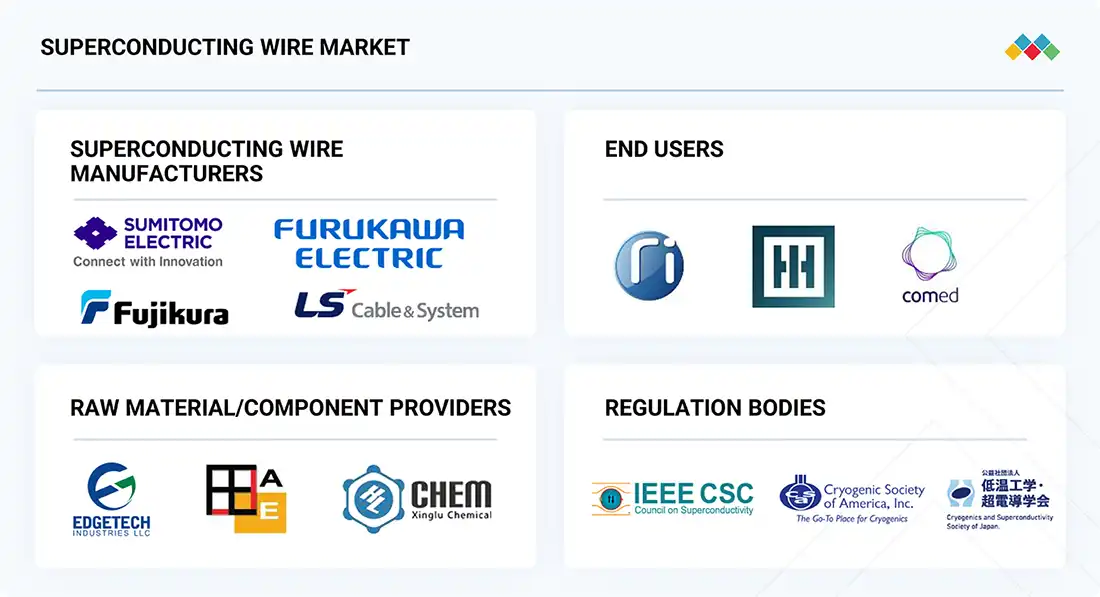
Superconducting Wire Market: COMMERCIAL USE CASES ACROSS INDUSTRIES
| COMPANY | USE CASE DESCRIPTION | BENEFITS |
|---|---|---|
 |
Supplies superconducting wire and magnet systems for particle accelerators and research facilities (e.g., CERN, fusion projects) | Enables high-field research magnets, supports compact accelerator designs, advances nuclear fusion research |
 |
Collaborates on superconducting wire integration in naval propulsion and defense systems | Higher energy efficiency, reduced acoustic signature, compact shipboard power systems |
 |
Deploys superconducting wire for ship propulsion motors and advanced power systems | Significant weight reduction, improved efficiency, silent operation, higher power density for naval vessels |
 |
Pilots superconducting cable projects for grid reliability and urban power delivery | Enhances grid stability, reduces transmission losses, supports renewable energy integration |
Logos and trademarks shown above are the property of their respective owners. Their use here is for informational and illustrative purposes only.
Related Ecosystem
Power Infrastructure
- Geographical Information System (GIS)
- Cogeneration
- Battery Electric Vehicle (BEV)
- Cellular Network
- Fuel Cell
- Siemens ag
- ABB India Limited
- SCHNEIDER ELECTRIC SE
- General Electric Company
- Eaton Corporation plc
Key Takeaways
- India's superconducting wire market is valued at USD 14.9 million in 2025 and is forecast to grow to USD 24.7 million by 2030.
- India's market is expanding at a CAGR of 10.7%, driven by grid modernization and renewable energy integration initiatives.
- India's power transmission sector represents the largest application segment for superconducting wire technology.
- India's government support for clean energy infrastructure and manufacturing localization is accelerating market adoption.
Superconducting Wire Market Report Scope
| Report Metric | Details |
|---|---|
| Base Year | 2025 |
| Fastest Growing Segment | HTS WIRES (Type) |
| Forecast Period | 2025-2030 |
| Growth Rate | CAGR of 10.6% from 2025 to 2030 |
| Largest Segment | DIRECT SALES CHANNEL (Sales Channel) |
| Market Size Base Year (Billions) | ~USD 1.32 (2025) |
| Revenue Forecast (Billions) | ~USD 2.19 (2030) |
| Segments Covered | Type, Sales Channel, Application, End User |
India Superconducting Wire Market Report Segmentation
4 segment dimensions are covered across the global market.
By Type
- First-Generation
- Hts Wires
- Lts Wires
- Mts Wires
- Second-Generation
By Sales Channel
- Direct Sales Channel
- Indirect Sales Channel
By Application
- Maglev
- Magnetic Resonance Imaging
- Other Applications
- Power Grid Infrastructure
- Superconducting Fault Current Limiter
By End User
- Energy
- Healthcare
- Other End Users
- Research
- Transportation
INDIA: SUPERCONDUCTING WIRE MARKET, BY END USER, 2025–2030
| Segment | 2025 | 2026 | 2027 | 2028 | 2029 | 2030 | CAGR (%) |
|---|---|---|---|---|---|---|---|
| ENERGY | 4.9 | 5.4 | 6 | 6.7 | 7.5 | 8.4 | 11.6 |
| HEALTHCARE | 5.7 | 6.3 | 6.9 | 7.6 | 8.4 | 9.3 | 10.2 |
| OTHER END USERS | 0.5 | 0.5 | 0.6 | 0.6 | 0.7 | 0.8 | 9.5 |
| RESEARCH | 2.6 | 2.8 | 3.1 | 3.4 | 3.8 | 4.2 | 10.4 |
| TRANSPORTATION | 1.3 | 1.4 | 1.5 | 1.7 | 1.9 | 2.1 | 10.3 |
| TOTAL | 14.9 | 16.5 | 18.2 | 20.1 | 22.3 | 24.7 | 10.7 |
Target Audience
- Power Utility Companies : Indian power utilities need market intelligence to plan grid modernization investments, evaluate superconducting wire adoption for transmission efficiency, and optimize capital allocation across infrastructure projects.
- Superconducting Wire Manufacturers : Global and regional manufacturers require India-specific demand forecasts, growth trajectory analysis, and competitive landscape insights to develop market entry strategies and production capacity plans.
- Renewable Energy Developers : Solar and wind energy companies need data on superconducting wire integration in grid connections, understanding how advanced transmission technologies support renewable capacity expansion in India.
- Infrastructure Investment Firms : Private equity and infrastructure funds require market sizing and growth projections to evaluate investment opportunities in India's power transmission modernization and smart grid development sectors.
- Government & Policy Makers : Indian government agencies and planning bodies need market research to inform infrastructure policy, renewable energy integration strategies, and technology adoption roadmaps for national grid modernization.
Reasons to Buy this Report
- India-Specific Market Sizing : Access precise valuation data for India's superconducting wire market with verified 2025 baseline (USD 14.9M) and 2030 forecasts (USD 24.7M), enabling accurate business planning and investment decisions.
- Infrastructure Investment Tracking : Understand India's power transmission modernization initiatives and their direct impact on superconducting wire demand, identifying key project opportunities and government spending patterns.
- Renewable Energy Correlation Analysis : Gain insights into how India's renewable energy targets drive superconducting wire adoption, with detailed analysis of grid integration requirements and technology deployment timelines.
- Competitive Positioning Strategy : Benchmark your organization against India market growth rates (10.7% CAGR) and identify regional expansion opportunities, supplier partnerships, and technology differentiation strategies.
- Policy & Regulatory Landscape : Stay informed on India's government initiatives supporting smart grid development and infrastructure modernization, enabling proactive alignment with regulatory requirements and incentive programs.
Frequently asked questions
What is the current market size of superconducting wire in India?
India's superconducting wire market was valued at USD 14.9 million in 2025 and is expected to grow significantly through 2030.
What is the projected growth rate for India's superconducting wire market?
India's superconducting wire market is projected to grow at a CAGR of 10.7% from 2025 to 2030.
What are the primary drivers of growth in India's superconducting wire market?
India's market growth is driven by grid modernization, renewable energy integration, transmission loss reduction, and government initiatives supporting clean energy infrastructure.
What is the forecast market size for India's superconducting wire market by 2030?
India's superconducting wire market is forecast to reach USD 24.7 million by 2030, representing a 65.8% increase from 2025 levels.
Which sectors are driving demand for superconducting wire in India?
India's primary demand drivers include power utilities for transmission infrastructure, research institutions, medical imaging applications, and industrial cooling systems.
RESEARCH METHODOLOGY
The study involved major activities in estimating the current size of the superconducting wire market. Exhaustive secondary research was done to collect information on the peer and parent markets. The next step was to validate these findings, assumptions, and sizing with industry experts across the value chain through primary research. Both top-down and bottom-up approaches were employed to estimate the complete market size. Thereafter, market breakdown and data triangulation were used to estimate the market size of the segments and subsegments.
Secondary Research
Secondary sources for this research study include annual reports, press releases, and investor presentations of companies; white papers; certified publications; articles from recognized authors; and databases of various companies and associations. Secondary research was mainly used to obtain key information about the industry’s supply chain, monetary chain, the pool of key players, market classification, and segmentation according to industry trends to the bottom-most level, regional markets, and key developments from market- and technology-oriented perspectives.
Primary Research
In the primary research process, various primary sources from both the supply and demand sides were interviewed to obtain qualitative and quantitative information for this report. Primary sources from the supply side include industry experts, such as CEOs, vice presidents, marketing directors, technology & innovation directors, and related key executives from various companies and organizations operating in the superconducting wire market.
In the complete market engineering process, the top-down and bottom-up approaches and several data triangulation methods were used to estimate and forecast the market segments and subsegments listed in this report. Extensive qualitative and quantitative analyses were performed to list key information/insights in the report.
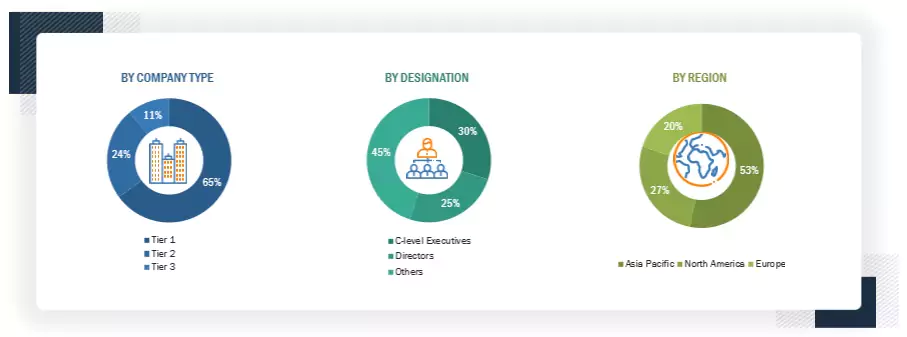
Note: Other designations include sales managers, engineers, and regional managers.
The tiers of the companies are defined based on their total revenue as of 2024: Tier 1: >USD 1 billion, Tier 2: USD 500
million–1 billion, and Tier 3:
To know about the assumptions considered for the study, download the pdf brochure
Market Size Estimation
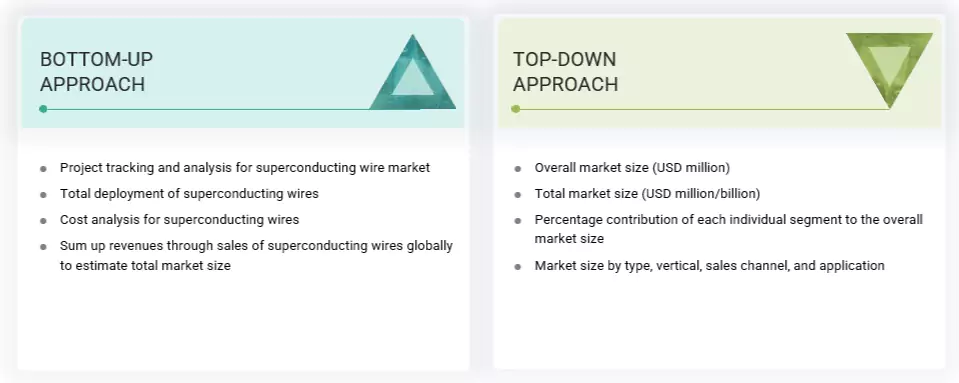
The top-down and bottom-up approaches were used to estimate and validate the size of the global superconducting wire market and evaluate the sizes of various dependent submarkets. The key players in the market were identified through secondary research, and their shares in the respective regions were determined through primary and secondary research. This entire procedure included studying annual and financial reports of top market players and extensive interviews for key insights with industry leaders such as CEOs, VPs, directors, and marketing executives. All percentage shares, splits, and breakdowns were determined using secondary sources and verified through primary sources. All possible parameters that affect the markets covered in this research study were accounted for, viewed in extensive detail, verified through primary research, and analyzed to get the final quantitative and qualitative data.
Superconducting Wire Market : Top-Down and Bottom-Up Approach
Data Triangulation
After arriving at the overall market size from the estimation process explained below, the total market was split into several segments and subsegments. Wherever applicable, the data triangulation and market breakdown procedures were employed to complete the overall market engineering process and arrive at the exact statistics for all the segments and subsegments. The data was triangulated by studying various factors and trends from both the demand and supply sides.
Market Definition
Superconducting wires are high-performance conductors characterized by zero electrical resistance and the expulsion of magnetic fields (known as the Meissner effect) when cooled below a specific critical temperature. The materials commonly used in these wires include niobium-titanium (NbTi) and niobium-tin (Nb3Sn) for low-temperature superconductors (LTS), as well as rare-earth-based compounds, such as YBCO and Bi-2212, for high-temperature superconductors (HTS). A typical superconducting wire or cable consists of a superconducting filament embedded within a stabilizing matrix—usually copper or silver—with optional insulation or sheathing, depending on the intended application. These wires are manufactured in various forms, including multi-filamentary wires, tapes, or round wires, tailored to meet specific performance requirements.
The production of superconducting wires involves several key processes, including powder-in-tube extrusion, chemical vapor deposition (CVD), pulsed laser deposition (PLD), and rolling-assisted biaxially textured substrates (RABiTS) for high-temperature superconductor (HTS) tapes. These wires are specifically engineered for demanding applications that require minimal energy loss, high current density, and strong magnetic field tolerance. Typical use cases include MRI systems, power transmission cables, superconducting fault current limiters (SFCLs), magnetically levitated (maglev) trains, and particle accelerators.
Stakeholders
- Superconducting magnet and coil system integrators
- Cryogenic equipment and cooling system providers
- Material suppliers (e.g., niobium, yttrium, bismuth, silver, copper)
- Medical imaging equipment manufacturers (e.g., MRI, NMR)
- High-energy physics laboratories and research institutes
- Smart grid and power transmission system integrators
- Maglev transportation and rail system developers
- Fusion energy and particle accelerator project stakeholders (e.g., ITER, CERN)
- Defense and aerospace organizations using superconducting systems
- National and regional energy ministries and regulatory bodies
- Research and development organizations (government and private)
- Academic institutions involved in superconductivity research
- Environmental and energy-efficiency policy advocacy groups
- Engineering, procurement, and construction (EPC) companies
- Testing, inspection, and certification (TIC) service providers
- Standardization bodies (e.g., IEC, IEEE, ASTM)
- Clean technology investment firms and venture capitalists
- Energy utilities and grid operators
- Consulting firms specializing in advanced materials and energy systems
Report Objectives
- To define, describe, segment, and forecast the superconducting wire market based on type, end user, application, sales channel, and region, in terms of value
- To forecast the market size, in terms of volume, at a global level
- To provide detailed information on the major factors influencing the growth of the market (drivers, restraints, opportunities, and challenges)
- To strategically analyze the micromarkets with respect to individual growth trends, future expansions, and the contribution to the market
- To analyze market opportunities for stakeholders and the details of the competitive landscape for market leaders
- To forecast the growth of the superconducting wire market with respect to the main regions—Asia Pacific, Europe, North America, and RoW
- To strategically profile key players and comprehensively analyze their market rankings and core competencies
- To analyze competitive developments in the superconducting wire market, such as agreements, investments & expansions, product launches/developments, and mergers & acquisitions
Available Customizations
MarketsandMarkets offers customizations according to the specific needs of the companies using the given market data.
The following customization options are available for the report:
Product Analysis
- Product matrix, which gives a detailed comparison of the product portfolio of each company
Geographic Analysis as per Feasibility
- Further breakdown of the superconducting wire market, by Europe, Asia Pacific, North America, and Rest of the World
Company Information
- Detailed analysis and profiling of additional market players (up to five)
Get the Full Superconducting Wire Market Report
Full forecast, segment splits, and company analysis for all Superconducting Wire Market.
- Japan Superconducting Wire Market
- South Korea Superconducting Wire Market
- Australia Superconducting Wire Market
- New Zealand Superconducting Wire Market
- Rest Of Europe Superconducting Wire Market
- Rest Of Asia Pacific Superconducting Wire Market
- US Superconducting Wire Market
- Canada Superconducting Wire Market
- Mexico Superconducting Wire Market
- Germany Superconducting Wire Market
- UK Superconducting Wire Market
- Italy Superconducting Wire Market
- France Superconducting Wire Market
- Switzerland Superconducting Wire Market
- Sweden Superconducting Wire Market
- China Superconducting Wire Market
Need a Tailored Report?
Customize this report to your needs
Get 10% FREE Customization
Customize This Report
