
Rest Of Europe Sustainability Certification Market (2025-2030)

The Rest Of Europe Sustainability Certification Market was valued at $17.8 Million in 2025 and projected to reach to $23.2 Million by 2030, representing a compound annual growth rate of 5.4%. Rest Of Europe's sustainability certification market is poised for steady expansion as regulatory frameworks tighten and corporate sustainability commitments become non-negotiable.


| Market Size in | USD 26.32 MN |
| Market Forecast in | |
| CAGR | |
| Forecast Period | |
| Units Considered | Value (USD MN) |
Rest Of Europe Sustainability Certification Market Trends and Insights
- This growth reflects increasing regulatory pressures and corporate sustainability commitments across Rest Of Europe, where manufacturers are adopting certifications to meet environmental and social governance standards.
- Rest Of Europe's market expansion is driven by stricter EU-aligned regulations, supply chain transparency demands, and consumer preference for certified sustainable electronics products. Rest Of Europe demonstrates steady momentum as semiconductor and electronics companies invest in sustainability certifications to maintain competitive advantage and regulatory compliance.
- The region's growth trajectory from 2025 to 2030 underscores the importance of environmental accountability in Rest Of Europe's electronics sector.
- Rest Of Europe's market participants are increasingly recognizing certification as a strategic differentiator, supporting the region's transition toward circular economy principles and responsible manufacturing practices..
Key Market Statistics
- CAGR (2025-2030) 5.4% CAGR
- Market Size, 2025 ~USD 17.8 Million
- Forecast, 2030 ~USD 23.2 Million
- Country Rest Of Europe
Rest Of Europe Sustainability Certification Market Overview
Market Valuation :
Rest Of Europe's sustainability certification market in semiconductor and electronics is valued at $17.8 million in 2025, with strong growth trajectory through 2030.
Growth Rate :
The region demonstrates a CAGR of 5.4% from 2025 to 2030, outpacing some mature markets but reflecting steady adoption of sustainability practices across European manufacturers.
Regulatory Environment :
Increasing regulatory pressures from EU directives and national sustainability mandates are driving manufacturers in Rest Of Europe to adopt certifications for compliance and competitive advantage.
Corporate Commitments :
European semiconductor and electronics companies are increasingly committing to sustainability goals, creating demand for third-party certifications to validate environmental and social responsibility claims.
Rest Of Europe Sustainability Certification Market Dynamics
- The region's manufacturers are increasingly recognizing certifications as essential tools for market access, supply chain transparency, and stakeholder trust.
- With the EU's Green Deal and circular economy initiatives driving policy changes, companies across the semiconductor and electronics sector are investing in certifications to demonstrate compliance and environmental stewardship. The forecast growth to $23.2 million by 2030 reflects accelerating adoption among mid-sized and smaller manufacturers who previously lacked resources for certification.
- Digital transformation and standardized certification processes are reducing barriers to entry, while consumer demand for sustainable electronics continues to intensify.
- Rest Of Europe's position as a manufacturing and innovation hub positions it well to lead certification adoption across the broader European market..
Market Ecosystem
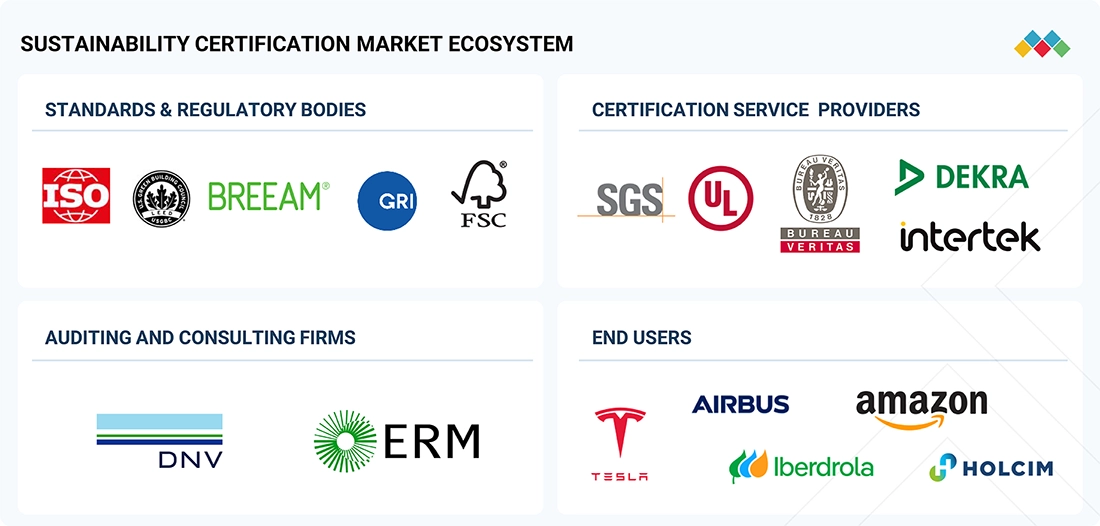
Sustainability Certification Market Trends: COMMERCIAL USE CASES ACROSS INDUSTRIES
| COMPANY | USE CASE DESCRIPTION | BENEFITS |
|---|---|---|
 |
ISCC PLUS certification for entire production chain validating chemical-free farming, efficient resource use, and responsible supply chain management | Enhanced credibility across automotive, construction, and food sectors | Positioned as industry leader in sustainable hemp production | Gained competitive edge as sustainability compliance became key market requirement |
 |
Planet Mark certification for net-zero roadmap; implemented digital printing, LED lighting, 100% renewable energy, and employee engagement programs | Reduction in carbon emissions | Decrease in energy consumption | Reduction in natural gas use | Employee engagement increased |
 |
Life Cycle Assessment (LCA) certification with SGS SA compliant with EN 15804 and Dutch NMD for fiber gypsum boards; included data collection, impact assessment, and third-party verification | Increased product visibility in Dutch market | Enhanced appeal to eco-conscious customers | Established foundation for future LCAs on Fermacell-branded products |
 |
ISO 14064 carbon footprint certification for Gigafactories; battery recycling certifications (R2, e-Stewards); renewable energy certifications for solar installations and energy storage systems | Verified carbon-neutral manufacturing operations | Battery material recovery rate | Enhanced credibility in EV market | Improved investor confidence in sustainability commitments. |
 |
LEED certification for fulfillment centers and data centers; Green-e renewable energy certifications for wind and solar projects; sustainable packaging certifications (FSC, How2Recycle) | LEED-certified buildings globally | Accelerated renewable energy goal | Reduction in packaging weight | Enhanced corporate reputation | Cost savings through energy efficiency |
Logos and trademarks shown above are the property of their respective owners. Their use here is for informational and illustrative purposes only.
Related Ecosystem
Testing Inspection And Certification
- Eddy Current Testing (ECT)
- Safety Testing
- Signal Generators
- Acoustic Emission Testing (AET)
- Automated Test Equipment
- Sgs s.a.
- Intertek Group plc
- Bureau veritas s.a.
- TUV RHEINLAND AG
- EUROFINS SCIENTIFIC SE
Key Takeaways
- Rest Of Europe's sustainability certification market grows from $17.8M (2025) to $23.2M (2030) at 5.4% CAGR.
- Rest Of Europe's semiconductor and electronics manufacturers prioritize certifications to meet regulatory and stakeholder expectations.
- Rest Of Europe's market is driven by EU-aligned regulations, supply chain transparency, and consumer sustainability preferences.
- Rest Of Europe's certification adoption supports competitive positioning and circular economy transition in the electronics sector.
Sustainability Certification Market Report Scope
| Report Metric | Details |
|---|---|
| Base Year | 2025 |
| Fastest Growing Segment | MOBILITY & TRANSPORTATION (Application) |
| Forecast Period | 2025–2030 |
| Growth Rate | CAGR of 6.5% from 2025 to 2030 |
| Largest Segment | CLIMATE IMPACT (Sustainability Focus) |
| Market Size Base Year (Billions) | ~USD 3.1 (2025) |
| Revenue Forecast (Billions) | ~USD 4.25 (2030) |
| Segments Covered | Application, Type, Sustainability Focus, Vertical |
Rest Of Europe Sustainability Certification Market Report Segmentation
4 segment dimensions are covered across the global market.
By Application
- Circular Economy
- Energy & Emissions Management
- Infrastructure
- Mobility & Transportation
By Type
- Biomass
- Blue
- Carbon & Ghg Management
- EV Batteries
- Green
- Green Buildings
- Hydrogen
- Renewable Energy
- Responsible Sourcing
- Solar
- Sustainable Construction Materials
- Sustainable Packaging & Materials
- Vehicle Emissions Testing
- Waste Management & Recycling
- Wind
By Sustainability Focus
- Climate Impact
- Energy Efficiency
- Material Sustainability
- Supply Chain Sustainability
By Vertical
- Commercial
- Industrial
- Residential
Target Audience
- Semiconductor Manufacturers : Need market data to understand certification adoption rates, competitive pressures, and investment requirements for sustainability compliance in Rest Of Europe's manufacturing ecosystem.
- Electronics OEMs : Require regional market intelligence to assess supply chain certification requirements, supplier qualification standards, and cost implications for sourcing from Rest Of Europe.
- Certification Bodies & Auditors : Seek market sizing and growth forecasts to identify service expansion opportunities, resource allocation, and revenue potential in Rest Of Europe's emerging sustainability certification sector.
- Sustainability Consultants : Need region-specific market data to advise clients on certification ROI, regulatory compliance timelines, and strategic positioning within Rest Of Europe's competitive landscape.
- Investment & Strategy Teams : Require detailed market analysis to evaluate acquisition targets, partnership opportunities, and capital allocation decisions in Rest Of Europe's sustainability certification market.
Key Companies in the Rest Of Europe Sustainability Certification Market
| Company | HQ | Ownership | Strongest segments |
|---|---|---|---|
| SGS SOCIéTé GéNéRALE DE SURVEILLANCE SA | Switzerland | Public Company | Testing & Inspection – Industrial, Power, Utilities, Mining, Oil, Gas and Chemicals,Testing – Agriculture, Food, and Environmental, Health and Safety,Consumer Products, Retail, Cosmetics, Personal Care, and MedTech Testing, |
| UL LLC | United States | Public Company | Cosmetics (color and related),Skincare and wellness,Haircare and professional products, |
| DEKRA | Germany | Private Company | Vehicle inspection, appraisals, and automotive safety services,Industrial inspection, NDT, and asset integrity services,Product testing and certification, |
| BUREAU VERITAS | France | Public Company | Buildings & Infrastructure,Industry,Agri-Food & Commodities, |
| INTERTEK GROUP PLC | United Kingdom | Public Company | Consumer Products,Industry and Infrastructure,World of Energy, |
| EUROFINS SCIENTIFIC | Luxembourg | Public Company | Food and Feed Testing & Assurance,Environment Testing,Biopharma Testing, |
| APPLUS+ | Spain | Private Company | Asset integrity and statutory inspections,Testing and certification (products, processes, facilities),Engineering and consulting services, |
SGS SOCIéTé GéNéRALE DE SURVEILLANCE SA
SGS Société Générale de Surveillance SA is a Swiss multinational public company founded in 1878 that operates as a leading inspection, verification, testing, and certification service provider. With 83,000 employees worldwide, the company serves diverse industries including agriculture, minerals, oil and gas, and consumer goods.
UL LLC
UL LLC is a United States-based public company founded in 1990 that provides safety testing, certification, and compliance services across multiple industries. The company employs 44,101 people and specializes in product safety, performance, and sustainability verification.
DEKRA
DEKRA is a German private company established in 1925 that offers testing, inspection, and certification services across automotive, industrial, and product safety sectors. With 47,803 employees, the company is a major provider of independent technical services in Europe and globally.
BUREAU VERITAS
Bureau Veritas is a French multinational public company founded in 1828 that provides testing, inspection, and certification services to the maritime, oil and gas, power, and consumer sectors. The company operates with 80,449 employees across the globe.
INTERTEK GROUP PLC
Intertek Group PLC is a United Kingdom-based public company founded in 1885 that provides quality and safety solutions including testing, inspection, and certification services across multiple industries. With 45,425 employees, the company serves clients in sectors ranging from consumer goods to energy.
EUROFINS SCIENTIFIC
Eurofins Scientific is a Luxembourg-based public company founded in 1987 that provides laboratory testing and scientific analysis services across pharmaceutical, food, environmental, and consumer product sectors. The company operates with 65,694 employees across multiple continents.
APPLUS+
APPLUS+ is a Spanish private company founded in 1996 that offers testing, inspection, and certification services for industrial, automotive, and infrastructure sectors. With 27,218 employees, the company provides technical assurance solutions globally.
Reasons to Buy this Report
- Regional Market Sizing : Obtain precise valuation data specific to Rest Of Europe's sustainability certification market, enabling accurate budget allocation and investment decisions for regional expansion strategies.
- Growth Forecasting : Access detailed projections through 2030 with 5.4% CAGR insights to identify market entry timing, capacity planning, and revenue forecasting for semiconductor and electronics manufacturers.
- Regulatory Intelligence : Understand region-specific regulatory drivers and compliance requirements shaping certification demand, helping organizations navigate complex European sustainability mandates effectively.
- Competitive Positioning : Benchmark your certification adoption against Rest Of Europe market trends to identify competitive gaps, differentiation opportunities, and market share potential in this growing segment.
- Strategic Planning : Leverage market insights to develop targeted go-to-market strategies, partnership opportunities, and service offerings tailored to Rest Of Europe's unique sustainability certification landscape.
Frequently asked questions
What is the market size of sustainability certification in Rest Of Europe?
Rest Of Europe's sustainability certification market is valued at $17.8 million in 2025 and is forecast to reach $23.2 million by 2030.
What is the growth rate for sustainability certification in Rest Of Europe?
Rest Of Europe's sustainability certification market is expected to grow at a compound annual growth rate of 5.4% from 2025 to 2030.
What drives sustainability certification adoption in Rest Of Europe's semiconductor sector?
Rest Of Europe's adoption is driven by EU-aligned regulatory requirements, supply chain transparency demands, corporate ESG commitments, and consumer preference for certified sustainable electronics.
Why is sustainability certification important for Rest Of Europe's electronics manufacturers?
Rest Of Europe's manufacturers use sustainability certifications to demonstrate environmental responsibility, ensure regulatory compliance, enhance brand reputation, and maintain competitive advantage in global markets.
Which certifications are most relevant in Rest Of Europe's semiconductor market?
Rest Of Europe's electronics sector prioritizes certifications aligned with EU standards, including ISO 14001, RoHS compliance, conflict minerals reporting, and circular economy certifications.
RESEARCH METHODOLOGY
The research study involved 4 major activities in estimating the size of the sustainability certification market. Exhaustive secondary research has been done to collect important information about the market and peer markets. The validation of these findings, assumptions, and sizing with the help of primary research with industry experts across the value chain has been the next step. Both top-down and bottom-up approaches have been used to estimate the market size. Post which the market breakdown and data triangulation have been adopted to estimate the market sizes of segments and sub-segments.
Secondary Research
In the secondary research process, various secondary sources have been referred to for identifying and collecting information required for this study. The secondary sources include annual reports, press releases, investor presentations of companies, white papers, and articles from recognized authors. Secondary research has been mainly done to obtain key information about the market’s value chain, the pool of key market players, market segmentation according to industry trends, regional outlook, and developments from both market and technology perspectives.
In the sustainability certification market report, the global market size has been estimated using both the top-down and bottom-up approaches, along with several other dependent submarkets. The major players in the market were identified using extensive secondary research, and their presence in the market was determined using secondary and primary research. All the percentage shares splits, and breakdowns have been determined using secondary sources and verified through primary sources.
Primary Research
Extensive primary research has been conducted after understanding the sustainability certification market scenario through secondary research. Several primary interviews have been conducted with key opinion leaders from both demand- and supply-side vendors across 4 major regions—North America, Europe, Asia Pacific, and Rest of the World. Approximately 25% of the primary interviews have been conducted with the demand-side vendors and 75% with the supply-side vendors. Primary data has been collected mainly through telephonic interviews, which consist of 80% of the total primary interviews; questionnaires and emails have also been used to collect the data.
After successful interaction with industry experts, brief sessions were conducted with highly experienced independent consultants to reinforce the findings of our primary research. This, along with the in-house subject matter experts’ opinions, has led us to the findings as described in the report.
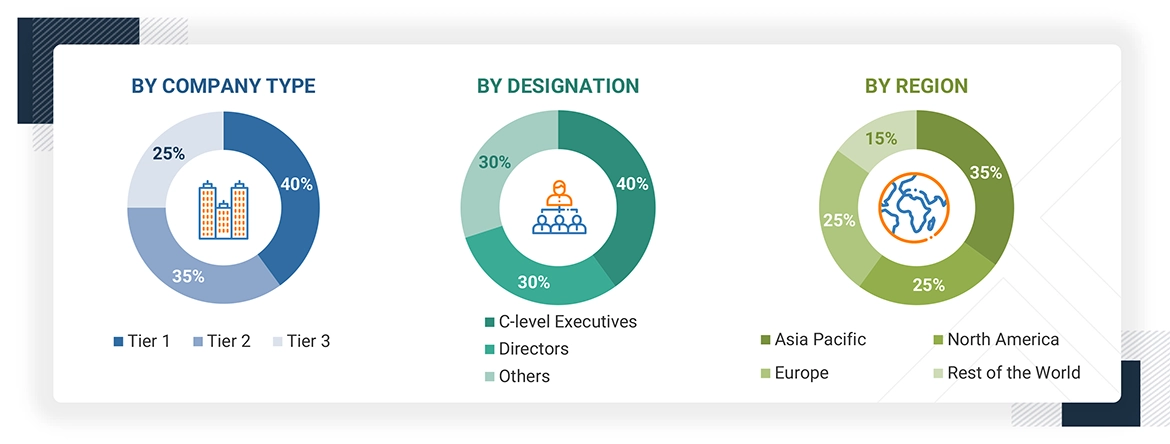
Note: “Others” includes sales, marketing, and product managers
To know about the assumptions considered for the study, download the pdf brochure
Market Size Estimation
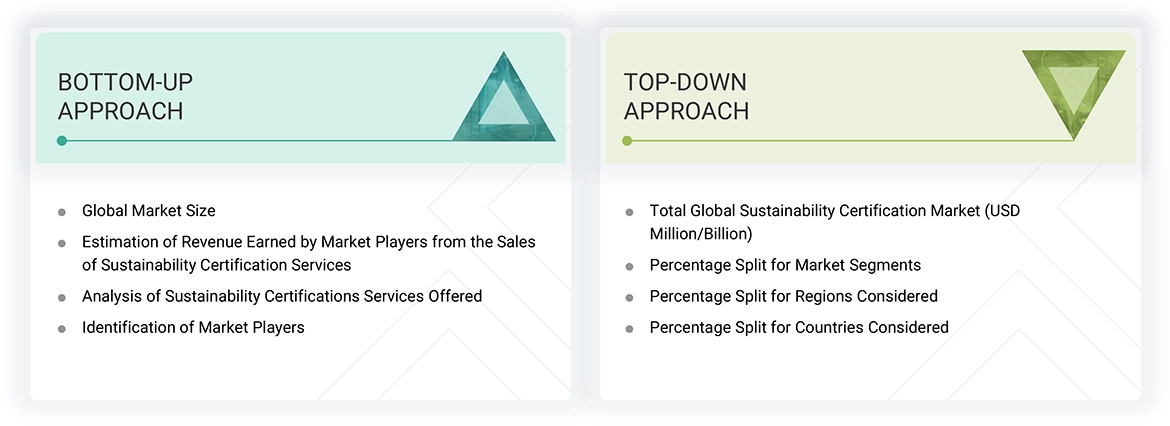
In the market engineering process, both top-down and bottom-up approaches, along with data triangulation methods, have been used to estimate and validate the size of the sustainability certification market and other dependent submarkets. The research methodology used to estimate the market sizes includes the following:
- Identifying top-line investments and spending in the ecosystem and considering segment-level splits and major market developments.
- Identifying different stakeholders in the sustainability certification market that influence the entire market, along with participants across the supply chain.
- Analyzing major certification providers in the sustainability certification market and studying their solutions.
- Analyzing trends related to the adoption of sustainability certification services and compliance solutions.
- Tracking recent and upcoming market developments, including R&D activities, service launches, expansions, acquisitions, partnerships, accreditations, and recognitions, as well as forecasting the market size based on these developments and other critical parameters.
- Carrying out multiple discussions with key opinion leaders to identify the adoption trends of sustainability certification programs across industries.
- Segmenting the overall market into various other market segments, considering certification types, industries, and regional trends.
- Validating the estimates at every level through discussions with key opinion leaders, such as chief executives (CXOs), directors, and operation managers, and finally with domain experts at MarketsandMarkets
Sustainability Certification Market : Top-Down and Bottom-Up Approach
Data Triangulation
After arriving at the overall market size by the market size estimation process explained in the earlier section, the overall sustainability certification market has been divided into several segments and subsegments. To complete the overall market engineering process and arrive at the exact statistics for all segments, the data triangulation and market breakdown procedures have been used, wherever applicable. The data has been triangulated by studying various factors and trends from both the demand and supply side perspectives. Along with data triangulation and market breakdown, the market has been validated by top-down and bottom-up approaches.
Market Definition
The sustainability certification market ensures compliance with environmental, social, and governance (ESG) requirements across industries. Driven by regulatory pressures, corporate sustainability goals, and consumer demand, the certifications allow companies to assure conformity with sustainability criteria. The major applications are energy & emissions management, mobility & transportation, infrastructure, and the circular economy. Certificates ensure compliance with renewable energy standards, carbon management, and EV battery standards with incentives for green building and sustainable supply chain practices. They also support circular economy activities like waste management and sustainable packaging. With more concern for climate action and business ESG reporting, the market will expand further. Digital verification, blockchain traceability, and AI-driven evaluations will enhance certification accuracy and authenticity. As industries compete to reach net-zero targets, sustainability certifications will become crucial in enabling open and ethical business operations globally.
Key Stakeholders
- Certification Bodies and Accreditation Agencies
- Auditing, Inspection, and Verification Service Providers
- Sustainability, ESG, and Compliance Consulting Firms
- Digital Platform Providers (SaaS/ESG Software and Tools)
- Training and Educational Institutions
- Regulatory Authorities, Standard-Setting Bodies, and Government Agencies
- Industry Associations and Non-Governmental Organizations (NGOs)
- Research and Development Institutes
- End-User Industries
Report Objectives
- To describe, segment, and forecast the size of the sustainability certification market, by application, vertical, sustainability focus, and region, in terms of value
- To define and describe the sustainability certification market based on certification function
- To forecast the market size for the application segment for hydrogen, in terms of volume
- To forecast the size of various segments for four regions: North America, Asia Pacific, Europe, and the Rest of the World (RoW), in terms of value
- To offer detailed information on drivers, restraints, opportunities, and challenges influencing the market growth
- To provide a detailed overview of the sustainability certification market value chain
- To strategically analyze the micromarkets concerning individual growth trends, prospects, and contributions to the overall market
- To study the impact of AI/Gen AI on the market under study, along with the macroeconomic outlook for each region
- To analyze opportunities for various stakeholders by identifying the high-growth segments of the market
- To benchmark the key players and analyze their market position in terms of revenue, market share, and core competencies, and detailed competitive landscape for the market leaders
- To analyze competitive developments such as service launches, expansions, acquisitions, partnerships, accreditations, and recognitions carried out by players in the sustainability certification market
Available Customizations
With the given market data, MarketsandMarkets offers customizations according to the specific requirements of companies. The following customization options are available for the report:
Country-wise Information:
- Country-wise breakdown for North America, Europe, Asia Pacific, and Rest of the World
Company Information:
- Detailed analysis and profiling of additional market players (up to five)
Get the Full Sustainability Certification Market Report
Full forecast, segment splits, and company analysis for all Sustainability Certification Market.
- US Sustainability Certification Market
- Canada Sustainability Certification Market
- Mexico Sustainability Certification Market
- Germany Sustainability Certification Market
- UK Sustainability Certification Market
- France Sustainability Certification Market
- Italy Sustainability Certification Market
- Spain Sustainability Certification Market
- Poland Sustainability Certification Market
- China Sustainability Certification Market
- Japan Sustainability Certification Market
- South Korea Sustainability Certification Market
- India Sustainability Certification Market
- Australia Sustainability Certification Market
- Indonesia Sustainability Certification Market
- Thailand Sustainability Certification Market
- Malaysia Sustainability Certification Market
- Vietnam Sustainability Certification Market
- Nordics Sustainability Certification Market
- Rest Of Asia Pacific Sustainability Certification Market
Need a Tailored Report?
Customize this report to your needs
Get 10% FREE Customization
Customize This Report
