
UK Sustainability Certification Market (2025-2030)

The UK Sustainability Certification Market was valued at $167.7 Million in 2025 and projected to reach to $222.2 Million by 2030, representing a compound annual growth rate of 5.8%. The UK sustainability certification market for semiconductors and electronics is poised for consistent expansion through 2030, underpinned by stringent environmental regulations and corporate ESG mandates.


| Market Size in | USD 26.32 MN |
| Market Forecast in | |
| CAGR | |
| Forecast Period | |
| Units Considered | Value (USD MN) |
UK Sustainability Certification Market Trends and Insights
- The UK market is projected to expand to $222.2 million by 2030, reflecting a compound annual growth rate of 5.8%.
- This growth trajectory underscores the UK's commitment to environmental standards and regulatory compliance in electronics manufacturing and supply chain transparency. Driving this expansion, the UK faces increasing pressure from both domestic regulations and European Union directives that mandate sustainability reporting and certification across the semiconductor sector.
- The UK market benefits from strong institutional support for green technology adoption and corporate accountability.
- By 2030, the UK is expected to solidify its position as a leader in sustainable electronics certification, with manufacturers and suppliers investing heavily in compliance infrastructure and third-party verification systems to meet evolving stakeholder expectations..
Key Market Statistics
- CAGR (2025-2030) 5.8% CAGR
- Market Size, 2025 ~USD 167.7 Million
- Forecast, 2030 ~USD 222.2 Million
- Country UK
UK Sustainability Certification Market Overview
UK Market Valuation :
The UK sustainability certification market in semiconductors and electronics reached $167.7 million in 2025, demonstrating strong institutional commitment to environmental compliance and responsible manufacturing practices across the region.
Steady Growth Trajectory :
With a CAGR of 5.8% through 2030, the UK market is expanding at a measured pace, reflecting consistent demand for certified sustainable practices among UK-based electronics manufacturers and supply chain partners.
Regulatory Drivers :
UK environmental regulations, post-Brexit standards, and alignment with EU sustainability frameworks are propelling adoption of certifications such as ISO 14001, RoHS compliance, and circular economy initiatives in electronics production.
2030 Market Projection :
The market is forecast to reach $222.2 million by 2030, representing a $54.5 million increase from 2025 levels, driven by stricter compliance requirements and corporate sustainability commitments among UK electronics manufacturers.
UK Sustainability Certification Market Dynamics
- UK manufacturers are increasingly investing in certifications to meet both domestic compliance standards and international supply chain requirements, particularly as global buyers demand verified sustainable sourcing.
- The market benefits from the UK's strong regulatory framework and competitive advantage in green technology adoption. Key growth drivers include the Electronics Waste Regulations, Extended Producer Responsibility schemes, and corporate net-zero commitments from major UK tech companies.
- Investment in circular economy initiatives and sustainable manufacturing processes will continue to fuel certification demand.
- The convergence of regulatory pressure, consumer expectations, and supply chain accountability positions the UK market for sustained growth, though expansion remains moderate compared to global rates due to market maturity and established compliance infrastructure..
Market Ecosystem
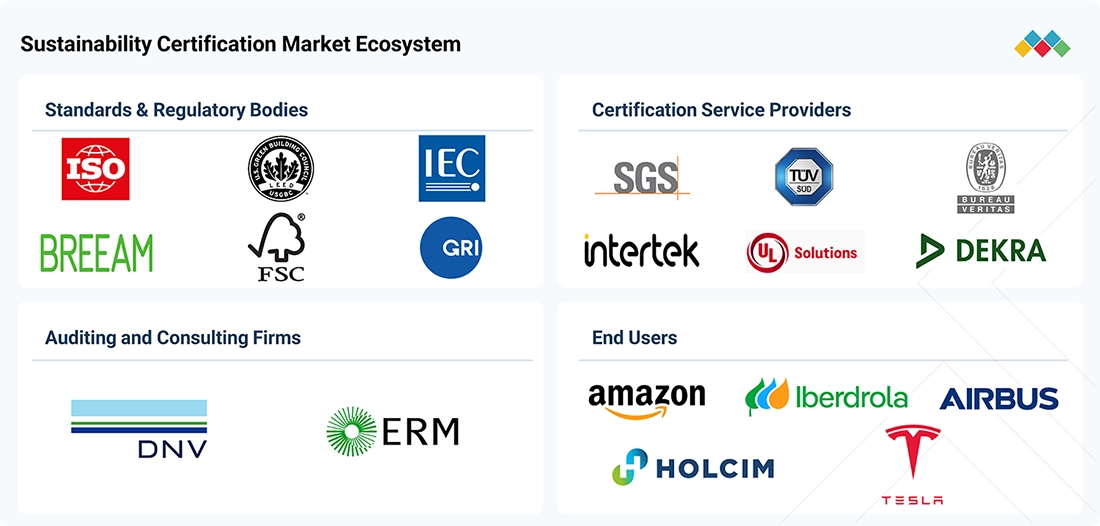
SUSTAINABILITY CERTIFICATION MARKET: COMMERCIAL USE CASES ACROSS INDUSTRIES
| COMPANY | USE CASE DESCRIPTION | BENEFITS |
|---|---|---|
 |
The Razer Viper V3 Pro esports gaming mouse achieved UL 2702 Platinum Recycled Content Certification, and select Razer esports products also received ECOLOGO certification under UL 2710. | Demonstrates verified recycled-content performance and environmental attributes across the product lifecycle, providing third-party credibility for sustainability claims. |
 |
Idemitsu Kosan lubricant products underwent validation of their Product Carbon Footprint (PCF) calculation and reporting approach in accordance with ISO 14067 Annex C. | Enables more credible, transparent product carbon footprint data and supports environmental disclosure and decarbonization across the lubricant supply chain. |
 |
Sunrise Resorts & Cruises – 21 hotels in Egypt received sustainability certification through the EcoCheck GSTC program. | Enables hotels to demonstrate alignment with internationally recognized sustainable tourism standards and provide verified sustainability credentials to guests, tour operators, and other stakeholders. |
Logos and trademarks shown above are the property of their respective owners. Their use here is for informational and illustrative purposes only.
Related Ecosystem
Testing Inspection And Certification
- Eddy Current Testing (ECT)
- Safety Testing
- Signal Generators
- Acoustic Emission Testing (AET)
- Automated Test Equipment
- Sgs s.a.
- Intertek Group plc
- Bureau veritas s.a.
- TUV RHEINLAND AG
- EUROFINS SCIENTIFIC SE
Key Takeaways
- The UK sustainability certification market is valued at $167.7 million in 2025 and is forecast to reach $222.2 million by 2030, growing at a 5.8% CAGR.
- The UK market is driven by stringent domestic and post-Brexit regulatory frameworks that require electronics manufacturers to demonstrate environmental compliance and supply chain transparency.
- The UK's semiconductor and electronics sector is increasingly adopting third-party sustainability certifications to meet investor, customer, and regulatory expectations.
- By 2030, the UK is positioned to lead European sustainability certification adoption in electronics, supported by institutional commitment to net-zero targets and circular economy principles.
Sustainability Certification Market Report Scope
| Report Metric | Details |
|---|---|
| Base Year | 2025 |
| Fastest Growing Segment | MOBILITY & TRANSPORTATION (Application) |
| Forecast Period | 2025–2030 |
| Growth Rate | CAGR of 6.5% from 2025 to 2030 |
| Largest Segment | CLIMATE IMPACT (Sustainability Focus) |
| Market Size Base Year (Billions) | ~USD 3.1 (2025) |
| Revenue Forecast (Billions) | ~USD 4.25 (2030) |
| Segments Covered | Application, Type, Sustainability Focus, Vertical |
UK Sustainability Certification Market Report Segmentation
4 segment dimensions are covered across the global market.
By Application
- Circular Economy
- Energy & Emissions Management
- Infrastructure
- Mobility & Transportation
By Type
- Biomass
- Blue
- Carbon & Ghg Management
- EV Batteries
- Green
- Green Buildings
- Hydrogen
- Renewable Energy
- Responsible Sourcing
- Solar
- Sustainable Construction Materials
- Sustainable Packaging & Materials
- Vehicle Emissions Testing
- Waste Management & Recycling
- Wind
By Sustainability Focus
- Climate Impact
- Energy Efficiency
- Material Sustainability
- Supply Chain Sustainability
By Vertical
- Commercial
- Industrial
- Residential
UK: SUSTAINABILITY CERTIFICATION MARKET, BY APPLICATION, 2025–2030
| Segment | 2025 | 2026 | 2027 | 2028 | 2029 | 2030 | CAGR (%) |
|---|---|---|---|---|---|---|---|
| CIRCULAR ECONOMY | 37.7 | 38.5 | 39.9 | 41.7 | 43.2 | 44.3 | 3.3 |
| ENERGY & EMISSIONS MANAGEMENT | 58.2 | 60.8 | 64.6 | 69 | 73.4 | 77.2 | 5.8 |
| INFRASTRUCTURE | 44.5 | 46.1 | 48.6 | 51.6 | 54.4 | 56.9 | 5 |
| MOBILITY & TRANSPORTATION | 27.3 | 29.6 | 32.6 | 36.3 | 40.1 | 43.8 | 9.9 |
| TOTAL | 167.7 | 175.1 | 185.8 | 198.5 | 211.1 | 222.2 | 5.8 |
Target Audience
- UK Electronics Manufacturers : Need detailed market data to understand certification requirements, competitive landscape, and investment priorities for achieving sustainability compliance and maintaining market access in the UK and EU regions.
- Supply Chain & Procurement Managers : Require UK market insights to develop supplier qualification criteria, assess certification trends, and ensure supply chain partners meet evolving sustainability standards demanded by UK-based OEMs and retailers.
- Sustainability & Compliance Officers : Need comprehensive UK market analysis to benchmark organizational performance, identify regulatory gaps, and justify investments in certification programs aligned with UK environmental legislation and corporate ESG targets.
- Certification & Audit Service Providers : Benefit from UK market sizing and growth forecasts to identify service expansion opportunities, develop targeted offerings for UK manufacturers, and allocate resources to high-growth certification segments.
- Investment & Strategy Consultants : Utilize UK-specific market data to advise clients on market entry strategies, M&A opportunities, and investment decisions within the UK sustainability certification ecosystem for semiconductors and electronics.
Key Companies in the UK Sustainability Certification Market
| Company | HQ | Ownership | Strongest segments |
|---|---|---|---|
| SGS SOCIéTé GéNéRALE DE SURVEILLANCE SA | Switzerland | Public Company | Testing & Inspection – Industrial, Power, Utilities, Mining, Oil, Gas and Chemicals,Testing – Agriculture, Food, and Environmental, Health and Safety,Consumer Products, Retail, Cosmetics, Personal Care, and MedTech Testing, |
| UL LLC | United States | Public Company | Cosmetics (color and related),Skincare and wellness,Haircare and professional products, |
| DEKRA | Germany | Private Company | Vehicle inspection, appraisals, and automotive safety services,Industrial inspection, NDT, and asset integrity services,Product testing and certification, |
| BUREAU VERITAS | France | Public Company | Buildings & Infrastructure,Industry,Agri-Food & Commodities, |
| INTERTEK GROUP PLC | United Kingdom | Public Company | Consumer Products,Industry and Infrastructure,World of Energy, |
| EUROFINS SCIENTIFIC | Luxembourg | Public Company | Food and Feed Testing & Assurance,Environment Testing,Biopharma Testing, |
| APPLUS+ | Spain | Private Company | Asset integrity and statutory inspections,Testing and certification (products, processes, facilities),Engineering and consulting services, |
SGS SOCIéTé GéNéRALE DE SURVEILLANCE SA
SGS Société Générale de Surveillance SA is a Swiss multinational public company founded in 1878 that operates as a leading inspection, verification, testing, and certification service provider. With 83,000 employees worldwide, the company serves diverse industries including agriculture, minerals, oil and gas, and consumer goods.
UL LLC
UL LLC is a United States-based public company founded in 1990 that provides safety testing, certification, and compliance services across multiple industries. The company employs 44,101 people and specializes in product safety, performance, and sustainability verification.
DEKRA
DEKRA is a German private company established in 1925 that offers testing, inspection, and certification services across automotive, industrial, and product safety sectors. With 47,803 employees, the company is a major provider of independent technical services in Europe and globally.
BUREAU VERITAS
Bureau Veritas is a French multinational public company founded in 1828 that provides testing, inspection, and certification services to the maritime, oil and gas, power, and consumer sectors. The company operates with 80,449 employees across the globe.
INTERTEK GROUP PLC
Intertek Group PLC is a United Kingdom-based public company founded in 1885 that provides quality and safety solutions including testing, inspection, and certification services across multiple industries. With 45,425 employees, the company serves clients in sectors ranging from consumer goods to energy.
EUROFINS SCIENTIFIC
Eurofins Scientific is a Luxembourg-based public company founded in 1987 that provides laboratory testing and scientific analysis services across pharmaceutical, food, environmental, and consumer product sectors. The company operates with 65,694 employees across multiple continents.
APPLUS+
APPLUS+ is a Spanish private company founded in 1996 that offers testing, inspection, and certification services for industrial, automotive, and infrastructure sectors. With 27,218 employees, the company provides technical assurance solutions globally.
Reasons to Buy this Report
- UK-Specific Market Sizing : Obtain precise valuation data for the UK market ($167.7M in 2025) with detailed forecasts through 2030, enabling accurate budget allocation and investment planning for UK-focused sustainability initiatives.
- Regulatory Compliance Insights : Understand UK-specific environmental regulations, post-Brexit standards, and compliance frameworks driving certification adoption, helping manufacturers navigate complex local requirements and avoid costly non-compliance penalties.
- Competitive Positioning : Benchmark your UK operations against market trends and identify growth opportunities within the $222.2M projected 2030 market, positioning your organization competitively within the UK electronics sector.
- Supply Chain Strategy : Leverage UK market intelligence to develop targeted sustainability certification strategies that meet supply chain partner expectations and enhance your competitive advantage in UK and European markets.
- Investment Decision Support : Make informed decisions on certification investments and resource allocation based on UK-specific growth projections (5.8% CAGR), market drivers, and emerging opportunities in sustainable electronics manufacturing.
Frequently asked questions
What is the current size of the UK sustainability certification market in semiconductors and electronics?
The UK sustainability certification market in the semiconductor and electronics industry is valued at $167.7 million in 2025.
What is the projected market size for the UK by 2030?
The UK market is forecast to reach $222.2 million by 2030, representing a 5.8% compound annual growth rate.
What regulatory drivers are shaping the UK sustainability certification market?
The UK market is shaped by domestic environmental regulations, post-Brexit compliance frameworks, and alignment with international sustainability standards that mandate certification across semiconductor supply chains.
Why is the UK investing in sustainability certifications for electronics?
The UK is investing in sustainability certifications to meet net-zero commitments, satisfy investor and customer demands for transparency, and maintain competitive advantage in global electronics markets.
Which sectors within UK electronics are driving certification adoption?
Semiconductor manufacturers, electronics component suppliers, and consumer electronics producers in the UK are leading certification adoption to demonstrate environmental responsibility and supply chain integrity.
RESEARCH METHODOLOGY
The research process for this technical, market-oriented, and commercial study of the sustainability certification market involved systematically gathering, recording, and analyzing data on companies operating in the market. It relied heavily on secondary sources, directories, and databases to identify and collect relevant information. In-depth interviews were conducted with various primary respondents, including experts from the sustainability certification and related industries and preferred certification providers, to obtain and verify critical qualitative and quantitative information, as well as to assess the growth prospects of the market. Key players in the sustainability certification market were identified through secondary research, and their market positions were assessed through primary and secondary research. This included studying annual reports of leading players and interviewing key industry experts, such as CEOs, directors, and marketing executives.
Secondary Research
In the secondary research process, various secondary sources were used to identify and collect information relevant to this study. Secondary sources include annual reports, press releases, investor presentations, sustainability reports, certification standards, regulatory publications, industry reports, articles from recognized authors, directories, and databases. Secondary research mainly focused on key information about the supply of sustainability certification services, the overall pool of key players, market segmentation by industry trends, geographic markets, certification types, applications, and key developments from market- and sustainability-oriented perspectives.
Primary Research
In the primary research process, primary sources from the supply and demand sides were interviewed to obtain qualitative and quantitative information for this report. Primary sources from the supply side include experts, such as CEOs, vice presidents, marketing directors, sustainability and certification specialists, subject-matter experts, consultants, and related key executives from major companies and organizations operating in the sustainability certification market.
After the complete market engineering process (market statistics calculations, market breakdown, market size estimations, market forecasting, and data triangulation), extensive primary research was conducted to gather information and verify and validate the critical market numbers.
Several primary interviews were conducted with experts from the demand and supply sides across four major regions—North America, Europe, Asia Pacific, and the Rest of the World (RoW). Approximately 25% of the primary interviews were conducted with the demand side and 75% with the supply side. This primary data was collected through questionnaires, emails, and telephonic interviews.
BREAKDOWN OF PRIMARY INTERVIEW PARTICIPANTS
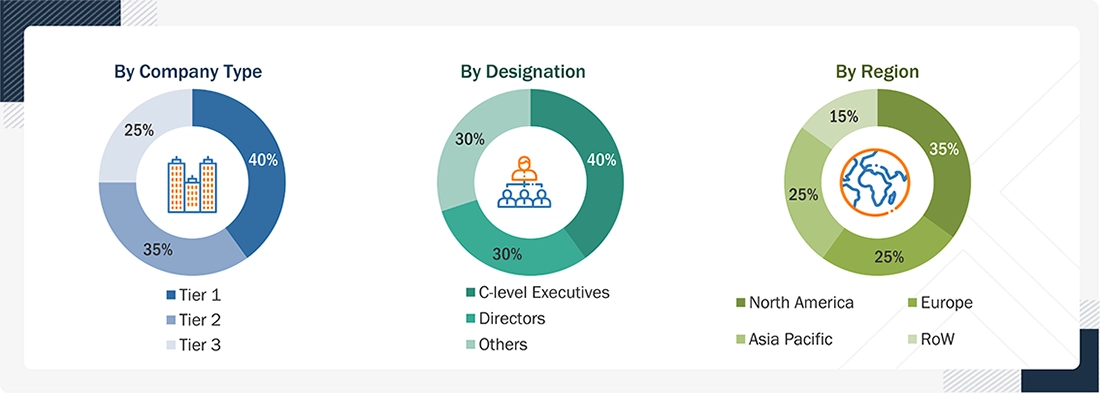
Note: Other designations include sales, marketing specialists, and product managers.
RoW mainly includes the Middle East, Africa and South America.
The 3 tiers of the companies are defined based on their total revenue as of 2025: tier 1 = >USD 500 million, tier 2 = USD 100 million to 500 million, and tier 3 = <USD 100 million.
To know about the assumptions considered for the study, download the pdf brochure
Market Size Estimation
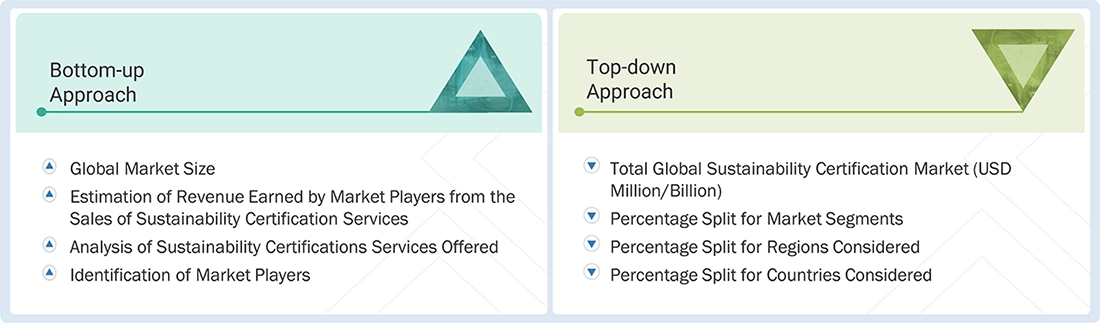
In the complete market estimation process, the top-down and bottom-up approaches, along with several data triangulation methods, were used to estimate and forecast the size of the sustainability certification market and its segments and subsegments listed in the report. Extensive qualitative and quantitative analyses were conducted throughout the market engineering process to identify key information and insights on the sustainability certification market.
Key players in the sustainability certification market were identified through secondary research, and their positions across respective regions were assessed through primary and secondary research. This entire procedure involved the study of annual reports, sustainability reports, financial reports, and other corporate disclosures of leading players, along with interviews with industry experts, such as chief executive officers, vice presidents, directors, sustainability specialists, certification experts, and marketing executives, to obtain quantitative and qualitative insights. All percentage shares, splits, and breakdowns were determined using secondary sources and verified through primary sources. This research accounted for all parameters affecting the sustainability certification market, examined them in detail, verified them through primary research, and analyzed them to produce the final quantitative and qualitative data. This data was consolidated and enhanced with detailed inputs and analysis from MarketsandMarkets and presented in this report.
BOTTOM-UP APPROACH
- Identifying entities in the sustainability certification market that influence the overall market, along with providers of related certification and verification services
- Analyzing major sustainability certification service providers and certification bodies, as well as studying their portfolios and understanding different sustainability certification and verification services offered by them
- Analyzing trends pertaining to the adoption of different sustainability certifications across industries and applications, including energy & emissions management, mobility & transportation, infrastructure, and circularity
- Tracking the ongoing and upcoming developments in the sustainability certification market, including investments, new certification standards and developments, regulatory updates, collaborations, and partnerships, as well as forecasting the market size based on these developments and other critical parameters
- Carrying out multiple discussion sessions with key opinion leaders to understand different types of sustainability certifications, standards used for certification, applications where they are adopted, and recent market trends, as well as to analyze the breakdown of the scope of work carried out by major companies
- Arriving at the market estimates by analyzing the revenues of sustainability certification companies and service providers and then combining these figures to arrive at the market size
- Segmenting each sustainability certification service by application and determining their respective market sizes
- Segmenting the overall market into various other market segments
- Verifying and cross-checking the estimate at every level through discussions with key opinion leaders such as chief executives (CXOs), directors, sustainability managers, and operations managers, and finally with the domain experts at MarketsandMarkets
TOP-DOWN APPROACH
- Identifying top-line investments in sustainability certification services, ESG compliance programs, and industry-specific certification frameworks, along with segment-level market splits and key developments
- Analyzing revenue streams of major sustainability certification providers, accreditation bodies, and consulting firms engaged in sustainability audits and compliance verification
- Conducting multiple discussions with key opinion leaders from certification organizations, ESG consulting firms, and regulatory agencies to assess market trends, demand, and future growth potential
- Estimating geographic market splits using secondary research based on the number of certification providers in a region, the adoption rate of sustainability certifications across industries, and the presence of key market players in the supply chain.
Sustainability Certification Market: Top-Down and Bottom-Up Approach
Data Triangulation
After arriving at the overall market size from the market size estimation process explained in the previous section, the total market was split into several segments and subsegments. Market breakdown and data triangulation procedures were used, where applicable, to complete the overall market engineering process and arrive at precise statistics for all segments and subsegments. The data was triangulated by studying various factors and trends from both the demand and supply sides. The sustainability certification market was also validated using both top-down and bottom-up approaches.
Market Definition
The sustainability certification market plays a crucial role in verifying and demonstrating adherence to environmental, social, and governance (ESG) standards across industries. These certifications assess and validate compliance with sustainability benchmarks, helping businesses, governments, and consumers make responsible decisions. The market is driven by increasing regulatory requirements, corporate sustainability commitments, and growing demand for environmentally responsible products and services. Sustainability certifications are applied across multiple sectors, including energy & emissions management, mobility & transportation, infrastructure, and circularity, covering areas such as renewable energy, carbon and greenhouse gas (GHG) management, electric mobility, green buildings, sustainable construction materials, sustainable packaging, waste management, recycling, and responsible supply chains. These certifications enable organizations to demonstrate environmental performance, improve resource efficiency, strengthen supply chain transparency, and support ethical and sustainable business practices. With growing emphasis on climate action, ESG compliance, corporate sustainability reporting, and net-zero targets, the sustainability certification market is expected to expand, while the integration of digital verification, data analytics, blockchain-based traceability, and artificial intelligence (AI)-enabled assessments is enhancing the efficiency, transparency, and credibility of certification processes.
Key Stakeholders
- Certification Bodies and Accreditation Agencies
- Auditing, Inspection, and Verification Service Providers
- Sustainability, ESG, and Compliance Consulting Firms
- Digital Platform Providers (SaaS/ESG Software and Tools)
- Training and Educational Institutions
- Regulatory Authorities, Standard-Setting Bodies, and Government Agencies
- Industry Associations and Non-Governmental Organizations (NGOs)
- Research and Development Institutes
- End Users
Report Objectives
- To describe, segment, and forecast the size of the sustainability certification market, by application, vertical, sustainability focus, and region, in terms of value
- To define and describe the sustainability certification market based on certification function
- To forecast the market size for the application segment for hydrogen, in terms of volume
- To forecast the size of various segments for four regions: North America, Asia Pacific, Europe, and the Rest of the World (RoW), in terms of value
- To offer detailed information on drivers, restraints, opportunities, and challenges influencing the market growth
- To provide a detailed overview of the sustainability certification market value chain
- To strategically analyze the micromarkets concerning individual growth trends, prospects, and contributions to the overall market
- To study the impact of AI/Gen AI on the market under study, along with the macroeconomic outlook for each region
- To analyze opportunities for various stakeholders by identifying the high-growth segments of the market
- To benchmark the key players and analyze their market position in terms of revenue, market share, and core competencies, and provide a detailed competitive landscape for the market leaders
- To analyze competitive developments such as service launches, expansions, acquisitions, partnerships, and recognitions carried out by players in the sustainability certification market
Available customizations:
With the given market data, MarketsandMarkets offers customizations according to the company’s specific needs. The following customization options are available for the report:
Company Information
-
Detailed analysis and profiling of additional market players (up to 5)
Get the Full Sustainability Certification Market Report
Full forecast, segment splits, and company analysis for all Sustainability Certification Market.
- US Sustainability Certification Market
- Canada Sustainability Certification Market
- Mexico Sustainability Certification Market
- Germany Sustainability Certification Market
- France Sustainability Certification Market
- Italy Sustainability Certification Market
- Spain Sustainability Certification Market
- Poland Sustainability Certification Market
- China Sustainability Certification Market
- Japan Sustainability Certification Market
- South Korea Sustainability Certification Market
- India Sustainability Certification Market
- Australia Sustainability Certification Market
- Indonesia Sustainability Certification Market
- Thailand Sustainability Certification Market
- Malaysia Sustainability Certification Market
- Vietnam Sustainability Certification Market
- Nordics Sustainability Certification Market
- Rest Of Europe Sustainability Certification Market
- Rest Of Asia Pacific Sustainability Certification Market
Need a Tailored Report?
Customize this report to your needs
Get 10% FREE Customization
Customize This Report
