
Brazil Synthetic Dyes Market (2024-2029)

The Brazil Synthetic Dyes Market was valued at $65.2 Million in 2024 and projected to reach to $78.1 Million by 2029, representing a compound annual growth rate of CAGR 3.7%. Brazil's synthetic dyes market is positioned for steady growth driven by the resilience of its textile and apparel manufacturing sectors, which remain central to the country's industrial economy.


| Market Size in | USD 26.32 MN |
| Market Forecast in | |
| CAGR | |
| Forecast Period | |
| Units Considered | Value (USD MN) |
Brazil Synthetic Dyes Market Trends and Insights
- Brazil's synthetic dyes sector is driven by robust demand from the textile, apparel, and chemical manufacturing industries, which remain core pillars of the country's industrial economy.
- The market in Brazil reflects steady growth momentum supported by increasing domestic consumption and regional trade integration within South America. The synthetic dyes market in Brazil is characterized by moderate expansion, with growth rates outpacing broader economic headwinds in the region.
- Brazil's position as a leading textile and chemical producer in South America underpins demand for synthetic colorants across multiple end-use applications.
- Between 2024 and 2029, Brazil is expected to capture incremental market value through rising industrialization, improved supply chain resilience, and growing adoption of sustainable dyeing technologies.
- The market trajectory in Brazil demonstrates resilience and opportunity for both established and emerging players in the synthetic dyes sector..
Key Market Statistics
- CAGR (2024-2029) CAGR 3.7%
- Market Size, 2024 ~USD 65.2 Million
- Forecast, 2029 ~USD 78.1 Million
- Country Brazil
Brazil Synthetic Dyes Market Overview
Market Valuation :
Brazil's synthetic dyes market reached USD 65.2 million in 2024, with projected growth to USD 78.1 million by 2029, representing a steady expansion in South America's largest chemical market.
Textile Industry Demand :
The Brazilian textile and apparel sector drives significant demand for synthetic dyes, leveraging the country's established manufacturing infrastructure and export-oriented production capabilities.
Growth Trajectory :
At a CAGR of 3.7% through 2029, Brazil's synthetic dyes market grows at a measured pace, reflecting stable industrial demand and regional economic conditions relative to the global 5% CAGR.
Industrial Integration :
Chemical manufacturing and downstream processing industries in Brazil create integrated demand chains, supporting consistent consumption of synthetic dyes across multiple industrial verticals.
Brazil Synthetic Dyes Market Dynamics
- The 3.7% CAGR reflects moderate but consistent expansion as domestic producers and exporters maintain demand for quality dyes to support competitive positioning in regional and global markets. Looking ahead to 2029, Brazil's market will benefit from infrastructure investments in chemical manufacturing and increased focus on sustainable production practices.
- While growth trails the global average, the market's stability and integration with established industrial clusters present reliable opportunities for suppliers and manufacturers targeting South America's largest economy..
Market Ecosystem
Related Ecosystem
Speciality Chemicals
- Corrosion Inhibitors
- Polyetheretherketone (PEEK)
- Acrylonitrile Butadiene Styrene (ABS)
- Epoxy Resin
- Polycarbonate
- Basf se
- DOW CHEMICAL COMPANY
- Evonik industries ag
- Clariant ag.
- Solvay sa
Food Safety And Tic
- Dairy Products
- Polymerase Chain Reaction (PCR)
- Campylobacter
- Enzyme-Linked Immunosorbent Assay (ELISA)
- Safety Testing
- Intertek Group plc
- EUROFINS SCIENTIFIC SE
- Sgs s.a.
- Als limited
- PROMEGA CORPORATION
Paints And Coatings
- Polyurethane Resin
- Alkyd Resins
- Epoxy Resin
- Polyester Resin
- Acrylics
- Basf se
- JOTUN
- PPG Industries, Inc.
- DOW CHEMICAL COMPANY
- Akzonobel n.v.
Key Takeaways
- Brazil's synthetic dyes market is valued at USD 65.2 million in 2024 with projected growth to USD 78.1 million by 2029.
- Brazil exhibits a 3.7% CAGR, reflecting steady but moderate expansion driven by textile and chemical manufacturing demand.
- Brazil's market growth is supported by regional trade integration, industrial development, and adoption of sustainable dyeing technologies.
- Brazil represents a key opportunity for synthetic dyes suppliers targeting South America's largest industrial economy.
Synthetic Dyes Market Report Scope
| Report Metric | Details |
|---|---|
| Base Year | 2024 |
| Fastest Growing Segment | VISCOSE (Fabric Type) |
| Forecast Period | 2024-2029 |
| Growth Rate | CAGR of 5% from 2024 to 2029 |
| Largest Segment | DYEING (Application) |
| Market Size Base Year (Billions) | ~USD 7.13 (2024) |
| Revenue Forecast (Billions) | ~USD 9.1 (2029) |
| Segments Covered | Application, Form, Structure, Type, Fabric Type, End-Use Industry |
Brazil Synthetic Dyes Market Report Segmentation
6 segment dimensions are covered across the global market.
By Application
- Dyeing
- Other Applications
- Paints & Coatings
- Printing Inks
- Tanning
By Form
- Liquid
- Powder
By Structure
- Anionic
- Cationic
- Non-Ionic
By Type
- Acid Dyes
- Basic Dyes
- Direct Dyes
- Disperse Dyes
- Other Dyes
- Reactive Dyes
- Solvent Dyes
By Fabric Type
- Acrylic
- Cotton
- Nylon
- Other Fabric Types
- Polyester
- Viscose
- Wool
By End-Use Industry
- Building & Construction
- Food & Beverage
- Leather
- Other End-Use Industries
- Personal Care
- Pulp & Paper
- Textile
- -Automotive Textile
- -Clothes & Apparel
- -Commercial Furnishing Textile
- -Home Furnishing Textile
- -Technical Textile
BRAZIL: SYNTHETIC DYES MARKET, BY END-USE INDUSTRY, 2024–2029
| Segment | 2024 | 2025 | 2026 | 2027 | 2028 | 2029 | CAGR (%) |
|---|---|---|---|---|---|---|---|
| BUILDING & CONSTRUCTION | 18.9 | 19.6 | 20.4 | 21.3 | 22.1 | 23.1 | 4.1 |
| FOOD & BEVERAGE | 14.9 | 15.4 | 16 | 16.6 | 17.2 | 17.9 | 3.8 |
| LEATHER | 30 | 31.3 | 32.6 | 34.1 | 35.6 | 37.2 | 4.4 |
| OTHER END-USE INDUSTRIES | 11.5 | 11.9 | 12.3 | 12.8 | 13.3 | 13.8 | 3.8 |
| PERSONAL CARE | 17.6 | 18.2 | 18.7 | 19.4 | 20 | 20.7 | 3.2 |
| PULP & PAPER | 26.4 | 27.6 | 28.8 | 30.1 | 31.5 | 33 | 4.5 |
| TEXTILE | 195.1 | 205.1 | 215.8 | 227.5 | 239.5 | 252.6 | 5.3 |
| TOTAL | 314.4 | 329 | 344.7 | 361.7 | 379.2 | 398.3 | 4.8 |
Target Audience
- Synthetic Dyes Manufacturers : Producers need Brazil-specific market data to assess production capacity requirements, pricing strategies, and expansion opportunities in South America's largest dyes market.
- Textile & Apparel Companies : Brazilian and international textile manufacturers require localized dyes market insights to secure reliable supply chains, forecast costs, and plan production volumes.
- Chemical Distributors & Traders : Regional distributors need Brazil market forecasts and demand trends to optimize inventory management, negotiate supplier contracts, and identify growth segments.
- Investment & Strategy Consultants : Consultants advising clients on Brazil operations need country-specific market data to develop market entry strategies, competitive analyses, and investment recommendations.
- Industrial Procurement Teams : Procurement professionals in Brazilian manufacturing require detailed market intelligence to benchmark pricing, evaluate supplier capabilities, and manage long-term sourcing agreements.
Reasons to Buy this Report
- Localized Market Intelligence : Gain Brazil-specific insights into market valuation, growth rates, and forecasts that differ from global trends, enabling precise strategic planning for South American operations.
- Textile Sector Opportunity Mapping : Understand demand drivers from Brazil's textile, apparel, and chemical manufacturing industries to identify high-potential customer segments and distribution channels.
- Competitive Positioning Data : Access Brazil market dynamics and growth trajectories to benchmark against competitors and identify gaps in the 3.7% CAGR expansion opportunity through 2029.
- Investment Decision Support : Leverage detailed Brazil market forecasts and industrial demand analysis to support capital allocation, facility planning, and market entry strategies in the region.
- Supply Chain Optimization : Identify integrated demand chains across Brazilian textile, apparel, and chemical sectors to optimize sourcing, production, and distribution strategies for synthetic dyes.
Frequently asked questions
What is the current size of Brazil's synthetic dyes market?
Brazil's synthetic dyes market was valued at USD 65.2 million in 2024 and is expected to reach USD 78.1 million by 2029.
What is the growth rate of Brazil's synthetic dyes market?
Brazil's synthetic dyes market is growing at a CAGR of 3.7% from 2024 to 2029.
Which industries drive demand for synthetic dyes in Brazil?
Brazil's synthetic dyes demand is primarily driven by the textile, apparel, and chemical manufacturing sectors.
What factors support growth in Brazil's synthetic dyes market?
Growth in Brazil is supported by rising industrialization, regional trade integration, supply chain improvements, and adoption of sustainable dyeing technologies.
How does Brazil's synthetic dyes market compare to global trends?
Brazil's 3.7% CAGR is more moderate than the global 5% CAGR, reflecting regional economic conditions and market maturity.
RESEARCH METHODOLOGY
The study involved four major activities in estimating the market size of the synthetic dyes market. Exhaustive secondary research was done to collect information on the market, the peer market, and the grandparent market. The next step was to validate these findings, assumptions, and sizing with industry experts across the value chain through primary research. Both top-down and bottom-up approaches were employed to estimate the complete market size. Thereafter, the market breakdown and data triangulation procedures were used to estimate the market size of the segments and subsegments.
Secondary Research
In the secondary research process, various secondary sources have been referred to for identifying and collecting information for this study. These secondary sources include annual reports, press releases, investor presentations of companies, white papers, certified publications, trade directories, articles from recognized authors, gold standard and silver standard websites, and databases. Secondary research has been used to obtain key information about the value chain of the industry, monetary chain of the market, the total pool of key players, market classification and segmentation according to industry trends to the bottom-most level, and regional markets. It was also used to obtain information about the key developments from a market-oriented perspective.
Primary Research
The synthetic dyes market comprises several stakeholders in the value chain, which include manufacturers, and end users. Various primary sources from the supply and demand sides of the synthetic dyes market have been interviewed to obtain qualitative and quantitative information. The primary interviewees from the demand side include key opinion leaders in industrial sectors. The primary sources from the supply side include manufacturers, associations, and institutions involved in the synthetic dyes industry. Primary interviews were conducted to gather insights such as market statistics, data of revenue collected from the products and services, market breakdowns, market size estimations, market forecasting, and data triangulation. Primary research also helped in understanding the various trends related to application, form, structure, type, fabric type, end-use industry, and region. Stakeholders from the demand side, such as CIOs, CTOs, and CSOs were interviewed to understand the buyer’s perspective on the suppliers, products, component providers, and their current usage of synthetic dyes and outlook of their business, which will affect the overall market.
The breakdown of profiles of the primary interviewees is illustrated in the figure below:
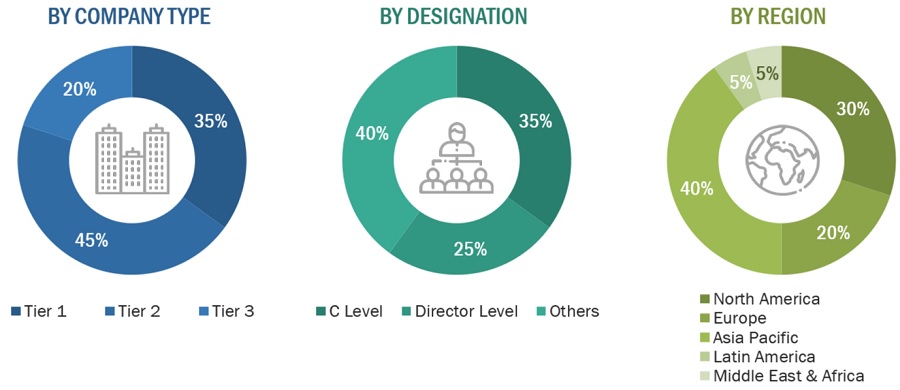
Note: Tier 1, Tier 2, and Tier 3 companies are classified based on their market revenue in 2022 available in the public domain, product portfolios, and geographical presence.
Other designations include consultants and sales, marketing, and procurement managers.
To know about the assumptions considered for the study, download the pdf brochure
Market Size Estimation
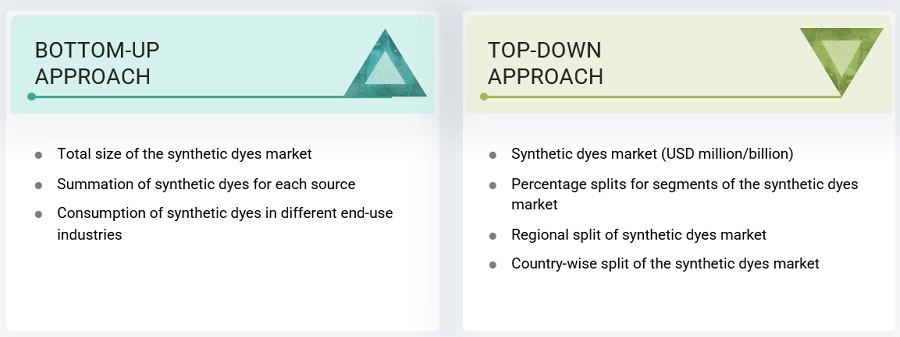
The top-down and bottom-up approaches have been used to estimate and validate the size of the synthetic dyes market.
- The key players in the industry have been identified through extensive secondary research.
- The supply chain of the industry has been determined through primary and secondary research.
- All percentage shares, splits, and breakdowns have been determined using secondary sources and verified through primary sources.
- All possible parameters that affect the markets covered in this research study have been accounted for, viewed in extensive detail, verified through primary research, and analyzed to obtain the final quantitative and qualitative data.
- The research includes the study of reports, reviews, and newsletters of the key market players, along with extensive interviews for opinions with leaders such as directors and marketing executives.
The following figure illustrates the overall market size estimation process employed for this study.
To know about the assumptions considered for the study, Request for Free Sample Report
Data Triangulation
After arriving at the total market size from the estimation process, the overall market has been split into several segments and sub-segments. To complete the overall market engineering process and arrive at the exact statistics for all the segments and sub-segments, the data triangulation and market breakdown procedures have been employed, wherever applicable. The data has been triangulated by studying various factors and trends from both the demand and supply sides. Along with this, the market size has been validated by using both the top-down and bottom-up approaches and primary interviews. Hence, for every data segment, there have been three sources—top-down approach, bottom-up approach, and expert interviews. The data was assumed correct when the values arrived from the three sources matched.
Market Definition
Synthetic dyes are substances that impart color to other materials such as textile, foodstuff, paper, and others. These are relatively stable to external factors such as washing and light. These dyes play important roles in modern life, with applications in both industry and scientific laboratories. Synthetic dyes are widely used in various end-use industries such as textile, leather, paint, and food & beverage. Acid dye, basic dye, reactive dye, direct dye, sulfur dye, disperse dye and solvent dye are the types of synthetic dyes. The rise of the dyestuffs industry in China and India is seen as an important driver of the synthetic dyes market globally. Growing development of low-VOC and eco-friendly dye products would provide ample growth opportunities to the market.
Key Stakeholders
- Senior Management
- End User
- Finance/Procurement Department
- R&D Department
- Manufacturers
- Raw Material Suppliers
Report Objectives
- To define, describe, and forecast the size of the synthetic dyes market, in terms of value and volume.
- To provide detailed information regarding the major factors (drivers, opportunities, restraints, and challenges) influencing the growth of the market
- To estimate and forecast the market size based on application, form, structure, type, fabric type, end-use industry, and region.
- To forecast the size of the market with respect to major regions, namely, Europe, North America, Asia Pacific, Middle East & Africa, and South America, along with their key countries
- To strategically analyze micro-markets with respect to individual growth trends, prospects, and their contribution to the overall market
- To analyze opportunities in the market for stakeholders and provide a competitive landscape of market leaders.
- To track and analyze recent developments such as expansions, new product launches, partnerships & agreements, and acquisitions in the market.
- To strategically profile key market players and comprehensively analyze their core competencies.
Available Customizations
Along with the given market data, MarketsandMarkets offers customizations according to the company’s specific needs. The following customization options are available for the report:
Regional Analysis
- Further breakdown of a region with respect to a particular country or additional application
Company Information
- Detailed analysis and profiles of additional market players
Tariff & Regulations
- Regulations and Impact on Synthetic dyes Market
Get the Full Synthetic Dyes Market Report
Full forecast, segment splits, and company analysis for all Synthetic Dyes Market.
- US Synthetic Dyes Market
- Canada Synthetic Dyes Market
- Mexico Synthetic Dyes Market
- Germany Synthetic Dyes Market
- UK Synthetic Dyes Market
- France Synthetic Dyes Market
- Italy Synthetic Dyes Market
- Spain Synthetic Dyes Market
- Turkey Synthetic Dyes Market
- China Synthetic Dyes Market
- India Synthetic Dyes Market
- Japan Synthetic Dyes Market
- South Korea Synthetic Dyes Market
- Indonesia Synthetic Dyes Market
- Vietnam Synthetic Dyes Market
- South Africa Synthetic Dyes Market
- Argentina Synthetic Dyes Market
- Rest Of Europe Synthetic Dyes Market
- Rest Of Asia Pacific Synthetic Dyes Market
- GCC Countries Synthetic Dyes Market
- -Other GCC Countries Synthetic Dyes Market
- Rest Of South America Synthetic Dyes Market
Need a Tailored Report?
Customize this report to your needs
Get 10% FREE Customization
Customize This Report
