
Europe Tactical Communication Market (2026-2031)

The Europe Tactical Communication Market was valued at $3437.68 Million in 2026 and projected to reach to $5336.04 Million by 2031, representing a compound annual growth rate of 9.2%. Europe's tactical communication market is positioned for sustained expansion through 2031, driven by geopolitical instability, NATO reinforcement initiatives, and EU defense autonomy objectives.


| Market Size in | USD 26.32 MN |
| Market Forecast in | |
| CAGR | |
| Forecast Period | |
| Units Considered | Value (USD MN) |
Europe Tactical Communication Market Trends and Insights
- This 9.2% compound annual growth rate reflects Europe's strategic investment in modernizing defense infrastructure and enhancing interoperability across NATO and EU member states.
- Europe's market expansion is driven by increasing geopolitical tensions, regulatory mandates for secure communications, and substantial defense budgets allocated to next-generation tactical systems. The European tactical communication sector benefits from a mature industrial base and strong technological capabilities across nations including Germany, France, and the United Kingdom.
- Europe's emphasis on autonomous systems, software-defined radios, and encrypted communications platforms positions the region as a critical hub for innovation.
- Between 2026 and 2031, Europe is expected to see accelerated adoption of integrated communication solutions that support multi-domain operations and joint force interoperability. Europe's market dynamics are shaped by regulatory frameworks, NATO standardization agreements, and collaborative defense procurement initiatives.
- The region's commitment to technological sovereignty and indigenous capability development further supports sustained market growth through 2031..
Key Market Statistics
- CAGR (2026-2031) 9.2% CAGR
- Market Size, 2026 ~USD 3437.68 Million
- Forecast, 2031 ~USD 5336.04 Million
- Geography Europe
Europe Tactical Communication Market Overview
NATO Modernization Driving Growth :
Europe's tactical communication market is accelerating due to NATO member states' commitment to modernizing defense capabilities and standardizing interoperability across allied forces, particularly in response to evolving geopolitical tensions.
Germany Leads European Market :
Germany commands the largest share of Europe's tactical communication market at $808.4 million, reflecting its strategic role in European defense and substantial investment in advanced communication infrastructure for military operations.
Strong CAGR Outpaces Global Average :
Europe's 9.2% CAGR significantly exceeds the global market growth rate of 8.1%, demonstrating the region's prioritization of tactical communication systems and sustained defense spending across EU and NATO member nations.
EU Interoperability Standards Boost Adoption :
Harmonization initiatives within the European Union and NATO frameworks are accelerating the adoption of compatible tactical communication systems, creating standardized procurement opportunities across multiple member states.
Europe Tactical Communication Market Dynamics
- Member states are prioritizing secure, interoperable communication systems to enhance operational effectiveness and joint mission capabilities.
- Investment in 5G-enabled tactical networks and software-defined radio platforms reflects Europe's commitment to next-generation defense infrastructure.
- The market's 9.2% CAGR trajectory indicates robust confidence in regional security spending and modernization programs across defense establishments. Key growth catalysts include increased defense budgets, cross-border military exercises requiring standardized communication protocols, and technological advancement in encrypted, resilient communication systems.
- European defense contractors and technology providers are capitalizing on procurement cycles across multiple nations, while partnerships between NATO allies strengthen market consolidation.
- By 2031, the market is expected to reach $5,336.04 million, reflecting Europe's strategic pivot toward enhanced tactical capabilities and interoperability standards..
Market Ecosystem
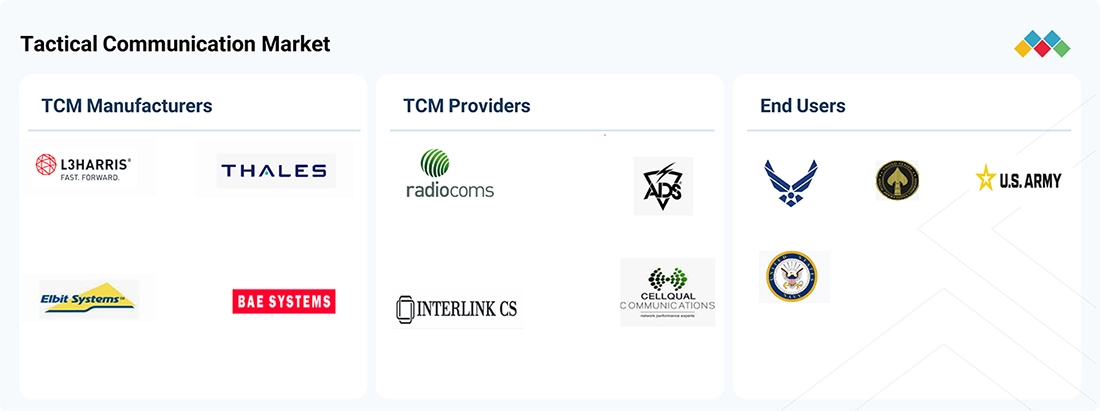
TACTICAL COMMUNICATION MARKET SIZE, SHARE, TRENDS: COMMERCIAL USE CASES ACROSS INDUSTRIES
| COMPANY | USE CASE DESCRIPTION | BENEFITS |
|---|---|---|
 |
L3Harris supplies Falcon tactical communication systems, including the AN/PRC-158C NGC2 Gateway Manpack, to support secure battlefield voice and high-speed data communications. In October 2025, the U.S. Army awarded the company a USD 24 million contract to deliver these systems to its 4th Infantry Division under the Next Generation Command and Control (NGC2) program, supporting resilient tactical networking and information exchange between sensors, deployed personnel, and command-and-control nodes. | Enables resilient battlefield communications; supports high-throughput tactical data exchange; strengthens secure networking and interoperability; improves command-and-control coordination; and enhances situational awareness among dispersed military formations. |
 |
Thales provides COMTICS voice distribution systems and PARTNER-C communication management systems for naval platforms. In November 2024, Thales confirmed that the French Navy's Jacques Chevallier fleet replenishment tanker had completed a deployment of several months equipped with these systems. COMTICS supports secure onboard communications, while PARTNER-C enables integrated management of internal and external naval communications, supporting coordinated maritime operations and connectivity across shipboard communication networks. | Provides secure and integrated shipboard communications; improves connectivity between naval personnel and onboard systems; supports internal and external communication management; enhances information exchange; and strengthens communication reliability during maritime operations. |
 |
Elbit Systems supplies E-LynX Airborne Software Defined Radios (SDRs) for secure air-to-air and air-to-ground tactical communications. In January 2022, Elbit Systems announced that its Brazilian subsidiary, AEL Sistemas, and the Brazilian Air Force had completed successful connectivity flight tests integrating E-LynX Airborne SDRs aboard two F-5M aircraft under the Link-BR2 program. The system demonstrated MANET-based data links, simultaneous voice and data transmission, and information exchange between airborne platforms and ground forces. | Enables secure air-to-air and air-to-ground communications; supports MANET-based tactical networking; facilitates simultaneous voice and data exchange; enhances interoperability between aircraft and ground forces; and improves situational awareness and operational coordination. |
Logos and trademarks shown above are the property of their respective owners. Their use here is for informational and illustrative purposes only.
Related Ecosystem
Key Takeaways
- Europe's tactical communication market will grow from $3,437.68M (2026) to $5,336.04M (2031) at a 9.2% CAGR, outpacing global growth.
- Europe's defense modernization and NATO interoperability requirements are primary drivers of tactical communication adoption across the region.
- European nations prioritize secure, encrypted, and software-defined communication platforms to ensure technological sovereignty and operational resilience.
- Europe's mature industrial base and collaborative procurement frameworks position the region as a leader in next-generation tactical communication innovation.
Tactical Communication Market Report Scope
| Report Metric | Details |
|---|---|
| Base Year | 2026 |
| Fastest Growing Segment | DEPLOYABLE 5G SYSTEMS (Tactical Private Wireless Systems) |
| Forecast Period | 2026-2031 |
| Growth Rate | CAGR of 8.1% from 2026 to 2031 |
| Largest Segment | SINGLE BAND (Frequency) |
| Market Size Base Year (Billions) | ~USD 13.14 (2026) |
| Revenue Forecast (Billions) | ~USD 19.39 (2031) |
| Segments Covered | Equipment Type, Tactical Radio Systems, Tactical Backbone & Backhaul Systems, Tactical Satcom Systems, Tactical Intercommunication Systems, Tactical Network Infrastructure, Tactical Private Wireless Systems, Tactical Communication Headsets & Control Equipment, Platform, Land Platform, Airborne Platform, Naval Platform, Unmanned Systems, Frequency, Single-Band Frequency, Application, End User, Procurement Type |
Europe Tactical Communication Market Report Segmentation
18 segment dimensions are covered across the global market.
By Equipment Type
- Tactical Backbone & Backhaul Systems
- Tactical Communication Headsets & Control Equipment
- Tactical Intercommunication Systems
- Tactical Network Infrastructure
- Tactical Private Wireless Systems
- Tactical Radio Systems
- Tactical Satcom Systems
By Tactical Radio Systems
- Fixed / Base-Station Radios
- Handheld / Personal Role Radios
- Manpack Radios
- Mounted / Embedded Radios
By Tactical Backbone & Backhaul Systems
- High-Capacity Line-Of-Sight (Hclos) Radios
- Tactical Radio Relay Systems
- Troposcatter Communication Systems
By Tactical Satcom Systems
- Fixed Tactical Satcom Terminals
- Flyaway / Transportable Satcom Terminals
- Portable / Manpack Satcom Terminals
- Satcom-On-The-Move (Sotm)
- Standalone Tactical Satcom Modems
By Tactical Intercommunication Systems
- Airborne Intercommunication Systems
- Naval Intercommunication Systems
- Vehicular Intercommunication Systems
By Tactical Network Infrastructure
- Cross-Band / Multi-Bearer Gateways
- Deployable Tactical Network Nodes
- Radio-Over-Ip Gateways
- Tactical Ethernet Switches
- Tactical Routers
By Tactical Private Wireless Systems
- Deployable 5G Systems
- Deployable Lte Systems
- Hybrid / Multi-Technology Private Wireless Systems
By Tactical Communication Headsets & Control Equipment
- Communication Control Units
- Military Handsets / Speaker Microphones
- Push-To-Talk (Ptt) Units
- Tactical Communication Headsets
By Platform
- Airborne
- Land
- Naval
- Unmanned Systems
By Land Platform
- Dismounted Personnel
- Ground Combat Vehicles
- Ground Command Posts / Control Stations
- Ground Command Posts/Control Stations
- Tactical/Utility/Support Vehicles
By Airborne Platform
- Attack Helicopters
- Combat Aircraft
- Fixed-Wing Aircraft
- Maritime Helicopters
- Rotary-Wing Aircraft
- Special Mission Aircraft
- Trainer Aircraft
- Transport Aircraft
- Transport Helicopters
- Utility / Multirole Helicopters
By Naval Platform
- Amphibious Vessels
- Major Surface Combatants
- Mine Warfare Vessels
- Patrol/Littoral Vessels
- Submarines
- Support/Auxiliary Vessels
- Surface Vessels
By Unmanned Systems
- Unmanned Aerial Vehicles (Uavs)
- Unmanned Ground Vehicles (Ugvs)
- Unmanned Surface Vehicles (Usvs)
- Unmanned Underwater Vehicles (Uuvs)
By Frequency
- Multiband
- Single Band
By Single-Band Frequency
- C-Band
- High Frequency (Hf)
- K-Band
- Ka-Band
- Ku-Band
- L-Band
- S-Band
- Ultra-High Frequency (Uhf)
- Very High Frequency (Vhf)
- X-Band
By Application
- Command & Control Communications
- Dismounted Soldier Communications
- Force Protection & Security Communications
- Isr Communications Transport
- Logistics & Sustainment Communications
- Platform & Crew Communications
- Training & Exercise Communications
By End User
- Air Force
- Army / Land Force
- Army/Land Force
- Border Guard / Paramilitary Force
- Border Guard/Paramilitary Force
- Joint / Unified Command
- Joint/Unified Command
- Marine / Amphibious Force
- Marine/Amphibious Force
- Navy
- Special Operations Force
By Procurement Type
- New Installation
- Replacement/Retrofit
Target Audience
- Defense Contractors & OEMs : European and international defense manufacturers require detailed market intelligence to identify procurement opportunities, optimize product portfolios for NATO standards, and compete effectively across multiple European nations.
- Government Defense Agencies : Military procurement officials and defense ministry planners need market data to benchmark spending, evaluate technology trends, and align tactical communication investments with NATO interoperability requirements.
- Technology & Telecom Providers : Communications technology companies targeting European defense sectors require market sizing and growth forecasts to develop military-grade solutions and establish partnerships with defense procurement bodies.
- Investment & Private Equity Firms : Investors evaluating European defense technology opportunities need comprehensive market analysis to assess portfolio companies, identify acquisition targets, and understand regional growth dynamics and risk factors.
- Strategic Consultants & Analysts : Management consulting firms and market research organizations require detailed European tactical communication data to support client advisory work, competitive analysis, and strategic planning initiatives.
Countries within Europe - compare and drill down
| Country | 2025 size (native) |
|---|---|
| UK | USD 528.7 Million |
| France | USD 511 Million |
| Germany | USD 808.4 Million |
| Italy | USD 336.4 Million |
| Poland | USD 710.5 Million |
| Spain | USD 266.8 Million |
| Rest Of Europe | USD 2174.3 Million |
Country market size visualization
Reasons to Buy this Report
- Country-Level Market Granularity : Access detailed market sizing for key European nations including Germany ($808.4M), UK ($528.7M), Poland ($710.5M), and France ($511.0M), enabling targeted market entry and competitive positioning strategies.
- NATO Procurement Intelligence : Understand standardization requirements and interoperability mandates driving procurement decisions across NATO member states, critical for defense contractors and technology providers seeking contract opportunities.
- Growth Trajectory Forecasting : Leverage comprehensive 2026-2031 forecast data showing 9.2% CAGR to identify expansion opportunities, plan product development cycles, and allocate resources to high-growth European markets.
- Competitive Landscape Analysis : Benchmark market performance across European regions and identify competitive dynamics within individual countries to refine go-to-market strategies and partnership opportunities.
- Geopolitical Risk Assessment : Evaluate how regional security concerns and defense spending priorities influence tactical communication adoption rates, informing long-term business planning and investment decisions in European markets.
Frequently asked questions
What is the projected size of Europe's tactical communication market by 2031?
Europe's tactical communication market is projected to reach $5,336.04 million by 2031, growing from $3,437.68 million in 2026 at a 9.2% CAGR.
What factors are driving growth in Europe's tactical communication market?
Europe's market growth is driven by geopolitical tensions, NATO interoperability mandates, increased defense spending, and demand for secure, encrypted communication systems across the region.
Which European nations are leading the tactical communication market?
Germany, France, and the United Kingdom are among Europe's leading nations in tactical communication innovation and procurement, supported by mature defense industrial bases.
What technologies are shaping Europe's tactical communication market?
Software-defined radios, encrypted platforms, autonomous system integration, and multi-domain communication solutions are key technologies driving Europe's tactical communication evolution.
How does Europe's tactical communication market compare to global growth?
Europe's 9.2% CAGR exceeds the global average of 8.1%, reflecting the region's strategic prioritization of defense modernization and secure communications infrastructure.
RESEARCH METHODOLOGY
The tactical communication market size was estimated through four interconnected research activities: secondary research, primary research, market size estimation, and data triangulation. Secondary research was conducted to assess relevant market information, adjacent military communication markets, and the broader industry ecosystem. The collected findings, underlying assumptions, and preliminary estimates were validated through consultations with industry experts across the value chain. Subsequently, both top-down and bottom-up estimation approaches were employed, incorporating demand-side and supply-side analyses to determine the overall market size. Finally, data triangulation was performed using inputs from both demand and supply sides to validate market estimates and determine the size of individual segments and subsegments.
Secondary Research
During the secondary research phase, a wide range of sources was reviewed to identify and gather relevant information for the study. These sources included government defense procurement databases, military modernization programs, defense budget documents, company annual reports, product brochures, press releases, investor presentations, and contract announcements; defense and military communication associations; defense acquisition and procurement publications; defense ministries; armed forces; spectrum authorities; and relevant government agencies; technical white papers; journals; defense standards, and certified publications; as well as articles and databases from recognized authors, defense industry experts, and established industry sources.
Primary Research
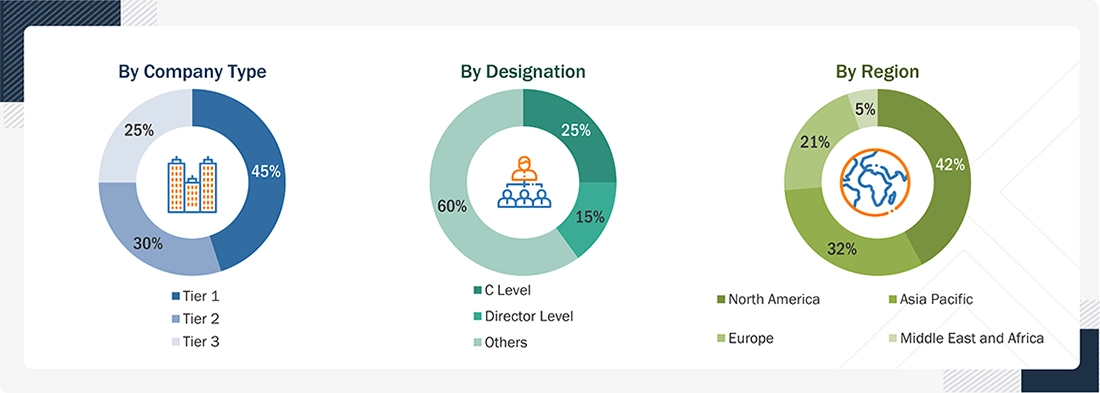
Primary research was structured after the collection of initial market information through secondary sources. Interviews and expert discussions were used to validate product positioning, Tactical Communication pricing, procurement patterns, integration activity, demand by end user, and market shares. Respondents represented both the demand and supply sides across key countries in North America, Europe, Asia Pacific, Latin America, and the Middle East and Africa. Primary information was gathered through questionnaires, email interactions, and telephonic or virtual interviews.
Following is the breakdown of primary respondents:
To know about the assumptions considered for the study, download the pdf brochure
Market Size Estimation
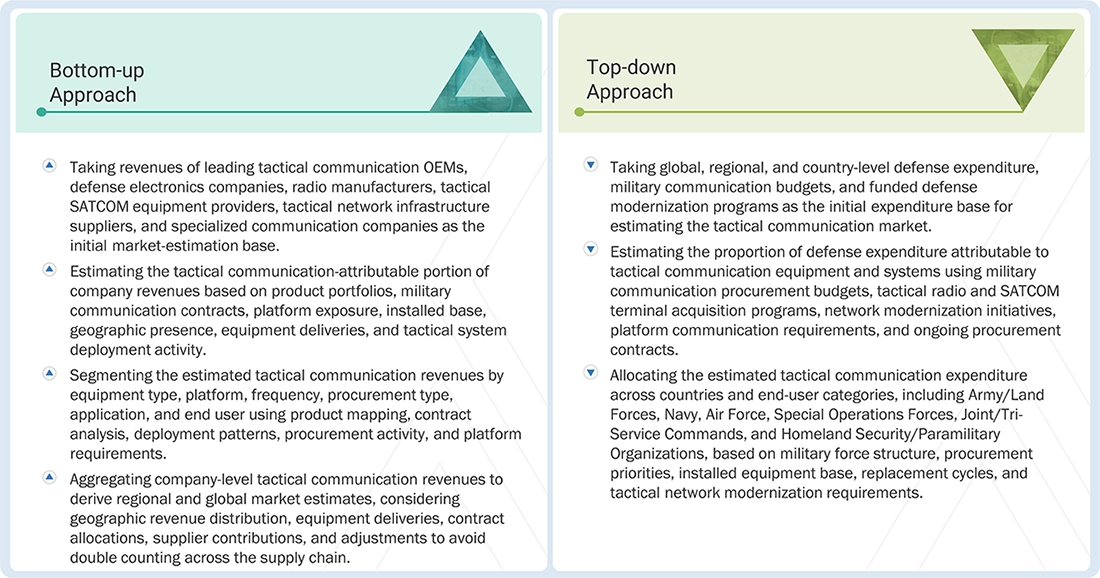
Top-down and bottom-up approaches were used to estimate and validate the size of the tactical communication market. The research methodology used to estimate the size of the market included the following details:
- Key players in the tactical communication market were identified through secondary research, while their revenues attributable to tactical communication products and systems were estimated using a supply-side approach. Company annual and financial reports, product portfolios, relevant tactical communication contracts, and platform integration programs were reviewed to derive company-specific revenue estimates, which were further validated through primary interviews with industry stakeholders. These estimates were subsequently reconciled with the overall market size through data triangulation incorporating both demand-side and supply-side inputs. Individual company market shares were then calculated by comparing their estimated tactical communication revenues with the estimated global tactical communication market size.
- All percentage shares, splits, and breakdowns were derived using secondary sources and validated against supplier portfolios, procurement evidence, country demand, and expert inputs.
- All major parameters affecting the tactical communication market were considered in detail, including new installation and replacements/retrofit tactical communication demand, product pricing, tactical communication applications, tactical communication procurement, end-user deployments, component pricing, upgrades, and the delivery pipeline. The resulting quantitative and qualitative data were consolidated and cross-validated for the final market model. This data were enhanced with detailed input, analyzed by MarketsandMarkets, and presented in this report.
Data Triangulation
After estimating the overall market size, the market was categorized into multiple segments and subsegments. The data triangulation and market breakdown procedures were applied, wherever relevant, to complete the market engineering process and derive estimated values for each segment and subsegment. The data were triangulated by assessing key factors and trends across both demand- and supply-side perspectives. In addition, the market estimates were cross-validated using top-down and bottom-up approaches, company revenues, product pricing, contract values, platform deliveries, and country-level procurement activity.
Market Definition
Tactical Communication is the capability to establish secure, resilient, and interoperable voice, data, imagery, video, and IP connectivity among military personnel, command posts, and manned and unmanned platforms operating in tactical environments. The tactical communication market encompasses ruggedized communication equipment and associated networking systems that support real-time information exchange, command and control, situational awareness, mission coordination, and battlefield connectivity across land, airborne, naval, and unmanned operations. The market includes tactical radio systems, tactical backbone and backhaul systems, tactical SATCOM systems, tactical intercommunication systems, tactical network infrastructure, tactical private wireless systems, and tactical communication headsets and control equipment used by military and security forces during tactical missions.
Key Stakeholders
- Tactical Communication Equipment OEMs
- Tactical Radio, SATCOM, Intercommunication, and Networking System Manufacturers
- Tactical Communication Component, Antenna, RF, and Power Equipment Suppliers
- Tactical Network Infrastructure, Router, Switch, and Gateway Providers
- Tactical Private LTE/5G and Deployable Wireless Communication System Providers
- Tactical Communication Headset, PTT, and Control Equipment Manufacturers
- Defense System Integrators and C4ISR Solution Providers
- Armed Forces, including Army, Air Force, Navy, Marine Forces, and Special Operations Forces
- Defense Ministries, Government Procurement Agencies, and Military Acquisition Organizations
- Border Security, Paramilitary, and Homeland Security Organizations
- Defense Communication MRO, Upgrade, and Retrofit Service Providers
- Spectrum Management, Cybersecurity, Standardization, and Certification Authorities
Report Objectives
- To define, describe, and forecast the tactical communication market based on equipment type, platform, frequency, application, end user, procurement type, and region in terms of value.
- To forecast the size of various segments of the market across North America, Europe, Asia Pacific, Latin America, the Middle East & Africa in terms of value.
- To identify and analyze the drivers, restraints, opportunities, and challenges influencing the growth of the market.
- To identify industry trends, market trends, and technology trends currently prevailing in the market.
- To provide an overview of the regulatory landscape with respect to Tactical Communication across regions.
- To analyze micro markets with respect to individual growth trends, prospects, and their contribution to the overall market.
- To analyze opportunities in the market for stakeholders by identifying key market trends.
- To profile key market players and comprehensively analyze their market share and core competencies.
- To evaluate the degree of competition in the market by analyzing recent developments, such as contracts, agreements, and acquisitions adopted by leading market players.
- To identify detailed financial positions, key products, and unique selling points of leading companies in the market.
- To provide a detailed competitive landscape of the market, along with market share analysis and revenue analysis of key players.
Customization Options
MarketsandMarkets offers the following customizations for this market report:
- Additional country-level analysis of the tactical communication market
- Profiling of other market players (up to 5)
Product Analysis
- Product matrix, which provides a detailed comparison of the product portfolios of each company in the tactical communication market
Get the Full Tactical Communication Market Report
Full forecast, segment splits, and company analysis for all Tactical Communication Market.
- Canada Tactical Communication Market
- US Tactical Communication Market
- UK Tactical Communication Market
- France Tactical Communication Market
- Germany Tactical Communication Market
- Italy Tactical Communication Market
- Poland Tactical Communication Market
- Spain Tactical Communication Market
- India Tactical Communication Market
- Japan Tactical Communication Market
- South Korea Tactical Communication Market
- Australia Tactical Communication Market
- Singapore Tactical Communication Market
- Indonesia Tactical Communication Market
- Brazil Tactical Communication Market
- Mexico Tactical Communication Market
- Saudi Arabia Tactical Communication Market
- UAE Tactical Communication Market
- Israel Tactical Communication Market
- South Africa Tactical Communication Market
- Rest Of Europe Tactical Communication Market
- Rest Of Asia Pacific Tactical Communication Market
- Rest Of Latin America Tactical Communication Market
Need a Tailored Report?
Customize this report to your needs
Get 10% FREE Customization
Customize This Report
