
Spain Taste Modulators Market (2023-2028)

The Spain Taste Modulators Market was valued at $21.1 Million in 2023 and projected to reach to $28.9 Million by 2028, representing a compound annual growth rate of 6.5%. Spain's taste modulators market is poised for steady expansion through 2028, driven by shifting consumer preferences toward healthier food options and clean-label products.


| Market Size in | USD 26.32 MN |
| Market Forecast in | |
| CAGR | |
| Forecast Period | |
| Units Considered | Value (USD MN) |
Spain Taste Modulators Market Trends and Insights
- This growth trajectory reflects Spain's increasing adoption of taste modulation technologies across the food and beverage sector, driven by consumer demand for healthier formulations and clean-label products.
- Spain's market expansion aligns with broader European trends toward reduced sodium, sugar, and artificial additives in processed foods. The Spanish taste modulators market benefits from the country's strong food manufacturing base and growing investment in food innovation.
- Spain's food industry is increasingly leveraging taste modulators to meet regulatory pressures and evolving consumer preferences for better-tasting, healthier products.
- Between 2023 and 2028, Spain is expected to see accelerated adoption among beverage manufacturers, dairy producers, and snack food companies seeking competitive differentiation. Spain's market growth is supported by rising health consciousness among consumers and stringent EU food regulations.
- The country's position within the European Union provides access to advanced ingredient suppliers and research capabilities, positioning Spain as a key market for taste modulation innovation in Southern Europe..
Key Market Statistics
- CAGR (2023-2028) 6.5% CAGR
- Market Size, 2023 ~USD 21.1 Million
- Forecast, 2028 ~USD 28.9 Million
- Country Spain
Spain Taste Modulators Market Overview
Market Valuation Growth :
Spain's taste modulators market reached USD 21.1 million in 2023 and is projected to grow to USD 28.9 million by 2028, representing a robust 6.5% CAGR over the forecast period.
Clean-Label Demand Driver :
Spanish consumers increasingly demand healthier food formulations with clean-label ingredients, propelling manufacturers to adopt taste modulation technologies to reduce sodium, sugar, and artificial additives.
Regional Market Alignment :
Spain's taste modulators adoption aligns with broader European trends toward functional foods and wellness-oriented products, positioning the country as a key growth market in Southern Europe.
Food & Beverage Sector Integration :
Spanish food and beverage manufacturers are increasingly integrating taste modulation solutions across dairy, beverages, snacks, and processed foods to meet evolving consumer preferences and regulatory standards.
Spain Taste Modulators Market Dynamics
- Spanish manufacturers are increasingly investing in taste modulation technologies to reformulate existing products while maintaining consumer appeal, particularly in the dairy and beverage segments.
- The market benefits from Spain's strong food processing industry and growing health consciousness among consumers. The forecast period will see accelerated adoption as regulatory pressures around sodium and sugar reduction intensify across Europe.
- Spanish food companies are leveraging taste modulators to differentiate products in competitive markets while addressing nutritional concerns.
- Strategic partnerships between local manufacturers and ingredient suppliers will further support market penetration and innovation in taste modulation solutions..
Market Ecosystem
Related Ecosystem
Fandb Ingredients
- Dairy Products
- Bakery Products
- Microorganism
- Polydextrose
- Carbohydrates
- AZELIS HOLDINGS SA
- Archer-Daniels-Midland Company
- Kerry Group plc
- Amway
- DSM FIRMMENICH
Key Takeaways
- Spain's taste modulators market is valued at USD 21.1 million in 2023 and is forecast to reach USD 28.9 million by 2028, representing a 6.5% CAGR.
- Spain's market growth is driven by consumer demand for healthier, reduced-sugar and reduced-sodium food products aligned with EU regulatory requirements.
- Spain's beverage and dairy sectors are primary adopters of taste modulation technologies to improve product taste while reducing unhealthy ingredients.
- Spain's position within the European Union enables access to advanced ingredient innovation and positions the country as a key Southern European market for taste modulators.
Taste Modulators Market Report Scope
| Report Metric | Details |
|---|---|
| Base Year | 2023 |
| Fastest Growing Segment | PHARMACEUTICALS (Application) |
| Forecast Period | 2023-2028 |
| Growth Rate | CAGR of 7.4% from 2023 to 2028 |
| Largest Segment | SYNTHETIC (Ingredient) |
| Market Size Base Year (Billions) | ~USD 1.4 (2023) |
| Revenue Forecast (Billions) | ~USD 2 (2028) |
| Segments Covered | Type, Application, Food Application, Beverage Application, Ingredient |
Spain Taste Modulators Market Report Segmentation
5 segment dimensions are covered across the global market.
By Type
- Chocolate & Brown
- Dairy
- Fat Modulators
- Fruit & Nut
- Mint
- Other Flavors
- Salt Modulators
- Spices & Savory
- Sweet Modulators
- Vanilla
By Application
- Beverages
- Food
- Pharmaceuticals
By Food Application
- Bakery Products
- Confectionery Products
- Dairy Products
- Meat Products
- Other Food Applications
- Snacks & Savory Products
By Beverage Application
- Alcoholic Beverages
- Non-Alcoholic Beverages
By Ingredient
- Natural
- Synthetic
SPAIN: TASTE MODULATORS MARKET, BY APPLICATION, 2023–2028
| Segment | 2023 | 2024 | 2025 | 2026 | 2027 | 2028 | CAGR (%) |
|---|---|---|---|---|---|---|---|
| BEVERAGES | 9.7 | 10.3 | 10.9 | 11.6 | 12.4 | 13.2 | 6.4 |
| FOOD | 8.2 | 8.7 | 9.2 | 9.8 | 10.5 | 11.1 | 6.3 |
| PHARMACEUTICALS | 3.2 | 3.4 | 3.7 | 3.9 | 4.2 | 4.5 | 6.9 |
| TOTAL | 21.1 | 22.4 | 23.9 | 25.4 | 27.2 | 28.9 | 6.5 |
Target Audience
- Spanish Food Manufacturers : Local food producers need Spain-specific market data to benchmark their taste modulator adoption against competitors, identify reformulation opportunities, and plan product innovation investments aligned with market growth.
- Ingredient Suppliers & Distributors : Suppliers targeting the Spanish market require detailed insights into local demand patterns, customer preferences, and growth projections to optimize inventory, sales strategies, and distribution partnerships.
- International Food Companies : Global manufacturers expanding into Spain need country-specific market intelligence to assess market potential, understand local consumer behavior, and develop Spain-tailored product strategies.
- Investment & Private Equity Firms : Investors evaluating Spanish food and beverage companies require validated market data and growth forecasts to assess investment returns, identify acquisition targets, and evaluate sector attractiveness.
- Food Technology & Innovation Teams : R&D and innovation leaders need Spain-focused market insights to prioritize taste modulation research initiatives, identify unmet needs, and develop solutions aligned with Spanish market demands.
Reasons to Buy this Report
- Spain-Specific Market Sizing : Access precise valuation data for Spain's taste modulators market with verified 2023 baseline (USD 21.1M) and 2028 forecasts, enabling accurate budget allocation and investment decisions for Spanish operations.
- Competitive Landscape Intelligence : Understand Spain's unique competitive dynamics, local manufacturer strategies, and regional ingredient supplier positioning to identify partnership and acquisition opportunities in the Spanish market.
- Consumer Trend Insights : Gain actionable intelligence on Spanish consumer preferences for clean-label and healthier formulations, informing product development and marketing strategies tailored to the Spanish demographic.
- Regulatory & Compliance Guidance : Navigate Spain-specific food regulations, EU compliance requirements, and labeling standards affecting taste modulator adoption, reducing market entry risks and accelerating commercialization timelines.
- Growth Opportunity Identification : Identify high-potential segments within Spanish food and beverage sectors (dairy, beverages, snacks) where taste modulation adoption is accelerating, enabling targeted market penetration strategies.
Frequently asked questions
What is the current size of Spain's taste modulators market?
Spain's taste modulators market was valued at USD 21.1 million in 2023 and is projected to grow to USD 28.9 million by 2028.
What is the expected growth rate for Spain's taste modulators market?
Spain's taste modulators market is expected to grow at a compound annual growth rate (CAGR) of 6.5% from 2023 to 2028.
Which food and beverage segments are driving growth in Spain's taste modulators market?
Spain's beverage manufacturers, dairy producers, and snack food companies are the primary drivers of taste modulators adoption, seeking to reduce sugar and sodium while maintaining taste appeal.
What factors are contributing to Spain's taste modulators market expansion?
Spain's market expansion is driven by rising consumer health consciousness, stringent EU food regulations, and the country's strong food manufacturing base investing in innovation.
How does Spain's taste modulators market compare to other European markets?
Spain's taste modulators market is positioned as a key Southern European market, benefiting from EU regulatory alignment and access to advanced ingredient suppliers across the continent.
RESEARCH METHODOLOGY
This research involves the extensive use of secondary sources; directories; and databases (Bloomberg and Factiva) to identify and collect information useful for a technical, market-oriented, and commercial study of the Taste Modulators market. In-depth interviews were conducted with various primary respondents, such as key industry participants, Subject Matter Experts (SMEs), C-level executives of key market players, and industry consultants, to obtain and verify critical qualitative and quantitative information and to assess prospects.
Secondary Research
In the secondary research process, various sources, such as the Food and Agricultural Organization (FAO), United States Department of Agriculture (USDA), U.S. Food and Drug Administration (FDA) U.S. Food and Drug Administration (FDA), European Food Safety Authority (EFSA), World Health Organization (WHO), Consumer Healthcare Products Association (CHPA), European Federation of Associations of Health Product Manufacturers (EHPM), Canadian Health Food Association (CHFA), and Health Food Manufacturers' Association (HFMA), associations were referred to identify and collect information for this study. The secondary sources also include journals, press releases, investor presentations of companies, whitepapers, certified publications, articles by recognized authors and regulatory bodies, trade directories, and paid databases.
Primary Research
The Taste Modulators market encompasses various stakeholders involved in the supply chain, raw material manufacturers, raw material suppliers, regulatory organizations, and research institutions. To gather comprehensive information, primary sources from both the supply and demand sides were engaged. Primary interviewees from the supply side consisted of manufacturers, distributors, importers, and technology providers involved in the production and distribution of Taste Modulators. On the demand side, key opinion leaders, executives, and CEOs of companies in the Taste Modulators industry were approached through questionnaires, emails, and telephonic interviews. This approach ensured a comprehensive and well-rounded understanding of the Taste Modulators market from various perspectives.
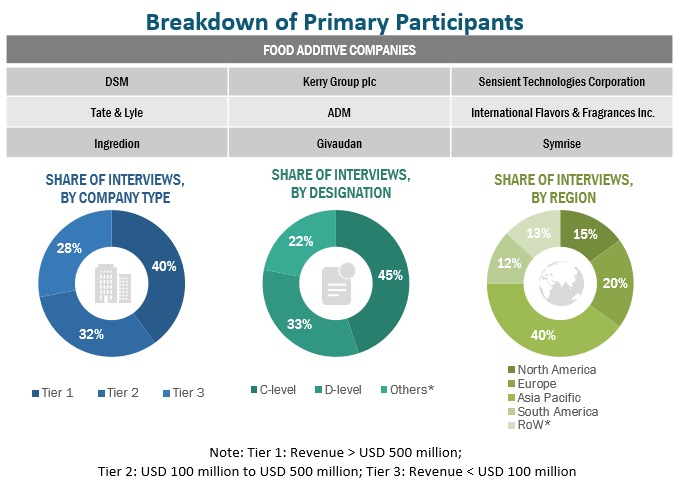
To know about the assumptions considered for the study, download the pdf brochure
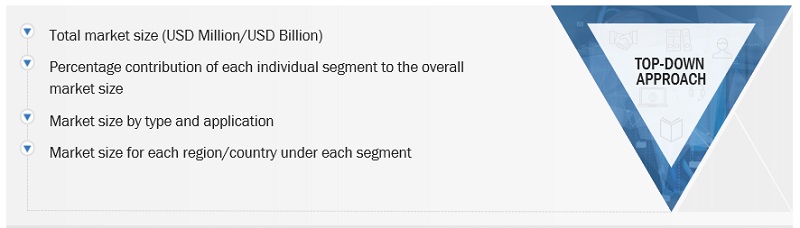
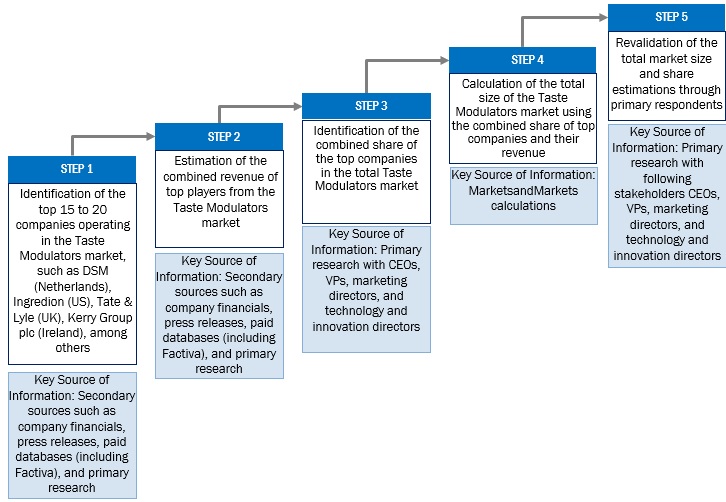
The top-down and bottom-up approaches were used to estimate and validate the market’s and various dependent submarkets’ size. The research methodology used to estimate the market size includes extensive secondary research of key players, reports, reviews, and newsletters of top market players, along with extensive interviews from leaders, such as CEOs, directors, and marketing executives.
Global Taste Modulators Market Size: Bottom-Up Approach
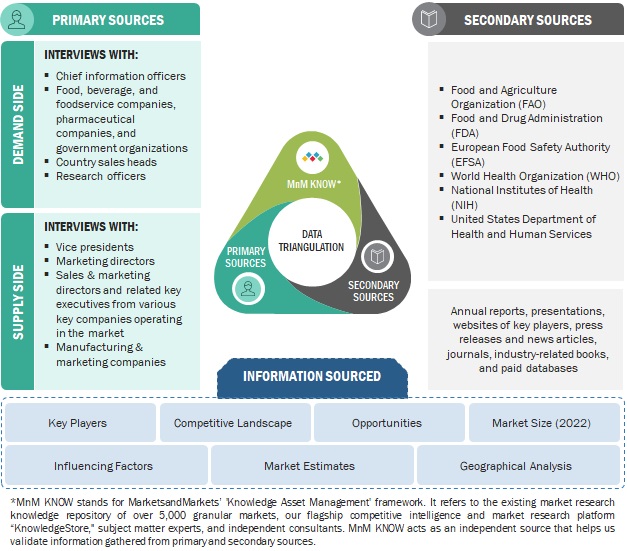 To know about the assumptions considered for the study, Request for Free Sample Report
Global Taste Modulators market Size: Top-Down Approach
Global Taste Modulators market size estimation: SUPPLY SIDE
Data Triangulation
The data triangulation and market breakdown procedures explained above were implemented, wherever applicable, to complete the overall market engineering process and arrive at the exact statistics for various market segments and subsegments. The data was triangulated by studying various factors and trends from the demand and supply sides. Along with this, the market size was validated using both the top-down and bottom-up approaches.
Market Definition
Taste modulators are substances used to restore any change in taste caused by using alternative food ingredients, providing the desired taste perception to a product. Sweet, salt, and fat modulators are available to compensate for the changes in taste that occur because of the use of low-calorie sugar substitutes, low-sodium salts, and fat reducers, respectively. These substances mask and modulate the taste of the respective substitutes, ensuring that the primary tastes of un-modified sugar, salt, and fat are emulated, in the absence of their presence.
Though the primary role of taste modulators involves the quality of taste, they also play a role in modulating the texture and mouthfeel of the food & beverage products that they are used in. Even though these substances play a role in changing more features than just the taste of a food or beverage product, it is important to note that these substances are not the same as flavor modulators.
Key Stakeholders
- Taste modulator manufacturers and processors
- Taste modulators traders, distributors, and suppliers
- Food product manufacturers, processors, and traders
- Food ingredient manufacturers, processors, and traders
- Organizations such as the Food and Drug Administration (FDA), the US Department of Agriculture (USDA), the European Food Safety Agency (EFSA), and The International Food Additives Council (IFAC)
- Government and research organization
- Associations. regulatory bodies, and other industry-related bodies:
- Food Processing Suppliers Association (FPSA)
- Center for Innovative Food Technology (CIFT)
- Food and Drug Administration (FDA)
- European Food Safety Agency (EFSA)
- The National Association of Flavors and Food-Ingredient Systems (NAFFS)
Report Objectives
- To define, segment, and project the global market for Taste Modulators on the basis of type, application, and region
- To provide detailed information regarding the key factors influencing the growth of the market (drivers, restraints, opportunities, and industry-specific challenges)
- To strategically analyze the micro markets with respect to individual growth trends, future prospects, and their contribution to the total market
- To analyze the opportunities in the market for stakeholders and provide a competitive landscape of the market leaders
- To project the size of the market and its submarkets, in terms of value with respect to the regions (along with the key countries)
- To strategically profile the key players and comprehensively analyze their market position and core competencies
- To analyze competitive developments in the Taste Modulators market, including joint ventures, mergers & acquisitions, new product developments, and research & development activities
Report Scope:
Taste Modulators market:
By Type
- Sweet Modulators
- Salt Modulators
- Fat Modulators
By Application
-
Food
- Confectionery Products
- Bakery Products
- Dairy Products
- Snacks & Savory Products
- Meat Products
- Other Food Applications
-
Beverages
- Non-Alcoholic Beverages
- Alcoholic Beverages
- Pharmaceutical
By Region
- North America
- Europe
- Asia Pacific
- South America
- Rest of the World
Available Customizations
With the given market data, MarketsandMarkets offers customizations according to company-specific scientific needs.
The following customization options are available for the report:
Product Analysis
- Product Matrix, which gives a detailed comparison of the product portfolio of each company
Geographic Analysis
With the given market data, MarketsandMarkets offers customizations according to company-specific scientific needs.
- Further breakdown of the Rest of the European Taste Modulators market, by key country
- Further breakdown of the Rest of the Asia Pacific Taste Modulators market, by key country
- Further breakdown of the Rest of South America Taste Modulators market, by key country
Company Information
- Detailed analyses and profiling of additional market players
Get the Full Taste Modulators Market Report
Full forecast, segment splits, and company analysis for all Taste Modulators Market.
- France Taste Modulators Market
- UK Taste Modulators Market
- Italy Taste Modulators Market
- Netherlands Taste Modulators Market
- Poland Taste Modulators Market
- China Taste Modulators Market
- India Taste Modulators Market
- Japan Taste Modulators Market
- Brazil Taste Modulators Market
- Argentina Taste Modulators Market
- Saudi Arabia Taste Modulators Market
- Iran Taste Modulators Market
- South Africa Taste Modulators Market
- Rest Of Europe Taste Modulators Market
- Rest Of Asia Pacific Taste Modulators Market
- Others In Rest Of The World Taste Modulators Market
- Rest Of South America Taste Modulators Market
- US Taste Modulators Market
- Canada Taste Modulators Market
- Mexico Taste Modulators Market
- Germany Taste Modulators Market
Need a Tailored Report?
Customize this report to your needs
Get 10% FREE Customization
Customize This Report
