
Japan Tea Extract Market (2025-2030)

The Japan Tea Extract Market was valued at $204.8 Million in 2025 and projected to reach to $289.9 Million by 2030, representing a compound annual growth rate of 7.2%. Japan's tea extract market is poised for sustained growth through 2030, driven by increasing consumer preference for natural, health-conscious beverages and functional food products.


| Market Size in | USD 26.32 MN |
| Market Forecast in | |
| CAGR | |
| Forecast Period | |
| Units Considered | Value (USD MN) |
Japan Tea Extract Market Trends and Insights
- Japan's strong tea culture and consumer preference for natural, functional beverages drive demand for premium tea extracts across food, beverage, and nutraceutical applications.
- The market in Japan benefits from established supply chains, advanced processing technologies, and high consumer awareness of health benefits associated with tea consumption. The forecast period through 2030 indicates sustained growth momentum in Japan's tea extract sector, supported by rising demand for convenient, concentrated tea products and clean-label formulations.
- Japan's position as both a major tea producer and consumer creates competitive advantages in innovation and product development.
- Market expansion in Japan is further catalyzed by increasing adoption of tea extracts in functional foods, ready-to-drink beverages, and dietary supplements targeting health-conscious Japanese consumers..
Key Market Statistics
- CAGR (2025-2030) 7.2% CAGR
- Market Size, 2025 ~USD 204.8 Million
- Forecast, 2030 ~USD 289.9 Million
- Country Japan
Japan Tea Extract Market Overview
Market Valuation :
Japan's tea extract market is valued at USD 204.8 million in 2025, with projected growth to USD 289.9 million by 2030, representing a steady 7.2% CAGR.
Cultural Advantage :
Japan's deep-rooted tea culture and centuries-old tradition of tea consumption create strong consumer affinity for premium tea extracts and functional tea-based products.
Product Diversification :
Tea extracts in Japan span multiple applications including beverages, food ingredients, dietary supplements, and cosmetics, driven by consumer demand for natural and functional ingredients.
Supply Chain Strength :
Japan benefits from established domestic tea production, advanced extraction technologies, and robust distribution networks supporting market expansion and product innovation.
Japan Tea Extract Market Dynamics
- The market benefits from Japan's established tea culture, premium positioning of Japanese tea varieties, and growing adoption of tea extracts in nutraceutical and cosmetic applications.
- Rising health awareness and demand for antioxidant-rich products further support market expansion.
- Innovation in extraction technologies and product formulations will enable manufacturers to capture emerging opportunities in ready-to-drink beverages and wellness supplements, maintaining the 7.2% CAGR trajectory..
Market Ecosystem
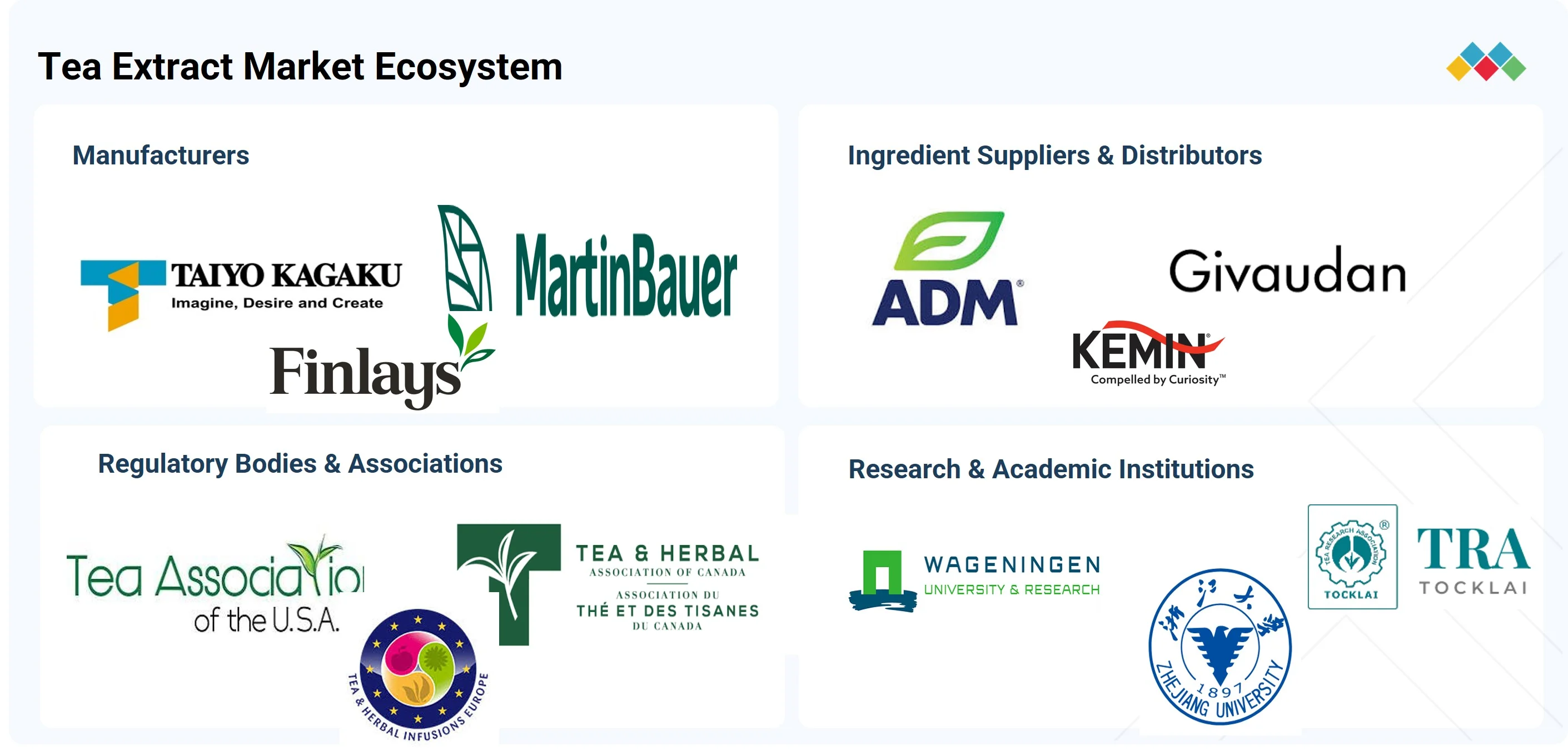
TEA EXTRACT MARKET: COMMERCIAL USE CASES ACROSS INDUSTRIES
| COMPANY | USE CASE DESCRIPTION | BENEFITS |
|---|---|---|
 |
Tea extracts, concentrates, powders, and aromas for ready-to-drink teas, functional beverages, and other food and beverage applications. | Consistent tea flavor, streamlined beverage manufacturing, and flexible product formulation. |
 |
Tea and botanical extracts for functional beverages, herbal infusions, dietary supplements, and wellness-oriented products. | Access to botanical ingredient expertise, diversified formulations, and reliable ingredient quality. |
 |
Green tea extracts and water-soluble tea ingredients for functional beverages, food products, and nutraceutical formulations. | Improved water solubility, convenient processing, and enhanced formulation versatility. |
 |
Green tea extracts and standardized botanical ingredients for dietary supplements, food, and health-oriented formulations. | Consistent ingredient specifications, formulation support, and the incorporation of bioactive compounds derived from tea. |
Logos and trademarks shown above are the property of their respective owners. Their use here is for informational and illustrative purposes only.
Related Ecosystem
Plant Based Alternatives Ingredients
- Dairy Products
- Bakery Products
- Diaphragm Pumps
- Enzymatic Hydrolysis
- Microorganism
- AZELIS HOLDINGS SA
- Archer-Daniels-Midland Company
- Amway
- CARGILL, INCORPORATED
- GRIFFITH FOODS
Key Takeaways
- Japan's tea extract market reaches USD 204.8 million in 2025 with projected growth to USD 289.9 million by 2030.
- Japan's 7.2% CAGR reflects strong demand for functional and natural tea-based products among health-conscious consumers.
- Japan's established tea production infrastructure and cultural affinity for tea support market innovation and premium product development.
- Japan's tea extract market benefits from expanding applications in functional foods, beverages, and nutraceuticals through 2030.
Tea Extract Market Report Scope
| Report Metric | Details |
|---|---|
| Base Year | 2025 |
| Fastest Growing Segment | ORGANIC TEA EXTRACTS (Category) |
| Forecast Period | 2025–2030 |
| Growth Rate | CAGR of 7.8% from 2025 to 2030 |
| Largest Segment | CONVENTIONAL TEA EXTRACTS (Category) |
| Market Size Base Year (Billions) | ~USD 2.99 (2025) |
| Revenue Forecast (Billions) | ~USD 4.36 (2030) |
| Segments Covered | Source, Form, Category, Application, Sub-Application |
Japan Tea Extract Market Report Segmentation
5 segment dimensions are covered across the global market.
By Source
- Black Tea
- Green Tea
- Oolong Tea
- Other Tea Sources
By Form
- Encapsulated
- Liquid
- Powder
By Category
- Conventional Tea Extracts
- Organic Tea Extracts
By Application
- Cosmetics & Personal Care
- Food & Beverage
- Pharmaceuticals & Dietary Supplements
By Sub-Application
- Anti-Aging Creams
- Antioxidant Supplements
- Bakery & Confectionery
- Carbonated & Soft Drinks
- Dairy Products
- Functional Beverages
- Hair Care
- Herbal Medicines
- Oral Care
- Other Cosmetics & Personal Care
- Other Foods & Beverages
- Other Pharmaceuticals & Dietary Supplements
- Skin Care
- Therapeutic Products
- Weight Loss Products
Target Audience
- Food & Beverage Manufacturers : Japanese and international F&B companies need market-specific data to develop tea extract-based products, optimize formulations, and capture growing demand for functional beverages in Japan.
- Nutraceutical & Supplement Companies : Supplement manufacturers require Japan market insights to identify growth opportunities in tea extract-based wellness products and align product development with local health trends.
- Tea Producers & Extractors : Domestic and international tea producers need Japan-specific market analysis to optimize extraction processes, expand product portfolios, and strengthen market positioning.
- Retail & Distribution Partners : Retailers and distributors require market forecasts and segment analysis to make informed inventory decisions, identify emerging product categories, and capitalize on Japan's tea extract growth.
- Investment & Strategy Consultants : Investors and business strategists need Japan market data to evaluate investment opportunities, assess market attractiveness, and develop entry or expansion strategies in the tea extract sector.
Key Companies in the Japan Tea Extract Market
| Company | HQ | Ownership | Strongest segments |
|---|---|---|---|
| ADM | United States | Public Company | Ag Services and Oilseeds,Carbohydrate Solutions,Nutrition, |
| TAIYO KAGAKU CO., LTD. | Japan | Public Company | Nutrition (catechins, L-theanine, fibers, NDS iron/vitamins/PUFA),Interface Solution (emulsifiers, emulsified products, protein-based materials, industrial cosmetics/chemicals),Natural Ingredients – processed eggs, instant food ingredients, beverages, confectionery inputs, |
| UMANG GLOBAL GROUP PVT. LTD. | India | Private Company | Core flagship products/services,Customized / value-added solutions,Ancillary products & trading lines, |
ADM
ADM (Archer Daniels Midland) is a publicly traded United States agricultural processing and food ingredients company founded in 1902 with over 41,000 employees.
TAIYO KAGAKU CO., LTD.
Taiyo Kagaku Co., Ltd. is a publicly traded Japanese food ingredients and specialty chemicals company founded in 1946 with 867 employees.
UMANG GLOBAL GROUP PVT. LTD.
Umang Global Group Pvt. Ltd. is a privately held Indian company founded in 1982.
Reasons to Buy this Report
- Japan-Specific Market Sizing : Access precise valuation data for Japan's tea extract market with verified 2025 baseline (USD 204.8M) and 2030 forecast (USD 289.9M), enabling accurate business planning and investment decisions.
- Cultural & Consumer Insights : Understand Japan's unique tea culture dynamics, consumer preferences for premium and functional tea extracts, and how traditional tea consumption patterns influence modern product demand.
- Application-Specific Opportunities : Identify high-growth segments within Japan including beverages, food ingredients, dietary supplements, and cosmetics, with tailored strategies for each application channel.
- Competitive Landscape Analysis : Gain intelligence on Japan's established supply chain, domestic tea producers, extraction technology leaders, and distribution networks to benchmark competitive positioning.
- Growth Strategy Development : Leverage Japan-focused market intelligence to develop targeted expansion strategies, product innovation roadmaps, and go-to-market approaches aligned with 7.2% CAGR opportunities.
Frequently asked questions
What is the current size of Japan's tea extract market?
Japan's tea extract market is valued at USD 204.8 million in 2025 and is expected to grow to USD 289.9 million by 2030.
What is the growth rate for tea extracts in Japan?
Japan's tea extract market is growing at a compound annual growth rate (CAGR) of 7.2% from 2025 to 2030.
What drives demand for tea extracts in Japan?
Demand in Japan is driven by strong tea culture, consumer preference for natural and functional beverages, and increasing adoption in functional foods and dietary supplements.
Which applications are growing fastest in Japan's tea extract market?
In Japan, the fastest-growing applications include functional foods, ready-to-drink beverages, and nutraceutical products targeting health-conscious consumers.
How does Japan's tea extract market compare regionally?
Japan's 7.2% CAGR positions it as a significant market within Asia Pacific, supported by its dual role as a major tea producer and consumer with advanced processing capabilities.
RESEARCH METHODOLOGY
This study used two main approaches to estimate the current size of the tea extract market. Exhaustive secondary research was done to collect information on the source (black tea, green tea, oolong tea & other tea sources), form, category, application, and region segments of the market. The next step involved validating these findings, assumptions, and sizing with industry experts across the value chain through primary research. Both top-down and bottom-up approaches were employed to estimate the complete market size. Thereafter, data triangulation was used to estimate the market size of segments and subsegments.
Secondary Research
This study used extensive secondary sources—directories and databases such as Bloomberg Businessweek and Factiva—to identify and collect information for a technical, market-oriented, and commercial market study. In the secondary research process, sources such as annual reports, press releases & investor presentations, white papers, food journals, certified publications, articles from recognized authors, directories, and databases were consulted to identify and collect information. Secondary research was mainly used to obtain key information about the industry’s supply chain, the pool of key players, and market classification and segmentation, aligned with industry trends, down to the bottom-most level, regional markets, and key developments from market- and technology-oriented perspectives.
Primary Research
Extensive primary research was conducted after obtaining information regarding the tea extract market scenario through secondary research. Several primary interviews were conducted with market experts from the demand and supply sides across major countries of North America, Europe, Asia Pacific, South America, and the Rest of the World. Primary data was collected through questionnaires, emails, and telephonic interviews. Primary supply-side sources included industry experts such as Chief Experience Officers (CXOs), vice presidents (VPs), directors from business development, marketing, research, and development teams, and key executives from distributors and key opinion leaders. Primary interviews were conducted to gather insights such as market statistics, data on revenue collected from the products and services, market breakdowns, market size estimations, market forecasting, and data triangulation. Primary research also helped understand the various trends related to source (black tea, green tea, oolong tea & other tea sources), form (liquid, powder, encapsulated), category (organic tea extract, conventional tea extract), application (food & beverages, pharmaceuticals & dietary supplements, cosmetics & personal care), and region. We interviewed demand-side stakeholders, such as farmers, agricultural cooperatives, and commercial agricultural enterprises, to understand buyers’ perspectives on suppliers, products, and business outlook, which will affect the overall market.
Following is the breakdown of primary respondents:
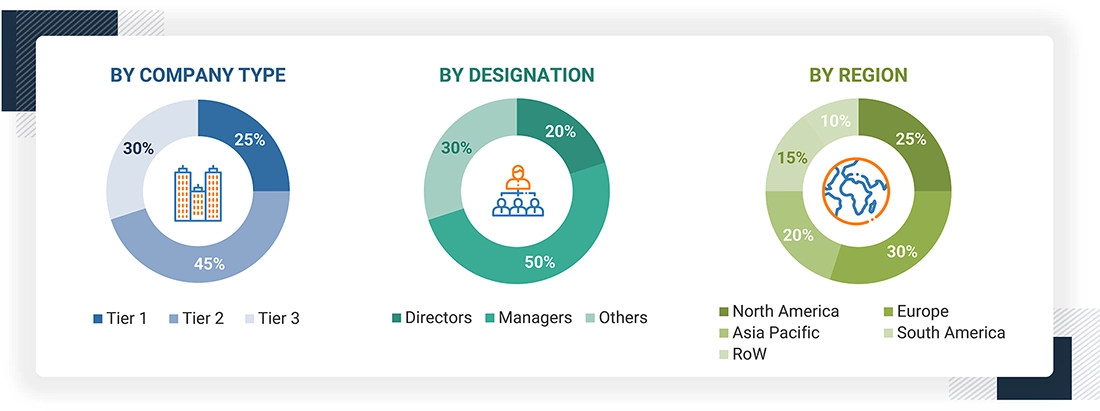
To know about the assumptions considered for the study, download the pdf brochure
Note: The three tiers of companies are defined based on total revenue in 2023 or 2024, based on available financial data: Tier 1: Revenue >USD 1 billion; Tier 2: USD 100 million ≤ revenue ≤ USD 1 billion; Tier 3: Revenue <USD 100 million. RoW includes Africa and the Middle East
|
COMPANY NAME |
DESIGNATION |
|
ADM (US) |
Product Development Manager |
|
Givaudan (Switzerland) |
Sales Head |
|
IFF (US) |
Marketing Head |
|
Tata Consumer Products (India) |
Sales Head |
|
Finlays (UK) |
Senior Research Executive |
Market Size Estimation
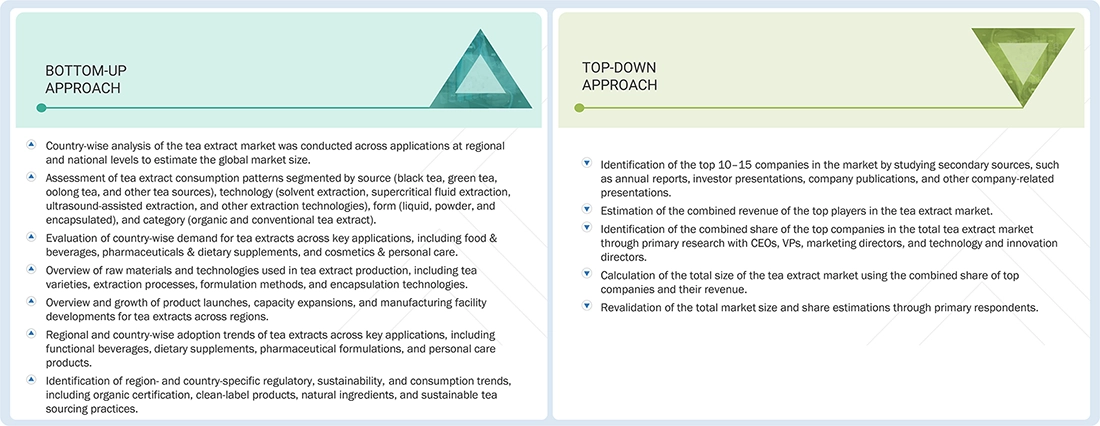
The top-down and bottom-up approaches were used to estimate and validate the total size of the tea extract market. These approaches were also used extensively to determine the size of various market subsegments. The research methodology used to estimate the market size includes the following details:
- The key players in the industry and the overall market were identified through extensive secondary research.
- All shares, splits, and breakdowns were determined using secondary sources and verified through primary sources.
- All possible parameters that affect the market covered in this research study were accounted for, viewed in extensive detail, verified through primary research, and analyzed to obtain final quantitative and qualitative data.
- The research included the study of reports, reviews, and newsletters of top market players, along with extensive interviews for opinions from leaders, such as CEOs, directors, and marketing executives.
Data Triangulation
After determining the overall market size from the estimation process explained above, the total market was split into several segments and subsegments. The data triangulation procedure was employed, where applicable, to estimate the overall tea extract market and derive accurate statistics for all segments and subsegments. The data was triangulated by studying various factors and trends from the demand and supply sides. The market size was also validated using both the top-down and bottom-up approaches.
Market Definition
Tea extract is a concentrated form derived from carefully processed tea leaves to capture their essential compounds, flavors, and nutrients. It contains soluble tea-leaf components, primarily caffeine, polyphenols, catechins, and antioxidants, which contribute to tea's health benefits and distinct taste. The extraction process involves selecting high-quality tea leaves and using water or solvent extraction to preserve their natural properties. Tea extracts are widely used in food, beverages, cosmetics, and supplements for their functional and nutritional benefits, offering a potent and convenient alternative to brewed tea in various applications.
Key Stakeholders
- Tea Extract Manufacturers
- Tea Growers and Plantation Owners
- Raw Material Suppliers
- Tea Processing Companies
- Extraction Technology and Equipment Providers
- Food and Beverage Manufacturers
- Pharmaceutical and Dietary Supplement Manufacturers
- Cosmetics and Personal Care Product Manufacturers
- Distributors and Ingredient Suppliers
- Retailers and E-commerce Companies
- Regulatory Authorities and Certification Agencies
- Research Institutions and Laboratories
- End Consumers
-
Associations and industry bodies:
- Tea Association of the USA
- Tea & Herbal Association of Canada
- UK Tea & Infusions Association
- Tea Board of India
- China Tea Marketing Association
- Sri Lanka Tea Board
- Kenya Tea Board
- FAO Intergovernmental Group on Tea
- European Tea Committee
- German Tea Association (Deutscher Tee & Kräutertee Verband)
- Japan Tea Association
- International Tea Committee
- Tea Research Association (India)
- Ethical Tea Partnership
- Rainforest Alliance
Report Objectives
- To determine and project the size of the tea extract market based on the source (green tea, black tea, oolong tea, other tea sources), category, application, form, and region, over five years, ranging from 2026 to 2031
- To identify the attractive opportunities in the market by determining the largest and fastest-growing segments across regions
- To provide detailed information about the key factors influencing market growth (drivers, restraints, opportunities, and challenges)
- To analyze the opportunities in the market for stakeholders and provide details of the competitive landscape for market leaders
- To analyze the micro markets with respect to individual growth trends, prospects, and their contribution to the total market
- To identify and profile the key players in the market
- To understand the competitive landscape and identify the major growth strategies adopted by players across the key regions
Customization Options
Based on the provided market data, MarketsandMarkets offers customizations to meet company-specific scientific needs. The following customization options are available for the report:
Product Analysis
- Product matrix, which gives a detailed comparison of the product portfolio of each company.
Geographic Analysis
With the given market data, MarketsandMarkets offers customizations according to company-specific.
- Further breakdown of the Rest of Europe tea extract market into key countries
- Further breakdown of the Rest of Asia Pacific tea extract market into key countries
- Further breakdown of the Rest of South America tea extract market into key countries
Company Information
- Detailed analyses and profiling of additional market players (up to five)
Get the Full Tea Extract Market Report
Full forecast, segment splits, and company analysis for all Tea Extract Market.
- China Tea Extract Market
- India Tea Extract Market
- Canada Tea Extract Market
- Mexico Tea Extract Market
- US Tea Extract Market
- Germany Tea Extract Market
- UK Tea Extract Market
- France Tea Extract Market
- Spain Tea Extract Market
- Italy Tea Extract Market
- Brazil Tea Extract Market
- Argentina Tea Extract Market
- Rest Of Europe Tea Extract Market
- Rest Of Asia Pacific Tea Extract Market
Need a Tailored Report?
Customize this report to your needs
Get 10% FREE Customization
Customize This Report
