
Japan Technical Textiles Market (2025-2030)

The Japan Technical Textiles Market was valued at $22677.1 Million in 2025 and projected to reach to $26933.1 Million by 2030, representing a compound annual growth rate of 3.5%. Japan's technical textiles market is poised for moderate but consistent growth through 2030, driven by sustained demand from the automotive sector for lightweight materials and the healthcare industry for advanced medical textiles.


| Market Size in | USD 26.32 MN |
| Market Forecast in | |
| CAGR | |
| Forecast Period | |
| Units Considered | Value (USD MN) |
Japan Technical Textiles Market Trends and Insights
- Japan maintains a significant position within the Asia Pacific technical textiles sector, driven by advanced manufacturing capabilities and strong demand from automotive, healthcare, and industrial applications.
- The market in Japan reflects steady growth momentum as domestic industries increasingly adopt high-performance textiles for specialized applications. Japan's technical textiles sector benefits from the country's robust industrial base and innovation-driven economy.
- Between 2025 and 2030, Japan is expected to see moderate but consistent expansion, supported by investments in sustainable textile technologies and rising demand from the automotive and medical device sectors.
- Japan's emphasis on quality and durability positions the market favorably for premium technical textile products that command higher margins. The growth trajectory in Japan underscores the region's commitment to advanced material solutions.
- Japan continues to leverage its manufacturing expertise to develop specialized textiles for filtration, protective wear, and composite reinforcement applications, ensuring sustained market relevance through 2030..
Key Market Statistics
- CAGR (2025-2030) 3.5% CAGR
- Market Size, 2025 ~USD 22677.1 Million
- Forecast, 2030 ~USD 26933.1 Million
- Country Japan
Japan Technical Textiles Market Overview
Market Valuation :
Japan's technical textiles market is valued at USD 22,677.1 million in 2025, reflecting the country's strong manufacturing base and advanced industrial applications across multiple sectors.
Growth Trajectory :
The market is projected to reach USD 26,933.1 million by 2030, expanding at a CAGR of 3.5%, demonstrating steady growth despite Japan's mature industrial landscape and economic constraints.
Key Application Drivers :
Japan's technical textiles demand is primarily driven by automotive, healthcare, and industrial applications, leveraging the country's expertise in precision manufacturing and quality standards.
Regional Significance :
Japan maintains a significant position within the Asia Pacific technical textiles sector, supported by advanced manufacturing capabilities and innovation in fiber technology and composite materials.
Japan Technical Textiles Market Dynamics
- The country's aging population and focus on healthcare innovation will continue to support market expansion, while automotive manufacturers' shift toward electric vehicles creates opportunities for specialized technical textiles in battery components and thermal management. However, growth will be tempered by Japan's mature market conditions, labor cost pressures, and competition from lower-cost Asian manufacturers.
- Investment in R&D for high-performance materials, sustainability initiatives, and smart textiles will be critical for maintaining competitiveness.
- Strategic partnerships and technological advancement in niche applications will define market dynamics through the forecast period..
Market Ecosystem
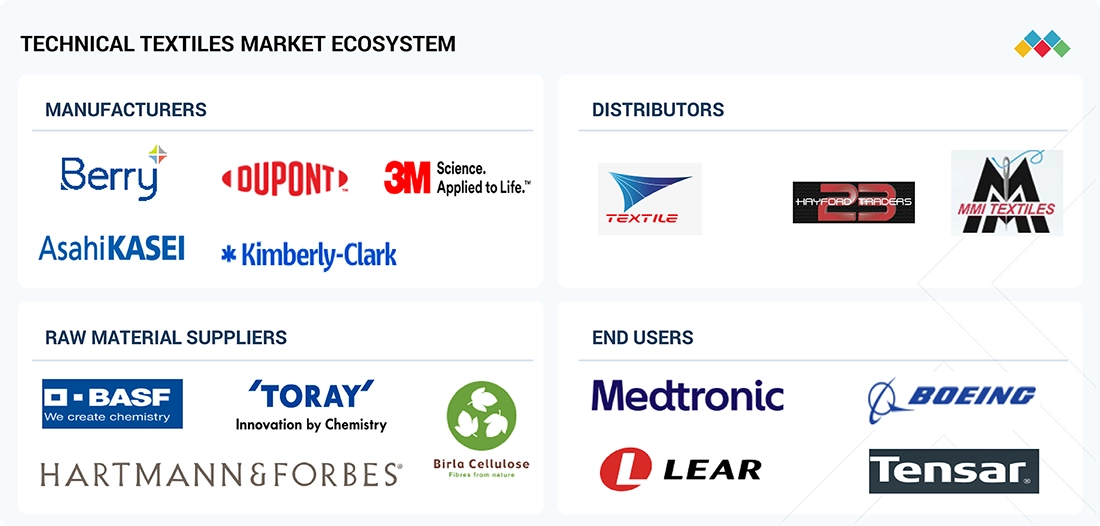
Technical Textile Market: COMMERCIAL USE CASES ACROSS INDUSTRIES
| COMPANY | USE CASE DESCRIPTION | BENEFITS |
|---|---|---|
 |
Develops advanced nonwovens and performance fabrics for medical, hygiene, and industrial filtration applications. | Offers high absorbency, strength, and sustainable material options ensuring quality and environmental compliance. |
 |
Produces engineered nonwovens and laminates for automotive, construction, and filtration sectors. | Provides customizable, durable, and sustainable textile solutions enhancing product performance and longevity. |
 |
Manufactures high-performance fibers and fabrics like Kevlar, Nomex, and Tyvek for protective and industrial uses. | Ensures superior strength, flame resistance, and lightweight protection across safety-critical applications. |
 |
Supplies nonwoven fabrics for hygiene, medical, and industrial filtration products. | Delivers exceptional absorbency, comfort, and hygiene compliance with scalable global production. |
 |
Integrates technical textiles with coatings and adhesives for filtration, PPE, and acoustic insulation. | Provides high-efficiency, reliable, and multifunctional materials combining protection and performance. |
Logos and trademarks shown above are the property of their respective owners. Their use here is for informational and illustrative purposes only.
Related Ecosystem
Yarns Fabric And Textile
- Agrotech
- Clothtech
- Indutech
- Oekotech
- Packtech
- MILLIKEN & COMPANY
- Toray Industries, Inc.
- 3M COMPANY
- DuPont de Nemours, Inc.
- Kimberly-Clark Corporation
Key Takeaways
- Japan's technical textiles market reaches USD 22.7 billion in 2025 with projected growth to USD 26.9 billion by 2030.
- Japan achieves a 3.5% CAGR, reflecting steady but moderate expansion driven by automotive and healthcare sectors.
- Japan's advanced manufacturing and quality-focused approach support premium technical textile product development.
- Japan's market growth is underpinned by investments in sustainable technologies and specialized industrial applications through 2030.
Technical Textiles Market Report Scope
| Report Metric | Details |
|---|---|
| Base Year | 2025 |
| Fastest Growing Segment | OEKOTECH (Application) |
| Forecast Period | 2025–2030 |
| Growth Rate | CAGR of 5.6% from 2025 to 2030 |
| Largest Segment | WOVEN (Process) |
| Market Size Base Year (Billions) | ~USD 247.36 (2025) |
| Revenue Forecast (Billions) | ~USD 324.83 (2030) |
| Segments Covered | Material, Process, Application |
Japan Technical Textiles Market Report Segmentation
3 segment dimensions are covered across the global market.
By Material
- Metal
- Mineral
- Natural Fiber
- Other Materials
- Regenerated Fiber
- Synthetic Polymer
By Process
- Knitted
- Non-Woven
- Other Processes
- Woven
By Application
- Agrotech
- Buildtech
- Clothtech
- Geotech
- Hometech
- Indutech
- Meditech
- Mobiltech
- Oekotech
- Other Applications
- Packtech
- Protech
- Sportech
JAPAN: TECHNICAL TEXTILES MARKET, BY APPLICATION, 2025–2030
| Segment | 2025 | 2026 | 2027 | 2028 | 2029 | 2030 | CAGR (%) |
|---|---|---|---|---|---|---|---|
| AGROTECH | 1295.3 | 1329.7 | 1366.2 | 1405.2 | 1446.6 | 1490.7 | 2.8 |
| BUILDTECH | 1259.1 | 1308.8 | 1361.8 | 1418.3 | 1478.6 | 1542.9 | 4.1 |
| CLOTHTECH | 1357.1 | 1386.3 | 1417.4 | 1450.7 | 1486.3 | 1524.2 | 2.3 |
| GEOTECH | 216.9 | 226.5 | 236.8 | 247.9 | 259.6 | 272.2 | 4.6 |
| HOMETECH | 1225.2 | 1252.7 | 1282.2 | 1313.6 | 1347.1 | 1382.8 | 2.4 |
| INDUTECH | 4677.1 | 4838.4 | 5010.2 | 5193.1 | 5387.8 | 5595.2 | 3.6 |
| MEDITECH | 1804.4 | 1873 | 1946 | 2023.9 | 2106.8 | 2195.3 | 4 |
| MOBILTECH | 4136.7 | 4263.7 | 4398.2 | 4540.6 | 4691.5 | 4851.3 | 3.2 |
| OEKOTECH | 231.2 | 243.5 | 256.8 | 271.1 | 286.4 | 302.8 | 5.5 |
| OTHER APPLICATIONS | 544 | 561.7 | 580.5 | 600.5 | 621.8 | 644.5 | 3.4 |
| PACKTECH | 1757.5 | 1819.9 | 1886.4 | 1957.1 | 2032.4 | 2112.7 | 3.7 |
| PROTECH | 2648.6 | 2739.9 | 2837.2 | 2940.8 | 3051 | 3168.5 | 3.6 |
| SPORTECH | 1524.1 | 1581.3 | 1642.1 | 1707 | 1776.1 | 1849.8 | 3.9 |
| TOTAL | 22677.1 | 23425.5 | 24221.9 | 25069.7 | 25972.1 | 26933.1 | 3.5 |
Target Audience
- Automotive Manufacturers & Suppliers : Japanese and international automotive companies need Japan-specific technical textile data to optimize material sourcing, support EV development, and maintain supply chain efficiency in this critical market.
- Healthcare & Medical Device Companies : Medical textile manufacturers and healthcare innovators require detailed Japan market insights to capitalize on the country's aging population and advanced healthcare standards driving specialized textile demand.
- Textile & Material Producers : Technical textile manufacturers need Japan market analysis to identify growth segments, understand local competition, and develop product strategies aligned with Japanese quality standards and industrial requirements.
- Investment & Private Equity Firms : Investors evaluating opportunities in Japan's advanced materials sector require comprehensive market data to assess growth potential, competitive dynamics, and valuation benchmarks for technical textile companies.
- Industrial & Manufacturing Companies : Industrial enterprises sourcing technical textiles for filtration, insulation, and protective applications need Japan-specific market intelligence to optimize procurement strategies and identify local suppliers.
Key Companies in the Japan Technical Textiles Market
| Company | HQ | Ownership | Strongest segments |
|---|---|---|---|
| INDO RAMA SYNTHETICS (INDIA) LIMITED | India | Public Company | Synthetic polymer fibers and yarns for technical textiles,PET resin and textile-grade chips into technical chains,Specialty and recycled yarns for value-added technical uses, |
| KIMBERLY-CLARK CORPORATION | United States | Public Company | MediTech (baby, feminine, incontinence non-wovens),HomeTech (tissue, towels, wipes basesheets),ClothTech (training pants, reusable underwear, specialty), |
| ASAHI KASEI CORPORATION | Japan | Public Company | Synthetic Polymer Technical Textiles,Regenerated Fiber Technical Textiles,Non-woven and Membrane-based Textiles, |
| BERRY GLOBAL INC. | United States | Private Company | Synthetic Polymer – Non-woven (MediTech, PackTech, HomeTech),Synthetic Polymer – Woven/Knitted (AgroTech, InduTech, GeoTech),Flexible Technical Films (PackTech, BuildTech, ProTech), |
| DUPONT | United States | Public Company | Synthetic Polymer Technical Textiles (Tyvek, high-performance nonwovens),Construction & BuildTech Solutions (house wrap, insulation-linked textiles),Industrial & MobilTech Components (automotive, aerospace, printing, packaging), |
| KCWW | United States | Public Company | MediTech (absorbent hygiene, wipes, incontinence),HomeTech (tissue, towels, napkins, household wipes),PackTech (packaging, hygiene-related packaging formats), |
| 3M | United States | Public Company | Synthetic Polymer Technical Textiles (non-wovens, films, coated substrates),Natural, Regenerated Fiber, and Blends,Metal and Mineral-based Technical Textiles, |
| AHLSTROM | Finland | Private Company | Non-woven technical textiles (filtration, medical, protective),Fiber-based food and consumer PackTech substrates,Industrial and electrical InduTech (insulation papers, tape backings, abrasives), |
| TORAY INDUSTRIES, INC. | Japan | Public Company | Synthetic Polymer Technical Textiles,Woven Technical Fabrics,Non-woven and Functional Materials, |
| MITSUI CHEMICALS, INC. | Japan | Public Company | Synthetic polymer-based nonwovens (hygiene, MediTech, HomeTech, PackTech),Mobility and InduTech materials (elastomers, PP compounds, filtration media),MediTech and life care technical materials, |
| SRF LIMITED | India | Public Company | Synthetic Polymer-based Technical Textiles (polyester/nylon tyre cord, industrial yarns, coated and laminated fabrics),Natural Fiber and Regenerated Fiber Technical Textiles,High-performance Coated/Engineered Technical Textiles (ProTech, GeoTech, BuildTech, AgroTech), |
INDO RAMA SYNTHETICS (INDIA) LIMITED
Indo Rama Synthetics (India) Limited is a publicly traded Indian company founded in 1974 with 6,789 employees. The company operates in the synthetics and textiles sector.
KIMBERLY-CLARK CORPORATION
Kimberly-Clark Corporation is a publicly traded American company founded in 1872 with 36,000 employees. The company is a leading manufacturer of personal care and consumer products.
ASAHI KASEI CORPORATION
Asahi Kasei Corporation is a publicly traded Japanese company founded in 1922 with 47,895 employees. The company operates across chemicals, fibers, and electronics sectors.
BERRY GLOBAL INC.
Berry Global Inc. is a privately held American company founded in 1967 with 42,000 employees. The company is a manufacturer of plastic packaging and engineered materials.
DUPONT
DuPont is a publicly traded American company founded in 2015 with 15,000 employees. The company operates in specialty chemicals and advanced materials.
KCWW
KCWW is a publicly traded American company founded in 1872 with 36,000 employees. The company operates in the consumer products and personal care sector.
3M
3M is a publicly traded American company founded in 1902 with 60,500 employees. The company manufactures a diverse range of products including adhesives, abrasives, and industrial materials.
AHLSTROM
Ahlstrom is a privately held Finnish company founded in 1851 with 6,883 employees. The company specializes in fiber-based materials and filtration products.
TORAY INDUSTRIES, INC.
Toray Industries, Inc. is a publicly traded Japanese company founded in 1926 with 46,294 employees. The company manufactures fibers, chemicals, and advanced materials.
MITSUI CHEMICALS, INC.
Mitsui Chemicals, Inc. is a publicly traded Japanese company founded in 1892 with 16,967 employees. The company produces chemicals, plastics, and specialty materials.
SRF LIMITED
SRF Limited is a publicly traded Indian company founded in 1970 with 7,686 employees. The company manufactures specialty chemicals, films, and textiles.
Reasons to Buy this Report
- Japan-Specific Market Sizing : Access precise valuation data for Japan's technical textiles market (USD 22.7B in 2025) with detailed forecasts through 2030, enabling accurate budgeting and investment planning for Japan-focused operations.
- Automotive Sector Insights : Understand Japan's automotive textile requirements, including lightweight composites and EV-specific materials, critical for suppliers targeting Japan's major OEMs and Tier-1 manufacturers.
- Healthcare & Medical Applications : Gain intelligence on Japan's growing demand for advanced medical textiles driven by an aging population, supporting market entry strategies for healthcare textile manufacturers and innovators.
- Competitive Positioning : Benchmark your business against Japan's technical textile landscape, identifying growth opportunities and competitive threats specific to the country's manufacturing ecosystem and regulatory environment.
- Regional Strategy Development : Leverage Japan-specific market data to develop targeted go-to-market strategies within Asia Pacific, understanding how Japan's market dynamics differ from broader regional trends and competitors.
Frequently asked questions
What is the current size of Japan's technical textiles market in 2025?
Japan's technical textiles market is valued at USD 22,677.1 million in 2025, representing a significant segment within the Asia Pacific region.
What is the projected market size for Japan's technical textiles by 2030?
Japan's technical textiles market is forecast to reach USD 26,933.1 million by 2030, reflecting steady growth over the five-year period.
What is the CAGR for Japan's technical textiles market?
Japan's technical textiles market is expected to grow at a compound annual growth rate (CAGR) of 3.5% from 2025 to 2030.
Which industries drive demand for technical textiles in Japan?
Japan's technical textiles demand is primarily driven by automotive, healthcare, medical devices, industrial filtration, and protective wear applications.
What factors support Japan's technical textiles market growth?
Japan's market growth is supported by advanced manufacturing capabilities, investments in sustainable textile technologies, and strong demand from premium industrial sectors.
RESEARCH METHODOLOGY
The study involves two major activities in estimating the current market size for the technical textiles market. Exhaustive secondary research was done to collect information on the market, peer, and parent markets. The next step was to validate these findings, assumptions, and sizing with industry experts across the value chain through primary research. Both top-down and bottom-up approaches were employed to estimate the complete market size. After that, market breakdown and data triangulation were used to estimate the market size of segments and subsegments.
Secondary Research
Secondary sources referred to for this research study include financial statements of companies offering technical textiles and information from various trade, business, and professional associations. Secondary research has been used to obtain critical information about the industry’s value chain, the total pool of key players, market classification, and segmentation according to industry trends to the bottom-most level and regional markets. The secondary data was collected and analyzed to determine the overall size of the technical textiles market, which was validated by primary respondents.
Primary Research
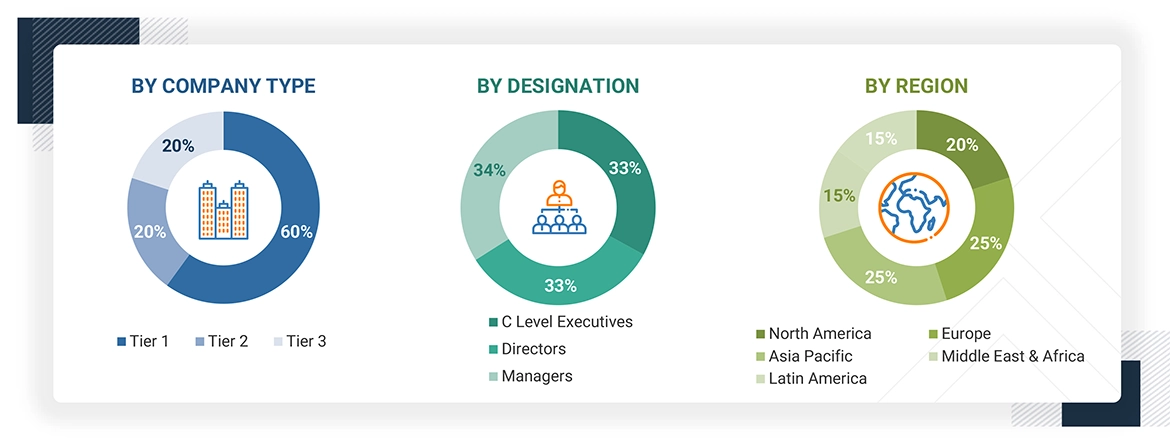
Extensive primary research was conducted after obtaining information regarding the technical textiles market scenario through secondary research. Several primary interviews were conducted with market experts from both the demand and supply sides across major countries of North America, Europe, Asia Pacific, Middle East & Africa, and South America. Primary data was collected through questionnaires, emails, and telephonic interviews. The primary sources from the supply side included various industry experts, such as Chief X Officers (CXOs), Vice Presidents (VPs), Directors from business development, marketing, product development/innovation teams, and related key executives from technical textiles industry vendors; material providers; distributors; and key opinion leaders. Primary interviews were conducted to gather insights such as market statistics, data on revenue collected from the products and services, market breakdowns, market size estimations, market forecasting, and data triangulation. Primary research also helped understand the various trends related to material, process, application, and region. Stakeholders from the demand side such as CIOs, CTOs, CSOs, and installation teams of the customer/end users who are seeking technical textiles services were interviewed to understand the buyer’s perspective on the suppliers, products, component providers, and their current usage of technical textiles and future outlook of their business which will affect the overall market.
Breakup of Primary Research:
To know about the assumptions considered for the study, download the pdf brochure
Market Size Estimation
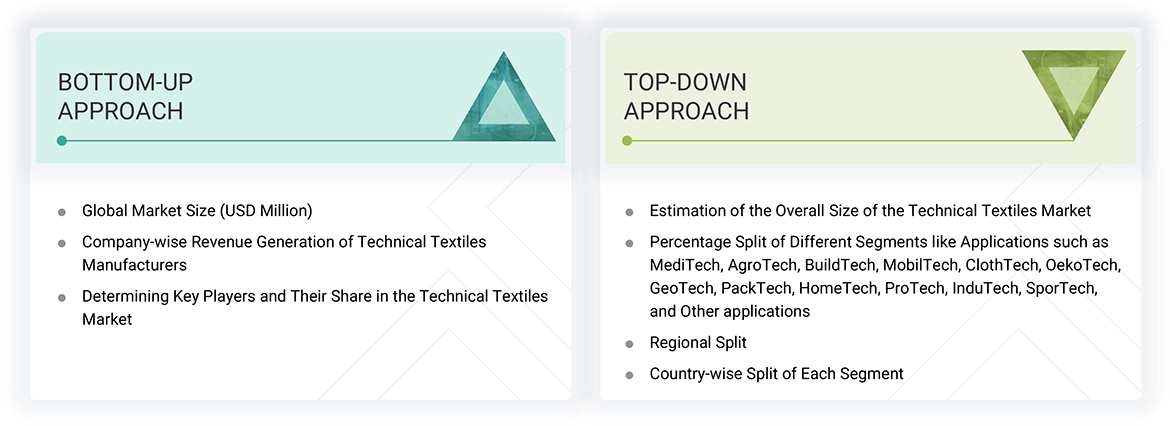
The research methodology used to estimate the size of the technical textiles market includes the following details. The market sizing was undertaken from the demand side. The market was upsized based on the demand for technical textiles in different applications at a regional level. Such procurements provide information on the demand aspects of the technical textiles industry for each application. All possible segments of the technical textiles market were integrated and mapped for each application.
Data Triangulation
After arriving at the overall size from the market size estimation process explained above, the total market was split into several segments and subsegments. The data triangulation and market breakdown procedures explained below were implemented, wherever applicable, to complete the overall market engineering process and arrive at the exact statistics for various market segments and subsegments. The data was triangulated by studying various factors and trends from the demand and supply sides. The market size was also validated using both the top-down and bottom-up approaches.
Market Definition
Technical textiles represent a category of advanced textile materials rigorously designed and manufactured to prioritize technical performance and functional properties over aesthetic or decorative considerations. These textiles are tailored to meet the specific requirements of a variety of applications, including MediTech, AgroTech, BuildTech, MobilTech, ClothTech, OekoTech, GeoTech, PackTech, HomeTech, ProTech, InduTech, and SporTech. They offer specialized attributes such as enhanced strength, durability, flame resistance, chemical resistance, and moisture management. Unlike conventional textiles typically used in apparel and home furnishings, technical textiles emphasize functionality, seamlessly integrating into products and processes where performance is paramount. They can be constructed from an extensive range of materials, including natural fibers, synthetic polymers, metals, and minerals, and may be employed independently or as integral components within composite products. Examples of applications include medical implants, geotextiles for soil stabilization, agrotextiles for crop protection, and protective garments designed for firefighters and military personnel. The technical textiles sector is experiencing rapid growth, fueled by ongoing innovation and the increasing demand for more efficient, cost-effective, and high-performance alternatives to traditional materials across a broad spectrum of industries.
Stakeholders
- Technical textile manufacturers
- Technical textile distributors and suppliers
- Applications
- Universities, governments, and research organizations
- Associations and industrial bodies
- R&D institutes
- Environmental support agencies
- Investment banks and private equity firms
- Research and consulting firms
Report Objectives
- To define, describe, and forecast the technical textiles market size in terms of volume and value
- To provide detailed information regarding the key factors, such as drivers, restraints, opportunities, and challenges influencing market growth
- To analyze and project the global technical textiles market by material, process, application, and region
- To forecast the market size concerning five main regions (along with country-level data), namely, North America, Europe, Asia Pacific, Middle East & Africa, and South America, and analyze the significant region-specific trends
- To strategically analyze micromarkets with respect to individual growth trends, prospects, and contributions of the submarkets to the overall market
- To analyze the market opportunities and the competitive landscape for stakeholders and market leaders
- To assess recent market developments and competitive strategies, such as agreements, contracts, acquisitions, and product developments/product launches, to draw the competitive landscapeTo strategically profile the key market players and comprehensively analyze their core competencies
Get the Full Technical Textiles Market Report
Full forecast, segment splits, and company analysis for all Technical Textiles Market.
- US Technical Textiles Market
- Canada Technical Textiles Market
- Mexico Technical Textiles Market
- Germany Technical Textiles Market
- France Technical Textiles Market
- Spain Technical Textiles Market
- UK Technical Textiles Market
- Italy Technical Textiles Market
- China Technical Textiles Market
- India Technical Textiles Market
- South Korea Technical Textiles Market
- South Africa Technical Textiles Market
- Brazil Technical Textiles Market
- Argentina Technical Textiles Market
- Rest Of Europe Technical Textiles Market
- Rest Of Asia Pacific Technical Textiles Market
- GCC Countries Technical Textiles Market
- –Rest Of The GCC Countries Technical Textiles Market
- Rest Of South America Technical Textiles Market
Need a Tailored Report?
Customize this report to your needs
Get 10% FREE Customization
Customize This Report
