
Nordics Temperature Data Logger Market (2025-2030)

The Nordics Temperature Data Logger Market was valued at $5.3 Million in 2025 and projected to reach to $6 Million by 2030, representing a compound annual growth rate of 2.5%. The Nordic temperature data logger market is characterized by steady, predictable growth driven by mature industrial practices and stringent regulatory frameworks.


| Market Size in | USD 26.32 MN |
| Market Forecast in | |
| CAGR | |
| Forecast Period | |
| Units Considered | Value (USD MN) |
Nordics Temperature Data Logger Market Trends and Insights
- This modest but steady expansion reflects the Nordics' mature industrial base and stringent regulatory requirements for temperature monitoring across pharmaceuticals, food logistics, and cold-chain applications.
- The Nordics region benefits from advanced infrastructure and high adoption of IoT-enabled monitoring solutions, though market growth remains constrained by market saturation and competitive pricing pressures. Driving the Nordics temperature data logger market are increasing compliance mandates in healthcare and food safety, coupled with rising demand for real-time temperature tracking in supply chains.
- The Nordics' emphasis on sustainability and energy efficiency further supports adoption of smart data logging devices.
- However, the region's relatively small population and established market penetration limit explosive growth compared to emerging markets, positioning the Nordics as a stable, quality-focused segment within the broader European temperature data logger landscape..
Key Market Statistics
- CAGR (2025-2030) 2.5% CAGR
- Market Size, 2025 ~USD 5.3 Million
- Forecast, 2030 ~USD 6 Million
- Country Nordics
Nordics Temperature Data Logger Market Overview
Mature Nordic Industrial Base :
The Nordics' established pharmaceutical, food processing, and logistics sectors drive consistent demand for temperature data loggers, with stringent EU compliance standards reinforcing adoption across cold-chain applications.
Regulatory Compliance Drivers :
Nordic countries enforce rigorous temperature monitoring requirements for pharmaceuticals and perishables, creating a stable market foundation with predictable growth tied to regulatory enforcement and quality assurance mandates.
Modest but Steady Growth :
The Nordic market grows at 2.5% CAGR (2025–2030), expanding from USD 5.3 million to USD 6.0 million, reflecting market maturity and incremental adoption rather than disruptive expansion.
Cold-Chain Infrastructure Investment :
Nordic logistics and food distribution networks prioritize temperature integrity, with data loggers becoming essential for traceability, compliance documentation, and supply-chain transparency across the region.
Nordics Temperature Data Logger Market Dynamics
- With a 2.5% CAGR through 2030, the region's market expansion reflects incremental adoption across established pharmaceutical, food logistics, and cold-chain sectors rather than rapid transformation.
- Nordic companies prioritize compliance and quality assurance, ensuring consistent demand for reliable monitoring solutions. Future growth will be anchored by continued EU regulatory tightening, digitalization of supply-chain documentation, and Nordic emphasis on sustainability and traceability.
- While the market remains smaller than global peers, its stability and regulatory predictability make it an attractive segment for specialized vendors targeting compliance-driven, quality-conscious customers in Northern Europe..
Market Ecosystem
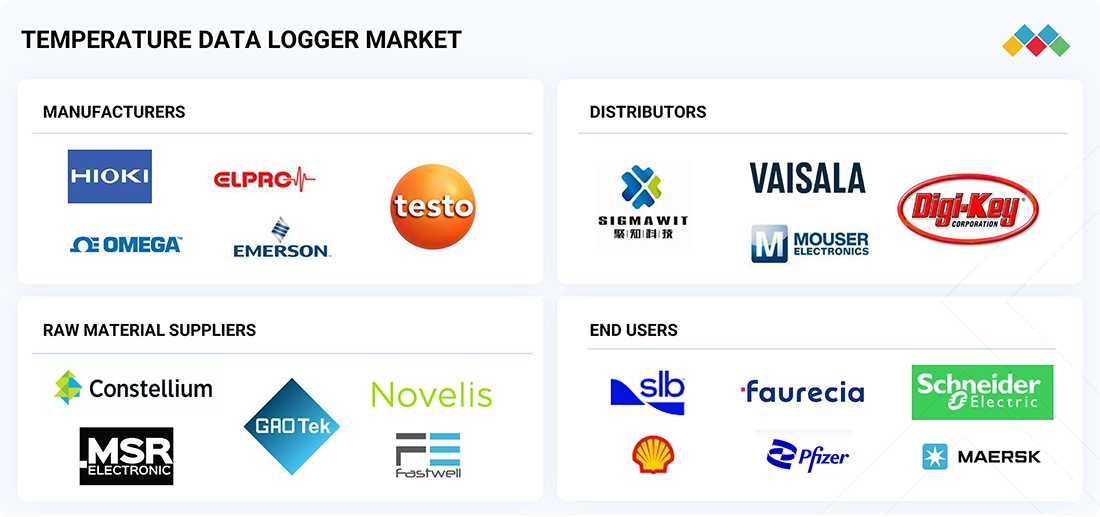
Temperature Data Logger Market: COMMERCIAL USE CASES ACROSS INDUSTRIES
| COMPANY | USE CASE DESCRIPTION | BENEFITS |
|---|---|---|
 |
Used for component-level and vehicle-wide temperature measurement in R&D, electronics, automotive, and energy efficiency settings | Enables remote, multi-channel, and wireless data logging in industrial, environmental, and automotive tests | Multi-channel, wireless measurements | Real-time display and alarm functions | Easy configuration and no dedicated PC needed |Robust for predictive maintenance and process optimization |
 |
Environmental monitoring in pharmaceutical, biotech, and healthcare; supports regulatory and GxP compliance worldwide; automated PDF reporting and secure, cloud-based data management | Advanced monitoring systems and GxP support | Compliance with industry standards |Cloud integration and automated reporting for audit reliability |
 |
Compliance monitoring in healthcare, pharma, food & beverage, medical devices; real-time access to temperature, humidity, and pressure via cloud-based systems; simplifies regulatory recordkeeping | Cloud-based monitoring and reporting | User-friendly interface and easy regulatory compliance | Maintains product integrity through precise monitoring |
 |
Environmental and energy monitoring (HOBO brand); agricultural, research, building management, and cold-chain logistics data collection and analysis; focus on ease-of-use for non-technical users | Reliable performance in diverse applications | Wide range for environmental monitoring and IoT readiness | Highly accessible for users with minimal technical expertise |
 |
Industrial, pharmaceutical, HVAC, and process monitoring with high-precision, multi-industry solutions; integrates temperature/humidity loggers for environmental and process monitoring | Extensive industry coverage and product variety | High-precision measurements | Strong global reputation for quality and innovation |
Logos and trademarks shown above are the property of their respective owners. Their use here is for informational and illustrative purposes only.
Related Ecosystem
Electronics System And Components
- Sensors
- Temperature Sensors
- Pressure Sensors
- Actuators
- Image Sensors
- Lenovo
- Samsung
- Texas Instruments Incorporated
- HONEYWELL INTERNATIONAL INC.
- Teledyne Technologies Incorporated
Sensors And Control
- Sensors
- Image Sensors
- Temperature Sensors
- Pressure Sensors
- Flow Sensors
- BAUMER ELECTRIC AG
- HONEYWELL INTERNATIONAL INC.
- Lenovo
- Stmicroelectronics
- Texas Instruments Incorporated
Key Takeaways
- The Nordics temperature data logger market grows at 2.5% CAGR from 2025 to 2030, reaching USD 6.0 million.
- Stringent regulatory compliance in pharmaceuticals and food safety drives steady demand across the Nordics.
- Market maturity and saturation in the Nordics limit growth compared to global expansion rates.
- IoT integration and sustainability focus position the Nordics as a premium, quality-driven segment.
Temperature Data Logger Market Report Scope
| Report Metric | Details |
|---|---|
| Base Year | 2025 |
| Fastest Growing Segment | PHARMACEUTICAL & LIFE SCIENCES (Application) |
| Forecast Period | 2025-2030 |
| Growth Rate | CAGR of 5.8% from 2025 to 2030 |
| Largest Segment | CONNECTED (Configuration) |
| Market Size Base Year (Billions) | ~USD 0.53 (2025) |
| Revenue Forecast (Billions) | ~USD 0.7 (2030) |
| Segments Covered | Type, Application, Utility, Configuration, Utility2021-2024 |
Nordics Temperature Data Logger Market Report Segmentation
5 segment dimensions are covered across the global market.
By Type
- Bluetooth
- Other Types
- Usb
- Wireless
By Application
- Cold Chain Logistics
- Electronics & Semiconductor
- Environmental Monitoring
- Food & Beverage
- Industrial Manufacturing
- Medical Devices
- Pharmaceutical & Life Sciences
By Utility
- Reusable
- Single-Use
By Configuration
- Connected
- Standalone
By Utility2021-2024
- Reusable
- Single-Use
Target Audience
- Nordic Pharmaceutical Manufacturers : Require detailed market data to understand temperature monitoring compliance obligations, competitive landscape, and investment opportunities in Nordic drug manufacturing and distribution cold-chain infrastructure.
- Food & Beverage Logistics Providers : Need Nordic-specific market insights to evaluate temperature data logger adoption rates, regulatory drivers, and ROI potential for implementing advanced monitoring solutions across Nordic food supply chains.
- Temperature Monitoring Equipment Vendors : Seek Nordic market analysis to assess market size, growth potential, customer segments, and competitive positioning for launching or scaling temperature data logger products in Scandinavia.
- Supply Chain & Quality Assurance Managers : Require Nordic market intelligence to benchmark cold-chain practices, understand regulatory requirements, and justify investments in temperature monitoring technology for Nordic operations and compliance.
- Strategic Investors & Consultants : Need Nordic market forecasts and segment analysis to evaluate investment opportunities, advise clients on market entry strategies, and identify growth drivers in the Nordic temperature monitoring sector.
Reasons to Buy this Report
- Regulatory Compliance Assurance : Gain detailed insights into Nordic-specific EU compliance requirements and temperature monitoring mandates, enabling vendors to tailor solutions that meet stringent pharmaceutical and food safety standards across Scandinavia.
- Market Sizing & Growth Forecasting : Access precise Nordic market valuation (USD 5.3M in 2025) and 2030 projections (USD 6.0M), allowing strategic planning and resource allocation for market entry or expansion in this stable, mature segment.
- Competitive Positioning Strategy : Understand Nordic market dynamics, customer priorities, and adoption drivers to differentiate offerings and identify white-space opportunities in a quality-focused, compliance-driven region with predictable demand patterns.
- Cold-Chain Sector Intelligence : Leverage Nordic-specific insights into pharmaceutical logistics, food distribution, and perishable supply chains to develop targeted go-to-market strategies and product features aligned with regional cold-chain infrastructure needs.
- Long-Term Investment Planning : Use Nordic market forecasts and CAGR data (2.5%) to inform multi-year business plans, partnership strategies, and investment decisions in a region known for regulatory stability and predictable market behavior.
Frequently asked questions
What is the market size of temperature data loggers in the Nordics in 2025?
The Nordics temperature data logger market is valued at USD 5.3 million in 2025.
What is the projected market size for the Nordics by 2030?
The Nordics temperature data logger market is forecast to reach USD 6.0 million by 2030.
What is the CAGR for the Nordics temperature data logger market?
The Nordics temperature data logger market is expected to grow at a CAGR of 2.5% between 2025 and 2030.
What industries drive demand for temperature data loggers in the Nordics?
Pharmaceuticals, food logistics, cold-chain management, and healthcare are the primary industries driving demand in the Nordics.
Why is the Nordics market growth slower than the global average?
The Nordics market is mature and saturated with established players, limiting explosive growth compared to emerging regions with higher global CAGR of 5.8%.
RESEARCH METHODOLOGY
The study utilized four major activities to estimate the temperature data logger market size. Exhaustive secondary research was conducted to gather information on the market and its peer and parent markets. The next step was to validate these findings, assumptions, and sizing with industry experts across the value chain through primary research. Both the top-down and bottom-up approaches were employed to estimate the total market size. Finally, market breakdown and data triangulation methods were utilized to estimate the market size for different segments and subsegments.
Secondary Research
In the secondary research process, various sources were used to identify and collect information on the temperature data logger market for this study. Secondary sources for this research study include corporate filings (such as annual reports, investor presentations, and financial statements), trade, business, and professional associations, white papers, certified publications, articles by recognized authors, directories, and databases. Secondary data was collected and analyzed to determine the overall market size, which was further validated through primary research.
List of Key Secondary Sources
|
Source |
Web Link |
|
The International Organization of Motor Vehicle Manufacturers |
https://www.oica.net/ |
|
International Society of Automation |
|
|
Technology & Services Industry Association (TSIA). |
|
|
Process Equipment Manufacturers' Association (PEMA) |
www.pemanet.org/ |
|
European Semiconductor Industry Association |
https://www.ama-sensorik.de/en/ |
|
AMA Association for Sensor Technology |
https://www.ama-sensorik.de/en/ |
Primary Research
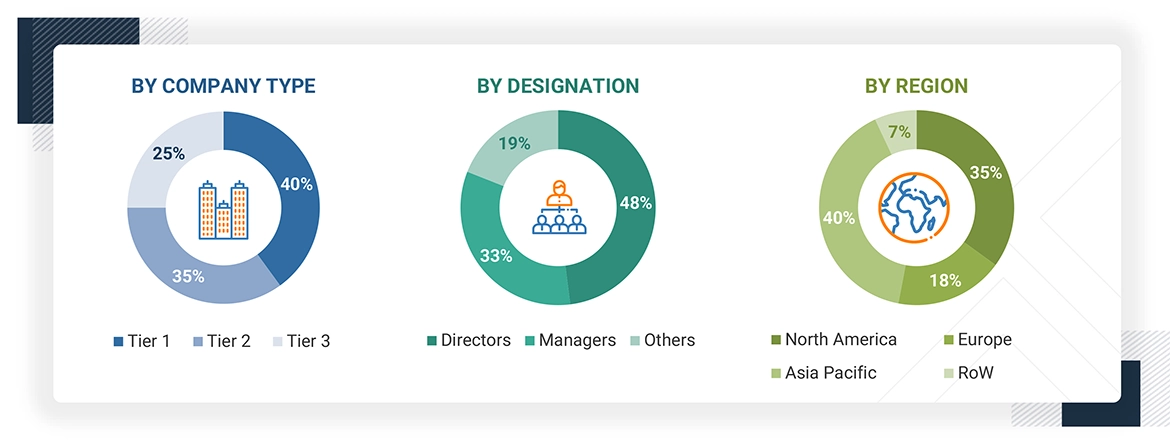
Primary interviews were conducted to gather insights on market statistics, revenue data, market breakdowns, size estimations, and forecasting. Additionally, primary research was used to comprehend the various technologies, types, end-uses, and regional trends. Interviews with stakeholders from the demand side, including CIOs, CTOs, CSOs, and customer/end-user installation teams using temperature data logger offerings and processes, were also conducted to understand their perspective on suppliers, products, component providers, and their current and future use of temperature data logger, which will impact the overall market. Several primary interviews were conducted across major countries in North America, Europe, Asia Pacific, and RoW.
To know about the assumptions considered for the study, download the pdf brochure
Market Size Estimation
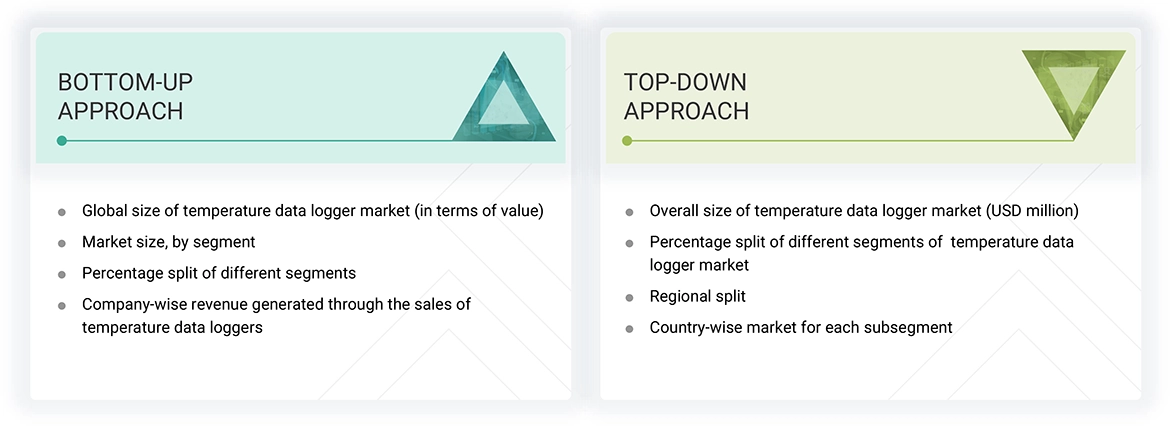
In the complete market engineering process, the top-down and bottom-up approaches and several data triangulation methods have been used to estimate and forecast the overall market segments and subsegments listed in this report. Key players in the market have been identified through secondary research, and their market shares in the respective regions have been determined through primary and secondary research. This entire procedure includes the study of annual and financial reports of the top market players and extensive interviews for key insights (quantitative and qualitative) with industry experts (CEOs, VPs, directors, and marketing executives).
All percentage shares, splits, and breakdowns have been determined using secondary sources and verified through primary sources. All the parameters affecting the markets covered in this research study have been accounted for, viewed in detail, verified through primary research, and analyzed to obtain the final quantitative and qualitative data. This data has been consolidated and supplemented with detailed inputs and analysis from MarketsandMarkets and presented in this report. The following figure represents this study's overall market size estimation process.
Temperature Data Logger Market : Top-Down and Bottom-Up Approach
Data Triangulation
Once the overall size of the temperature data logger market was determined using the methods described above, it was divided into multiple segments and subsegments. Market engineering was performed for each segment and subsegment using market breakdown and data triangulation methods, as applicable, to obtain accurate statistics. Various factors and trends from the demand and supply sides were studied to triangulate the data. The market was validated using both the top-down and bottom-up approaches..
Market Definition
A temperature data logger is an electronic device designed to monitor, measure, and automatically record temperature data. Temperature data loggers come in various shapes and sizes and have various features and capabilities equipped with different technologies. Some of these are compact, portable devices that can be battery-powered and equipped with a microprocessor that uses internal memory to store temperature measurements. A few data loggers connect directly to a personal computer, allowing users to activate the device and analyze the recorded data remotely via specialized software. Some function as standalone devices with a built-in user interface, enabling them to operate independently without requiring a separate computer.
The report study covers a comprehensive analysis of the temperature data logger market based on type, utility, configuration, industry, and region. The temperature data logger market is competitive, with prominent players such as Onset Computer Corporation (US), HIOKI E.E. Corporation (Japan), Testo SE & Co. KGaA (Germany), ELPRO-BUCHS AG (Switzerland), and Dickson (US).
Key Stakeholders
- Original equipment manufacturers (OEMs)
- Pharmaceutical manufacturers
- Components suppliers
- Temperature data logger distributors and traders
- Research organizations and consulting companies
- Government bodies such as regulating authorities and policymakers
- Venture capitalists, private equity firms, and startup companies
- Forums, alliances, and associations related to temperature monitoring
- Financial institutions, analysts, and strategic business planners
- Existing end users and prospective ones
- System integrators and technology consultants
Report Objectives
- To describe and forecast the temperature data logger market size by type, utility, configuration, industry, and region in terms of value
- To describe and forecast the market for various segments across four main regions, namely, North America, Europe, Asia Pacific, and RoW, in terms of value
- To strategically analyze micromarkets about individual growth trends, prospects, and market contributions
- To provide detailed information regarding drivers, restraints, opportunities, and challenges influencing market growth
- To analyze opportunities for stakeholders by identifying high-growth segments in the market
- To provide a detailed overview of the temperature data logger value chain
- To strategically analyze key technologies, indicative selling price trends, trends impacting customer business, ecosystem, regulatory landscape, patent landscape, Porter's five forces, import and export scenarios, trade landscape, key stakeholders and buying criteria, and case studies about the market under study
- To strategically profile key players in the temperature data logger market and comprehensively analyze their market share and core competencies
- To analyze competitive developments, such as partnerships, acquisitions, expansions, collaborations, and product launches, along with R&D in the temperature data logger market
Available Customizations
With the given market data, MarketsandMarkets offers customizations according to the specific requirements of companies. The following customization options are available for the report:
Company Information
- Detailed analysis and profiling of additional market players (up to five)
- Additional country-level analysis of the temperature data logger market
Product Analysis
- Product matrix, for a detailed comparison of the product portfolio of each company in the temperature data logger market
Get the Full Temperature Data Logger Market Report
Full forecast, segment splits, and company analysis for all Temperature Data Logger Market.
- US Temperature Data Logger Market
- Canada Temperature Data Logger Market
- Mexico Temperature Data Logger Market
- Germany Temperature Data Logger Market
- UK Temperature Data Logger Market
- France Temperature Data Logger Market
- Rest Of Europe Temperature Data Logger Market
- China Temperature Data Logger Market
- Japan Temperature Data Logger Market
- India Temperature Data Logger Market
- Rest Of Asia Pacific Temperature Data Logger Market
Need a Tailored Report?
Customize this report to your needs
Get 10% FREE Customization
Customize This Report
