
Australia Textile Recycling Market (2025-2030)

The Australia Textile Recycling Market was valued at $223.1 Million in 2025 and projected to reach to $337 Million by 2030, representing a compound annual growth rate of 8.6%. Australia's textile recycling market is poised for sustained expansion as the nation strengthens its commitment to circular economy principles and sustainable fashion practices.


| Market Size in | USD 26.32 MN |
| Market Forecast in | |
| CAGR | |
| Forecast Period | |
| Units Considered | Value (USD MN) |
Australia Textile Recycling Market Trends and Insights
- This 8.6% compound annual growth rate reflects Australia's increasing commitment to circular economy principles and sustainable fashion practices.
- Australia is positioning itself as a regional leader in textile waste management, driven by stringent environmental regulations and growing consumer awareness of fast fashion's environmental impact. The Australian textile recycling sector is benefiting from both regulatory support and market-driven innovation.
- Australia's waste management infrastructure is evolving to accommodate higher volumes of textile recovery, with investments in sorting and processing technologies accelerating across the country.
- Between 2025 and 2030, Australia is expected to see significant expansion in collection networks and recycling facilities, supported by government initiatives and corporate sustainability commitments. Australia's market outpaces the global average of 7.2% CAGR, indicating strong regional demand for recycled textiles and fiber recovery solutions.
- The country's fashion and retail sectors are increasingly adopting circular business models, creating new opportunities for textile-to-textile and textile-to-fiber recycling pathways throughout Australia..
Key Market Statistics
- CAGR (2025-2030) 8.6% CAGR
- Market Size, 2025 ~USD 223.1 Million
- Forecast, 2030 ~USD 337 Million
- Country Australia
Australia Textile Recycling Market Overview
Market Valuation :
Australia's textile recycling market is valued at USD 223.1 million in 2025, with strong momentum driven by regulatory support and consumer demand for sustainable fashion solutions.
Growth Trajectory :
The market is projected to reach USD 337.0 million by 2030, representing an 8.6% CAGR—outpacing the global average of 7.2% and positioning Australia as a regional growth leader.
Circular Economy Leadership :
Australia is emerging as a regional leader in textile waste management, leveraging advanced recycling technologies and strong government incentives to establish circular economy frameworks.
Sustainability Drivers :
Growing consumer awareness, extended producer responsibility schemes, and corporate sustainability commitments are accelerating adoption of textile recycling practices across Australian industries.
Australia Textile Recycling Market Dynamics
- Government policies promoting waste reduction, combined with increasing consumer consciousness around environmental impact, are creating favorable conditions for market growth.
- Major retailers and fashion brands are investing in recycling infrastructure and closed-loop systems to meet regulatory requirements and consumer expectations. The forecast period through 2030 will see accelerated adoption of innovative recycling technologies, including fiber-to-fiber processes and chemical recycling methods.
- Strategic partnerships between textile manufacturers, recyclers, and retailers will drive market consolidation and operational efficiency.
- Australia's geographic position and developed infrastructure position it as a hub for regional textile recycling innovation and best practices..
Market Ecosystem
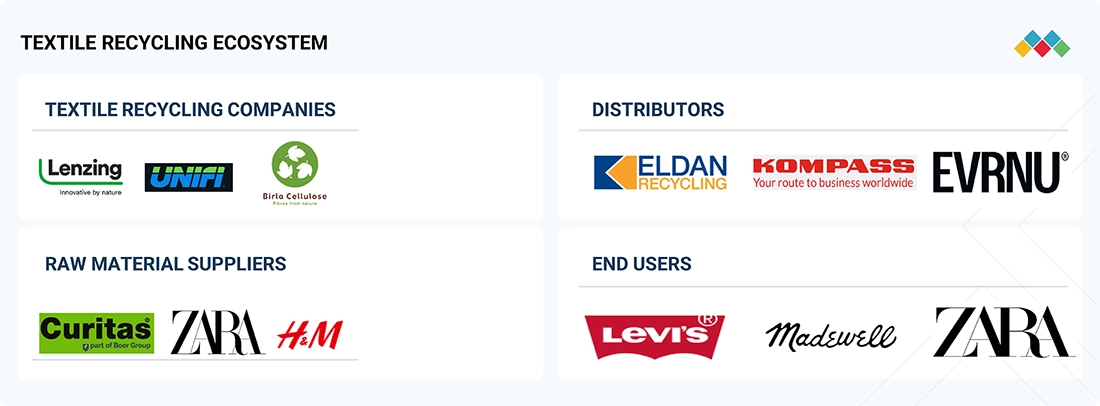
Textile Recycling Market: COMMERCIAL USE CASES ACROSS INDUSTRIES
| COMPANY | USE CASE DESCRIPTION | BENEFITS |
|---|---|---|
 |
H&M collects post-consumer garments through in-store take-back programs and invests in chemical recycling technologies like Renewcell to produce Circulose. | Reduces textile waste, secures a sustainable raw material source, enhances brand reputation, and supports closed-loop fashion systems |
 |
Adidas collaborates with partners (e.g., Parley for the Oceans) to create apparel and footwear from recycled polyester and ocean plastic waste. | Limits virgin plastic use, promotes sustainable sportswear, reduces environmental footprint, and engages eco-conscious consumers |
 |
Levi’s incorporates recycled cotton and polyester into denim, while promoting take-back programs for old jeans. | Conserves water and energy, lowers raw cotton dependency, reduces landfill waste, and strengthens sustainability-driven brand value |
 |
Patagonia uses recycled polyester from PET bottles and old garments in outdoor clothing. It also encourages consumers to return old gear for repair or recycling. | Extends product life cycle, builds customer loyalty, reduces environmental harm, and sets industry benchmarks for circular apparel |
Logos and trademarks shown above are the property of their respective owners. Their use here is for informational and illustrative purposes only.
Related Ecosystem
Fibers And Composites
- Polyetheretherketone (PEEK)
- Polyphenylene Sulfide (PPS)
- Epoxy Resin
- Polycarbonate
- Polyester Resin
- Toray Industries, Inc.
- Teijin Limited
- Sgl carbon se
- Hexcel Corporation
- Solvay sa
Yarns Fabric And Textile
- Agrotech
- Clothtech
- Indutech
- Oekotech
- Packtech
- MILLIKEN & COMPANY
- Toray Industries, Inc.
- 3M COMPANY
- DuPont de Nemours, Inc.
- Kimberly-Clark Corporation
Key Takeaways
- Australia's textile recycling market will grow from USD 223.1M (2025) to USD 337.0M (2030) at an 8.6% CAGR, outpacing global growth rates.
- Australia's regulatory environment and circular economy initiatives are driving investment in textile collection and processing infrastructure.
- Australia's fashion and retail sectors are increasingly adopting sustainable practices, creating demand for recycled fiber and textile-to-textile solutions.
- Australia's market expansion is supported by technological innovation in sorting, processing, and fiber recovery technologies across the country.
Textile Recycling Market Report Scope
| Report Metric | Details |
|---|---|
| Base Year | 2025 |
| Fastest Growing Segment | PRE-CONSUMER WASTE (Textile Waste) |
| Forecast Period | 2025–2030 |
| Growth Rate | CAGR of 7.2% from 2025 to 2030 |
| Largest Segment | POST-CONSUMER WASTE (Textile Waste) |
| Market Size Base Year (Billions) | ~USD 8.39 (2025) |
| Revenue Forecast (Billions) | ~USD 11.88 (2030) |
| Segments Covered | Material, Textile Waste, Process, Distribution Channel, End-Use Industry |
Australia Textile Recycling Market Report Segmentation
5 segment dimensions are covered across the global market.
By Material
- Cotton
- Nylon & Nylon Fibers
- Other Materials
- Polyester & Polyester Fibers
- Wool
By Textile Waste
- Post-Consumer Waste
- Pre-Consumer Waste
By Process
- Chemical
- Mechanical
By Distribution Channel
- Online Channel
- Retail & Departmental Stores
By End-Use Industry
- Apparel
- Home Furnishing
- Industrial & Institutional
- Other End-Use Industries
AUSTRALIA: TEXTILE RECYCLING MARKET, BY END-USE INDUSTRY, 2025–2030
| Segment | 2025 | 2026 | 2027 | 2028 | 2029 | 2030 | CAGR (%) |
|---|---|---|---|---|---|---|---|
| APPAREL | 109.7 | 117.7 | 126.3 | 135.6 | 145.7 | 156.7 | 7.4 |
| HOME FURNISHING | 45.9 | 50.3 | 55.2 | 60.6 | 66.6 | 73.3 | 9.8 |
| INDUSTRIAL & INSTITUTIONAL | 56.4 | 61.9 | 68 | 74.8 | 82.4 | 90.8 | 10 |
| OTHER END-USE INDUSTRIES | 11.1 | 11.9 | 12.9 | 13.9 | 15 | 16.3 | 8 |
| TOTAL | 223.1 | 241.8 | 262.4 | 285 | 309.7 | 337 | 8.6 |
Target Audience
- Textile Manufacturers & Brands : Need Australia-specific market data to develop sustainable product lines, establish recycling partnerships, and comply with local circular economy regulations and consumer expectations.
- Recycling & Waste Management Companies : Require detailed market sizing and growth forecasts for Australia to identify expansion opportunities, assess competitive positioning, and plan infrastructure investments in textile recycling.
- Investors & Private Equity : Seek Australia market intelligence to evaluate investment opportunities in textile recycling startups, technology providers, and established players with strong growth potential.
- Government & Policy Makers : Need comprehensive market analysis to inform policy development, sustainability targets, and regulatory frameworks supporting Australia's circular economy and textile waste reduction goals.
- Retailers & Fashion Distributors : Require Australia market insights to develop take-back programs, establish sustainable sourcing strategies, and meet consumer demand for environmentally responsible fashion solutions.
Key Companies in the Australia Textile Recycling Market
| Company | HQ | Ownership | Strongest segments |
|---|---|---|---|
| LENZING AG | Austria | Public Company | Cotton-rich recycled blends (textile-to-textile),Polyester & polyester fiber blends,Cellulosic fiber from wood-based and waste inputs, |
| HYOSUNG TNC. | South Korea | Public Company | Recycled polyester & polyester fibers,Recycled nylon & nylon fibers,Recycled cotton and blends, |
| UNIFI, INC. | United States | Public Company | Polyester & Polyester Fibers (Repreve and related rPET yarns),Nylon & Nylon Fibers (recycled nylon yarns),Cotton and Cotton Blends (recycled content programs), |
| LEIGH FIBERS | United States | Private Company | Cotton-based recycled fibers,Polyester & polyester fiber recycling,Wool and specialty fibers, |
| MARTEX FIBER | United States | Private Company | Cotton and cotton-rich recycled fibers,Polyester & polyester fiber recycling,Wiping products and converted nonwovens, |
LENZING AG
Lenzing AG is an Austrian textile fiber manufacturer founded in 1892 that operates as a public company with 7,589 employees. The company specializes in producing cellulose-based fibers for the textile industry.
HYOSUNG TNC.
Hyosung TNC is a South Korean public company founded in 1957 with 1,203 employees, operating in the textile and chemical fiber sectors.
UNIFI, INC.
Unifi, Inc. is a United States-based public company founded in 1971 that produces synthetic and recycled fibers for the textile industry.
LEIGH FIBERS
Leigh Fibers is a United States-based private company founded in 1922 that manufactures textile fibers.
MARTEX FIBER
Martex Fiber is a United States-based private company founded in 1975 that produces textile fibers.
Reasons to Buy this Report
- Market-Specific Sizing : Access precise valuation data for Australia's textile recycling market with verified 2025 baseline (USD 223.1M) and 2030 forecasts, enabling accurate business planning and investment decisions.
- Competitive Benchmarking : Understand Australia's 8.6% CAGR performance relative to global 7.2% growth, identifying competitive advantages and market opportunities unique to the Australian landscape.
- Regulatory Intelligence : Gain insights into Australia-specific policies, extended producer responsibility schemes, and government incentives driving textile recycling adoption and market expansion.
- Regional Strategy Development : Leverage Australia-focused market analysis to develop targeted expansion strategies, identify key stakeholders, and assess partnership opportunities in the regional textile recycling ecosystem.
- Investment Validation : Support investment decisions with comprehensive Australia market data, growth projections, and sustainability trend analysis specific to the country's textile recycling sector.
Frequently asked questions
What is the current size of Australia's textile recycling market?
Australia's textile recycling market is valued at USD 223.1 million in 2025 and is projected to reach USD 337.0 million by 2030.
What is the growth rate of Australia's textile recycling market?
Australia's textile recycling market is growing at a compound annual growth rate (CAGR) of 8.6% from 2025 to 2030, which exceeds the global average of 7.2%.
What factors are driving growth in Australia's textile recycling sector?
Growth in Australia is driven by stringent environmental regulations, increasing consumer awareness of sustainability, corporate circular economy commitments, and investments in recycling infrastructure and technology.
How does Australia's textile recycling market compare to global trends?
Australia's 8.6% CAGR outpaces the global average of 7.2%, indicating stronger regional demand and market maturity in textile recycling solutions.
What opportunities exist in Australia's textile recycling market?
Opportunities in Australia include expansion of collection networks, development of advanced sorting and processing technologies, textile-to-textile recycling, fiber recovery solutions, and partnerships with fashion retailers adopting circular business models.
RESEARCH METHODOLOGY
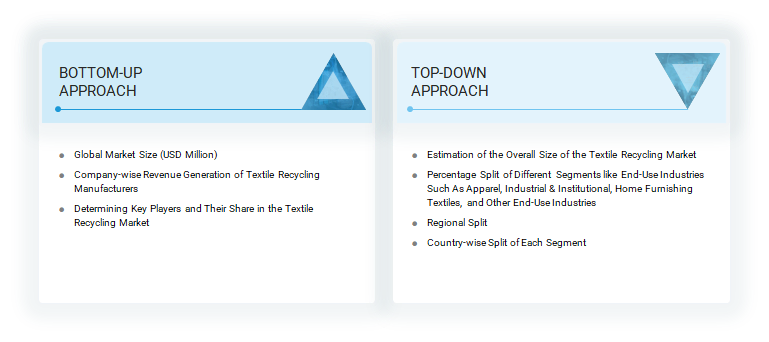
The study involves two major activities in estimating the current market size for the textile recycling market. Exhaustive secondary research was done to collect information on the market, peer, and parent markets. The next step was to validate these findings, assumptions, and sizing with industry experts across the value chain through primary research. Both top-down and bottom-up approaches were employed to estimate the complete market size. After that, market breakdown and data triangulation were used to estimate the market size of segments and subsegments.
Secondary Research
Secondary sources for this research study include financial statements of companies offering textile recycling and information from various trade, business, and professional associations. Secondary research has been used to obtain critical information about the industry’s value chain, the pool of key players, market classification, and segmentation according to industry trends to the bottom-most level and regional markets. The secondary data was collected and analyzed to arrive at the overall size of the textile recycling market, which was validated by primary respondents.
Primary Research
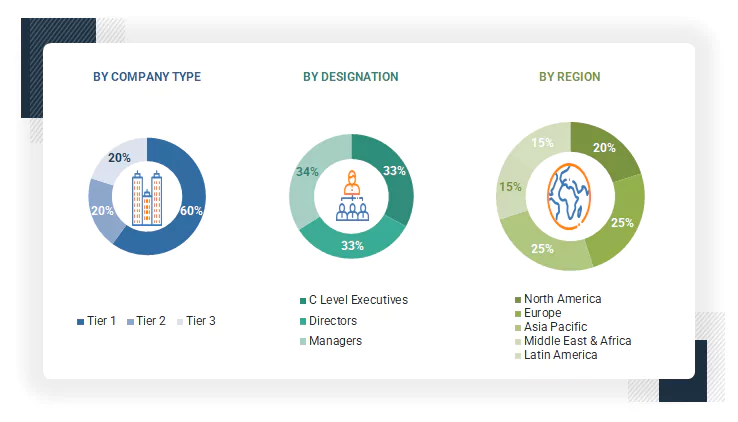
Extensive primary research was conducted after obtaining information regarding the textile recycling market scenario through secondary research. Several primary interviews were conducted with market experts from both the demand and supply sides across major countries of North America, Europe, Asia Pacific, the Middle East & Africa, and South America. Primary data was collected through questionnaires, emails, and telephonic interviews. The primary sources from the supply side included various industry experts, such as Chief X Officers (CXOs), Vice Presidents (VPs), Directors from business development, marketing, product development/innovation teams, and related key executives from textile recycling industry vendors; material providers; distributors; and key opinion leaders. Primary interviews were conducted to gather insights such as market statistics, data on revenue collected from the products and services, market breakdowns, market size estimations, market forecasting, and data triangulation. Primary research also helped in understanding the various trends related to material, textile waste, process, distribution channel, end-use industry, and region. Stakeholders from the demand side, such as CIOs, CTOs, CSOs, and installation teams of the customer/end users who are seeking textile recycling services, were interviewed to understand the buyer’s perspective on the suppliers, products, component providers, and their current usage of textile recycling and future outlook of their business which will affect the overall market.
The Breakup of Primary Research:
To know about the assumptions considered for the study, download the pdf brochure
Market Size Estimation
The research methodology used to estimate the size of the textile recycling market includes the following details. The market sizing was undertaken from the demand side. The market was upsized based on the demand for textile recycling in different end-use industries at a regional level. Such procurements provide information on the demand aspects of the textile recycling industry for each end-use industry. For each end-use industry, all possible segments of the textile recycling market were integrated and mapped.
Data Triangulation
After determining the overall size from the market size estimation process outlined above, the total market was divided into several segments and subsegments. The data triangulation and market breakdown methods described below were used, where applicable, to complete the overall market analysis and determine precise statistics for various market segments and subsegments. The data was triangulated by examining various factors and trends from both the demand and supply sides. Additionally, the market size was validated using both top-down and bottom-up approaches.
Market Definition
Textile recycling is the process of recovering fibers, fabrics, and finished garments from post-industrial or post-consumer textile waste and reprocessing them into usable raw materials for new products. This includes mechanical recycling (e.g., shredding into fibers), chemical recycling (breaking down fibers at the molecular level), and reuse of textiles in their original form. The primary goal is to reduce landfill waste, minimize environmental impact, and promote a circular economy by extending the life cycle of textile materials through sustainable recovery and reintegration into the production chain.
Stakeholders
- Textile Recycling Manufacturers
- Textile Recycling Distributors and Suppliers
- End-use Industries
- Universities, Governments, and Research Organizations
- Associations and Industrial Bodies
- R&D Institutes
- Environmental Support Agencies
- Investment Banks and Private Equity Firms
- Research and Consulting Firms
Report Objectives
- To define, describe, and forecast the textile recycling market size in terms of volume and value
- To provide detailed information regarding the key factors, such as drivers, restraints, opportunities, and challenges influencing market growth
- To analyze and project the global textile recycling market, by material, textile waste, process, distribution channel, end-use industry, and region
- To forecast the market size in five main regions (along with country-level data), namely, North America, Europe, Asia Pacific, Middle East & Africa, and South America, and analyze the significant region-specific trends
- To strategically analyze micromarkets with respect to individual growth trends, prospects, and contributions of the submarkets to the overall market
- To analyze the market opportunities and the competitive landscape for stakeholders and market leaders
- To assess recent market developments and competitive strategies, such as agreements, contracts, acquisitions, and new product developments/new product launches, to draw the competitive landscape
- To strategically profile the key market players and comprehensively analyze their core competencies
Get the Full Textile Recycling Market Report
Full forecast, segment splits, and company analysis for all Textile Recycling Market.
- China Textile Recycling Market
- Japan Textile Recycling Market
- India Textile Recycling Market
- South Korea Textile Recycling Market
- Indonesia Textile Recycling Market
- Vietnam Textile Recycling Market
- Canada Textile Recycling Market
- Mexico Textile Recycling Market
- US Textile Recycling Market
- UK Textile Recycling Market
- Germany Textile Recycling Market
- Russia Textile Recycling Market
- France Textile Recycling Market
- Italy Textile Recycling Market
- Spain Textile Recycling Market
- Netherlands Textile Recycling Market
- South Africa Textile Recycling Market
- Brazil Textile Recycling Market
- Argentina Textile Recycling Market
- Rest Of Europe Textile Recycling Market
- Rest Of Asia Pacific Textile Recycling Market
- GCC Countries Textile Recycling Market
- –Rest Of GCC Countries Textile Recycling Market
- Rest Of South America Textile Recycling Market
Need a Tailored Report?
Customize this report to your needs
Get 10% FREE Customization
Customize This Report
