
Rest Of Asia Pacific Threat Intelligence Market (2025-2030)

The Rest Of Asia Pacific Threat Intelligence Market was valued at $822.1 Million in 2025 and projected to reach to $1945.7 Million by 2030, representing a compound annual growth rate of 18.8%. Rest Of Asia Pacific represents one of the fastest-growing threat intelligence markets globally, driven by accelerating digital transformation and heightened cybersecurity awareness among enterprises.


| Market Size in | USD 26.32 MN |
| Market Forecast in | |
| CAGR | |
| Forecast Period | |
| Units Considered | Value (USD MN) |
Rest Of Asia Pacific Threat Intelligence Market Trends and Insights
- Rest Of Asia Pacific represents a critical growth region driven by increasing cyber threats, regulatory compliance requirements, and digital transformation initiatives across emerging economies.
- The region's threat intelligence market is accelerating faster than global averages, reflecting heightened security investments and rising awareness of advanced persistent threats among enterprises in Rest Of Asia Pacific. Rest Of Asia Pacific's 18.8% compound annual growth rate significantly outpaces the global market trajectory, underscoring the region's strategic importance in the threat intelligence landscape.
- Organizations across Rest Of Asia Pacific are prioritizing threat intelligence capabilities to combat sophisticated cyberattacks and meet evolving data protection mandates.
- Between 2025 and 2030, Rest Of Asia Pacific will witness substantial market maturation, with increased adoption of AI-driven threat detection, managed security services, and intelligence-sharing platforms tailored to regional threat vectors and compliance frameworks..
Key Market Statistics
- CAGR (2025-2030) 18.8% CAGR
- Market Size, 2025 ~USD 822.1 Million
- Forecast, 2030 ~USD 1945.7 Million
- Country Rest Of Asia Pacific
Rest Of Asia Pacific Threat Intelligence Market Overview
Rapid Market Expansion :
Rest Of Asia Pacific threat intelligence market is projected to grow from $822.1 million in 2025 to $1,945.7 million by 2030, representing a robust 18.8% CAGR, significantly outpacing the global average of 14.7%.
Regulatory Compliance Drivers :
Emerging economies across Rest Of Asia Pacific are implementing stricter data protection and cybersecurity regulations, compelling organizations to invest in advanced threat intelligence solutions for compliance and risk mitigation.
Digital Transformation Acceleration :
Rapid digital adoption and cloud migration initiatives across Rest Of Asia Pacific are creating heightened vulnerability to cyber threats, driving urgent demand for real-time threat intelligence and monitoring capabilities.
Rising Cyber Threat Landscape :
Increasing sophistication and frequency of cyberattacks targeting financial institutions, government agencies, and critical infrastructure in Rest Of Asia Pacific are accelerating threat intelligence adoption rates.
Rest Of Asia Pacific Threat Intelligence Market Dynamics
- The region's emerging economies are rapidly modernizing their IT infrastructure while simultaneously facing escalating cyber threats, creating substantial demand for sophisticated threat intelligence platforms and services. Organizations across Rest Of Asia Pacific are increasingly recognizing threat intelligence as essential for proactive defense strategies.
- Government initiatives promoting cybersecurity frameworks, combined with growing regulatory requirements and cross-border data protection mandates, are expected to sustain double-digit growth through 2030.
- Investment in threat intelligence capabilities will remain critical for organizations seeking competitive advantage and operational resilience..
Market Ecosystem
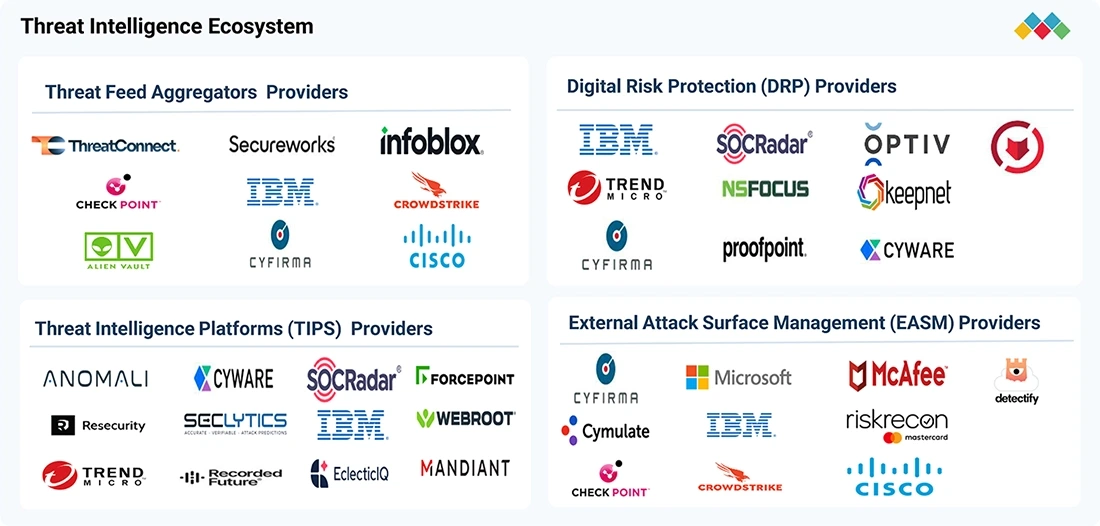
THREAT INTELLIGENCE MARKET: COMMERCIAL USE CASES ACROSS INDUSTRIES
| COMPANY | USE CASE DESCRIPTION | BENEFITS |
|---|---|---|
 |
Threat intelligence feeds integrated with firewall and security platforms to detect and block cyber threats in real-time | Faster threat detection, reduced risk of breaches, improved network security visibility |
 |
Endpoint threat intelligence and monitoring using cloud-native AI to detect malware, ransomware, and advanced threats | Enhanced endpoint protection, rapid threat mitigation, proactive threat hunting capabilities |
 |
Security Intelligence and Event Management (SIEM) combined with threat analytics to monitor, correlate, and predict threats | Comprehensive threat visibility, reduced incident response time, improved compliance posture |
 |
Threat intelligence integrated into network and cloud security solutions to identify suspicious activities and vulnerabilities | Strengthened network defense, real-time threat alerts, reduced operational impact from attacks |
 |
Detects and blocks phishing and malware attacks in real time to protect organizations | Helps organizations proactively prevent cyberattacks and data breaches |
Logos and trademarks shown above are the property of their respective owners. Their use here is for informational and illustrative purposes only.
Related Ecosystem
Cyber Security
- Cloud Security
- Biometric Systems
- Data Loss Prevention (DLP)
- Multi-Factor Authentication
- Security Analytics
- International Business Machines Corporation
- MITSUI BUSSAN SECURE DIRECTIONS INC
- Cisco Systems, Inc.
- MICROSOFT CORPORATION
- Allot Ltd.
Key Takeaways
- Rest Of Asia Pacific threat intelligence market valued at $822.1M in 2025, expanding to $1,945.7M by 2030 at 18.8% CAGR
- Rest Of Asia Pacific growth rate outpaces global average, driven by regulatory mandates and rising cyber threat sophistication
- Rest Of Asia Pacific enterprises increasingly adopt AI-powered threat detection and managed security intelligence services
- Rest Of Asia Pacific market maturation reflects digital transformation acceleration and heightened security investment priorities
Threat Intelligence Market Report Scope
| Report Metric | Details |
|---|---|
| Base Year | 2025 |
| Fastest Growing Segment | IOT VULNERABILITIES (Target) |
| Forecast Period | 2025-2030 |
| Growth Rate | CAGR of 14.7% from 2025 to 2030 |
| Largest Segment | NETWORK SECURITY (Security Type) |
| Market Size Base Year (Billions) | ~USD 11.57 (2025) |
| Revenue Forecast (Billions) | ~USD 22.97 (2030) |
| Segments Covered | Offering, Solution, Service, Professional Services, Managed Services, Application, Deployment Mode, Organization Size, Vertical, Services, Solutions, Solution Type, Security Type, Component, Type, Target |
Rest Of Asia Pacific Threat Intelligence Market Report Segmentation
16 segment dimensions are covered across the global market.
By Offering
- Services
- Solution
- Solutions
By Solution
- Digital Risk Protection
- External Attack Surface Management (Easm)
- Malware And Vulnerability Tools
- Malware/Vulnerability Tools
- Siem/Soar Integrations
- Threat Enrichment Apis
- Threat Feed Aggregators
- Threat Intelligence Platforms (Tips)
By Service
- Managed Services
- Professional Services
By Professional Services
- Consulting & Advisory Services
- Designing, Integration, & Deployment
- Designing, Integration,& Deployment
- Risk Assessment & Threat Hunting
- Training & Support
By Managed Services
- Managed Detection & Response (Mdr)
- Managed Detection And Response (Mdr)
- Threat Intelligence As A Services (Tiaas)
By Application
- Fraud & Financial Crime Detection
- Incident Response
- Insider Threat Detection
- Other Applications
- Risk & Compliance Management
- Threat Hunting
By Deployment Mode
- Cloud
- Fraud & Financial Crime Detection
- Hybrid
- Incident Response
- Insider Threat Detection
- On-Premises
- Risk & Compliance Management
- Threat Hunting
By Organization Size
- Large Enterprises
- Smes
By Vertical
- Aerospace & Defense
- Banking, Financial Services, & Insurance (Bfsi)
- Bfsi
- Defense & Intelligence
- Energy & Industrial
- Energy & Utilities
- Government
- Healthcare
- Healthcare & Life Sciences
- It & Ites
- It, Ites, & Telecom
- Manufacturing
- Media & Entertainment
- Other Verticals
- Retail
- Retail & E-Commerce
- Retail & Ecommerce
- Telecommunications
- Transportation & Logistics
- Travel, Aviation, & Logistics
- Travels & Hospitality
By Services
- Managed Services
- Professional Services
By Solutions
- Digital Risk Protection
- External Attack Surface Management (Easm)
- Malware/Vulnerability Tools
- Siem/Soar Integrations
- Threat Enrichment Apis
- Threat Feed Aggregators
- Threat Intelligence Platforms (Tips)
By Solution Type
- Antivirus/Antimalware
- Compliance & Policy Management
- Dlp, Encryption, & Tokenization
- Firewall & Vpn
- Iam
- Log Management & Siem
- Other Solution Types
- Patch Management
By Security Type
- Application Security
- Cloud Security
- Endpoint & IoT Security
- Network Security
By Component
- Services
- Software
By Type
- Application Security
- Cloud Security
- Endpoint Security
- Network Security
By Target
- Api Vulnerabilities
- Content Management System Vulnerabilities
- IoT Vulnerabilities
- Other Target Vulnerabilities
Target Audience
- Threat Intelligence Solution Vendors : Vendors need Rest Of Asia Pacific market data to identify expansion opportunities, understand regional customer requirements, and develop localized threat intelligence offerings for emerging economies.
- Enterprise Security Leaders : CISOs and security directors across Rest Of Asia Pacific require market insights to benchmark threat intelligence investments, evaluate regional solution providers, and align security strategies with market trends.
- Government & Regulatory Bodies : Policy makers and regulatory agencies in Rest Of Asia Pacific need market intelligence to inform cybersecurity frameworks, assess regional threat landscape, and guide digital security investments.
- Investment & Private Equity Firms : Investors targeting Rest Of Asia Pacific cybersecurity sector require detailed market analysis to identify high-growth opportunities, evaluate portfolio companies, and assess regional market dynamics.
- System Integrators & Consultants : SIs and consulting firms operating in Rest Of Asia Pacific need market insights to advise clients on threat intelligence solutions, understand regional adoption trends, and develop implementation strategies.
Reasons to Buy this Report
- Regional Growth Opportunity Analysis : Gain comprehensive insights into the fastest-growing threat intelligence market segment with 18.8% CAGR, enabling strategic market entry and expansion planning across Rest Of Asia Pacific economies.
- Competitive Landscape Intelligence : Understand regional vendor positioning, market share dynamics, and competitive strategies specific to Rest Of Asia Pacific, identifying partnership and acquisition opportunities in high-growth emerging markets.
- Regulatory & Compliance Roadmap : Access detailed analysis of country-specific regulatory requirements and compliance mandates driving threat intelligence adoption across Rest Of Asia Pacific, informing product development and go-to-market strategies.
- Investment Decision Support : Leverage market sizing, growth projections, and trend analysis for Rest Of Asia Pacific to make informed investment decisions, resource allocation, and portfolio optimization in the region.
- Customer Segmentation Insights : Identify high-value customer segments, vertical opportunities, and emerging use cases specific to Rest Of Asia Pacific organizations, enabling targeted sales and marketing initiatives.
Frequently asked questions
What is the current market size of threat intelligence in Rest Of Asia Pacific?
Rest Of Asia Pacific threat intelligence market is valued at $822.1 million in 2025, representing significant regional demand for advanced security intelligence solutions.
What is the projected market size for Rest Of Asia Pacific by 2030?
Rest Of Asia Pacific threat intelligence market is forecast to reach $1,945.7 million by 2030, reflecting sustained double-digit growth momentum.
What is the CAGR for Rest Of Asia Pacific threat intelligence market?
Rest Of Asia Pacific threat intelligence market is growing at 18.8% CAGR from 2025 to 2030, outpacing global market expansion rates.
What factors are driving growth in Rest Of Asia Pacific threat intelligence market?
Rest Of Asia Pacific market growth is driven by increasing cyber threats, regulatory compliance requirements, digital transformation initiatives, and enterprise security investments.
Which technologies are gaining adoption in Rest Of Asia Pacific threat intelligence?
Rest Of Asia Pacific organizations are increasingly adopting AI-driven threat detection, managed security services, intelligence-sharing platforms, and automated threat response capabilities.
RESEARCH METHODOLOGY
Secondary research was conducted to collect information useful for this technical, market-oriented, and commercial study of the threat intelligence market. The next step involved validating these findings, assumptions, and sizing with industry experts across the value chain using primary research. Different approaches, including top-down and bottom-up methods, were employed to estimate the total market size. After that, the market breakup and data triangulation procedures were used to estimate the market size of the segments and subsegments of the market.
Secondary Research
During the secondary research process, various secondary sources were consulted to identify and collect information relevant to the study. The secondary sources included annual reports, press releases, investor presentations of threat intelligence vendors, forums, certified publications, and whitepapers. Secondary research was mainly used to obtain key information about the industry's supply chain, the total pool of key players, market classification and segmentation according to industry trends to the bottom-most level, regional markets, and key developments from both market- and technology-oriented perspectives, all of which were further validated by primary sources.
Primary Research
In the primary research process, various primary sources from both the supply and demand sides were interviewed to obtain qualitative and quantitative information for this report. The primary sources from the supply side included industry experts such as chief executive officers (CEOs), vice presidents (VPs), marketing directors, technology and innovation directors, and other key executives from major companies and organizations operating in the threat intelligence market.
In the market engineering process, top-down and bottom-up approaches were extensively used, along with several data triangulation methods, to estimate and forecast the overall market segments and subsegments listed in this report. Extensive qualitative and quantitative analyses were performed on the complete market engineering process to present key information/insights throughout the report.
After the complete market engineering process (including calculations for market statistics, market breakups, market size estimates, market forecasts, and data triangulation), extensive primary research was conducted to gather information and verify & validate the derived critical numbers. Primary research was also conducted to identify the segmentation types, industry trends, competitive landscape of threat intelligence market players, and key market dynamics, such as drivers, restraints, opportunities, challenges, and key strategies.
Following is the breakup of the primary study:
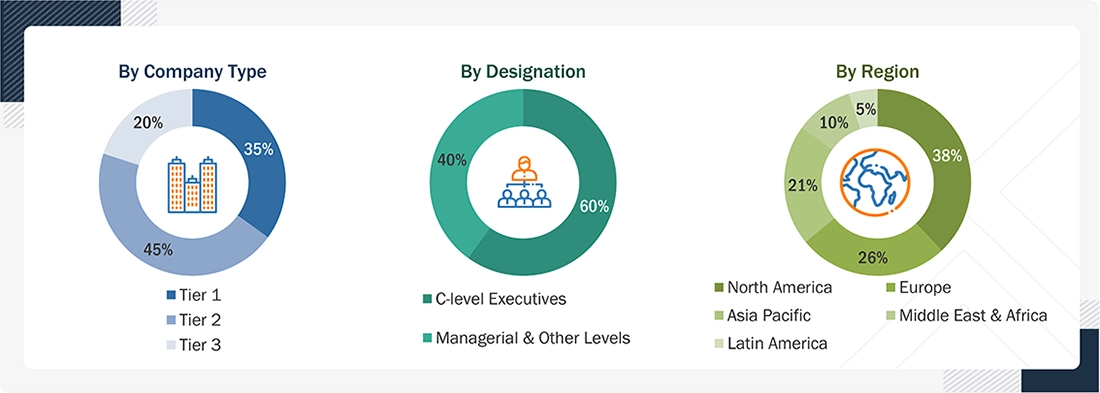
Notes: Tier 1 companies receive revenues higher than USD 10 billion; Tier 2 companies' revenues range between USD 1 and 10 billion; and Tier 3 companies' revenues range between USD 500 million and USD 1 billion. Other designations include sales, marketing, and product managers.
Source: Industry Experts
To know about the assumptions considered for the study, download the pdf brochure
Market Size Estimation
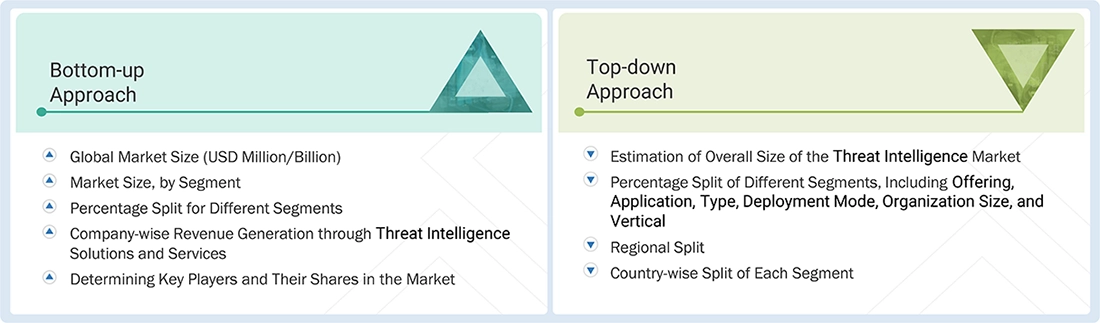
Top-down and bottom-up approaches were employed to estimate and validate the size of the threat intelligence market and of various dependent subsegments within it. The research methodology used to estimate the market size includes the following: critical players in the market were identified through secondary research, and their market shares in the respective regions were determined through both primary and secondary research. This procedure involved analyzing the annual and financial reports of the top market players and conducting extensive interviews with key industry leaders, including CEOs, VPs, directors, and marketing executives, to gather valuable insights.
All percentage splits and breakdowns were determined using secondary sources and verified through primary sources. All parameters that affect the market covered in this study were accounted for, examined in detail, verified through primary research, and analyzed to obtain final quantitative and qualitative data. This data was consolidated with detailed inputs and analysis from MarketsandMarkets.
Threat Intelligence Market : Top-Down and Bottom-Up Approach
Data Triangulation
The market was divided into several segments and subsegments after determining the overall market size using the market size estimation processes explained above. Data triangulation and market breakup procedures were employed, where applicable, to complete the overall market engineering process and arrive at the exact statistics for each market segment and subsegment. The data was triangulated by studying various factors and trends from both the demand and supply sides.
Market Definition
According to MarketsandMarkets, "Threat intelligence is a comprehensive approach that provides organizations with actionable insights to anticipate, detect, and mitigate cyber risks in an increasingly complex digital landscape. It encompasses multiple domains such as cyber threat intelligence, threat intelligence platforms, external attack surface management, and digital risk protection, each working together to strengthen defenses against evolving threats."
Key Stakeholders
- Technology & solution providers
- Managed security service providers (MSSPs)
- Cybersecurity consulting firms
- End-user organizations (across industries)
- Government agencies
- Regulatory bodies
- Threat intelligence sharing communities
- Industry-specific ISACs/ISAOs
- Open-source intelligence communities
- Investors and venture capital firms
- Strategic technology partners
Report Objectives
- To describe and forecast the threat intelligence market by offering, application, type, deployment mode, organization size, vertical, and region, as well as analyze the various macroeconomic and microeconomic factors that affect market growth
- To forecast the market size of five major regions: North America, Europe, Asia Pacific, the Middle East & Africa, and Latin America
- To analyze the subsegments of the market concerning individual growth trends, prospects, and contributions to the overall market
- To provide detailed information related to the primary factors (drivers, restraints, opportunities, and challenges) influencing the growth of the market
- To analyze opportunities in the market for stakeholders by identifying high-growth segments of the market
- To profile the key players of the threat intelligence market and comprehensively analyze their market size and core competencies
- To analyze competitive developments, such as product launches, mergers & acquisitions, partnerships, agreements, and collaborations in the global market
Available customizations:
With the given market data, MarketsandMarkets offers customizations based on company-specific needs. The following customization options are available for the report:
Company Information
-
Detailed analysis and profiling of additional market players (up to 5)
Geographic Analysis
- Further breakdown of the Asia Pacific market, by country
- Further breakdown of the North American market, by country
- Further breakdown of the Latin American market, by country
- Further breakdown of the Middle Eastern & African market, by country
- Further breakdown of the European market, by country
Get the Full Threat Intelligence Market Report
Full forecast, segment splits, and company analysis for all Threat Intelligence Market.
- Canada Threat Intelligence Market
- US Threat Intelligence Market
- UK Threat Intelligence Market
- Germany Threat Intelligence Market
- France Threat Intelligence Market
- Italy Threat Intelligence Market
- China Threat Intelligence Market
- Japan Threat Intelligence Market
- India Threat Intelligence Market
- Singapore Threat Intelligence Market
- UAE Threat Intelligence Market
- Brazil Threat Intelligence Market
- Mexico Threat Intelligence Market
- Rest Of Europe Threat Intelligence Market
- Rest Of Latin America Threat Intelligence Market
- Ksa Threat Intelligence Market
- Rest Of Middle East Threat Intelligence Market
Need a Tailored Report?
Customize this report to your needs
Get 10% FREE Customization
Customize This Report
