
Asia Pacific Titanium Market (2025-2030)

The Asia Pacific Titanium Market was valued at $11029.3 Million in 2025 and projected to reach to $13301.5 Million by 2030, representing a compound annual growth rate of 3.8%. Asia Pacific's titanium market is positioned for sustained growth through 2030, supported by accelerating industrialization across China, India, and Southeast Asia.


| Market Size in | USD 26.32 MN |
| Market Forecast in | |
| CAGR | |
| Forecast Period | |
| Units Considered | Value (USD MN) |
Asia Pacific Titanium Market Trends and Insights
- Asia Pacific's titanium demand is driven by robust activity in packaging, construction, mining, and industrial gases sectors across the region's rapidly industrializing economies.
- The region's manufacturing base and infrastructure development initiatives continue to support steady titanium consumption across aerospace, automotive, and chemical processing applications. Asia Pacific represents a critical hub for titanium production and consumption, with key markets including China, India, Japan, and Southeast Asia leading regional demand.
- Between 2025 and 2030, Asia Pacific is expected to maintain moderate but consistent growth, supported by rising construction investments, expanding mining operations, and increasing adoption of titanium in high-performance applications.
- The region's competitive cost structure and growing end-user industries position Asia Pacific as a strategic market within the global titanium landscape..
Key Market Statistics
- CAGR (2025-2030) 3.8% CAGR
- Market Size, 2025 ~USD 11029.3 Million
- Forecast, 2030 ~USD 13301.5 Million
- Geography Asia Pacific
Asia Pacific Titanium Market Overview
China Dominates Regional Market :
China accounts for the largest share of Asia Pacific's titanium market at USD 6,768.3 million, driven by massive demand from packaging, construction, and mining sectors across its industrializing economy.
Steady 3.8% CAGR Growth :
The Asia Pacific titanium market is projected to expand from USD 11,029.3 million in 2025 to USD 13,301.5 million by 2030, reflecting consistent growth aligned with regional industrial expansion.
Japan & India as Secondary Hubs :
Japan (USD 1,742 million) and India (USD 1,177 million) represent significant secondary markets, with India showing strong growth potential due to rapid industrialization and infrastructure development.
Multi-Sector Demand Drivers :
Packaging, construction, mining, and industrial gases sectors across Asia Pacific's rapidly industrializing economies are the primary growth catalysts for titanium consumption in the region.
Asia Pacific Titanium Market Dynamics
- The region's expanding manufacturing base, coupled with rising demand from packaging and construction sectors, creates robust opportunities for market participants.
- Infrastructure development initiatives and growing mining activities further bolster titanium consumption across the region. Key growth drivers include increasing urbanization, rising disposable incomes, and technological advancements in titanium applications.
- However, supply chain complexities and raw material availability remain considerations.
- Strategic investments in production capacity and regional partnerships will be critical for capturing market share in this dynamic and rapidly evolving Asia Pacific landscape..
Market Ecosystem
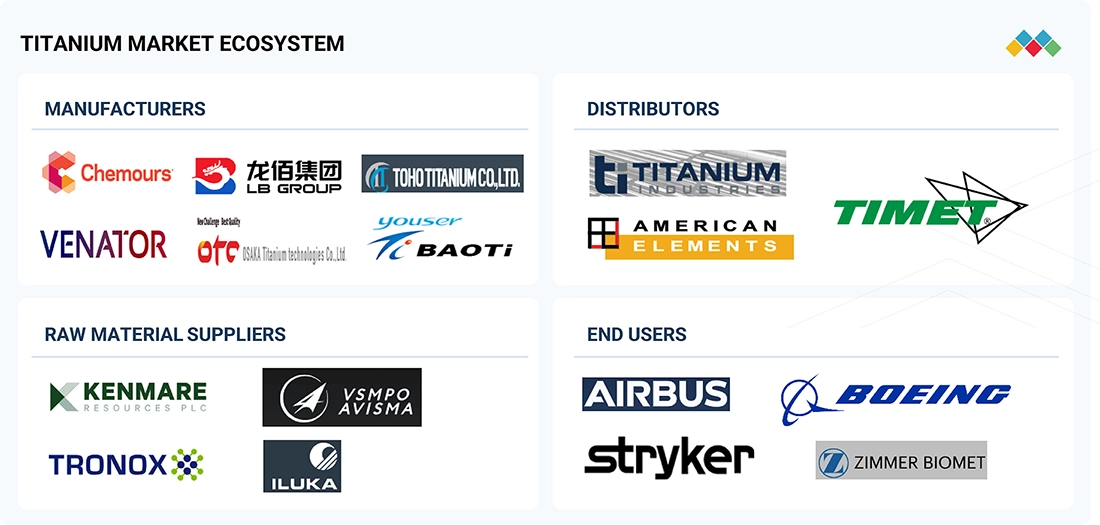
Titanium Market: COMMERCIAL USE CASES ACROSS INDUSTRIES
| COMPANY | USE CASE DESCRIPTION | BENEFITS |
|---|---|---|
 |
Utilizes titanium alloys (Ti-6Al-4V, Ti-5553) for aircraft structural components, jet engine parts, and landing gear due to their high strength-to-weight ratio and corrosion resistance. | Enhances fuel efficiency, reduces aircraft weight, and increases fatigue life under extreme aerospace conditions |
 |
Applies titanium additive manufacturing (3D printing) for complex aircraft parts and brackets to replace heavier steel components. | Enables design optimization, reduced assembly steps, and lower production waste |
 |
Uses titanium dioxide in automotive paints and architectural coatings for brightness and color stability. | Provides enhanced reflectivity, improved weather resistance, and longer coating life |
 |
Incorporates TiO2 into specialty glass and optical products to improve refractive index and UV absorption. | Enhances optical clarity, reduces UV degradation, and supports specialty glass durability. |
Logos and trademarks shown above are the property of their respective owners. Their use here is for informational and illustrative purposes only.
Related Ecosystem
Building And Construction
- HVAC System
- Acoustic Insulation
- Alkyd Resins
- Fiberglass
- Thermal Insulation
- Snc-lavalin group inc.
- Saint-gobain
- LHOIST S.A
- USG CORPORATION
- Basf se
Mining Minerals And Metals
- Wastewater Treatment
- Fiberglass
- Light Commercial Vehicles (LCVs)
- Nitrogen
- Acetic Acid
- LHOIST S.A
- SEVERSTAL JSC
- ArcelorMittal S.A.
- TW METALS, INC.
- Linde plc
Key Takeaways
- Asia Pacific titanium market valued at USD 11,029.3M in 2025, forecast to reach USD 13,301.5M by 2030
- Region growing at 3.8% CAGR, driven by construction, mining, packaging, and industrial gases sectors
- Asia Pacific accounts for significant share of global titanium demand with China, India, and Japan as key markets
- Steady growth trajectory supported by infrastructure development and expanding aerospace and automotive applications
Titanium Market Report Scope
| Report Metric | Details |
|---|---|
| Base Year | 2025 |
| Fastest Growing Segment | TITANIUM METAL (Product Type) |
| Forecast Period | 2025-2030 |
| Growth Rate | CAGR of 3.8% from 2025 to 2030 |
| Largest Segment | TITANIUM DIOXIDE (Product Type) |
| Market Size Base Year (Billions) | ~USD 24.79 (2025) |
| Revenue Forecast (Billions) | ~USD 29.87 (2030) |
| Segments Covered | Product Type, Form, End-Use Industry |
Asia Pacific Titanium Market Report Segmentation
3 segment dimensions are covered across the global market.
By Product Type
- Titanium Dioxide
- Titanium Metal
By Form
- Milled Products
- Other Forms
By End-Use Industry
- Aerospace & Defense
- Chemical & Process Industry
- Desalination
- Energy & Power
- Other Titanium Dioxide End-Use Industries
- Other Titanium Metal End-Use Industries
- Paints & Coatings
- Paper
- Plastics & Rubber
Target Audience
- Titanium Manufacturers & Producers : Optimize production planning and supply chain strategies by understanding regional demand patterns, country-specific market sizes, and sector-wise consumption trends across Asia Pacific.
- Packaging & Construction Companies : Identify growth opportunities in Asia Pacific's booming packaging and construction sectors, with detailed market forecasts to guide procurement and expansion decisions.
- Mining & Industrial Gas Operators : Assess titanium demand from mining and industrial gases sectors across Asia Pacific to optimize operations and capitalize on regional growth trajectories.
- Investment & Private Equity Firms : Evaluate investment opportunities in Asia Pacific's titanium market with comprehensive market sizing, growth forecasts, and country-level performance metrics through 2030.
- Strategic Consultants & Business Analysts : Support client advisory with region-specific titanium market data, competitive insights, and actionable intelligence for Asia Pacific market strategy development.
Countries within Asia Pacific - compare and drill down
| Country | 2025 size (native) |
|---|---|
| China | USD 6768.3 Million |
| Japan | USD 1742 Million |
| India | USD 1177 Million |
| South Korea | USD 950 Million |
| Rest Of Asia Pacific | USD 1193 Million |
Country market size visualization
Reasons to Buy this Report
- Country-Level Market Insights : Access detailed market sizing for China, Japan, India, South Korea, and Rest of Asia Pacific to identify high-potential markets and tailor regional expansion strategies.
- Sector-Specific Demand Analysis : Understand titanium consumption patterns across packaging, construction, mining, and industrial gases sectors specific to Asia Pacific's unique market dynamics.
- Competitive Positioning Data : Benchmark your operations against regional market trends and identify competitive gaps in Asia Pacific's rapidly growing titanium landscape.
- Growth Forecasting Through 2030 : Leverage 5-year projections to plan capital investments, production capacity, and market entry strategies aligned with Asia Pacific's 3.8% CAGR expansion.
- Strategic Investment Guidance : Make informed decisions on market entry, partnerships, and resource allocation based on comprehensive Asia Pacific titanium market intelligence and regional economic indicators.
Frequently asked questions
What is the current size of the Asia Pacific titanium market?
The Asia Pacific titanium market is valued at USD 11,029.3 million in 2025 and is expected to grow to USD 13,301.5 million by 2030.
What is the growth rate of the Asia Pacific titanium market?
Asia Pacific's titanium market is growing at a compound annual growth rate (CAGR) of 3.8% from 2025 to 2030.
Which industries drive titanium demand in Asia Pacific?
Titanium demand in Asia Pacific is primarily driven by packaging, construction, mining, and industrial gases sectors, with additional applications in aerospace and automotive industries.
Which countries are the largest titanium markets in Asia Pacific?
China, India, Japan, and Southeast Asian nations are the leading titanium markets in the Asia Pacific region, supported by strong manufacturing and construction activities.
What factors support titanium market growth in Asia Pacific?
Growth in Asia Pacific is supported by infrastructure development initiatives, expanding mining operations, rising aerospace and automotive demand, and the region's competitive manufacturing cost structure.
RESEARCH METHODOLOGY
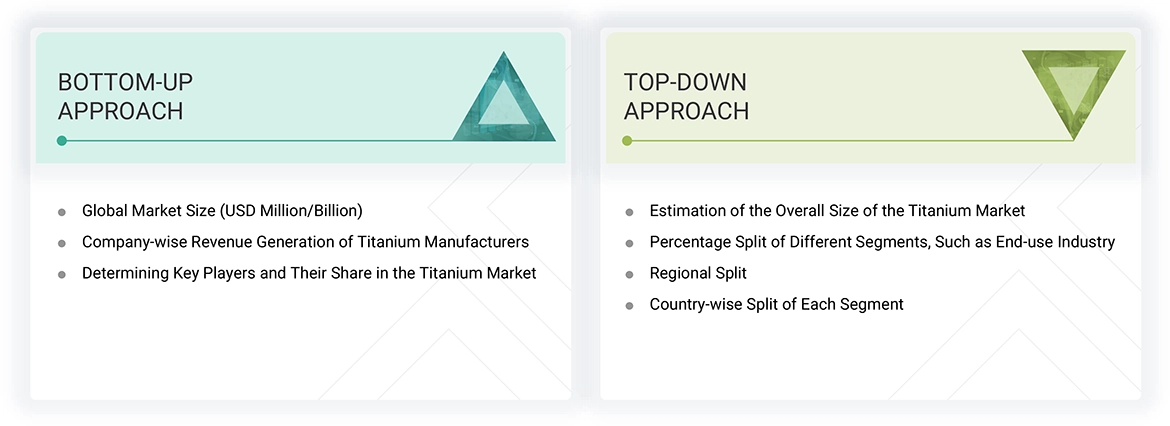
The study involves two major activities in estimating the current market size for the titanium market. Exhaustive secondary research was done to collect information on the market, peer market, and parent market. The next step was to validate these findings, assumptions, and sizing with industry experts across the value chain through primary research. Both, top-down and bottom-up approaches were employed to estimate the complete market size. After that, market breakdown and data triangulation were used to estimate the market size of segments and subsegments.
Secondary Research
Secondary sources referred to for this research study include financial statements of companies offering titanium and information from various trade, business, and professional associations. Secondary research has been used to obtain critical information about the industry’s value chain, the total pool of key players, market classification, and segmentation according to industry trends to the bottom-most level and regional markets. Secondary data was collected and analyzed to arrive at the overall size of the titanium market, which was validated through interviews with experts.
Primary Research
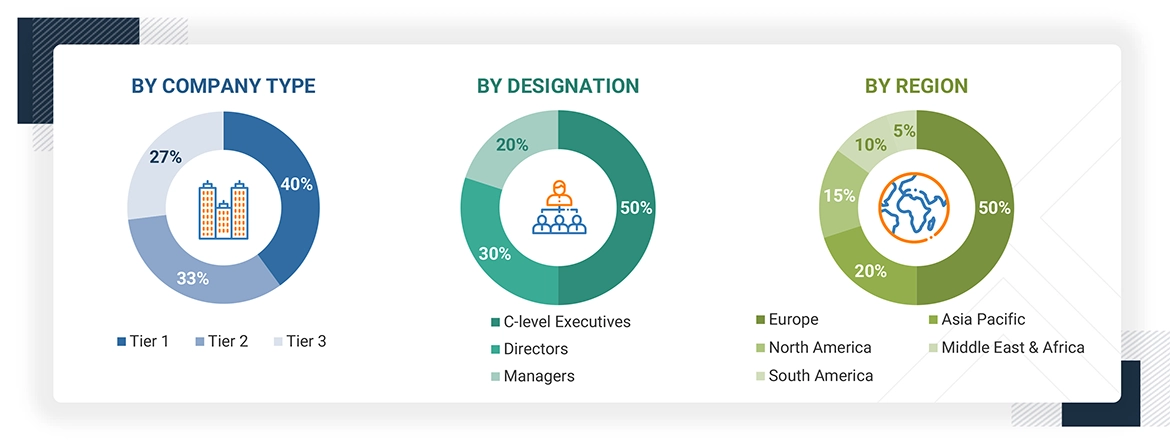
Extensive primary research was conducted after obtaining information regarding the titanium market scenario through secondary research. Several interviews were conducted with market experts from both, the demand and supply sides across the major countries of North America, Europe, Asia Pacific, the Middle East & Africa, and South America. Primary data was collected through questionnaires, emails, and telephonic interviews. The primary sources from the supply side included various industry experts, such as chief experience officers (CXOs), vice presidents (VPs), business development/marketing directors, product development/innovation teams, related key executives from the titanium industry, system integrators, component providers, distributors, and key opinion leaders. Interviews with experts were conducted to gather insights such as market statistics, data on revenue collected from the products and services, market breakdowns, market size estimations, market forecasting, and data triangulation. Primary research also helped in understanding the various trends related to product type, end-use industry, and region. Stakeholders from the demand side, such as CIOs, CTOs, CSOs, and installation teams of the customers/end users who are titanium services, were interviewed to understand the buyer’s perspective on the suppliers, products, component providers, and their current usage of titanium and future outlook of their business which will affect the overall market.
Breakup of Primary Research:
To know about the assumptions considered for the study, download the pdf brochure
Market Size Estimation
The research methodology used to estimate the size of the titanium market includes the following details. The market sizing was undertaken from the demand side. The market was upsized based on the demand for titanium in different end-use industries at the regional level. Such procurements provide information on the demand aspects of the titanium industry for each end-use industry. For each end-use industry, all possible segments of the titanium market were integrated and mapped.
Data Triangulation
After arriving at the overall size from the market size estimation process explained above, the total market was split into several segments and subsegments. The data triangulation and market breakdown procedures explained below were implemented, wherever applicable, to complete the overall market engineering process and arrive at the exact statistics for various market segments and subsegments. The data was triangulated by studying various factors and trends from the demand and supply sides. Along with this, the market size was validated using both, the top-down and bottom-up approaches.
Market Definition
Titanium is the ninth-most common element in the Earth’s crust. The majority of the titanium extracted is in the form of titanium dioxide, which is used as a pigment. The rest is used in making metals. Titanium dioxide (TiO2, titanium (IV) oxide, or Titania) occurs naturally in various rocks and mineral sands. It is a white solid inorganic substance that is thermally stable, chemically inert, non-flammable, has excellent ultraviolet (UV) resistant qualities, and acts as a UV-absorbent. It has the highest refractive index and is one of the whitest materials on Earth. When ground into a fine powder, it transforms into a white pigment that provides whiteness and opacity to products. It is mainly sourced from the minerals anatase, brookite, ilmenite, leucoxene, perovskite, rutile, and sphene. Titanium dioxide is utilized in paints & coatings, plastics, paper, inks, and other end-use industries.
In the form of metal, titanium is known for its superior performance properties, such as high strength-to-weight ratio, low density, ductility, biocompatibility, high melting point, and corrosion resistance. In the commercially pure form, titanium has low strength and high ductility and is, therefore, used in applications that require low strength. However, in applications that demand high strength, titanium alloys are mainly used.
Stakeholders
- Titanium Manufacturers
- Titanium Distributors and Suppliers
- Universities, Governments, and Research Organizations
- Associations and Industrial Bodies
- R&D Institutes
- Environmental Support Agencies
- Investment Banks and Private Equity Firms
- Research and Consulting Firms
Report Objectives
- To define, describe, and forecast the titanium market size in terms of volume and value
- To provide detailed information regarding the key factors, such as drivers, restraints, opportunities, and challenges influencing market growth
- To analyze and project the global titanium market by product type, end-use industry, and region
- To forecast the market size concerning five main regions (along with country-level data), namely, North America, Europe, Asia Pacific, the Middle East & Africa, and South America, and analyze the significant region-specific trends
- To strategically analyze micromarkets with respect to individual growth trends, prospects, and contributions of the submarkets to the overall market
- To analyze the market opportunities and the competitive landscape for stakeholders and market leaders
- To assess recent market developments and competitive strategies, such as agreements, contracts, acquisitions, and product developments/product launches, to draw the competitive landscape
- To strategically profile the key market players and comprehensively analyze their core competencies
Get the Full Titanium Market Report
Full forecast, segment splits, and company analysis for all Titanium Market.
- US Titanium Market
- Canada Titanium Market
- Mexico Titanium Market
- Germany Titanium Market
- UK Titanium Market
- France Titanium Market
- Russia Titanium Market
- Italy Titanium Market
- Spain Titanium Market
- China Titanium Market
- Japan Titanium Market
- India Titanium Market
- South Korea Titanium Market
- South Africa Titanium Market
- Brazil Titanium Market
- Argentina Titanium Market
- Rest Of Europe Titanium Market
- Rest Of Asia Pacific Titanium Market
- GCC Countries Titanium Market
- -Rest Of GCC Countries Titanium Market
- Rest Of South America Titanium Market
Need a Tailored Report?
Customize this report to your needs
Get 10% FREE Customization
Customize This Report
