
China Tower Crane Rental Market (2024-2029)

The China Tower Crane Rental Market was valued at $2163.5 Million in 2024 and projected to reach to $3121.2 Million by 2029, representing a compound annual growth rate of 6.3%. China's tower crane rental market is positioned for sustained expansion through 2029, driven by continuous urbanization, government infrastructure spending, and the country's dominance in global construction activity.


| Market Size in | USD 26.32 MN |
| Market Forecast in | |
| CAGR | |
| Forecast Period | |
| Units Considered | Value (USD MN) |
China Tower Crane Rental Market Trends and Insights
- This expansion in China reflects accelerating infrastructure development, urbanization, and large-scale construction projects across residential, commercial, and industrial sectors.
- China's dominance in global construction activity and heavy investment in smart cities and transportation networks are driving sustained demand for tower crane rental services. The tower crane rental market in China is supported by rising labor costs that incentivize equipment rental over ownership, coupled with technological advancements in crane safety and automation.
- China's construction industry recovery post-pandemic and government stimulus for infrastructure modernization have reinvigorated demand across packaging, construction, mining, and gas sectors.
- Between 2024 and 2029, China is expected to maintain its position as a critical growth engine, with regional players and international operators competing to capture market share in this high-growth geography..
Key Market Statistics
- CAGR (2024-2029) 6.3% CAGR
- Market Size, 2024 ~USD 2163.5 Million
- Forecast, 2029 ~USD 3121.2 Million
- Country China
China Tower Crane Rental Market Overview
Rapid Urbanization Drive :
China's accelerating urbanization and mega-city development projects are driving unprecedented demand for tower crane rentals, particularly in tier-1 and tier-2 cities experiencing massive infrastructure expansion.
Infrastructure Investment Surge :
Government-backed infrastructure initiatives and large-scale construction projects across residential, commercial, and industrial sectors are fueling sustained growth in the Chinese tower crane rental market.
Market Valuation Growth :
The Chinese market is valued at USD 2,163.5 million in 2024 and is projected to reach USD 3,121.2 million by 2029, demonstrating a robust 6.3% CAGR outpacing the global average of 5.2%.
Sector Diversification :
Growth spans multiple sectors including packaging facilities, mining operations, gas infrastructure, and construction, with tower cranes becoming essential equipment for complex vertical construction projects across China.
China Tower Crane Rental Market Dynamics
- The 6.3% CAGR reflects strong demand from residential and commercial real estate development, particularly in emerging urban centers.
- Industrial expansion in mining and gas sectors further supports market growth.
- Technological advancements in crane efficiency and safety features are enhancing rental appeal among contractors seeking cost-effective solutions. The market's outperformance relative to global growth rates underscores China's strategic importance in the construction equipment rental sector.
- Rising labor costs and preference for equipment rental over ownership are accelerating market adoption.
- Competitive rental operators are expanding fleets and service capabilities to capture growing demand, while consolidation among regional players is expected to enhance service quality and operational efficiency across the Chinese market..
Market Ecosystem
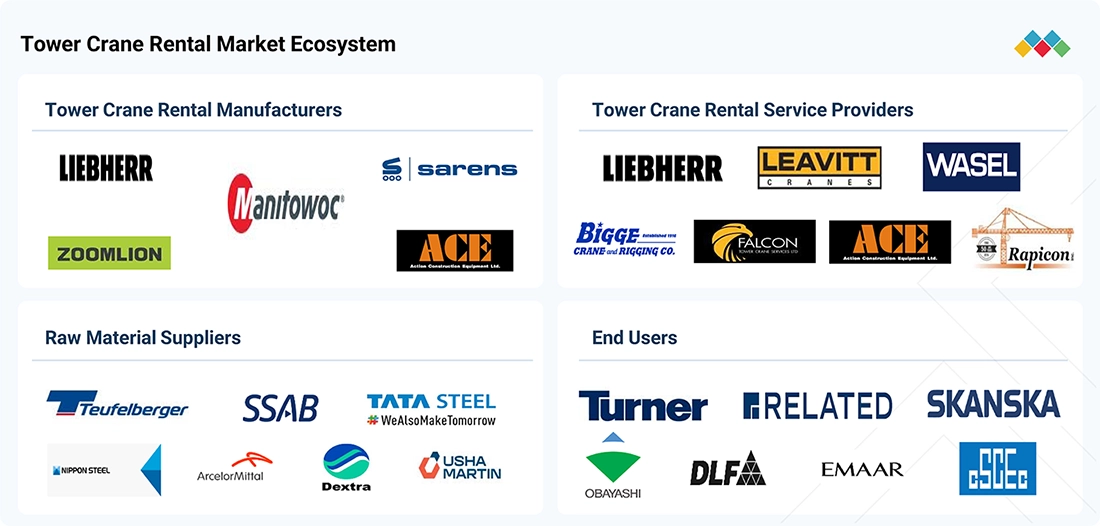
TOWER CRANE RENTAL MARKET: COMMERCIAL USE CASES ACROSS INDUSTRIES
| COMPANY | USE CASE DESCRIPTION | BENEFITS |
|---|---|---|
 |
Customized Comansa 21LC1050 tower crane for offshore platform lifting near the North Sea | Reliable heavy lifting up to 200 tons, weather-resistant design, reduced downtime |
 |
Liebherr 81.1K Self-Erecting Tower Crane for a 12-month housing project in UK | Quick assembly, efficient lifting for multiple contractors, boosted productivity |
Logos and trademarks shown above are the property of their respective owners. Their use here is for informational and illustrative purposes only.
Related Ecosystem
Equipment Machine And Tooling
- Wastewater Treatment
- Air Cooled Heat Exchangers
- Diaphragm Pumps
- Fiberglass
- HVAC System
- Alfa Laval Corporate AB
- Veolia
- Johnson Controls International plc
- Daikin Industries,Ltd.
- Parker-Hannifin Corporation
Infrastructure Material
- Alumina Ceramics
- Ceramic Coatings
- Monolithic Ceramics
- Polyphenylene Sulfide (PPS)
- Titanate Ceramics
- Saint-gobain
- Simpson Manufacturing Co., Inc.
- DOW CHEMICAL COMPANY
- Basf se
- Sika ag
Building And Construction
- HVAC System
- Acoustic Insulation
- Alkyd Resins
- Fiberglass
- Thermal Insulation
- Snc-lavalin group inc.
- Saint-gobain
- LHOIST S.A
- USG CORPORATION
- Basf se
Key Takeaways
- China's tower crane rental market is valued at USD 2,163.5 million in 2024 and will grow to USD 3,121.2 million by 2029 at a 6.3% CAGR.
- Rapid urbanization and infrastructure modernization in China are primary drivers of tower crane rental demand across construction and industrial sectors.
- Rising labor costs and equipment ownership expenses in China are shifting market preference toward rental models over capital-intensive purchases.
- China's competitive landscape features both domestic and international operators vying for market share in this high-growth Asia Pacific region.
Tower Crane Rental Market Report Scope
| Report Metric | Details |
|---|---|
| Base Year | 2024 |
| Fastest Growing Segment | LOW (5 TO 20 TON) (Capacity) |
| Forecast Period | 2024-2029 |
| Growth Rate | CAGR of 5.2% from 2024 to 2029 |
| Largest Segment | MOBILE CRANES (Type) |
| Market Size Base Year (Billions) | ~USD 16.3 (2024) |
| Revenue Forecast (Billions) | ~USD 22.1 (2029) |
| Segments Covered | Capacity, Product Type, End-Use Industry, End-Use Industry2023-2030, Type, Weightlifting Capacity |
China Tower Crane Rental Market Report Segmentation
6 segment dimensions are covered across the global market.
By Capacity
- Extreme Heavy (>500 Ton)
- Extreme Heavy(>500 Ton)
- Heavy (100 To 500 Ton)
- Low (5 To 20 Ton)
- Low To Medium (20 To 100 Ton)
- Low To Medium(20 To 100 Ton)
By Product Type
- Hammerhead Crane
- Luffing Jib Tower Crane
- Mobile Tower Crane
- Other Product Types
- Self-Erecting Tower
By End-Use Industry
- Building & Construction
- Energy & Power
- Infrastructure
- Marine & Offshore
- Mining & Excavation
- Oil & Gas
- Other End-Use Industries
- Transportation
By End-Use Industry2023-2030
- Building & Construction
- Energy & Power
- Infrastructure
- Marine & Offshore
- Other End-Use Industries
By Type
- Fixed Cranes
- Mobile Cranes
By Weightlifting Capacity
- Extreme Heavy
- Heavy
- Low
- Low To Medium
CHINA: TOWER CRANE RENTAL MARKET, BY END-USE INDUSTRY, 2023–2030
| Segment | 2023 | 2024 | 2025 | 2026 | 2027 | 2028 | 2029 | 2030 | CAGR (%) |
|---|---|---|---|---|---|---|---|---|---|
| BUILDING & CONSTRUCTION | 844.8 | 955.7 | 1021.1 | 1090.8 | 1164.8 | 1243.6 | 1327.2 | 1416.2 | 6.8 |
| ENERGY & POWER | 215.9 | 227.8 | 240.4 | 253.7 | 267.7 | 282.4 | 298 | 314.5 | 5.5 |
| INFRASTRUCTURE | 722.8 | 767 | 814 | 863.8 | 916.7 | 972.8 | 1032.4 | 1095.6 | 6.1 |
| MARINE & OFFSHORE | 117.3 | 124.2 | 131.4 | 139 | 147.1 | 155.7 | 164.8 | 174.4 | 5.8 |
| OTHER END-USE INDUSTRIES | 84.5 | 88.9 | 93.5 | 98.4 | 103.5 | 108.9 | 114.6 | 120.6 | 5.2 |
| TOTAL | 1985.3 | 2163.5 | 2300.4 | 2445.7 | 2599.9 | 2763.5 | 2937.1 | 3121.2 | 6.3 |
Target Audience
- Construction & Real Estate Developers : Need market data to understand tower crane rental demand trends, pricing dynamics, and equipment availability across China's residential, commercial, and industrial construction projects for project planning and budgeting.
- Equipment Rental Companies : Require detailed market sizing, growth forecasts, and competitive landscape analysis for China to make informed decisions on fleet investments, geographic expansion, and service offerings in this high-growth market.
- Infrastructure & Mining Operators : Seek market intelligence on tower crane rental availability, pricing trends, and service capabilities in China to optimize equipment procurement strategies and manage construction project costs effectively.
- Investment & Private Equity Firms : Need comprehensive market analysis and growth projections for China's tower crane rental sector to evaluate investment opportunities, assess portfolio companies, and identify acquisition targets in the construction equipment space.
- Market Consultants & Analysts : Require verified market data, CAGR metrics, and sector-specific insights for China to support client advisory services, competitive benchmarking, and strategic recommendations in the construction equipment rental industry.
Reasons to Buy this Report
- Market Size & Growth Validation : Obtain precise valuation data for China's tower crane rental market (USD 2,163.5M in 2024) with verified 6.3% CAGR projections through 2029, enabling accurate business planning and investment decisions.
- Competitive Positioning Intelligence : Understand China's market dynamics relative to global trends (5.2% global CAGR) to identify competitive advantages, market gaps, and opportunities for fleet expansion or service differentiation in this high-growth region.
- Sector-Specific Demand Insights : Access detailed analysis of tower crane demand across packaging, construction, mining, and gas sectors in China, enabling targeted marketing strategies and resource allocation to high-opportunity segments.
- Urbanization & Infrastructure Trends : Leverage comprehensive data on China's urbanization drivers, mega-city projects, and government infrastructure initiatives to forecast demand patterns and plan long-term rental fleet investments strategically.
- Strategic Market Entry & Expansion : Utilize China-specific market intelligence to evaluate entry strategies, identify regional growth hotspots, assess competitive intensity, and develop localized business models for maximizing market penetration and profitability.
Frequently asked questions
What is the current size of China's tower crane rental market?
China's tower crane rental market was valued at USD 2,163.5 million in 2024 and is projected to reach USD 3,121.2 million by 2029.
What is the expected growth rate for tower crane rentals in China?
China's tower crane rental market is expected to grow at a compound annual growth rate (CAGR) of 6.3% from 2024 to 2029.
What sectors drive tower crane rental demand in China?
Tower crane rental demand in China is driven by construction, packaging, mining, and gas sectors, with particular strength in infrastructure, urbanization, and smart city projects.
Why is the rental model gaining traction in China's construction industry?
Rising labor costs, equipment maintenance expenses, and the flexibility of rental arrangements are making tower crane rentals more attractive than ownership in China.
Who are the key competitors in China's tower crane rental market?
China's tower crane rental market includes both domestic regional operators and international equipment rental companies competing for market share in this high-growth geography.
RESEARCH METHODOLOGY
The study involved four major activities to estimate the current size of the global tower crane rental market. Exhaustive secondary research was carried out to collect information on the market, the peer product market, and the parent product group market. The next step was to validate these findings, assumptions, and sizes with industry experts across the value chain of tower crane rental through primary research. The top-down and bottom-up approaches were employed to estimate the overall size of the tower crane rental market. After that, market breakdown and data triangulation procedures were used to determine the size of different segments of the market.
Secondary Research
The market for companies offering tower crane rentals was arrived at using secondary data available through paid and unpaid sources, analyzing the product portfolios of the major companies in the ecosystem, and rating the companies by their performance and quality. For this study, various secondary sources, such as Business Standard, Bloomberg, the World Bank, and Factiva, were referred to identify and collect information on the tower crane rental market. In the secondary research process, various secondary sources were referred to identify and collect information related to the study. Secondary sources included annual reports, press releases, and investor presentations of tower crane rental vendors, forums, certified publications, and whitepapers. The secondary research was used to obtain critical information on the industry’s value chain, the total pool of key players, market classification, and segmentation from the market and technology-oriented perspectives.
Primary Research
In the primary research process, various primary sources from the supply and demand sides were interviewed to obtain qualitative and quantitative information for this report. The primary sources from the supply side included industry experts, such as chief executive officers (CEOs), vice presidents (VPs), marketing directors, technology and innovation directors, and related key executives from several key companies and organizations operating in the tower crane rental market. After the complete market engineering (calculations for market statistics, market breakdown, market size estimations, market forecasting, and data triangulation), extensive primary research was conducted to gather information and verify and validate the critical numbers arrived at.
Primary research was also conducted to identify the segmentation types, industry trends, competitive landscape of tower crane rental offered by various market players, and key market dynamics, such as drivers, restraints, opportunities, challenges, trends, and key player strategies. In the complete market engineering process, the top-down and bottom-up approaches and several data triangulation methods were extensively used to perform the market estimation and market forecasting for the overall market segments and subsegments listed in this report. Extensive qualitative and quantitative analysis was performed on the complete market engineering process to list the key information/insights throughout the report.
The following is the breakdown of primary respondents:
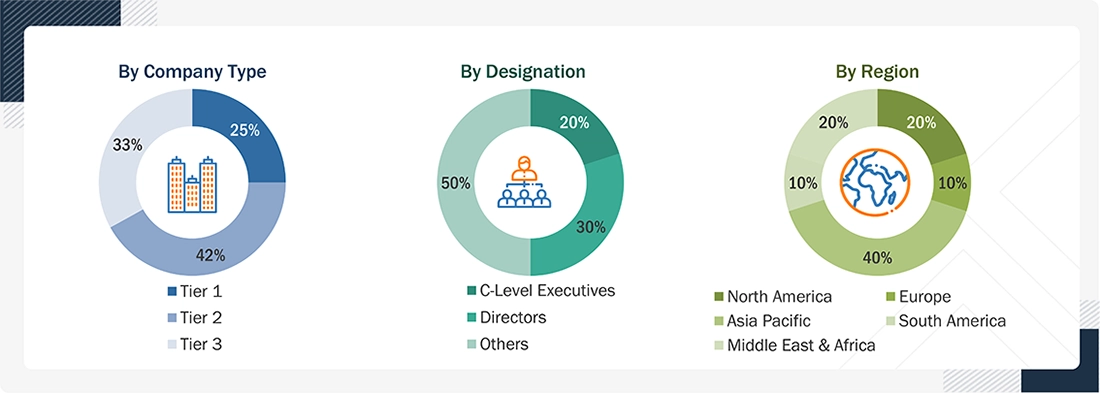
To know about the assumptions considered for the study, download the pdf brochure
Market Size Estimation
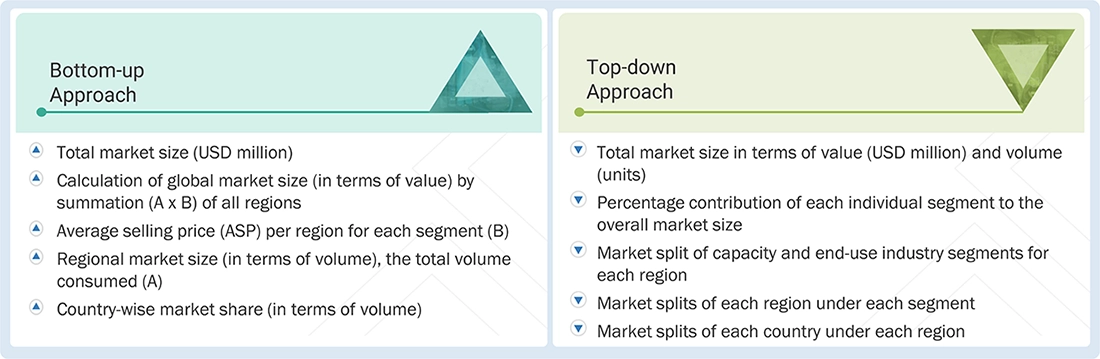
The top-down and bottom-up approaches were used to estimate and validate the size of the global tower crane rental market. These approaches were also used extensively to estimate the size of various dependent market segments. The research methodology used to estimate the market size included the following:
Tower Crane Rental Market: Top-Down and Bottom-Up Approach
Data Triangulation
After arriving at the overall market size using the market size estimation processes, the market was split into several segments and subsegments. The data triangulation and market breakup procedures were employed, wherever applicable, to complete the overall market engineering process and arrive at the exact statistics of each market segment and subsegment. The data was triangulated by studying various factors and trends from the demand and supply sides.
Market Definition
The tower crane rental market involves the leasing of tall, fixed cranes used primarily in the construction of high-rise buildings, industrial plants, and infrastructure projects. Tower cranes are balance cranes that offer high lifting capacity and height reach, making them essential for vertical construction. These cranes consist of a mast, jib (horizontal arm), counterweights, and operator cab, and are either fixed to the ground or mounted on building structures. Renting tower cranes allows construction companies to access specialized equipment without the high upfront investments, offering flexibility based on project timelines and scale. Tower crane rentals are available in various configurations, including hammerhead, luffing jib, and self-erecting models, catering to different project needs such as tight urban sites or heavy lifting. Key advantages include reduced capital expenditure, lower maintenance responsibility, and access to modern, well-maintained machinery. Rental providers often offer additional services such as delivery, setup, dismantling, and on-site technical support. Tower cranes are widely used across end-use sectors, including building & construction, infrastructure, energy & power, marine & offshore, and other end-use industries.
Key Stakeholders
- Tower Crane Rental Service Providers
- Raw Material Suppliers
- Converters & Processors
- Distributors and Traders
- Industry Associations and Regulatory Bodies
- End Users
Report Objectives
- To define, describe, and forecast the size of the global tower crane rental market by capacity and end-use industry in terms of value
- To forecast the market size of segments for North America, Europe, Asia Pacific, South America, and the Middle East & Africa, along with their respective countries, in terms of value and volume
- To provide detailed information on the significant drivers, restraints, opportunities, and challenges influencing the market
- To strategically analyze micromarkets concerning individual growth trends, prospects, and their contribution to the market
- To assess the growth opportunities in the market for stakeholders and provide details on the competitive landscape for market leaders
- To strategically profile key players and comprehensively analyze their market shares and core competencies
- To analyze competitive developments, such as partnerships, agreements, acquisitions, and expansions in the tower crane rental market
- To provide the impact of AI/Gen AI on the market
- To provide the macroeconomic outlook for each region covered under the study, and the impact of the 2025 US tariff on the market
Available customizations:
With the given market data, MarketsandMarkets offers customizations according to client-specific needs.
The following customization options are available for the tower crane rental report:
Product Analysis
-
A product matrix that gives a detailed comparison of the product portfolio of each company
Regional Analysis
-
A further breakdown of the tower crane rental market for additional countries
Company Information
-
Detailed analysis and profiling of additional market players (up to five)
Get the Full Tower Crane Rental Market Report
Full forecast, segment splits, and company analysis for all Tower Crane Rental Market.
Need a Tailored Report?
Customize this report to your needs
Get 10% FREE Customization
Customize This Report
